

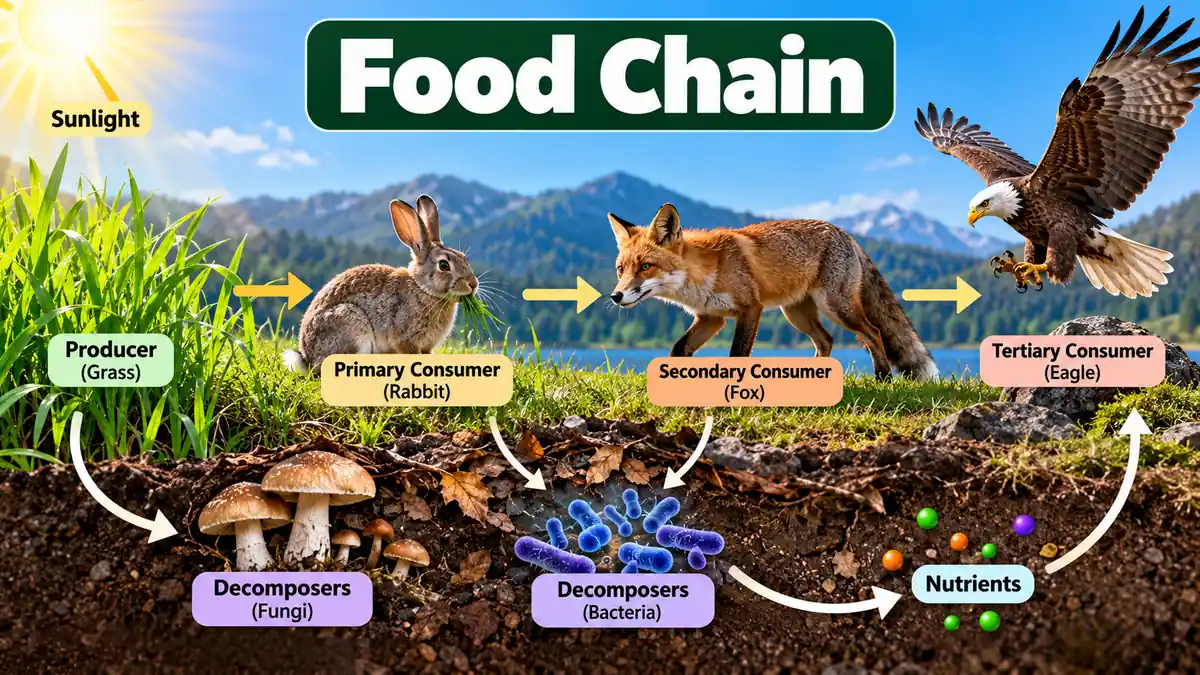
Every organism needs energy to survive, but that energy does not appear from nowhere. In an ecosystem, it moves from one organism to another through feeding relationships. A plant captures energy, an herbivore eats the plant, and a predator may then eat the herbivore.
A food chain is a linear sequence showing how energy and nutrients pass from one organism to another through feeding. It usually begins with a producer, continues through one or more consumers, and connects to decomposers that recycle nutrients from dead organisms and waste back into the ecosystem.
Understanding food chains helps explain how ecosystems function, why predators are less abundant than organisms lower in the chain, and how a change in one species can affect many others.
What Is a Food Chain?
A food chain describes a possible pathway through which food, energy, and nutrients move within an ecosystem.
Consider a simple grassland example:
Grass → Rabbit → Fox
Grass is the producer. It captures sunlight and makes organic food through photosynthesis. The rabbit gets energy by eating the grass, while the fox receives energy by eating the rabbit.
The arrows are important. In ecological food-chain diagrams, an arrow normally points from the organism being eaten toward the organism that eats it. In other words, it represents the direction in which energy and matter are transferred.
Most food chains ultimately depend on an external energy source. In many ecosystems that source is sunlight, although some ecosystems rely on chemical energy instead.
Why Are Food Chains Important?
Food chains provide a simplified way to understand feeding relationships.
They help scientists and students see:
- where organisms obtain energy
- how energy moves through an ecosystem
- which organisms are producers or consumers
- how predators and prey are connected
- why higher trophic levels support fewer organisms
- how disturbances can affect an ecological community
A food chain is therefore more than a list of animals eating one another. It represents part of the structure that allows an ecosystem to function.
The Main Parts of a Food Chain
Most food chains can be understood by looking at producers, consumers, and decomposers.
Producers
Producers form the biological starting point of most food chains.
They are autotrophs, organisms capable of producing organic compounds from inorganic materials rather than obtaining all their food by eating other organisms.
Common producers include:
- grasses
- trees
- algae
- phytoplankton
- cyanobacteria
Plants and many algae are photoautotrophs. They use sunlight during photosynthesis to produce energy-rich organic compounds.
Not every producer depends directly on sunlight. Certain microorganisms are chemoautotrophs and obtain energy from chemical reactions through chemosynthesis. Such organisms are especially important in environments where sunlight is unavailable, including some deep-sea ecosystems.
Primary Consumers
Primary consumers eat producers.
They are commonly herbivores, although aquatic primary consumers may feed on algae, phytoplankton, or microorganisms rather than terrestrial plants.
Examples include:
- rabbits
- grasshoppers
- deer
- caterpillars
- zooplankton
- some mollusks
In the chain:
Grass → Grasshopper → Frog
the grasshopper is the primary consumer because it eats the producer directly.
Secondary Consumers
Secondary consumers feed on primary consumers.
Many are carnivores, although omnivores can also occupy this level depending on what they are eating.
Examples may include:
- frogs
- small fish
- spiders
- some birds
- snakes
In:
Grass → Grasshopper → Frog
the frog is a secondary consumer.
Tertiary Consumers
A tertiary consumer eats secondary consumers.
These organisms generally occur higher in a food chain and may include larger predatory animals.
For example:
Grass → Grasshopper → Frog → Snake
Here, the snake functions as the tertiary consumer.
Food chains can sometimes continue beyond this point to quaternary consumers.
Apex Consumers and Predators
An organism at or near the highest feeding level may be described as an apex consumer or, depending on the ecological context, an apex predator.
An apex predator has few or no natural predators within the ecosystem being considered.
However, an animal does not always occupy exactly the same trophic level. Omnivores can feed at different levels because they consume both plant and animal material. Food webs therefore provide a more realistic picture than assigning every species permanently to a single position.
Decomposers
Dead organisms still contain nutrients.
Bacteria and fungi are among the most important decomposers. They break down dead organic material and wastes, releasing nutrients that can become available to producers again.
Earthworms and other detritivores also participate in processing dead material, although ecologists distinguish organisms that physically consume detritus from microorganisms that chemically decompose it.
This highlights a crucial difference between energy and matter: energy flows through ecosystems, while matter can be recycled.
Trophic Levels in a Food Chain
Each feeding position in a food chain is called a trophic level.
A trophic level indicates an organism’s position relative to the beginning of the chain.
| Trophic Level | Typical Role | Example |
|---|---|---|
| First | Producer | Grass |
| Second | Primary consumer | Grasshopper |
| Third | Secondary consumer | Frog |
| Fourth | Tertiary consumer | Snake |
| Higher levels | Higher-order consumer | Hawk or other predator |
Producers occupy the first trophic level because they introduce biologically usable energy into the chain.
Primary consumers occupy the second level, secondary consumers the third, and tertiary consumers the fourth.
Real ecosystems complicate this neat arrangement. An omnivore, for instance, can occupy different trophic levels depending on its diet.
A human eating vegetables is consuming producers directly. The same person eating an herbivorous animal is feeding at a different trophic level.
That is one reason trophic levels should be viewed as ecological positions rather than permanent labels attached to species.
How Does Energy Flow Through a Food Chain?
Energy movement is one of the most important concepts behind a food chain.
For many ecosystems, the process begins with sunlight:
Sunlight → Producer → Primary Consumer → Secondary Consumer → Tertiary Consumer
Plants, algae, and other photosynthetic producers capture a fraction of incoming solar energy and store some of it as chemical energy in organic molecules.
When a herbivore eats plant material, some of that stored energy enters the herbivore. If a predator eats the herbivore, some energy moves to the predator.
The transfer is never completely efficient.
Organisms use energy for movement, growth, maintenance, reproduction, cellular processes, and other activities. Energy is also dissipated as heat, while not all available biomass is eaten or digested.
The 10% Rule
A common educational approximation is that roughly 10% of the energy stored as biomass at one trophic level becomes available as biomass at the next level.
It is not a universal fixed percentage. Actual ecological transfer efficiency varies among organisms and ecosystems, but the approximation is useful for understanding why available energy generally decreases toward the top of an energy pyramid.
Imagine producers contain 10,000 units of usable energy.
A simplified model might look like this:
| Level | Approximate Energy |
|---|---|
| Producers | 10,000 units |
| Primary consumers | 1,000 units |
| Secondary consumers | 100 units |
| Tertiary consumers | 10 units |
This progressive reduction helps explain why food chains cannot normally continue indefinitely.
Higher trophic levels simply have less energy available to support biomass.
Food Chain Examples
Food chains differ depending on habitat, available producers, and the organisms living in a community.
Grassland Food Chain
A simple terrestrial chain could be:
Grass → Grasshopper → Frog → Snake
Grass captures solar energy through photosynthesis. The grasshopper eats the grass, the frog eats the grasshopper, and the snake eats the frog.
Forest Food Chain
A simplified forest example is:
Plant → Caterpillar → Small Bird → Hawk
The plant acts as the producer, while the caterpillar, bird, and hawk occupy progressively higher consumer levels.
In an actual forest, each organism is likely to have several feeding relationships, so this chain would represent only one pathway within a larger food web.
Aquatic Food Chain
Aquatic ecosystems often begin with microscopic producers:
Phytoplankton → Zooplankton → Small Fish → Large Fish
Phytoplankton perform photosynthesis and support enormous aquatic food networks.
Khan Academy gives an Arctic example in which phytoplankton act as producers, zooplankton as primary consumers, polar cod as secondary consumers, and polar bears as tertiary consumers.
Pond Food Chain
A simplified pond sequence could be:
Algae → Aquatic Insect → Small Fish → Larger Fish
Again, the actual pond community contains numerous overlapping feeding pathways.
A Human Food Chain
Humans can also participate in food chains:
Grass → Cow → Human
The grass is a producer, the cow is a primary consumer, and a person eating the cow is a secondary consumer in this simplified pathway.
Because humans are omnivores and consume foods from many sources, their real feeding relationships are better represented as part of a food web.
Types of Food Chains
Ecology commonly distinguishes pathways based on where the feeding sequence begins.
Grazing Food Chain
A grazing food chain starts with living primary producers and moves to organisms that consume them.
For example:
Grass → Rabbit → Fox
The rabbit feeds directly on living plant material, and the fox feeds on the rabbit.
This is the familiar model commonly used to introduce food-chain concepts.
Detrital Food Chain
A detrital pathway begins with dead organic material, known as detritus.
Dead leaves, animal remains, and organic waste can provide resources for detritivores and decomposers. Those organisms may themselves become food for other consumers.
Grazing and detrital pathways are not isolated systems. Dead material and waste produced throughout a grazing food web provide inputs into detrital pathways, while decomposition returns nutrients that producers can use again.
Food Chain vs. Food Web
A food chain shows one linear feeding pathway. A food web combines many feeding pathways into a network.
| Feature | Food Chain | Food Web |
|---|---|---|
| Structure | Linear | Interconnected network |
| Feeding relationships | One pathway | Multiple pathways |
| Complexity | Simple | More complex |
| Realism | Simplified model | Closer to real ecosystems |
| Best use | Understanding basic energy flow | Understanding community interactions |
Suppose a mouse eats seeds and insects. The mouse may then be eaten by a snake, owl, or fox.
A single food chain can show only one of those pathways at a time. A food web can connect all of them.
Food webs are therefore generally more realistic representations of ecological feeding relationships because organisms usually have multiple food sources and multiple predators.
Even food webs remain models rather than perfect copies of nature. They may leave out some feeding interactions, microorganisms, decomposers, seasonal dietary changes, or relationships that are difficult to observe.
Food Chain vs. Energy Pyramid
Food chains and energy pyramids describe related ecological ideas, but they answer different questions.
A food chain asks:
Who eats whom, and in what direction does energy move?
An energy pyramid asks:
How does the amount of available energy change between trophic levels?
The broad base of an energy pyramid represents producers. Progressively higher consumer levels contain less available energy.
This declining energy supply helps explain why ecosystems generally support fewer organisms or less biomass at high trophic levels than at their producer base, although the exact patterns can vary among ecosystems.
Why Are Food Chains Usually Short?
A common question is why a chain does not continue through ten, twenty, or even more consumer levels.
The main limitation is energy.
Only part of the energy present in one trophic level becomes biomass available to organisms at the next level. With each transfer, energy is used in metabolism and other biological processes or dissipated as heat.
Eventually, too little usable energy remains to support another trophic level.
Khan Academy notes that terrestrial food chains typically contain no more than about five trophic levels, while some marine food chains can extend farther.
Food-chain length can also be influenced by ecosystem productivity, organism size, feeding behavior, environmental conditions, and the structure of the surrounding food web.
What Happens If One Part of a Food Chain Changes?
A food chain may look linear on paper, but its organisms belong to a wider ecological network.
Imagine:
Grass → Rabbit → Fox
If rabbit numbers fall sharply, foxes may have less access to one of their prey species. If rabbit numbers rise dramatically, grazing pressure on vegetation could increase.
The actual result depends on the larger food web. Foxes may switch prey, plants may be consumed by other herbivores, and predators may compete for alternative food.
This interconnectedness is why removing or adding a species can have effects beyond one simple predator-prey relationship. Texas Parks and Wildlife notes that removing a link can disturb the balance of the broader food web.
In some ecosystems, changes involving influential predators or other ecologically important species can contribute to trophic cascades, where effects spread across multiple trophic levels.
The Role of Decomposers in Nutrient Cycling
Decomposers are sometimes placed at the end of a textbook food chain, but nature is more complicated.
Decomposition can occur at every trophic level because plants, herbivores, predators, and other organisms all eventually produce waste or die.
Bacteria and fungi break down organic matter and help release nutrients into the environment. Producers can then use available nutrients to build new tissues.
Consider this simplified cycle:
Plant → Herbivore → Predator → Dead Organic Matter → Decomposition → Nutrients → Plant
The key distinction is that nutrients such as carbon, nitrogen, and phosphorus participate in cycles, while energy moves through the ecosystem and is progressively dissipated rather than endlessly recycled.
Without decomposition, nutrients would remain locked in dead biomass and waste, reducing their availability to producers.
Common Mistakes When Reading a Food Chain
Food-chain diagrams are simple, but several details commonly cause confusion.
Reading the Arrows Backward
In ecological diagrams, the arrow generally points toward the organism receiving the energy.
For:
Grass → Rabbit
the arrow means energy and matter are transferred from grass to rabbit when the rabbit eats the grass.
Assuming Every Chain Starts Directly With the Sun
Sunlight is the ultimate energy source for many ecosystems, but the first trophic level is normally the producer rather than the Sun itself.
There are also ecosystems in which primary producers obtain energy from chemical reactions rather than sunlight.
Treating Decomposers as Only the Final Step
Decomposers act on dead material and waste originating throughout an ecosystem, not only on the organism shown at the top of a chain.
Assuming One Species Always Has One Trophic Level
Diet determines trophic position.
Omnivores and other organisms with varied diets can participate at different levels in different feeding pathways.
Confusing a Food Chain With a Food Web
A chain isolates one route of energy transfer. A web connects many routes.
Real ecosystems generally resemble food webs far more closely than simple chains.
Why Food Chains Matter in Ecology
A food chain provides a foundation for understanding some of ecology’s most important concepts.
It connects photosynthesis and primary production to herbivory, predation, decomposition, nutrient cycling, trophic levels, biomass, and energy transfer.
The model also makes an important ecological principle easy to visualize: organisms are connected through their dependence on other living things and their environment.
National Geographic describes each food chain as one possible pathway that energy and nutrients can follow through an ecosystem. That word—possible—is especially useful because a chain is not meant to represent every relationship occurring in nature.
A rabbit may eat several plant species. A fox may consume rabbits, rodents, insects, and other prey. A dead fox may support decomposers and detritivores. Each connection adds another pathway.
Together, those pathways create a food web.
Food Chain: The Key Idea
A food chain is a simplified model of how energy and nutrients move through feeding relationships in an ecosystem. Producers form the base, primary consumers feed on producers, higher-level consumers feed on other consumers, and decomposers help return nutrients from organic matter to the environment.
The most useful way to read any food chain is to follow the arrows and ask one question: where is the energy going next?
Once that principle is clear, trophic levels, food webs, energy pyramids, predator-prey relationships, and nutrient cycling become much easier to understand.
