

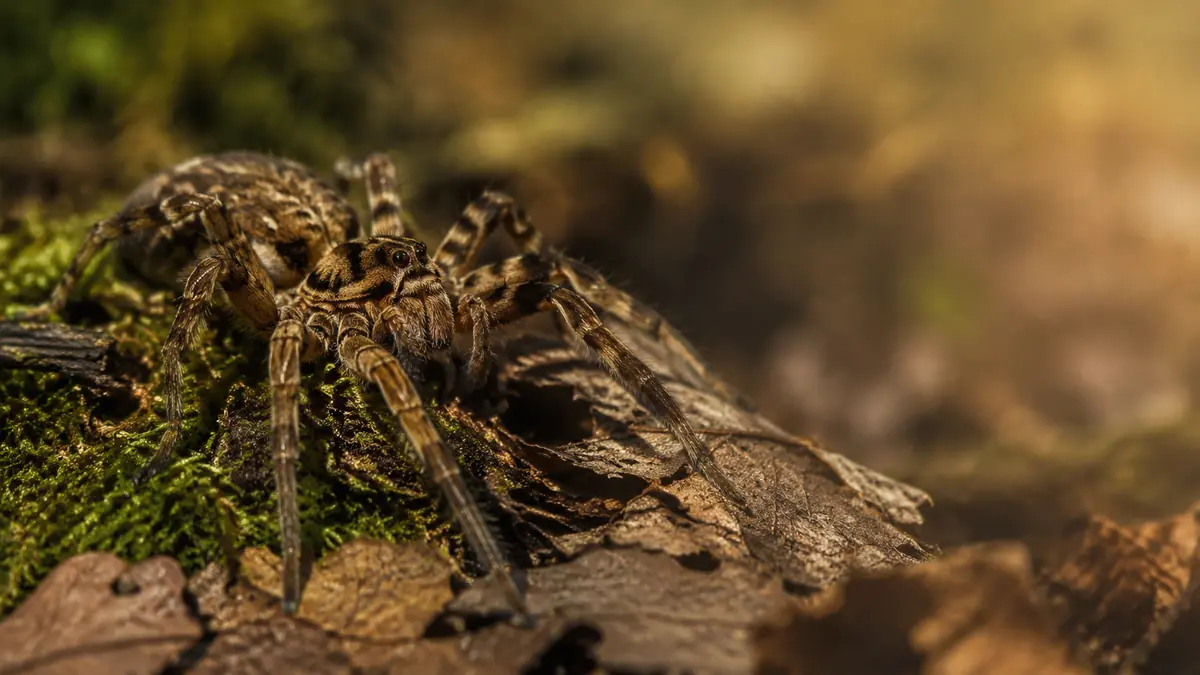
A large, fast-moving brown spider racing across the floor can be alarming. In many cases, however, the unexpected visitor is a wolf spider—an active hunter that would much rather escape than confront a person.
A wolf spider is a ground-dwelling arachnid in the family Lycosidae. It hunts insects using speed and strong eyesight instead of catching prey in a conventional web. Most species are brown, gray or black with camouflage markings. They possess venom, but their bites are uncommon and generally not medically dangerous to healthy people.
What Is a Wolf Spider?
Wolf spiders belong to the family Lycosidae, a large and widely distributed group within the spider order Araneae. The family name comes from the Greek word lykos, meaning wolf, although these spiders do not hunt cooperatively in packs.
They are solitary predators. Depending on the species, an individual may actively chase prey, ambush it from vegetation or wait near the entrance to a silk-lined burrow.
Unlike orb-weavers and many common house spiders, wolf spiders do not build elaborate capture webs. They still produce silk, using it to construct retreats, protect their eggs and sometimes line their burrows.
Several traits distinguish them:
- Eight eyes arranged in three rows
- Two unusually large forward-facing eyes
- A sturdy, hairy body
- Long legs adapted for running
- Brown, gray, tan or black camouflage
- Strong eyesight and sensitivity to vibration
- Active hunting rather than web-based prey capture
Wolf spiders are found on every continent except Antarctica. Their adaptability has allowed different species to occupy grasslands, forests, deserts, wetlands, farmland, gardens and coastal habitats.
What Does a Wolf Spider Look Like?
A typical wolf spider has a robust body, prominent eyes and hairy legs. Its mottled coloring blends into soil, bark, dead leaves and grass.
Color alone is unreliable because numerous unrelated spiders are brown. Eye arrangement, body shape, markings and behavior provide better identification clues.
Size and body structure
Wolf spider size varies considerably among species. Body length—excluding the legs—can range from only a few millimeters to approximately 35 millimeters, or about 1.4 inches. With its legs extended, a large individual may appear substantially bigger.
Like other spiders, its body has two main sections:
- The cephalothorax, which carries the eyes, mouthparts and legs
- The abdomen, which contains most internal organs and the spinnerets
The spider has eight legs, two short sensory appendages called pedipalps, and paired mouthparts known as chelicerae. The fangs connected to the chelicerae inject venom into prey.
Adult males are often slimmer than females and have enlarged, bulb-shaped pedipalps used during mating.
The distinctive eye pattern
The eyes are among the most reliable identifying features. A wolf spider has eight eyes arranged in three rows:
- Four small eyes in the bottom row
- Two large eyes in the middle row
- Two medium-sized eyes in the upper row
The two large central eyes support excellent vision compared with that of many other spiders. The upper eyes also give the animal a broad field of view.
At night, wolf spider eyes reflect light. If a flashlight is held near eye level and directed across a lawn, tiny blue-green or silvery reflections may reveal spiders hiding among the grass. This effect is caused by a reflective layer within the eyes called the tapetum.
Do not pick up a spider to examine its eyes. Use a clear container, a magnifying glass or a close photograph taken from a safe distance.
Wolf Spider vs. Brown Recluse and Similar Spiders
Misidentification is common because many ground-dwelling spiders share brown coloring and longitudinal stripes. A single marking should never be used as the only evidence.
| Feature | Wolf spider | Brown recluse | Grass spider |
|---|---|---|---|
| Eyes | Eight in three rows | Six in three pairs | Eight, without two dominant central eyes |
| Body | Robust and visibly hairy | Smoother and more uniformly colored | Slender with relatively long legs |
| Markings | Stripes, mottling or chevrons | Possible violin-shaped mark on cephalothorax | Long stripes on body |
| Spinnerets | Usually short and inconspicuous | Short | Long and visible from above |
| Hunting style | Runs after or ambushes prey | Wandering nocturnal hunter | Waits in a funnel web |
| Typical behavior | Often seen running in the open | Usually remains in secluded spaces | Commonly stays on or near its web |
Wolf spider vs. brown recluse
A brown recluse, Loxosceles reclusa, has six eyes rather than eight. Its legs are generally uniform in color and lack obvious bands or heavy spines. It is usually less hairy and more delicate-looking than a wolf spider.
The famous violin marking is not enough to confirm a brown recluse. Shadows and ordinary body patterns can resemble a violin on many harmless species. Geographic range also matters: established brown recluse populations are limited primarily to parts of the central and south-central United States.
A suspected medically significant spider should be photographed or preserved in a sealed container without handling it. Expert identification is safer than relying on an online image comparison.
Wolf spider vs. grass spider
Grass spiders belong to the family Agelenidae and frequently build sheet-like webs with funnel-shaped retreats. They tend to have two conspicuous spinnerets projecting from the rear of the abdomen.
A wolf spider’s spinnerets are much less noticeable. It may produce a silk retreat, but it does not normally sit on a broad funnel web waiting for prey.
Wolf spider vs. fishing spider
Fishing spiders belong to the family Pisauridae. They often have longer, more widely spread legs and may be found beside ponds, streams or wetlands. Some can move across water and dive beneath the surface.
Maternal behavior offers another distinction. A female wolf spider attaches her egg sac to her spinnerets at the back of the abdomen. A female nursery web or fishing spider carries her egg sac beneath the front of her body with her chelicerae and pedipalps.
Where Do Wolf Spiders Live?
Wolf spiders inhabit almost any environment containing suitable prey and shelter. Most species live at or near ground level.
Common outdoor habitats include:
- Leaf litter and woodland floors
- Meadows, fields and pastures
- Gardens and lawns
- Rocks, logs and landscaping timbers
- Sandy ground and deserts
- Stream banks, marshes and shorelines
- Agricultural land
- Underground burrows
Burrowing species may excavate their own shelters or occupy existing cracks. Some reinforce the walls with silk and construct a small turret of grass, stones or plant material around the entrance.
Why wolf spiders enter houses
A wolf spider found indoors is usually a temporary visitor rather than part of an established household infestation. It may enter while searching for prey, water, warmth, a mate or protection from severe weather.
Likely entry points include:
- Gaps beneath exterior doors
- Damaged window screens
- Foundation cracks
- Open garages
- Utility-line openings
- Firewood, boxes or plants carried inside
Indoors, they may hide beneath furniture, in basements, along garage walls or inside other quiet ground-level spaces. They do not normally establish large communal webs or live in colonies.
Sightings may become more noticeable in late summer and autumn when mature males wander in search of females. Seasonal movement varies by species and climate.
What Do Wolf Spiders Eat?
Wolf spiders are carnivorous predators that primarily eat insects and other small arthropods. Their prey may include:
- Crickets
- Beetles
- Cockroaches
- Ants
- Grasshoppers
- Flies
- Moths
- Earwigs
- Other spiders
Large species may occasionally capture very small vertebrates, but insects make up the normal diet.
The spider detects movement through its eyesight, sensitive leg hairs and vibrations traveling through the ground. It then stalks, rushes or pounces on the prey. Venom helps immobilize the victim, while digestive fluids break down internal tissues that the spider consumes as liquid.
This predatory role benefits gardens and natural ecosystems. Wolf spiders help limit populations of insects that feed on plants or enter buildings. They are also prey for birds, reptiles, amphibians, rodents, wasps and larger arthropods, making them part of the wider food web.
Wolf Spider Behavior and Life Cycle
Most wolf spiders live and hunt alone. Many are nocturnal, although some species are active during daylight. When disturbed, their usual response is to freeze briefly, run away or hide.
They can move surprisingly fast across open ground. That speed is defensive as well as useful for catching food; a spider racing toward a wall is generally seeking cover, not pursuing a person.
Courtship and mating
A male identifies a potential mate through chemical signals and vibrations. He may wave his front legs, tap the ground, vibrate his body or perform species-specific pedipalp movements.
These courtship signals allow the female to recognize him as a mate rather than prey. Even so, approaching a larger predatory female carries risks for the male.
Egg-sac care
The female’s care of her offspring is one of the family’s most recognizable behaviors. She encloses her eggs in a round silken sac and attaches it to the spinnerets at the tip of her abdomen.
She carries the sac while walking and hunting, raising her abdomen enough to prevent it from dragging. If the sac becomes detached, she may actively search for it and reconnect it.
Why babies ride on the mother’s back
After hatching, the spiderlings climb onto their mother’s abdomen and remain clustered there for several days or longer, depending on the species and environmental conditions. A female may appear to have a rough or unusually textured back because she is carrying dozens of tiny offspring.
The young eventually disperse and begin hunting independently. Breaking or crushing a female carrying spiderlings can cause them to scatter, so capturing the family in a container is the cleaner removal method.
Growth occurs through molting, during which the spider sheds its external skeleton. Young spiders molt repeatedly before becoming adults. Lifespan varies, but many live for roughly one to two years, with females of some larger species surviving longer.
Are Wolf Spiders Poisonous or Venomous?
The accurate term is venomous, not poisonous. Venom is injected through fangs, whereas poison causes harm when touched, swallowed or otherwise absorbed.
Wolf spiders use venom to subdue prey. However, their venom is not considered medically significant for most healthy people. These spiders are not aggressive toward humans and typically bite only when pressed against the skin, trapped in clothing or handled.
Pets may investigate or paw at a spider and could be bitten. Serious effects are not expected in most cases, but a veterinarian should assess persistent pain, facial swelling, weakness, vomiting or breathing difficulty.
What Does a Wolf Spider Bite Look and Feel Like?
A confirmed wolf spider bite may cause immediate pain followed by a small red, swollen or itchy area. The discomfort is sometimes compared with a bee sting. Mild symptoms commonly improve within a few hours to several days.
Possible local symptoms include:
- Pain or stinging
- Redness
- Mild swelling
- Itching
- Tenderness around the puncture
- Two tiny fang marks, although these may not be visible
Appearance alone cannot identify the responsible spider. Many skin problems described as “spider bites” are caused by bacterial infections, allergic reactions, ticks, fleas or other insects. A reliable diagnosis is more likely when the spider was seen biting and then professionally identified.
Tissue destruction is not a normal feature of a wolf spider bite. A spreading wound, blistering, darkened skin or worsening ulcer needs medical evaluation because another condition or secondary infection may be responsible.
How to Treat a Wolf Spider Bite
Most mild bites can be managed with basic first aid:
- Move away from the spider. Do not try to catch it with bare hands.
- Wash the area. Use soap and clean water to reduce the risk of infection.
- Apply a cold compress. Wrap ice in cloth and use it for short intervals to ease pain and swelling.
- Elevate the affected limb. Raising an arm or leg may help control swelling.
- Avoid scratching. Scratching can damage the skin and introduce bacteria.
- Monitor the reaction. Photograph the area and note whether redness or swelling expands.
- Use appropriate nonprescription medicine if needed. An antihistamine may help itching, while a suitable pain reliever can reduce discomfort. Follow the label and consider personal medical conditions or interactions.
Do not cut the wound, squeeze it, attempt to remove venom or apply extreme heat. These methods can cause additional injury.
When to seek medical help
Obtain urgent medical care for:
- Difficulty breathing or swallowing
- Swelling of the lips, tongue, face or throat
- Fainting, severe weakness or confusion
- Rapidly spreading swelling or hives
- Severe or increasing pain
- Fever, pus, red streaks or other signs of infection
- Muscle cramps, heavy sweating or repeated vomiting
- A worsening open wound or darkening skin
Children, older adults and people with serious health conditions may need earlier professional assessment. In the United States, Poison Help is available at 1-800-222-1222. Elsewhere, contact the local poison-information service or emergency provider.
If it can be done safely, take a clear photograph of the spider. Do not delay medical treatment while attempting to capture it.
How to Remove a Wolf Spider Safely
A single spider can usually be relocated without pesticide.
- Place a wide glass or plastic container over it.
- Slide a stiff piece of paper or thin cardboard beneath the container.
- Keep the container level and carry it outside.
- Release the spider in sheltered vegetation away from entrances.
Wear closed shoes and avoid direct contact. A vacuum can remove a spider from an inaccessible location, but relocation preserves a useful predator. If a female is carrying spiderlings, the container method also prevents the young from scattering indoors.
Repeated sightings are usually a sign that the building offers entry points or abundant insect prey.
How to Keep Wolf Spiders Out of the House
Long-term prevention focuses on exclusion, shelter reduction and insect control.
Seal entry points
Inspect the exterior at ground level and:
- Install tight door sweeps
- Repair damaged screens
- Seal foundation and siding cracks
- Add covers around utility penetrations
- Use weatherstripping around doors and windows
- Keep garage doors closed when possible
Reduce hiding places
Move firewood, stones, boards and dense plant growth away from the foundation. Remove indoor clutter from basements, garages and storage rooms. Shake out shoes, gloves and outdoor clothing that have been left undisturbed.
Outdoor lighting can attract flying insects, which in turn attract spiders. Direct necessary lights away from doors or consider bulbs that are less attractive to insects.
Address the food source
Vacuum crumbs, manage moisture and repair screens to reduce insect activity. Sticky monitoring traps placed along walls can help reveal where spiders and their prey are entering, but traps should be kept away from children and pets.
Broad pesticide spraying is rarely necessary for one wandering spider. If numerous spiders continue appearing after exclusion work, a qualified pest-management professional can inspect for structural gaps and underlying insect activity.
Should You Be Worried About a Wolf Spider?
A wolf spider can look intimidating, especially when its eyes reflect a flashlight or a large female carries spiderlings across her back. Its appearance is more dramatic than its risk to people.
These spiders are shy, solitary hunters that help control insects. They do not seek human contact, infest food or attack without provocation. Give an outdoor individual space; relocate an indoor visitor with a container; and treat any suspected bite with sensible first aid while watching for unusual symptoms.
Correct identification matters most. Look for the robust body, short spinnerets and characteristic eight-eye arrangement, but never handle an unknown spider for a closer view. Once recognized, a wolf spider is usually best understood as a useful predator—not a household emergency.
