

Imagine someone describing a difficult exam as “a mountain to climb” or calling a cheerful friend “a ray of sunshine.” Neither statement is meant literally. Instead, each creates a vivid picture by comparing one thing to another.
These expressions are examples of metaphors, one of the most widely used figures of speech in English.
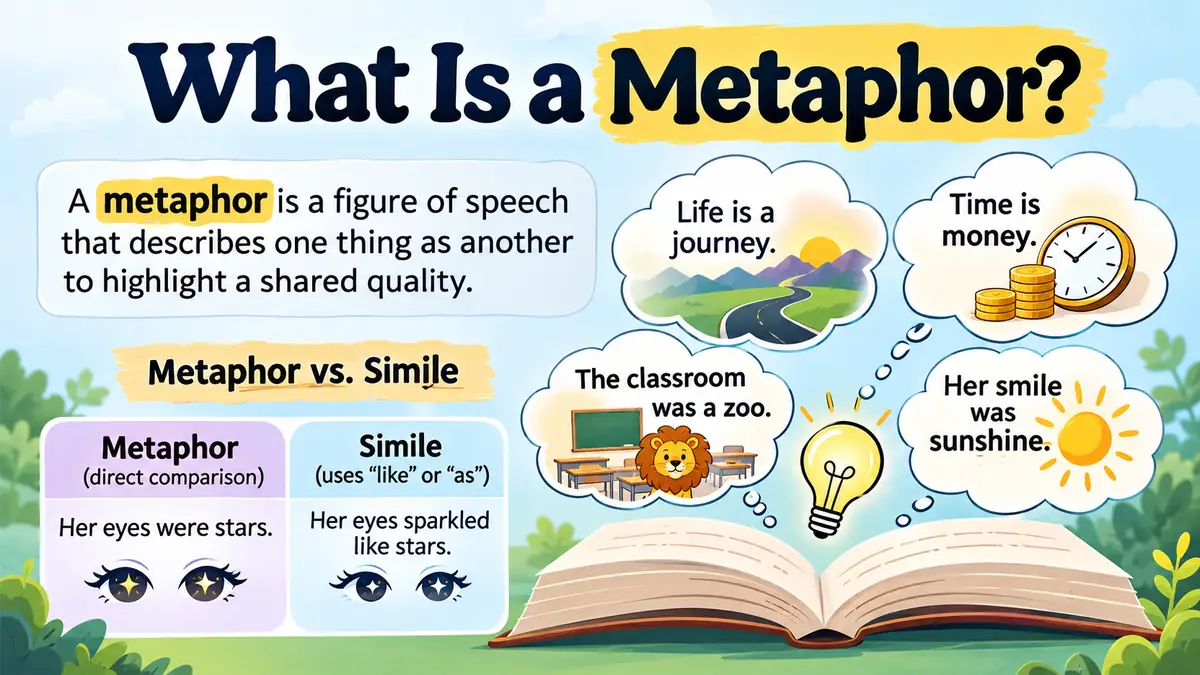
A metaphor is a figure of speech that describes one thing as another to suggest a shared quality or characteristic. Unlike a simile, which typically uses “like” or “as” to make a comparison, a metaphor states the comparison directly. Metaphors help writers and speakers communicate ideas, emotions, and experiences through vivid, imaginative language.
Metaphors appear in everyday conversations, literature, poetry, advertising, speeches, and even scientific explanations. Understanding how they work makes it easier to interpret figurative language and communicate more effectively.
What Is a Metaphor in Simple Words?
A metaphor is a way of explaining or describing something by saying that it is something else, even though the two things are not literally identical.
For example:
- “Time is money.”
- “The classroom was a zoo.”
- “Her voice was music to his ears.”
- “He has a heart of stone.”
- “The world is a stage.”
Each expression connects two different ideas through a shared characteristic.
When someone says “the classroom was a zoo,” they do not mean that the classroom contained wild animals. They mean that it was noisy, chaotic, or difficult to control.
The Basic Structure of a Metaphor
A simple metaphor often follows this pattern:
Subject + linking verb + comparison
For example:
“Life is a journey.”
Here, life is the subject being described, while journey provides the comparison.
The metaphor suggests that life involves experiences, challenges, decisions, progress, and unexpected changes, much like traveling along a road.
Not every metaphor follows this grammatical pattern. Consider “She planted the seeds of hope.” The verb planted creates a metaphor by treating hope as something that can grow.
What Does Metaphorical Mean?
The adjective metaphorical describes language used symbolically or figuratively rather than literally.
If someone says, “I’m drowning in homework,” the statement is metaphorical because the person is overwhelmed by assignments, not physically underwater.
The distinction between literal and figurative meaning is essential to understanding metaphors.
20 Common Metaphor Examples With Meanings
Metaphors are easier to recognize when you see how they connect familiar ideas.
| Metaphor | Meaning |
|---|---|
| Time is money. | Time is valuable and should be used wisely. |
| Life is a journey. | Life involves progress, choices, and challenges. |
| The classroom was a zoo. | The classroom was noisy and chaotic. |
| He has a heart of stone. | He seems emotionally cold or unkind. |
| She is a shining star. | She is exceptionally talented or successful. |
| The world is a stage. | People perform different roles in life. |
| Knowledge is power. | Understanding provides advantages and influence. |
| His words were daggers. | His words were deeply hurtful. |
| Hope is a light in the darkness. | Hope provides comfort during difficult times. |
| Her mind is a computer. | She processes or remembers information efficiently. |
| The news was a punch in the gut. | The news caused emotional shock. |
| The city is a concrete jungle. | The city feels crowded, competitive, or overwhelming. |
| He is a walking encyclopedia. | He possesses extensive knowledge. |
| The deadline is approaching fast. | The deadline feels like something moving toward us. |
| Her smile was sunshine. | Her smile brought warmth or happiness. |
| Fear is a prison. | Fear restricts freedom or choices. |
| His temper is a volcano. | His anger can erupt suddenly. |
| The internet is an ocean of information. | The internet contains enormous amounts of information. |
| Their friendship is a bridge. | Their friendship connects people or overcomes differences. |
| My thoughts are a tangled web. | My thoughts are complicated or confusing. |
These comparisons work because readers recognize the qualities associated with the second object or concept.
Metaphors in Everyday Conversations
Many people use metaphors without realizing it.
A student might say, “My brain is fried” after studying for several hours. A manager might describe an efficient employee as “the backbone of the team.”
Other familiar expressions include “breaking the ice,” “a wave of excitement,” “a flood of emails,” and “a storm of criticism.”
Some have become so common that their figurative nature is barely noticeable.
What Is a Metaphor Compared With a Simile?
One of the most common questions about figurative language is the difference between a metaphor and a simile.
Both devices compare different things, but they express the relationship differently.
A metaphor generally makes a direct comparison, while a simile makes an explicit comparison using words such as “like” or “as.”
| Feature | Metaphor | Simile |
|---|---|---|
| Comparison | Direct or implied identification | Explicit comparison |
| Typical wording | Says something is another thing | Uses “like” or “as” |
| Example | Her eyes were stars. | Her eyes sparkled like stars. |
| Example | He is a lion in battle. | He fights like a lion. |
| Effect | Often creates a strong identification | Highlights a particular resemblance |
Consider these sentences:
Metaphor: “The snow was a white blanket.”
Simile: “The snow covered the ground like a white blanket.”
Both describe snow covering a landscape, but the metaphor identifies the snow as a blanket, creating a more immediate image.
Can a Metaphor Use “Like” or “As”?
The presence of “like” or “as” does not automatically determine whether a sentence contains a simile.
For instance, “She works as a teacher” is a literal statement, not a simile.
Similarly, metaphorical language can contain those words elsewhere in a sentence without making the central comparison a simile.
The key is understanding how the comparison works rather than searching for particular words alone.
Types of Metaphors in English
Metaphors appear in several forms, ranging from short expressions to comparisons developed across entire literary works.
1. Direct Metaphor
A direct metaphor explicitly identifies one thing as another.
Example: “His voice is thunder.”
The comparison suggests that his voice is loud, powerful, or commanding.
Another example is “Her determination is steel,” which emphasizes strength and resilience.
2. Implied Metaphor
An implied metaphor suggests a comparison without directly naming both things.
Example: “The manager barked orders at the staff.”
The verb barked indirectly compares the manager to a dog.
Another example is “She clawed her way to the top,” where the action suggests an animal-like struggle.
3. Extended Metaphor
An extended metaphor develops one central comparison over several sentences, paragraphs, or even an entire literary work.
Consider this original example:
“Education is a garden. Teachers plant ideas, students nurture them through practice, and curiosity provides the sunlight that helps knowledge grow.”
The comparison between education and gardening continues through multiple related images.
Extended metaphors are especially common in poetry, storytelling, speeches, and persuasive writing.
4. Dead Metaphor
A dead metaphor is an expression whose original figurative meaning has become so familiar that people often interpret it without noticing the comparison.
Examples include:
- The foot of a mountain
- The leg of a table
- The hands of a clock
- The mouth of a river
These expressions originated through comparisons with parts of the human body.
Over time, many became conventional meanings in everyday English.
5. Mixed Metaphor
A mixed metaphor combines comparisons that do not fit together logically.
For example:
“We need to plant the seeds of success before the train leaves the station.”
The sentence moves from gardening imagery to transportation imagery without developing a meaningful connection.
Mixed metaphors are sometimes used intentionally for humor, but accidental combinations can make writing confusing.
6. Conceptual Metaphor
A conceptual metaphor is a broader pattern in which people understand one domain of experience through another.
Linguists George Lakoff and Mark Johnson explored this idea in their influential 1980 book, Metaphors We Live By.
For example, the conceptual metaphor ARGUMENT IS WAR appears in expressions such as:
- “She defended her position.”
- “He attacked my argument.”
- “They won the debate.”
These expressions describe discussion using concepts associated with conflict.
Conceptual metaphors are particularly important in cognitive linguistics because they help explain how figurative comparisons influence everyday thought.
7. Visual Metaphor
A visual metaphor communicates a comparison through an image rather than words alone.
For example, an illustration of a person’s head filled with tangled wires might represent confusion or mental overload.
Visual metaphors frequently appear in editorial cartoons, film, photography, graphic design, and advertising.
What Is a Metaphor in Literature and Poetry?
Writers use metaphors to communicate complex emotions, develop themes, create imagery, and give readers a deeper understanding of characters and situations.
Metaphors can also establish symbolism that continues throughout a poem, novel, or play.
William Shakespeare’s Metaphors
William Shakespeare frequently used metaphors to explore love, identity, time, and human behavior.
In Romeo and Juliet, Romeo declares:
“Juliet is the sun.”
The metaphor compares Juliet to the sun, suggesting that she brings light, warmth, and meaning into Romeo’s life.
In As You Like It, Shakespeare presents the famous metaphor:
“All the world’s a stage.”
The comparison develops into an extended metaphor about human life, with people playing different roles as they grow older.
Emily Dickinson’s Metaphors
Emily Dickinson often transformed abstract emotions into concrete images.
Her poem Hope is the Thing with Feathers portrays hope as a bird.
This metaphor suggests that hope is persistent, comforting, and capable of surviving difficult circumstances.
Rather than defining hope in ordinary language, Dickinson makes the emotion feel alive.
Langston Hughes and Extended Metaphors
In Mother to Son, Langston Hughes uses a staircase as an extended metaphor for life’s struggles.
The difficult staircase represents obstacles, hardship, and perseverance.
The comparison develops throughout the poem, making the speaker’s advice more memorable and emotionally meaningful.
These examples demonstrate how a metaphor can do more than decorate a sentence. It can shape the meaning of an entire literary work. gccplustraining.org+1
Why Do Writers Use Metaphors?
Metaphors serve several important purposes in both creative and informational writing.
Creating Vivid Imagery
A metaphor encourages readers to visualize an idea.
Compare:
“The room was very quiet.”
With:
“The room was a tomb.”
The second sentence communicates silence while also suggesting an unsettling atmosphere.
Explaining Abstract Ideas
Concepts such as freedom, justice, love, anxiety, and time can be difficult to describe directly.
Metaphors make these ideas easier to understand by connecting them to familiar experiences.
For example, “Anxiety is a shadow” suggests something that follows a person and may be difficult to escape.
Expressing Emotions
Metaphors can communicate emotional experiences more powerfully than literal descriptions.
Instead of saying “She was extremely sad,” a writer might say, “A cloud of sorrow followed her.”
The metaphor communicates sadness while suggesting that the feeling persists.
Making Language Memorable
A memorable metaphor can express an idea in very few words.
“Knowledge is power” is a familiar example because it connects learning with the ability to influence circumstances.
Influencing Perspective
Metaphors can shape how readers interpret situations.
Describing a disagreement as a “battle” emphasizes conflict, while describing it as a “puzzle” encourages cooperation and problem-solving.
This is one reason metaphors are studied in rhetoric, communication, philosophy, and cognitive linguistics.
How to Identify a Metaphor in a Sentence
Recognizing metaphors becomes easier when you follow a simple process.
- Look for an unusual description. Identify words that seem impossible or inaccurate when interpreted literally.
- Find the two ideas being connected. Determine what is being described and what it is being compared with.
- Identify the shared characteristic. Ask what quality connects the two ideas.
- Consider the context. Determine whether the statement is literal or figurative.
- Explain the intended meaning. Translate the metaphor into ordinary language.
Example: Identifying a Metaphor
Consider the sentence:
“Her words were arrows.”
The two elements are words and arrows.
Words are not physical arrows, but both can cause harm.
The metaphor suggests that her words were sharp, hurtful, or deliberately directed at someone.
Understanding Tenor, Vehicle, and Ground
Literary analysis sometimes uses three terms to explain how metaphors work.
| Term | Definition | Example: “Her words were arrows” |
|---|---|---|
| Tenor | The subject being described | Her words |
| Vehicle | The image used for comparison | Arrows |
| Ground | The shared characteristic | Ability to hurt or strike a target |
The difference between the tenor and vehicle can also create tension, encouraging readers to explore the comparison more deeply.
These terms are useful when analyzing poetry, literature, and rhetorical devices. plato.stanford.edu+1
How to Write a Good Metaphor
Writing an effective metaphor requires more than placing two unrelated nouns together.
The comparison should communicate something meaningful about the subject.
Step 1: Choose What You Want to Describe
Start with a person, object, emotion, or experience.
For example: confidence.
Step 2: Identify Its Main Quality
Think about what confidence represents.
It might suggest strength, stability, courage, or security.
Step 3: Find a Familiar Comparison
Choose something associated with that characteristic.
For example: an anchor.
Step 4: Create the Metaphor
“Her confidence was an anchor during uncertain times.”
The comparison suggests that confidence provided stability when circumstances were difficult.
Step 5: Check Whether the Image Makes Sense
Ask whether readers can understand the connection without needing a lengthy explanation.
A good metaphor should add meaning rather than create unnecessary confusion.
Turning Ordinary Sentences Into Metaphors
| Ordinary Sentence | Metaphorical Version |
|---|---|
| He is very intelligent. | His mind is a library of knowledge. |
| She felt extremely happy. | Joy was fireworks inside her. |
| The city was busy. | The city was a restless machine. |
| He was very angry. | His anger was a raging fire. |
| The task was difficult. | The task was a mountain before us. |
| She gave helpful advice. | Her advice was a compass. |
The metaphorical versions introduce imagery, but they are not automatically better. In technical, legal, or instructional writing, literal language may be more precise.
Quick takeaway: Choose metaphors that clarify the intended meaning, fit the tone, and help readers picture the idea.
Metaphor vs. Other Figures of Speech
Metaphors belong to a broader category called figurative language, which includes similes, personification, hyperbole, symbolism, and other literary devices.
Although these techniques sometimes overlap, they serve different functions.
| Literary Device | Main Function | Example |
|---|---|---|
| Metaphor | Identifies one thing with another | The office was a battlefield. |
| Simile | Compares using “like” or “as” | The office was like a battlefield. |
| Personification | Gives human qualities to nonhuman things | The wind whispered through the trees. |
| Hyperbole | Uses deliberate exaggeration | I’ve told you a million times. |
| Symbolism | Uses something to represent a broader idea | A dove represents peace. |
| Analogy | Explains a relationship through comparison | Learning a language resembles building a house: each skill supports the next. |
Is Personification a Metaphor?
Personification and metaphor can overlap, but they are not identical.
Personification specifically attributes human qualities or actions to something nonhuman.
For example:
“The wind whispered secrets.”
The wind is described as performing a human action.
This sentence can be understood as both personification and metaphorical language because it transfers a human activity to a natural phenomenon.
However, “The classroom was a zoo” is a metaphor without personification.
Is an Analogy the Same as a Metaphor?
An analogy compares relationships or situations to clarify an idea.
A metaphor may be part of an analogy, but analogies often provide a more detailed explanation.
For example:
“Memory is a filing cabinet” is a metaphor.
Explaining how memories are organized, stored, and retrieved in ways resembling files in a cabinet develops that comparison into an analogy.
Unlike a simple metaphor, an analogy commonly emphasizes reasoning and explanation.
Common Mistakes When Using Metaphors
Metaphors can improve writing, but poorly chosen comparisons may weaken a sentence.
Using Too Many Metaphors
A paragraph filled with unrelated images can become difficult to follow.
For example:
“His career was a mountain, his ambition a rocket, and his problems an ocean.”
Each metaphor introduces a different image without a clear connection.
Choosing one strong comparison usually creates a more coherent description.
Using Clichéd Metaphors
Expressions such as “heart of gold,” “roller coaster of emotions,” and “light at the end of the tunnel” are widely understood.
They are not necessarily incorrect, but frequent repetition can make creative writing feel predictable.
An original metaphor may communicate a more specific experience.
Creating Confusing Comparisons
Consider:
“Her happiness was a broken refrigerator.”
Without additional context, the relationship between happiness and a broken refrigerator is unclear.
Unusual metaphors can be effective, but readers need enough context to understand the intended connection.
Mixing Incompatible Images
“The project is sailing smoothly, but we need to keep the engine on the right track.”
This sentence combines sailing, machinery, and railway imagery.
A clearer alternative would be:
“The project is sailing smoothly, but we must stay on course.”
Maintaining a consistent image helps readers follow the comparison.
Treating Figurative Language as Literal Fact
Metaphors express selected similarities rather than complete equivalence.
For example, describing the brain as a computer can help explain information processing, but the human brain does not function exactly like a digital computer.
This limitation matters when metaphors are used in education, science, or public communication.
What Is a Metaphor for Kids and Students?
For younger learners, a metaphor can be explained as a comparison that says one thing is another thing to describe it in a creative way.
Consider these simple examples:
- “My brother is a monkey.” This suggests that the brother is playful or mischievous.
- “The moon is a silver coin.” This describes the moon’s round shape and shining appearance.
- “My teacher is a walking dictionary.” This suggests that the teacher knows many words.
- “The playground was a jungle.” This suggests that the playground was wild, crowded, or noisy.
- “Her hair is silk.” This describes hair that feels extremely smooth.
A Simple Metaphor Exercise
Read each sentence and identify the metaphorical comparison.
Test Your Understanding
0 / 3 correct
1. The baby was an angel.The baby and an angelThe baby and a birdThe baby and a cloud
2. His anger was a volcano.Anger and thunderAnger and a volcanoAnger and a river
3. The library was a treasure chest.The library and a schoolThe library and a bookThe library and a treasure chest
Try Again
Practicing with familiar objects helps students understand the relationship between literal and figurative meanings.
Teachers can also encourage students to create original metaphors about school, friendship, weather, and emotions.
What Is a Metaphor? Final Thoughts
A metaphor is a figure of speech that describes one thing through another, creating a meaningful connection between different ideas.
From simple expressions such as “time is money” to extended comparisons in Shakespeare’s plays and Dickinson’s poetry, metaphors make language more vivid, expressive, and memorable.
The essential distinction is that a metaphor presents one thing as another, while a simile typically compares them using “like” or “as.”
Understanding metaphors improves reading comprehension, literary analysis, creative writing, and everyday communication.
The next time you encounter an unusual comparison, identify the two ideas being connected and ask what characteristic they share. That simple habit will help you recognize metaphors and understand the meaning behind them.
