

Ask five people what is a good GPA and you’ll get five different answers. A guidance counselor, a college admissions officer, and a hiring manager are all looking at the same number through completely different lenses — and none of them are wrong.
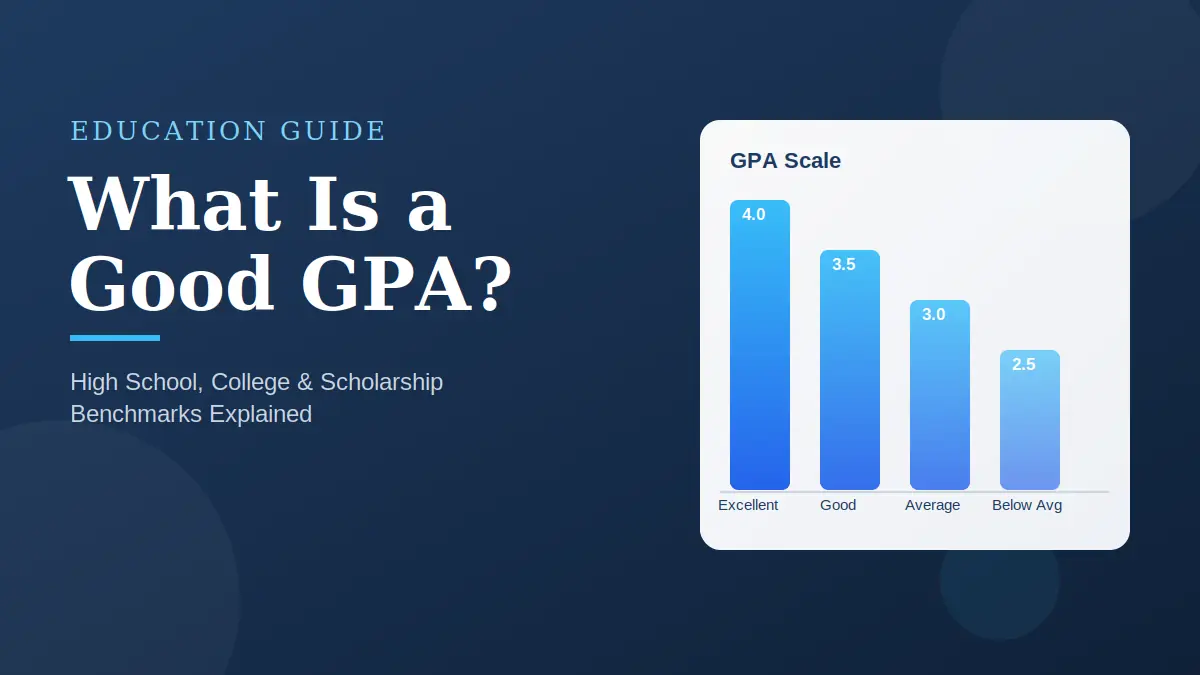
A good GPA is generally 3.5 or higher on a 4.0 scale, though “good” shifts by context: 3.0+ is solid for most colleges, 3.7+ is competitive for selective schools, and 3.9+ is expected at Ivy League and top-tier universities. Below that, a GPA can still work in your favor with strong test scores or a rigorous course load.
That short answer is useful, but it skips the part that actually matters: how GPA is calculated, how the “average” has crept upward over the past two decades, and where you actually stand compared to real applicants — not just a rule of thumb.
If you want to calculate your semester or cumulative GPA in seconds, try our GPA calculator.
How GPA Actually Works
A GPA takes every letter grade you earn, converts it to a point value, and averages those points across all your classes. On the standard 4.0 scale, an A is worth 4 points, a B is 3, a C is 2, and so on down to an F at 0.
That sounds simple until you realize schools don’t all calculate it the same way.
Unweighted vs. Weighted GPA
An unweighted GPA treats every class equally. An A in gym counts the same as an A in AP Calculus — both are 4.0. This makes it easy to compare students across schools, but it doesn’t reward students who take on harder coursework.
A weighted GPA fixes that gap by giving extra points for honors, AP, or IB classes — often pushing the scale up to 5.0. So a B in an AP class might still register as a 4.0 weighted, even though it’s a 3.0 unweighted. A weighted GPA scale can go up to 5.0 or higher, giving students who take Advanced Placement or college-level coursework the chance to reach a higher GPA.
This is why two students with wildly different “GPAs” can actually be performing at a similar level — one school reports weighted numbers, the other doesn’t. Always check which scale a college or scholarship is asking for before comparing yourself to a benchmark.
Semester GPA vs. Cumulative GPA
Your semester GPA reflects just one term. Your cumulative GPA averages every term you’ve completed — and that’s almost always the number colleges, scholarship boards, and employers actually look at. A rough semester won’t sink you if the cumulative trend is upward; admissions officers notice growth, not just the final average.
What Is a Good GPA in High School?
Average High School GPA Right Now
<cite index=”2-1″>The average high school GPA sits around 3.00, and it has been climbing over time.As a general rule, a GPA of 3.0 or higher is seen as good, while 3.5 or higher is considered excellent.
That number isn’t static across demographics or school types, either. Students at more affluent schools post a median GPA of 3.0, while those at less affluent schools average 2.59 — a gap that says more about school resources than student effort. And a 3.5 at a notoriously difficult school can represent tougher work than a 4.0 somewhere with looser grading standards, which is exactly why colleges look past the raw number.
Quick takeaway: A 3.0 is average. A 3.5 puts you ahead of most peers. A 4.0 places you in the 98th percentile nationally — genuinely rare territory. Reports indicate roughly 98% of high schools have an average GPA below 4.0, meaning a perfect 4.0 lands a student in the 98th percentile.
GPA by College Selectivity Tier
| College Type | Typical GPA Expected |
|---|---|
| Ivy League / Highly Selective | 3.7–4.0+ (unweighted) |
| Selective State Schools | 3.3–3.7 |
| Moderately Selective Colleges | 3.0–3.3 |
| Open-Admission / Less Selective | 2.5–3.0 |
The eight Ivy League universities carry an average GPA across all schools of around 3.91, and a good GPA for the Ivy League generally means at least 3.9 on a 4-point scale. Meanwhile, national averages for admitted students at less competitive schools often fall between 3.0 and 3.5, which is genuinely workable for a large share of four-year colleges.
What Is a Good GPA in College?
Average College GPA
The average college GPA in the U.S. sits around 3.15 — noticeably lower than the high school average, which surprises a lot of first-year students who assumed college grading would feel similar. Part of that drop comes from harder material; part of it comes from professors who don’t grade on the same curve a high school teacher might.
GPA by Major (Why STEM GPAs Run Lower)
Not all majors produce the same GPA distribution, and this matters if you’re benchmarking yourself against a friend in a different program. Education majors tend to post higher averages around 3.36, while STEM majors — chemistry in particular — average closer to 2.78.
That gap isn’t a red flag. Grad schools and employers in technical fields already expect it, and often weigh a 3.3 in mechanical engineering the same way they’d weigh a 3.7 in a less rigorously graded major.
What Is a Good GPA for Grad School and Scholarships?
Most graduate programs set a 3.0 minimum just to consider an application, with competitive programs preferring 3.5+. Scholarship committees vary widely, but a GPA of 3.0 is a common floor for many college scholarships, and boards awarding merit-based aid frequently expect 3.5 or better.
Latin honors designations give a useful reference point too: a 3.75+ GPA typically earns summa cum laude, 3.66+ earns magna cum laude, and 3.5+ earns cum laude.
Good GPA Benchmarks Table (Quick Reference)
| Context | “Good” GPA | “Excellent” GPA |
|---|---|---|
| High school (general) | 3.0+ | 3.5+ |
| Highly selective college admissions | 3.7+ | 3.9+ |
| Average four-year college | 2.5–3.0 | 3.3+ |
| Grad school application | 3.0+ | 3.5+ |
| Merit scholarships | 3.0+ | 3.5+ |
| Job screening (where used) | 3.0+ | 3.5+ |
Does GPA Still Matter for Jobs?
Less than it used to, but not zero. The share of employers that screen candidates by GPA has dropped noticeably —from around 75% of companies in 2019 to about 46% in 2025, according to NACE data. That’s a real shift, driven by employers leaning more on skills assessments, portfolios, and internship experience.
Still, in fields where GPA screening survives — finance, consulting, some engineering pipelines — anything below a 3.5 tends to be viewed less favorably unless the major is notoriously demanding. If you’re early in your career with a thin resume, GPA is one of the few objective signals you have. Once you’ve got two or three years of work experience, almost nobody asks.
Common Mistakes That Quietly Wreck a GPA
A few patterns show up again and again in students who watch their GPA slide without meaning to:
- Front-loading easy classes and back-loading hard ones. A rough senior year or junior year in college carries more weight than people expect, since cumulative GPA is recency-blind but colleges aren’t.
- Ignoring the first few weeks of a new class. Early quizzes and homework grades often carry disproportionate weight before the curve evens out later.
- Treating weighted and unweighted GPA as interchangeable. Submitting the wrong number on an application can misrepresent your standing in either direction.
- Skipping the syllabus grading breakdown. Not knowing whether a final exam is 15% or 40% of your grade leads to badly misallocated study time.
How to Raise a Low GPA (What Actually Works)
Raising a GPA isn’t about studying harder in a general sense — it’s about fixing the specific thing that’s dragging the average down.
- Identify your weakest class category, not just your weakest class. If every low grade is in a subject you struggle with structurally (writing-heavy classes, lab reports), fix the skill, not just the individual course.
- Retake or replace where your school allows it. Many schools let a retaken class replace the old grade in GPA calculations — check the policy before assuming a bad semester is permanent.
- Front-load harder classes when you have the most bandwidth, and schedule lighter terms around known busy periods (internships, sports seasons, family obligations).
- Use office hours before a grade drops, not after. Professors and teachers are far more flexible about extra credit or regrading before final grades post than after.
- Track trend, not just average. An upward trajectory over several semesters tells admissions officers and employers something a flat 3.2 never will — that you’re still improving.
A GPA is a lagging indicator. It tells you what already happened, not what you’re capable of next semester. The number matters, but it’s not a verdict.
Explore our full range of calculators at GradeCalcs.
FAQ Section
Is a 3.5 GPA good? Yes. A 3.5 is well above the national average and puts you in strong standing for most four-year colleges and many scholarships. It falls short of average admitted-student GPAs at the most selective schools, where 3.7–4.0 is more typical, but it’s a solid, competitive number almost everywhere else.
What is a good GPA out of 4.0? Generally, 3.0 is considered good, 3.5 is considered excellent, and 3.7+ is competitive for selective college admissions. A perfect 4.0 places a student in roughly the 98th percentile nationally.
What GPA do you need for Harvard or other Ivy League schools? Most Ivy League admits carry an average GPA around 3.9 unweighted. A GPA below that can still work if paired with exceptional test scores, rigorous coursework, and standout extracurriculars, but 3.9+ reflects the typical admitted profile.
Is a 2.5 GPA bad? It’s below the national high school and college averages, which sit closer to 3.0. A 2.5 can still work for less selective or open-admission colleges, but it will limit scholarship eligibility and competitiveness at mid-tier and selective schools.
Can you get into college with a 3.0 GPA? Yes, easily, at most colleges. A 3.0 sits right around the national average and is workable for the majority of four-year schools, especially when paired with solid test scores or strong extracurriculars.
What’s the difference between weighted and unweighted GPA? An unweighted GPA treats every class the same on a 4.0 scale. A weighted GPA gives bonus points for honors, AP, or IB classes, often allowing scores above 4.0. Colleges may ask for either, so always check which one is required.
Does GPA matter after you graduate? Less than it used to. Employer use of GPA screening has dropped substantially in recent years, and it typically stops mattering once someone has a few years of work experience. It still carries weight for entry-level roles in some competitive fields.
What is considered a perfect GPA? On the standard unweighted scale, 4.0 is perfect — meaning straight A’s across every class. On weighted scales that factor in honors or AP courses, some students exceed 4.0, occasionally reaching 5.0 depending on the school’s system.

The employer-screening drop from 75% to 46% in just six years is a bigger swing than I’d have guessed: it makes the “GPA barely matters after a few years” advice feel less like reassurance and more like a documented trend.