

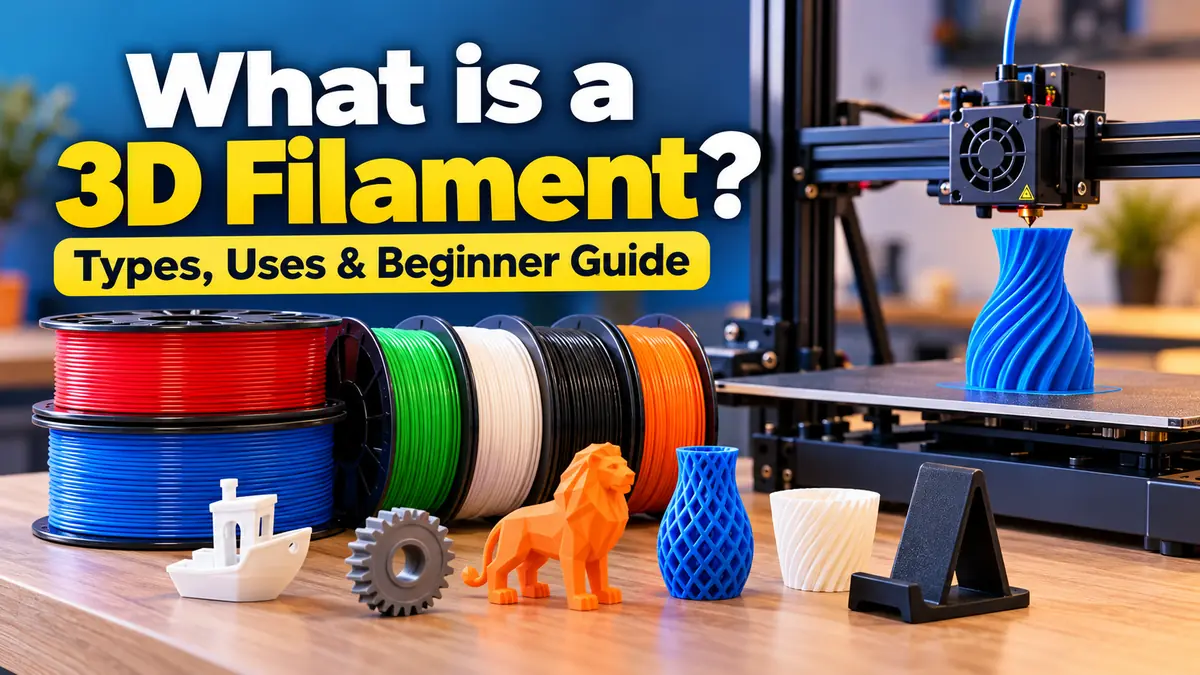
If you have ever watched a 3D printer create an object layer by layer, you might wonder what material makes that possible. The answer is 3D printing filament, a material that transforms digital designs into physical objects.
Understanding what is a 3d filament is one of the first steps toward learning how 3D printing works. Different filaments produce objects with different levels of strength, flexibility, heat resistance, and surface finish.
3D filament is a continuous strand of thermoplastic material used in fused deposition modeling (FDM) 3D printers. It is typically supplied on a spool and fed through a heated nozzle, where it softens and is deposited in layers. Common filament materials include PLA, ABS, PETG, and TPU, each offering different properties and applications.
Filament is used for everything from decorative models and educational projects to prototypes, replacement components, and engineering parts.
What Is 3D Filament Made Of?
3D printing filament is primarily manufactured from thermoplastic polymers. These plastics soften when heated and solidify as they cool, allowing a printer to build objects in controlled layers.
Unlike thermosetting plastics, which undergo permanent chemical changes during curing, thermoplastics can generally be reheated and reshaped.
The exact chemical composition determines the filament’s performance.
Common raw materials include:
- Polylactic acid (PLA): A polymer commonly produced from renewable plant-derived feedstocks such as corn starch or sugarcane.
- Acrylonitrile butadiene styrene (ABS): A petroleum-derived thermoplastic valued for toughness and heat resistance.
- Polyethylene terephthalate glycol-modified (PETG): A modified polyester known for durability and good layer adhesion.
- Thermoplastic polyurethane (TPU): An elastic polymer used for flexible, rubber-like objects.
- Polyamide (nylon): An engineering polymer used for wear-resistant and mechanically demanding parts.
- Polycarbonate (PC): A strong engineering thermoplastic with relatively high heat resistance.
Manufacturers may also mix polymers with pigments, stabilizers, and additives to change their appearance or mechanical properties.
Some specialty filaments contain wood particles, carbon fibers, glass fibers, or metallic powders.
These additives can influence surface texture, stiffness, weight, abrasion resistance, and printing requirements.
How Does 3D Printer Filament Work?
Most filament-based 3D printers use a process called fused deposition modeling (FDM), also known as fused filament fabrication (FFF).
The process works by heating and extruding thermoplastic material through a nozzle, following instructions generated from a digital 3D model.
Step 1: Create a digital 3D model
The printing process begins with a three-dimensional design.
A model can be created using computer-aided design (CAD) software such as Autodesk Fusion or FreeCAD. Existing designs can also be obtained in formats such as STL or 3MF.
The digital model defines the shape and dimensions of the object.
Step 2: Prepare the model using slicing software
A slicer converts the model into layers and generates the printer’s instructions, commonly in G-code.
Popular slicing programs include PrusaSlicer, Cura, and Bambu Studio.
The software determines settings such as:
- Layer height
- Nozzle temperature
- Printing speed
- Infill density
- Wall thickness
- Support structures
- Cooling requirements
These settings affect printing time, material consumption, surface quality, and mechanical performance.
Step 3: Feed filament into the extruder
A motor-driven extruder grips the filament and pushes it toward the hotend.
Depending on the printer, the extruder may be mounted close to the hotend in a direct-drive configuration or connected through a Bowden tube.
The filament must have the correct diameter and consistent dimensions to feed reliably.
Step 4: Heat and deposit the material
Inside the hotend, the filament is heated to a suitable processing temperature.
The softened material flows through a nozzle, commonly with a 0.4 mm opening, and is deposited onto the build plate.
The printer moves the nozzle or build platform according to the sliced model.
Step 5: Build the object layer by layer
As the deposited material cools, it solidifies and bonds with neighboring material.
The printer repeats the process until the object is complete.
The resulting part may require support removal, surface finishing, or additional processing.
This manufacturing method is known as additive manufacturing because material is added rather than removed from a solid block.
Types of 3D Printing Filament
Different filament types serve different purposes. Some prioritize easy printing, while others provide improved durability, flexibility, or resistance to demanding environments.
PLA Filament
PLA, or polylactic acid, is among the most widely used materials in desktop 3D printing.
It is particularly suitable for beginners because it generally requires lower printing temperatures and experiences relatively little warping.
Advantages of PLA:
- Easy to print
- Good dimensional accuracy
- Available in numerous colors
- Suitable for detailed models
- Generally compatible with open-frame printers
- Relatively low printing temperatures
Limitations:
PLA has relatively poor heat resistance compared with engineering plastics. Objects made from standard PLA may soften or deform in hot environments, including inside a parked car.
It can also be brittle under certain types of mechanical loading.
Common uses: Decorative objects, educational models, figurines, architectural prototypes, organizers, and visual prototypes.
PLA is often the most practical starting material for someone learning 3D printing.
ABS Filament
ABS stands for acrylonitrile butadiene styrene.
It is an engineering thermoplastic used in manufactured products such as electronic housings and automotive components.
ABS is valued for its toughness and ability to tolerate higher temperatures than standard PLA.
Advantages:
- Good impact resistance
- Higher heat resistance than PLA
- Suitable for functional components
- Can be smoothed using controlled acetone-vapor processes
Limitations:
ABS can shrink and warp during cooling. It generally benefits from an enclosed printer, heated build plate, and controlled chamber conditions.
ABS printing can also emit ultrafine particles and volatile organic compounds, so suitable ventilation and exposure controls are necessary.
Common uses: Mechanical housings, functional prototypes, brackets, and components exposed to moderately elevated temperatures.
PETG Filament
PETG is polyethylene terephthalate modified with glycol.
It offers a useful combination of toughness, layer adhesion, chemical resistance, and relatively manageable printing behavior.
PETG is frequently selected when a PLA part does not provide sufficient durability.
Advantages:
- Good impact resistance
- Strong interlayer bonding
- Better heat tolerance than standard PLA
- Useful moisture and chemical resistance
- Generally less prone to warping than ABS
Limitations:
PETG can produce stringing, where thin strands appear between separate areas of a print.
It can also adhere too strongly to certain build surfaces, requiring appropriate release layers or build-plate selection.
Common uses: Tool holders, functional brackets, protective housings, containers for non-food applications, and workshop accessories.
TPU Filament
TPU, or thermoplastic polyurethane, is a flexible material that can bend and recover its shape.
Its rubber-like properties make it different from rigid filaments such as PLA and ABS.
Advantages:
- High flexibility
- Good abrasion resistance
- Useful impact absorption
- Suitable for soft grips and protective components
Limitations:
Flexible filament can buckle or jam inside poorly constrained filament paths.
It often requires slower printing speeds and careful extruder tuning. Direct-drive extruders are frequently helpful.
TPU flexibility is commonly described using Shore hardness ratings, such as 95A.
Common uses: Protective cases, flexible feet, vibration dampers, gaskets, grips, and cable protectors.
ASA Filament
ASA stands for acrylonitrile styrene acrylate.
It shares several characteristics with ABS but generally provides better resistance to ultraviolet exposure and outdoor weathering.
ASA is commonly used for outdoor components that need dimensional stability and durability.
However, it typically requires an enclosure and appropriate ventilation because of its printing characteristics and emissions.
Nylon Filament
Nylon, also known as polyamide or PA, is used for demanding mechanical applications.
It offers toughness, wear resistance, and useful performance in moving or loaded components.
Common applications include gears, bushings, hinges, and engineering prototypes.
Nylon readily absorbs moisture from the surrounding air. Proper drying and moisture-controlled storage are therefore particularly important.
Specialty and Composite Filaments
Beyond standard polymers, specialty filaments provide additional characteristics.
Examples include:
- Carbon-fiber-filled filament: Usually increases stiffness, although performance depends on the base polymer, fiber content, and print orientation.
- Glass-fiber-filled filament: Used to modify stiffness and dimensional performance.
- Wood-filled filament: Contains wood particles for a wood-like appearance.
- Metal-filled filament: Contains metallic particles for decorative appearance and additional weight.
- PVA and BVOH: Water-soluble support materials used with compatible multi-material printing systems.
- HIPS: A polymer sometimes used as a removable support material.
- Polypropylene (PP): Useful for certain chemically resistant or flexible functional parts.
Abrasive composite filaments can wear standard brass nozzles quickly, making hardened nozzles advisable.
For additional material properties and hardware requirements, see the Prusa filament material guide.

Prusa Knowledge Base
+1
3D Filament Comparison: PLA vs ABS vs PETG vs TPU
The following table compares common filament materials and their typical characteristics.
| Material | Typical nozzle temperature | Main advantage | Difficulty |
|---|---|---|---|
| PLA | 190–220°C | Easy printing | Easy |
| PETG | 220–250°C | Toughness and layer adhesion | Easy–Moderate |
| ABS | 230–255°C | Heat resistance | Advanced |
| TPU | 220–250°C | Flexibility | Moderate |
| ASA | 240–260°C | Outdoor UV resistance | Advanced |
| Nylon | 240–285°C | Wear resistance and toughness | Advanced |
Temperature ranges are approximate starting points, not universal settings. Always follow the specific filament manufacturer’s recommendations and the printer’s supported temperature limits.
Prusa Knowledge Base
+1
No single material is best for every application.
PLA is generally appropriate for learning and decorative objects. PETG is useful for tougher everyday components, while ABS and ASA are better suited to certain heat-related applications.
TPU is the preferred option among these materials when flexibility is essential.
What Is a 3D Filament Size and Why Does It Matter?
Filament diameter is one of the most important compatibility specifications.
The two common nominal diameters are:
- 1.75 mm: Widely used in modern desktop FDM printers.
- 2.85 mm: Used by certain printers, including some UltiMaker systems.
Some 2.85 mm filament is informally described as 3 mm filament.
The diameter must match the printer’s extrusion system. A printer designed for 1.75 mm filament cannot normally use 2.85 mm filament without substantial hardware changes.
Does filament diameter affect print quality?
Diameter consistency matters because the printer calculates extrusion based on an expected filament cross-sectional area.
Unexpected diameter variations can cause inconsistent material flow, contributing to over-extrusion or under-extrusion.
Manufacturers commonly specify dimensional tolerances such as ±0.02 mm or ±0.03 mm, although tolerances vary by product.
Filament spool weight
Filament is frequently supplied in 1 kg spools, although smaller and larger packages are available.
The actual length of filament depends on its diameter and material density.
For example, a 1 kg spool of 1.75 mm PLA with an assumed density of 1.24 g/cm³ contains approximately 335 meters of filament, excluding the spool itself.
This is an estimate; actual lengths vary with density and manufacturing tolerances.
What Is a 3D Filament Used For?
Filament-based printing supports many applications because it can produce customized objects without traditional molds.
Prototyping and product development
Engineers and designers use 3D printing to test product shapes, dimensions, and assembly concepts.
A prototype can reveal fit problems before expensive tooling or manufacturing begins.
Education and scientific models
Schools and universities use 3D printing to create geometric shapes, mechanical demonstrations, anatomical teaching models, and other learning materials.
Physical objects can make complex concepts easier to understand.
Household accessories
Filament printing is commonly used for:
- Cable organizers
- Drawer dividers
- Desk accessories
- Storage brackets
- Decorative objects
- Replacement knobs
Functional parts must still be designed and tested for the loads and environments they will encounter.
Engineering and manufacturing
Engineering filaments can be used for jigs, fixtures, equipment covers, and selected replacement components.
However, printed parts are not automatically equivalent to injection-molded or machined parts.
Their performance depends on material choice, layer orientation, print quality, and design.
Art and creative projects
Artists, hobbyists, and designers use filament to produce sculptures, miniatures, custom decorations, cosplay accessories, and architectural models.
Specialty colors and finishes make filament printing useful for visual experimentation.
How to Choose the Right 3D Printing Filament
Choosing a filament begins with understanding what the finished object must do.
Consider the object’s purpose
A decorative model and a functional mechanical bracket have very different requirements.
For decorative projects, PLA is usually sufficient.
For parts requiring improved toughness, PETG may be more suitable.
For flexible components, TPU is often the logical choice.
Check temperature requirements
A material must tolerate the temperatures it will experience after printing.
PLA is unsuitable for many high-temperature applications because it can soften at relatively modest temperatures.
ABS, ASA, nylon, and polycarbonate may provide better thermal performance, depending on their specific grades.
Evaluate mechanical requirements
Strength is not a single property.
Consider whether the object needs resistance to:
- Tensile loading
- Bending
- Impact
- Repeated movement
- Abrasion
- Long-term stress
For example, a stiff material may perform well under one load but fracture under impact.
Printed objects also tend to have direction-dependent properties because the bonds between layers can differ from the strength within each layer.
Confirm printer compatibility
Before selecting a material, check the printer’s:
- Maximum nozzle temperature
- Maximum heated-bed temperature
- Filament diameter
- Extruder design
- Enclosure availability
- Build-surface compatibility
- Nozzle material
Not every desktop printer can safely process engineering-grade polymers.
Account for environmental exposure
Outdoor applications may require ultraviolet resistance, moisture resistance, and temperature stability.
ASA is often suitable for prolonged outdoor exposure.
PETG can also work for many outdoor applications, but its suitability depends on the formulation and service conditions.
Match the material to your experience
PLA is generally the easiest material for beginners.
PETG is a reasonable next material after learning basic printer calibration.
ABS, ASA, nylon, and polycarbonate often require more advanced temperature control, drying, ventilation, or hardware.
How to Store 3D Printer Filament Properly
Many thermoplastic filaments absorb moisture from the surrounding atmosphere.
This behavior is called hygroscopicity.
Moisture absorption varies considerably by material. Nylon, TPU, PVA, and certain other polymers can be especially sensitive.
When wet filament enters a heated nozzle, absorbed moisture may vaporize and disrupt the extrusion process.
Signs of wet filament
Common symptoms include:
- Popping or crackling during extrusion
- Excessive stringing
- Rough or uneven surfaces
- Small bubbles in extruded plastic
- Reduced consistency of printed parts
- Poor layer bonding in some materials
These symptoms can have other causes, so moisture should not be assumed to be the only problem.
Proper storage methods
Store filament in sealed containers or moisture-resistant bags.
Silica gel or other desiccants can help keep the surrounding air dry.
A hygrometer can help monitor humidity inside a storage container.
For moisture-sensitive materials, a dry box can maintain suitable conditions while printing.
Can wet filament be dried?
Yes. Many filament types can be dried using a purpose-built filament dryer or suitable temperature-controlled equipment.
However, drying temperatures and durations vary by polymer and manufacturer.
Excessive drying temperatures can deform filament or damage the spool.
A standard household oven is generally not recommended because its temperature control may be inaccurate, and equipment used for food should not be contaminated with printing materials.
Prusa’s material documentation explains the importance of moisture control for FFF filaments.
Prusa Knowledge Base
+1
Common 3D Filament Problems and How to Fix Them
Even compatible filament can produce poor prints when storage conditions, calibration, or temperature settings are incorrect.
Filament stringing
Stringing occurs when thin strands of plastic form between printed features.
Common causes include excessive nozzle temperature, unsuitable retraction settings, and moisture.
Possible solutions include adjusting retraction, optimizing nozzle temperature, and drying the material when needed.
Warping
Warping occurs when parts of a print lift away from the build plate.
It is particularly common with materials that shrink significantly during cooling, such as ABS.
Improving build-plate adhesion, reducing drafts, and using an enclosure can help.
Nozzle clogging
Clogs can occur when material accumulates inside the hotend or fails to flow correctly.
Possible causes include unsuitable temperatures, debris, heat creep, and incompatible additives.
Cleaning the nozzle, verifying the material profile, and checking the filament path can help restore normal extrusion.
Under-extrusion
Under-extrusion occurs when the printer deposits less material than intended.
It may result from a partial clog, filament slipping, excessive printing speed, or incorrect extrusion settings.
Inspect the filament path and verify temperature, flow calibration, and extruder operation.
Poor layer adhesion
Weak bonding between layers can make an object split or fracture.
Possible causes include insufficient nozzle temperature, excessive cooling, unsuitable printing speeds, and material moisture.
Improving layer adhesion may require adjusting temperature and cooling settings.
For load-bearing parts, changing the print orientation can also make a substantial difference.
Is 3D Printing Filament Safe?
Filament printing involves heated plastics, electrical equipment, moving machinery, and potentially airborne emissions.
Safety depends on the material, printer design, operating conditions, and environment.
Airborne particles and fumes
FDM printers can emit ultrafine particles and volatile organic compounds during operation.
The quantity and composition vary with filament type, temperature, and equipment.
ABS and ASA can produce particularly concerning emissions, but PLA and PETG should not be treated as emission-free.
Use suitable ventilation, avoid unnecessary exposure, and consider enclosed equipment with appropriate filtration where applicable.
Is PLA biodegradable?
PLA is often described as biodegradable because it can break down under certain industrial composting conditions.
However, ordinary PLA prints generally do not biodegrade rapidly in typical household or outdoor environments.
PLA should not automatically be placed in household compost or recycling streams.
Local waste-management rules determine the appropriate disposal method.
Is 3D printed filament food-safe?
A polymer described as food-contact compliant does not automatically make a finished 3D printed object safe for food use.
Safety also depends on pigments, additives, printer contamination, surface porosity, cleaning, and the intended contact conditions.
Printed layer lines and internal gaps may make sanitation difficult.
Food-contact applications require appropriate materials, validated processes, and consideration of relevant regulations.
Can filament be recycled?
Some thermoplastic printing waste can be mechanically recycled, and specialized systems can convert suitable plastic scrap into new filament.
However, recycling quality depends on polymer identification, contamination, thermal degradation, and processing control.
Different plastics should not be mixed indiscriminately.
What Is a 3D Filament Compared With 3D Printing Resin?
Filament and resin are two different materials used in different additive manufacturing processes.
Filament printers typically use FDM or FFF technology, while many resin printers use vat photopolymerization processes such as SLA, DLP, or masked stereolithography (MSLA).
| Feature | 3D Filament | 3D Printing Resin |
|---|---|---|
| Material form | Solid plastic strand | Liquid photopolymer |
| Printing process | Heated extrusion | Light-induced curing |
| Common applications | Prototypes and functional parts | Detailed miniatures and precision models |
| Typical equipment | FDM/FFF printer | Resin printer |
| Post-processing | Support removal and optional finishing | Washing and often additional curing |
| Handling concerns | Heat and airborne emissions | Uncured resin exposure, cleaning chemicals and ventilation |
Resin printing can produce very fine details, but it involves different handling and post-processing requirements.
Filament printing is often easier for beginners to manage, particularly when producing larger, everyday objects.
How Much Filament Does a 3D Print Use?
The amount of filament required depends on the object’s size, design, wall thickness, infill, support structures, and material density.
Slicing software can estimate material usage before printing.
For example, a small decorative object might require 20 grams of PLA.
A 1 kg spool would theoretically contain enough material for 50 such objects:
\[ 1000\text{ g}\div20\text{ g}=50 \]
Actual yield will be lower if there is waste from failed prints, supports, purging, or other material losses.
Does higher infill use more filament?
Generally, yes.
Infill is the internal structure of a printed object.
Increasing infill density usually increases material consumption and printing time, although the relationship depends on geometry and other slicer settings.
For many decorative models, moderate or low infill is sufficient.
For functional parts, wall count, material choice, and print orientation may matter more than simply increasing infill density.
What Is a 3D Filament’s Lifespan?
There is no universal expiration date for 3D printing filament.
Its usable lifespan depends on polymer chemistry, storage conditions, moisture exposure, temperature, ultraviolet exposure, and additives.
Properly stored PLA or PETG can remain usable for years, although this is not a guarantee for every product.
A filament may become brittle, contaminated, or moisture-affected over time.
How can you tell if old filament is still usable?
Inspect the material for obvious damage and excessive brittleness.
If the filament has been stored in humid conditions, dry it according to the manufacturer’s recommendations.
A small test print can help evaluate extrusion quality and layer adhesion.
For critical functional parts, appearance alone is not sufficient to establish mechanical reliability.
What Is a 3D Filament’s Environmental Impact?
3D printing filament has environmental impacts associated with raw material production, manufacturing, transportation, electricity consumption, and waste disposal.
The environmental performance of a filament depends on more than whether it comes from renewable or petroleum-based feedstocks.
PLA is commonly produced using renewable biological resources, but it still requires energy and processing.
PETG, ABS, and many other common materials are generally produced from fossil-derived feedstocks.
Recycled-content filaments may reduce demand for virgin material, although environmental benefits depend on the recycling process and supply chain.
To reduce waste, users can optimize designs, avoid unnecessary support structures, improve first-print success rates, and reuse or recycle suitable materials where facilities exist.
Printing only what is needed is often more meaningful than assuming every 3D printed object is environmentally friendly.
Final Thoughts on what is a 3d filament
Understanding what is a 3d filament helps explain how desktop 3D printers transform digital designs into real objects.
Filament is the thermoplastic feedstock used in FDM and FFF printing. Its composition determines how easily it prints and how the finished object responds to heat, impact, moisture, and mechanical stress.
For most beginners, PLA offers the simplest introduction. PETG is useful for tougher functional objects, TPU provides flexibility, and materials such as ABS, ASA, nylon, and polycarbonate support more demanding applications when appropriate equipment is available.
The most effective approach is to start with a compatible material, learn the printer’s basic settings, and select more specialized filaments as project requirements become clearer.
