

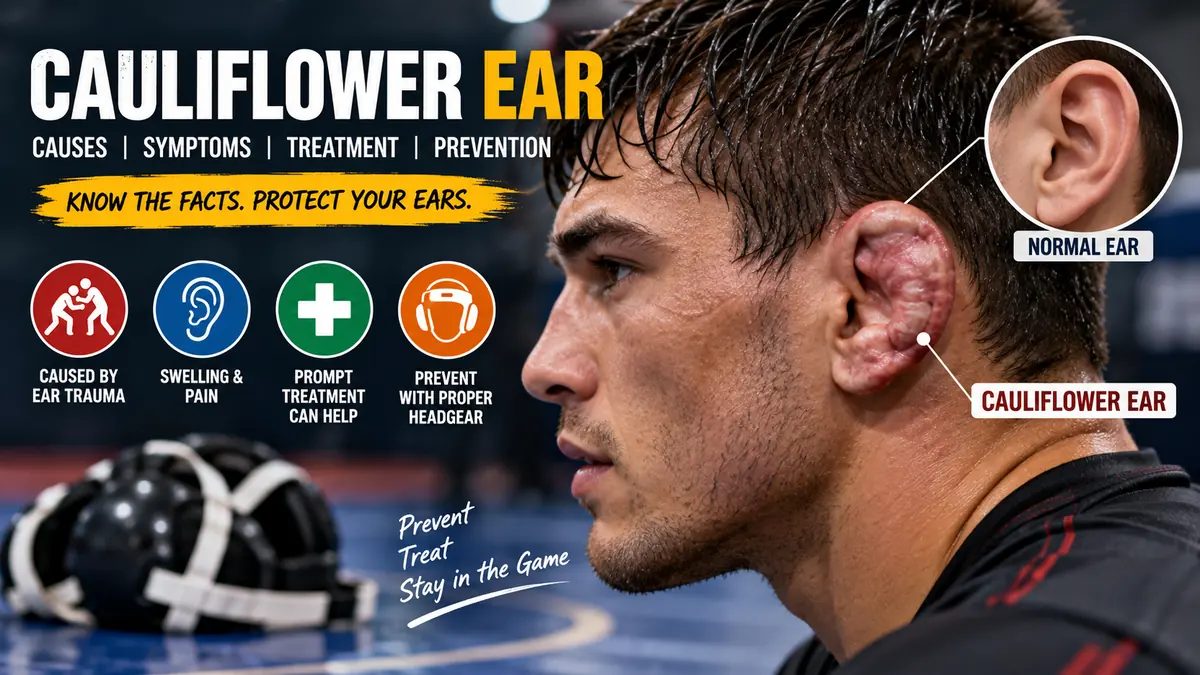
A swollen ear after wrestling, boxing, rugby, or martial arts can look like a minor sports injury. But when blood collects between the skin and cartilage of the outer ear, the damage can become permanent surprisingly quickly.
cauliflower ear is a permanent or potentially permanent deformity of the outer ear caused by trauma that produces an auricular hematoma. The trapped blood disrupts nourishment to the cartilage, triggering inflammation, cartilage damage, scar tissue, and abnormal fibrocartilage growth. Prompt medical drainage and compression can often prevent the characteristic lumpy appearance.
The condition is strongly associated with wrestlers and combat-sport athletes, which explains the alternative name wrestler’s ear. However, anyone who experiences sufficient blunt force, friction, or shearing trauma to the pinna can develop it.
Understanding the difference between a fresh auricular hematoma and established cauliflower ear is particularly important. The first may still be treatable before permanent deformation occurs; the second can require reconstructive surgery.
What Is cauliflower ear?
Cauliflower ear is an acquired deformity of the auricle, also called the pinna—the visible external portion of your ear.
Your outer ear contains elastic cartilage covered by a layer of connective tissue called the perichondrium. Unlike many tissues, cartilage has limited direct blood supply and depends heavily on surrounding tissue for nourishment.
A strong blow, repeated rubbing, crushing pressure, or shearing force can separate these layers and damage small blood vessels. Blood then accumulates within or around the cartilage, forming an auricular hematoma.
If that blood collection isn’t treated appropriately, circulation to the affected cartilage can be disrupted. The resulting sequence may include:
- Bleeding and hematoma formation.
- Separation of tissue from the cartilage.
- Reduced nutrient and oxygen supply.
- Inflammation and cartilage injury or necrosis.
- Formation of scar tissue and new fibrocartilage.
- Thickening and permanent distortion of the ear.
The irregular folds and nodules produced by this healing process resemble the surface of a cauliflower, giving the condition its familiar name.
Auricular hematoma vs. cauliflower ear
These terms are sometimes used interchangeably, but they’re not exactly the same.
| Feature | Auricular Hematoma | Established Cauliflower Ear |
|---|---|---|
| What it is | Collection of blood after ear trauma | Deformity resulting from abnormal healing |
| Typical feel | Soft, fluctuant or swollen | Firm, thickened and irregular |
| Timing | Develops shortly after injury | Develops as the injury organizes and heals |
| Main concern | Cartilage damage and recurrence | Permanent structural deformity |
| Treatment goal | Remove blood and prevent reaccumulation | Improve established deformity |
| Common treatment | Professional drainage plus compression | Reconstructive surgery when desired |
An auricular hematoma is therefore the warning stage at which permanent cauliflower ear may still be preventable.
What Causes cauliflower ear?
The primary cause is trauma to the external ear.
A direct blow can cause it, but repeated friction and shearing forces are especially relevant because the skin can move against the underlying cartilage.
That explains why the condition is strongly associated with sports involving close physical contact.
Wrestling and grappling
Wrestlers frequently experience their ears rubbing against an opponent, the mat, shoulders, arms, and head. Repeated compression and shearing can damage blood vessels even when there isn’t one memorable major impact.
For the same reason, Brazilian jiu-jitsu and other grappling disciplines can expose athletes to auricular hematomas.
Boxing and martial arts
Punches and other direct impacts can injure the pinna. Combat athletes may also experience repeated minor trauma over months or years.
The cumulative damage can be as significant as a single powerful injury.
Other contact sports
Rugby, American football and similar activities can expose the ear to accidental blows, crushing forces and friction.
Cauliflower ear isn’t exclusively an athlete’s condition, however. Any sufficiently significant injury to the outer ear can potentially produce an auricular hematoma.
Less common risk factors
Not every hematoma follows an obvious sporting injury. Clinical evaluation may consider other contributing factors, including bleeding disorders, anticoagulant medication, inflammatory conditions or infection when the circumstances warrant it.
A published clinical review also notes that spontaneous auricular hematomas occur, so absence of a remembered injury doesn’t automatically exclude the diagnosis.
cauliflower ear Symptoms and Early Warning Signs
Fresh injuries often look quite different from the hard, irregular ears associated with longtime wrestlers.
Early recognition matters because this is when treatment has the greatest opportunity to preserve the normal shape of the ear.
Common signs of an acute auricular hematoma include:
- Rapid swelling after trauma
- Outer-ear pain
- Tenderness
- Redness
- Bruising or discoloration
- A soft or fluctuant lump
- Pressure or fullness in the ear
- Visible distortion of normal ear contours
Some people can also experience tinnitus, bleeding, headache or changes in hearing, particularly when the trauma is more substantial.
What does cauliflower ear feel like?
Initially, the affected area may feel swollen, tender and somewhat soft because blood or fluid is collecting beneath the tissue.
As healing progresses, the ear can become increasingly firm and irregular. Mature scar tissue and fibrocartilage don’t feel like a fresh fluid-filled hematoma.
That distinction matters because a firm, established deformity can’t simply be treated like a new pocket of blood.
Does cauliflower ear hurt?
The original injury can be painful, and an acute hematoma is often tender.
Pain may decrease as the injury heals even though the deformity continues developing. Persistent or increasing pain—especially with warmth, worsening redness, fever or pus—can indicate infection and deserves prompt medical evaluation.
Why Does the Ear Become Permanently Deformed?
The mechanism behind cauliflower ear is more than ordinary bruising.
The pinna consists largely of cartilage. The surrounding perichondrium helps support its blood and nutrient supply.
Trauma can create a pocket between these structures or within damaged cartilage. Once blood occupies this space, normal tissue contact and circulation are disturbed.
If the hematoma remains untreated, inflammation and tissue damage follow.
During healing, chondroblasts and other reparative processes can produce abnormal fibrocartilage. Instead of restoring the ear’s thin, defined curves, healing creates thickened, irregular tissue.
Clinical literature indicates that pathologic new-cartilage formation may begin around seven to 10 days after injury, underscoring why early assessment matters.
Quick Takeaway: The lump isn’t simply trapped blood forever. The initial hematoma triggers structural changes in cartilage and scar tissue. Once those changes mature, draining the ear won’t restore its original anatomy.
How Is cauliflower ear Diagnosed?
Diagnosis is usually clinical.
A healthcare professional examines the external ear and asks about recent injuries, contact sports, previous hematomas and the timing of the swelling.
Imaging isn’t routinely required for an uncomplicated auricular hematoma or established cauliflower ear.
However, testing may be appropriate when symptoms suggest another injury or condition.
For example, CT imaging may be considered when significant head or bony trauma is suspected. Neurological symptoms following a major impact may require assessment for traumatic brain injury. Hearing problems can justify further ear examination or audiometry.
A clinician also needs to distinguish auricular hematoma from conditions capable of producing similar swelling or distortion, such as:
- Perichondritis
- Abscess
- Cellulitis
- Seroma
- Auricular pseudocyst
- Keloid
- Hemangioma
- Chondritis
- Otitis externa
- Skin lesions or malignancy
The correct diagnosis matters because these conditions aren’t treated in the same way.
cauliflower ear Treatment: What Happens After an Injury?
Treatment depends heavily on how recently the injury occurred.
A fresh auricular hematoma and an old, hardened cauliflower ear require fundamentally different approaches.
Treating a fresh auricular hematoma
The immediate objective is to evacuate the accumulated blood and eliminate the empty space where fluid could collect again.
Healthcare professionals may use needle aspiration or incision and drainage, depending on the hematoma’s age, size, consistency, location and other clinical factors.
One clinical review describes needle aspiration as an option for some hematomas presenting within approximately six hours and measuring less than 2 centimeters, while larger or older collections may require incision and drainage. Treatment decisions should be individualized rather than based solely on those thresholds.
Removing the blood isn’t the end of treatment.
Why compression is so important
After drainage, the tissue must remain closely opposed to the underlying cartilage. Otherwise, the newly created space can simply refill.
Clinicians may use compression techniques such as:
- Bolster dressings
- Dental rolls
- Splints
- Mattress or quilting sutures
- Other pressure dressings
Clinical guidance commonly recommends maintaining appropriate pressure for roughly five to seven days, depending on the technique and treating clinician’s instructions. Follow-up is important because recurrence can occur even after successful initial drainage.
Can you drain cauliflower ear yourself?
Trying to drain an auricular hematoma yourself isn’t recommended.
A needle may remove some blood, but that doesn’t solve the underlying potential space between the tissues. Without adequate sterile technique, complete evacuation, compression and follow-up, the hematoma can refill.
Home drainage also introduces infection risk.
Cleveland Clinic specifically advises against self-drainage for these reasons and recommends prompt professional care after an ear injury.
What can you do immediately after an ear injury?
A cold compress can temporarily help with swelling and discomfort while you’re arranging medical evaluation.
Avoid repeatedly pressing, squeezing, puncturing or attempting to reshape the injured area yourself.
More importantly, don’t assume that reduced pain means the problem has resolved. The structural changes leading to deformity can continue while discomfort is subsiding.
How Quickly Does cauliflower ear Become Permanent?
There isn’t a precise countdown that applies to every injury.
The important point is that cartilage changes can begin within days rather than weeks or months.
Cleveland Clinic notes that untreated deformity typically becomes permanent within approximately seven to 10 days, while clinical literature describes neocartilage formation beginning within a similar period.
Treatment is therefore time-sensitive.
Waiting to see whether a substantial ear hematoma disappears by itself can sacrifice the period during which relatively straightforward treatment may prevent permanent distortion.
If you notice significant swelling after an ear injury, seeking assessment promptly is safer than relying on appearance alone.
Can cauliflower ear Go Away on Its Own?
An established cauliflower ear generally does not return to its original shape on its own.
Swelling and bruising from the original injury may resolve, which can make the ear seem better temporarily. But mature scar tissue and abnormal cartilage remain.
That creates an important distinction:
Acute swelling may improve; established structural deformity usually doesn’t.
Once the ear has become hard and chronically misshapen, treatment shifts from draining a hematoma to reconstructing abnormal tissue.
Treating Old or Permanent cauliflower ear
Longstanding deformity may be treated surgically when appearance, comfort, hearing-related issues or equipment fit becomes problematic.
One option is otoplasty, broadly referring to surgery used to reshape the external ear.
Cauliflower-ear reconstruction can be more complicated than standard cosmetic ear surgery because normal tissue planes may have been replaced by fibrosis and abnormal cartilage.
Depending on the deformity, a surgeon may need to remove or reshape scar tissue and cartilage while rebuilding normal contours.
Specialists involved can include:
- Otolaryngologists (ENT physicians)
- Facial plastic surgeons
- Plastic surgeons
- Other surgeons experienced in auricular reconstruction
StatPearls notes that established cauliflower-ear deformities can be challenging to correct and may require techniques related to those used in otoplasty and microtia reconstruction.
Surgery also doesn’t make the reconstructed ear immune to future trauma. Continued wrestling, grappling or other high-risk activity can damage it again.
Can cauliflower ear Affect Hearing?
Most of the damage occurs in the external ear rather than directly inside the hearing apparatus.
Still, severe deformity can create functional problems.
If abnormal tissue significantly changes the conchal bowl or narrows the external auditory meatus, it may interfere with the ear canal. Clinical literature identifies potential consequences including conductive hearing loss and increased cerumen impaction.
The altered anatomy may also make it difficult or uncomfortable to use:
- Earbuds
- Earplugs
- Headphones
- Hearing protection
Hearing loss immediately after a substantial ear or head injury shouldn’t automatically be blamed on cauliflower ear. It can indicate additional damage requiring medical evaluation.
Infection and Other Complications
Cosmetic deformity is the most recognizable complication, but it isn’t the only concern.
An injured ear can develop infection, particularly when the skin is damaged or the hematoma is improperly punctured.
Warning signs include worsening:
- Pain
- Redness
- Warmth
- Swelling
- Drainage or pus
Fever is another reason to seek prompt care.
Infection involving the cartilage or surrounding tissue can make treatment more difficult and potentially worsen deformity.
Repeated hematoma formation is another major problem. Even after drainage, fluid can accumulate again if the tissue isn’t adequately compressed or monitored.
That’s why follow-up isn’t an optional extra—it is part of effective treatment.
How to Prevent cauliflower ear
Prevention focuses on stopping ear trauma and treating hematomas before abnormal healing begins.
1. Wear properly fitted protective headgear
This is particularly important for wrestling, Brazilian jiu-jitsu, grappling and other activities involving frequent ear friction.
Protective equipment reduces direct impact and shearing between the skin and cartilage.
Research summarized in clinical reviews indicates that protective headgear can substantially reduce auricular hematomas among wrestlers.
Headgear only helps consistently when it fits correctly and is actually worn during high-risk activity.
2. Don’t ignore a newly swollen ear
Athletes sometimes become accustomed to sore ears and continue training.
That can be a costly mistake.
A new soft swelling after trauma should be treated as a potential hematoma rather than ordinary bruising.
3. Stop repeated trauma while the ear heals
Returning immediately to grappling or contact training exposes healing tissue to the same forces that caused the problem.
Clinical guidance commonly recommends avoiding strenuous activity and contact sports for roughly 10 to 14 days after auricular hematoma treatment, although the treating clinician should determine the appropriate return-to-sport timeline.
4. Watch for recurrence
Check the ear after treatment.
Renewed swelling, increasing tenderness or fluid accumulation warrants reassessment because recurrence increases the chance of permanent deformity.
Quick Takeaway: Protective headgear helps prevent the initial injury, but rapid treatment of any hematoma is equally important. Prevention continues after the first impact.
Why Is cauliflower ear So Common in Wrestling and MMA?
Wrestling and grappling create an almost ideal environment for this injury.
An athlete’s ear can repeatedly rub against mats, heads, shoulders and limbs while being compressed during clinches, takedowns and ground exchanges.
These movements create the shearing forces associated with auricular hematoma formation.
Boxing produces a somewhat different mechanism because direct blows may play a larger role, although athletes can experience both impact and friction.
Repeated injuries compound the problem. An ear that has already been damaged may develop progressively thicker and more distorted tissue after subsequent trauma.
Historically, this appearance became strongly associated with wrestling and combat sports. Some athletes even view it as evidence of experience.
From a medical standpoint, however, deliberately allowing an auricular hematoma to progress carries avoidable risks, including infection, permanent deformation and possible functional problems.
When Should You See a Doctor?
Seek prompt medical evaluation when significant swelling develops after trauma to the outer ear—particularly when the swollen area feels soft, fluid-filled or tender.
Early assessment provides the best opportunity to prevent permanent cauliflower ear.
Urgent evaluation is particularly appropriate if an ear injury is accompanied by:
- Significant hearing loss
- Severe or worsening headache
- Dizziness or neurological symptoms
- Loss of consciousness
- Heavy bleeding
- Fluid draining from the ear canal
- Rapidly increasing swelling
- Fever
- Pus
- Severe redness or worsening pain
These findings can indicate infection or an associated head, ear or neurological injury rather than an isolated uncomplicated hematoma.
Recovery After Treatment
Recovery varies according to the severity and age of the injury and the treatment performed.
After hematoma drainage, the most important period is the first several days because the collection can return.
A pressure dressing or bolster is often maintained for about five to seven days, and follow-up allows a healthcare professional to check for reaccumulation, infection and appropriate healing.
Contact activity generally needs to be temporarily restricted.
An athlete may feel physically ready before the tissue has healed enough to tolerate another impact, so symptom improvement alone isn’t a reliable signal for returning to sport.
Recovery from reconstructive surgery is different and depends on the extent of the operation.
The Most Important Thing to Know About cauliflower ear
The easiest cauliflower ear to treat is the one that hasn’t fully formed.
A fresh auricular hematoma represents the crucial opportunity. Blood has accumulated around injured cartilage, but prompt professional drainage followed by effective compression can allow the tissues to reconnect and significantly reduce the chance of permanent deformity.
Once scar tissue and abnormal fibrocartilage have remodeled the ear, waiting longer won’t restore its normal contours. Established deformity may require otoplasty or another form of reconstructive surgery.
For wrestlers, boxers, MMA fighters, Brazilian jiu-jitsu practitioners, rugby players and anyone else exposed to repeated ear trauma, prevention comes down to two habits: protect the ears during high-risk activities and take new swelling seriously.
If cauliflower ear appears to be starting after an injury, prompt medical assessment—not home drainage or waiting for it to harden—is the safest next step.
