

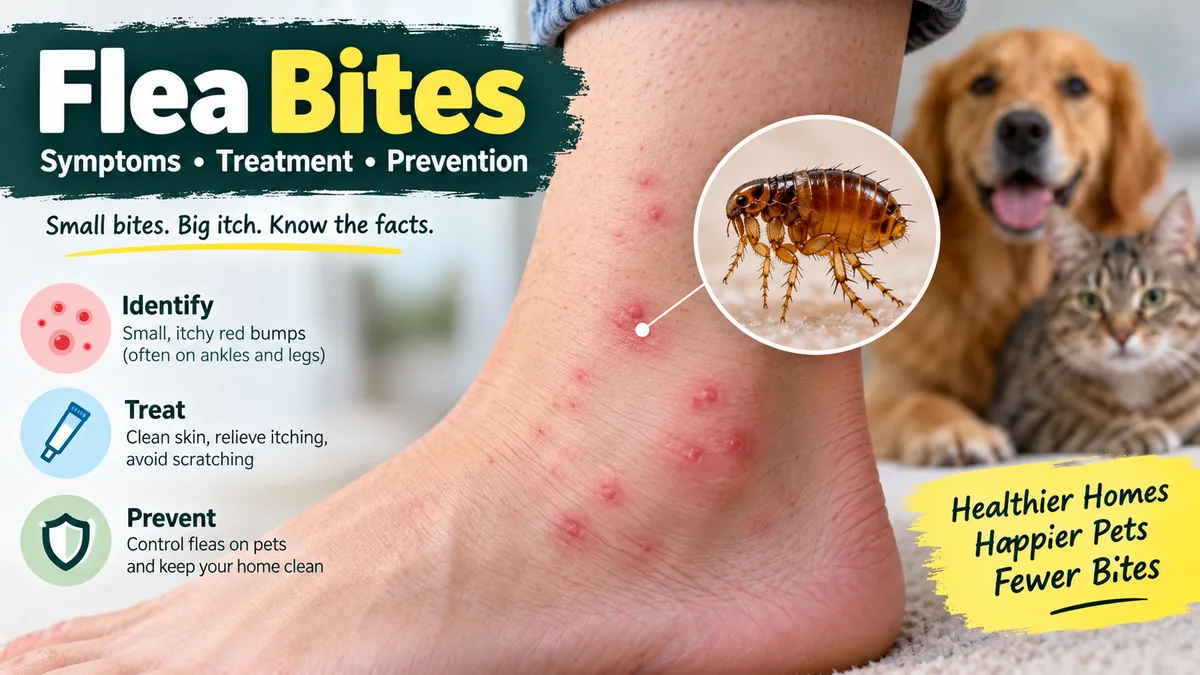
A few intensely itchy red bumps around your ankles can appear seemingly overnight. If you have pets—or recently spent time somewhere animals live—flea bites are one possible explanation.
Flea bites are small skin reactions caused when blood-feeding fleas pierce the skin and inject saliva while feeding. They commonly produce clusters of itchy red bumps, especially around the feet, ankles, and lower legs. Most are minor and improve with simple home care, but scratching can cause secondary infection, and fleas can occasionally transmit disease.
This guide explains how flea bites look and feel, how they differ from other bug bites, what actually helps the itching, when medical attention is appropriate, and how to stop new bites by addressing the underlying infestation.
What Are Flea Bites?
Fleas are tiny, wingless insects belonging to the order Siphonaptera. They are external parasites that survive by feeding on the blood of warm-blooded hosts.
Several species can interact with humans. Common examples include the cat flea (Ctenocephalides felis), dog flea (Ctenocephalides canis), human flea (Pulex irritans), and rat fleas such as Xenopsylla cheopis. Cats and dogs are particularly important hosts around homes.
A flea uses specialized mouthparts to pierce intact skin and take a blood meal. During feeding, flea saliva enters the skin. Proteins and other substances in that saliva can trigger an immune response, producing the familiar itching, redness, and swelling.
That means the bump you see is primarily your body’s reaction to the bite rather than physical damage from a large wound.
Why do flea bites itch so much?
Flea saliva can be highly antigenic, meaning the immune system may recognize components of it as foreign and mount an inflammatory response.
For many people, this produces pruritus, the medical term for itching.
Some people are much more sensitive than others. A person with a stronger hypersensitivity reaction may develop larger, longer-lasting bumps or papular urticaria, while someone else exposed to the same fleas may show relatively subtle marks.
Quick Takeaway: The intensity of itching doesn’t necessarily tell you how many fleas are present. Skin sensitivity varies considerably between people.
What Do Flea Bites Look Like?
Typical flea bites appear as small, red, intensely itchy bumps or papules.
They may have a darker or more obvious center corresponding to the bite site. Some people develop swelling around the bump, and particularly sensitive individuals can develop small blisters.
A common pattern is several bites located close together. MedlinePlus notes that small red bumps may occur in groups of three, although that pattern alone cannot prove fleas caused them.
Common characteristics include:
- Small red or pink bumps
- Significant itching
- Multiple nearby lesions
- A central bite point in some cases
- Mild surrounding swelling
- Occasional blisters in sensitive people
- Crusting or irritation after scratching
Skin reactions vary with skin tone and individual sensitivity, so redness may be less obvious on darker skin.
Where do flea bites usually appear?
Location provides an important clue.
Flea bites frequently occur on the feet, ankles, and lower legs because fleas living in carpets, flooring, pet bedding, or similar environments can jump onto exposed skin.
DermNet also notes bites around the waistband, while MedlinePlus lists the waist, buttocks, thighs, and lower abdomen among possible locations where clothing sits close to the body.
They aren’t restricted to the legs, however. Fleas can bite other exposed areas when circumstances allow.
What does an allergic reaction to flea bites look like?
People who are especially sensitive to flea saliva can develop a more pronounced reaction.
This may include larger areas of redness and swelling, persistent itchy papules, or blisters. DermNet describes papular urticaria as an excessive immune response that can cause more persistent reactions. Old bite sites may sometimes become inflamed again.
Flea Bites vs. Bed Bug, Mosquito, and Other Bites
Identifying an insect from the skin reaction alone can be difficult. Many arthropod bites produce a similar itchy red bump.
Location, timing, environmental evidence, and exposure history are therefore more useful than relying on appearance alone.
| Feature | Flea Bites | Bed Bug Bites | Mosquito Bites |
|---|---|---|---|
| Common location | Feet, ankles, lower legs | Exposed skin; often torso or limbs | Any exposed skin |
| Typical appearance | Small itchy papules | Itchy red bumps or welts | Raised itchy bump |
| Pattern | Clusters or several nearby bites | May appear in lines or groups | Often scattered |
| Common exposure | Pets, carpets, animal bedding | Infested sleeping areas/furniture | Outdoor or indoor mosquitoes |
| Main symptom | Intense itching | Itching | Itching and swelling |
Merck notes that flea bites may be numerous and concentrated on the feet and legs, while bedbug bites often occur in linear patterns and commonly involve the torso. These patterns can help, but none is completely diagnostic.
Flea bites vs. bed bug bites
People commonly confuse these two.
Bed bugs generally hide near areas where people sleep and feed primarily at night. Fleas are strongly associated with animals and environments frequented by animals.
Finding fleas or flea dirt on a pet makes fleas much more likely. Flea dirt resembles tiny dark grains and consists largely of flea fecal material containing digested blood. DermNet notes that it can appear reddish when placed on a damp surface because of the blood content.
Flea bites vs. mosquito bites
Mosquito bites are frequently larger, more isolated, raised welts on exposed skin. Flea bites tend to be smaller and may occur in concentrated groups, particularly around the ankles.
Still, skin appearance alone is not a reliable identification test.
If the source isn’t obvious, inspect the environment rather than repeatedly guessing from the bumps.
How Long Do Flea Bites Last?
A mild reaction generally improves as the body’s inflammatory response settles, although the exact duration varies.
Persistent scratching can make the bites appear to last much longer because it repeatedly damages the skin. People with hypersensitivity reactions may also have more prolonged symptoms.
The key sign of an ongoing problem is new bites continuing to appear.
If new lesions keep developing after older ones begin healing, consider whether fleas remain in the home, pet bedding, furniture, carpets, or on an animal.
The flea’s life cycle helps explain why infestations can persist.
The flea life cycle
Fleas develop through four stages:
- Egg
- Larva
- Pupa
- Adult
Adult fleas feed on blood, while eggs can fall from an animal into bedding, carpets, floors, and other areas.
Larvae subsequently develop in the environment before forming cocoons and becoming pupae. Under suitable conditions, adults emerge and begin searching for a host.
DermNet reports that environmental factors such as warmth, humidity, and vibrations can influence emergence from the pupal stage.
This is why treating visible adult fleas alone may not end an infestation.
Quick Takeaway: If bites disappear and then return, the problem may be newly emerged fleas rather than the original bites somehow “coming back.”
How to Treat Flea Bites
Most uncomplicated flea bites can be managed at home.
Treatment has two separate goals: calm the skin reaction and prevent additional bites.
Ignoring the infestation while treating only the skin often leads to an endless cycle of new lesions.
1. Clean the affected skin
Gently wash the area with soap and water.
Keeping bites clean becomes especially important if you’ve been scratching because broken skin creates an entry point for bacteria.
Avoid aggressive scrubbing, which can further irritate already inflamed skin.
2. Use a cool compress
A cool, damp cloth or wrapped cold pack can temporarily reduce itching and swelling.
Apply it for short periods rather than placing ice directly against the skin.
3. Control the itching
MedlinePlus states that over-the-counter 1% hydrocortisone cream may help relieve itching from flea bites. Oral antihistamines may also reduce itching in appropriate patients.
DermNet similarly describes oral antihistamines, antipruritic preparations, and topical corticosteroids as possible treatments for the inflammatory reaction.
Follow the product label and check with a pharmacist or healthcare professional when treating young children, during pregnancy, if you take other medications, or if you are uncertain whether a product is appropriate.
4. Avoid scratching
This sounds simple but matters considerably.
Repeated scratching damages the skin barrier and increases the chance of a secondary bacterial infection.
Try keeping fingernails short and covering especially tempting lesions with clean clothing when practical.
5. Don’t deliberately break blisters
If a blister develops, avoid intentionally popping it.
An intact blister provides a natural barrier against bacteria. If one breaks accidentally, gently clean and protect the area.
When Should You See a Doctor for Flea Bites?
Most flea bites do not require medical treatment.
Medical assessment becomes more appropriate when symptoms are unusually severe, don’t behave like ordinary bites, or suggest infection or a significant allergic reaction.
Seek medical advice if you develop:
- Increasing pain
- Expanding redness or warmth
- Significant swelling
- Pus or pustules
- Oozing or persistent crusting
- Fever or systemic illness
- Bites that aren’t improving
- A severe or widespread skin reaction
DermNet notes that pain, redness, oozing, crusting, and pustules can indicate secondary bacterial infection, which may require antibiotic treatment.
Symptoms such as difficulty breathing, facial or throat swelling, faintness, or other signs of a severe allergic reaction require urgent emergency medical care. Merck advises immediate medical attention for serious hypersensitivity reactions.
Can Flea Bites Spread Disease?
Most flea bites cause nothing more serious than temporary itching and inflammation.
However, fleas are medically significant because some species can act as vectors, carrying infectious organisms between animals and humans.
Historically and currently, important flea-associated diseases include plague and flea-borne (murine) typhus.
The bacterium Yersinia pestis causes plague, while Rickettsia typhi causes murine typhus. Rat fleas, including Xenopsylla cheopis, have played an important role in plague transmission.
This does not mean an ordinary flea bite is likely to give someone plague. Disease risk varies dramatically by geography, flea species, animal reservoirs, and local epidemiology.
Some flea species are also associated with other pathogens. Merck notes associations involving Bartonella henselae, Rickettsia typhi, and Yersinia pestis.
If someone develops fever or significant systemic symptoms following suspected flea exposure—particularly after contact with sick or dead wildlife or in an area where flea-borne disease occurs—medical evaluation is appropriate.
Why Am I Getting Flea Bites?
Seeing flea bites doesn’t necessarily mean fleas live permanently on your body.
The more useful question is where the fleas are coming from.
Common sources include:
- Cats
- Dogs
- Pet bedding
- Carpets and rugs
- Upholstered furniture
- Floor cracks
- Wildlife
- Stray animals
- Previously occupied homes with an infestation
People sometimes notice bites after a pet has temporarily or permanently left the house. Without its usual animal host available, adult fleas may seek another blood source.
MedlinePlus specifically notes that fleas can begin biting humans when their usual pet host is absent.
Can you get flea bites without having pets?
Yes.
Previous occupants may have had animals, fleas may be associated with rodents or wildlife, or you may encounter an infested environment outside your own home.
DermNet notes that entering an unoccupied building previously inhabited by infested pets can expose someone to fleas living in carpets or floorboards.
So “I don’t own a pet” doesn’t automatically rule fleas out.
How to Check for Fleas at Home
The skin tells only part of the story. Look for evidence in the environment.
If you have a dog or cat, inspect areas where fleas commonly hide, particularly around the neck, tail base, groin, back, and hindquarters.
Watch for:
- Tiny dark insects moving through fur
- Frequent pet scratching or grooming
- Small black specks resembling pepper
- Fleas jumping around carpets or bedding
- Repeated human bites around the ankles
A flea comb can help identify adult fleas and flea dirt.
Because fleas are small, dark, and fast-moving, finding environmental evidence can take patience.
How to Get Rid of Fleas and Stop New Bites
Treating your skin without controlling the infestation is unlikely to solve the problem.
Effective control generally requires addressing pets and the environment together.
Treat every pet appropriately
CDC recommends checking pets regularly, bathing and brushing them, limiting contact with wild or stray animals, and discussing appropriate year-round flea-control products with a veterinarian.
Don’t assume a product suitable for one species is automatically safe for another.
Veterinary flea treatments vary by animal, age, weight, health status, and active ingredient. Follow the label and your veterinarian’s advice rather than improvising with pesticides.
Vacuum thoroughly and repeatedly
Focus on places pets spend time:
- Carpets
- Rugs
- Upholstered furniture
- Floor edges
- Under furniture
- Pet sleeping areas
- Cracks and crevices
CDC recommends frequent sweeping or vacuuming of carpets, rugs, and furniture cushions and emptying the vacuum outside afterward.
Vacuuming matters because much of an infestation develops away from the animal.
Wash bedding
Wash pet bedding regularly and clean human bedding when fleas may have entered sleeping areas.
DermNet recommends washing pet bedding weekly during control efforts.
Continue treatment long enough
One of the most common mistakes is stopping once adult fleas seem to disappear.
Eggs, larvae, and pupae can remain in the environment. Newly emerged adults may therefore appear after the first cleaning or treatment.
Breaking the flea life cycle requires persistence.
Quick Takeaway: Treating the dog or cat once isn’t the same as eliminating a household flea infestation. Control the animal and its environment simultaneously.
How to Prevent Flea Bites
Prevention begins with keeping fleas away from the animals and environments closest to you.
The CDC states that the best way to prevent fleas on people is to keep pets free of fleas. Fleas can survive year-round when suitable animal hosts are available, even though warmer, humid conditions often favor them.
Practical prevention includes regular veterinary flea prevention, frequent pet checks, vacuuming, washing pet bedding, limiting pets’ contact with stray or wild animals, and responding quickly when a flea is discovered.
When exposure is likely, covering the lower legs with pants and long socks can reduce accessible skin.
CDC also recommends EPA-registered insect repellents containing active ingredients such as DEET, picaridin, IR3535, oil of lemon eucalyptus (OLE), para-menthane-diol (PMD), or 2-undecanone when appropriate and used according to label directions. OLE and PMD should not be used on children younger than three years.
Flea Bites in Children
Children can develop the same basic reaction as adults: itchy papules, redness, swelling, and occasionally blisters.
The challenge is often scratching.
Young children may scratch unconsciously, particularly at night, increasing irritation and the possibility of bacterial infection.
Keep nails trimmed, clean irritated skin gently, and discourage scratching where possible.
Before using hydrocortisone, oral antihistamines, insect repellents, or other medicines on babies and young children, follow age restrictions on the label and seek advice from a pediatrician or pharmacist when uncertain.
What About Sand Fleas?
The phrase “sand flea” can create confusion because it is used for different organisms in different places.
Of particular medical importance is the chigoe flea, Tunga penetrans. Unlike an ordinary cat or dog flea that bites and moves away, the female chigoe flea can embed in human skin, causing a condition called tungiasis.
Tungiasis commonly affects the feet, including areas around or between the toes, and can cause inflammation, itching, pain, and secondary infection.
This is different from the ordinary flea bites most people experience around homes with cats or dogs.
If you have recently traveled to a region where tungiasis occurs and notice a persistent embedded lesion on the foot, don’t attempt to dig it out yourself with a needle or other sharp object. Seek appropriate medical evaluation.
Common Mistakes That Make Flea Problems Worse
The first is assuming every itchy cluster is definitely fleas. Bed bugs, mosquitoes, mites, dermatitis, and other skin conditions can sometimes look similar.
The second is treating the bites but ignoring the source. Hydrocortisone may calm itching, but it won’t remove fleas from a carpet.
Another common mistake is treating only one pet. If multiple susceptible animals share the home, untreated animals may allow the infestation to continue.
People also tend to stop environmental cleaning too early. The egg, larval, and pupal stages explain why fleas may continue emerging even after visible adults disappear.
Finally, avoid indiscriminate pesticide use. Products designed for environments, clothing, dogs, cats, or human skin are not automatically interchangeable. Follow label directions and professional veterinary or pest-control guidance.
Flea Bites: The Bottom Line
Flea bites usually appear as small, intensely itchy bumps, often clustered around the feet, ankles, or lower legs. The reaction occurs largely because the immune system responds to substances in flea saliva.
For uncomplicated bites, gentle cleansing, avoiding scratching, cool compresses, and appropriate anti-itch treatments are usually enough. Watch for increasing redness, pain, pus, fever, or severe allergic symptoms that warrant medical attention.
Most importantly, don’t treat the skin problem in isolation. Check pets, wash bedding, vacuum areas where animals rest, use appropriate veterinary flea control, and continue environmental management long enough to interrupt the flea life cycle. That is what stops today’s itchy bumps from becoming tomorrow’s new flea bites.
