

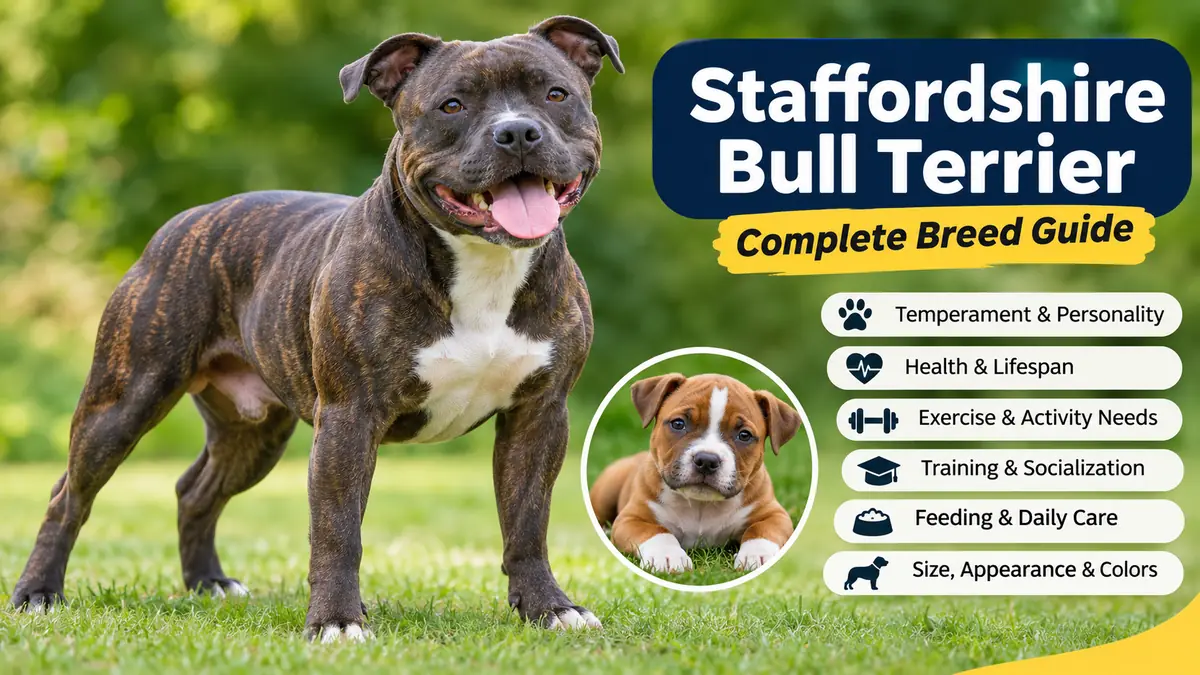
The Staffordshire Bull Terrier is a muscular, affectionate, and energetic dog with a personality that often surprises people unfamiliar with the breed. Behind its powerful build is a people-oriented companion that thrives on attention, activity, and close family relationships.
The staffordshire bull terrier, commonly called the Staffy or Staffie, is a small-to-medium British terrier breed known for its strength, courage, intelligence, and affectionate nature. Adults typically weigh 24–38 pounds (11–17 kg), stand 14–16 inches tall, and live approximately 12–14 years. These dogs need consistent training, daily exercise, and regular human companionship.
Understanding the breed’s temperament, health risks, exercise requirements, and behavior around other animals is essential before deciding whether it fits your household.
Staffordshire Bull Terrier Breed Overview
Dazmarnic Know Wot I Mean | Staffordshire Bull Terrier | Bred by Dazmarnic – SBT Pedigree
12
The Staffordshire Bull Terrier originated in England and belongs to the terrier group. Although compact, it has substantial muscle, a broad skull, strong jaws, and an athletic body.
| Characteristic | Breed information |
|---|---|
| Origin | Staffordshire, England |
| Breed group | Terrier |
| Height | 14–16 inches (36–41 cm) |
| Male weight | 25–38 lb (11–17 kg) |
| Female weight | 24–34 lb (11–15 kg) |
| Life expectancy | Approximately 12–14 years |
| Coat | Short, smooth, close-fitting |
| Common colors | Red, fawn, white, black, blue, brindle, and combinations with white |
| Temperament | Affectionate, courageous, playful, energetic |
| Exercise needs | Moderate to high |
| Grooming | Low maintenance |
| Trainability | Good with patient, reward-based methods |
The breed is recognized by organizations including The Kennel Club in the United Kingdom, the American Kennel Club (AKC), and the Fédération Cynologique Internationale (FCI).
Its distinctive combination of strength and sociability makes it different from many other terrier breeds.
Where did the breed originate?
The Staffordshire Bull Terrier developed in nineteenth-century Britain from crosses involving bulldog-type dogs and terriers.
These early dogs were associated with blood sports, including dog fighting, which shaped their physical strength and determination. Following the prohibition of animal fighting, breeders increasingly selected dogs for companionship, stability, and conformation.
The Kennel Club formally recognized the breed in 1935, while the American Kennel Club recognized it in 1974.
Modern Staffordshire Bull Terriers are primarily companion dogs, although responsible ownership must still account for their strength, energy, and individual behavioral tendencies.
Staffordshire Bull Terrier Temperament and Personality
The Staffordshire Bull Terrier is widely appreciated for its affectionate, enthusiastic, and people-focused personality.
Many Staffies enjoy being physically close to their owners, following family members around the house, and participating in everyday activities.
Are Staffordshire Bull Terriers good family dogs?
A well-socialized Staffordshire Bull Terrier can be an excellent family companion.
Common characteristics include:
- Affectionate behavior: Many seek frequent attention and physical closeness.
- Playfulness: They often enjoy games, toys, and interactive exercise.
- Confidence: The breed is generally bold and curious.
- Loyalty: Strong attachments to familiar people are common.
- Intelligence: They can learn household routines and obedience skills quickly.
- Determination: Their persistence sometimes requires extra patience during training.
However, breed tendencies do not guarantee an individual dog’s temperament. Genetics, early experiences, training, health, and environment all influence behavior.
Are Staffordshire Bull Terriers good with children?
Staffies have a longstanding reputation for being affectionate toward children. In Britain, the breed has sometimes been associated with the nickname “nanny dog.”
That nickname should not be interpreted as evidence that the breed can safely supervise children or that every Staffy is naturally tolerant.
Children should learn to avoid pulling ears, disturbing sleeping dogs, taking food, or forcing physical contact. Adults should actively supervise interactions, especially with younger children.
A strong, excitable dog can accidentally knock over a small child during play, even without aggressive intentions.
Can Staffordshire Bull Terriers live with other dogs?
Some Staffies live peacefully with other dogs, particularly when carefully introduced and socialized from an early age.
Others may show dog-directed reactivity, selectivity, or aggression as they mature.
Owners should avoid assuming that a dog-friendly puppy will automatically remain comfortable with every unfamiliar dog in adulthood.
Controlled introductions, appropriate distance, reward-based training, and careful observation of body language are more reliable than forcing social encounters.
Dog parks are not essential for socialization, and they may be unsuitable for individuals that become overwhelmed or reactive.
Do Staffies get along with cats and smaller pets?
Compatibility varies considerably.
Some Staffordshire Bull Terriers coexist successfully with cats and smaller animals, especially after careful introductions. Others have a strong chase response or prey drive.
Early exposure can help, but it cannot eliminate predatory behavior.
Use physical separation when necessary, provide escape routes for cats, and never leave animals together unsupervised until their interactions have been thoroughly assessed. Some combinations may require permanent separation.
Staffordshire Bull Terrier Size, Appearance, and Coat Colors
The Staffordshire Bull Terrier has a distinctive athletic appearance.
Its body is compact, well-muscled, and balanced, with a broad chest, strong neck, and relatively short back.
Despite its powerful appearance, the breed should remain agile rather than excessively bulky.
How big does a Staffordshire Bull Terrier get?
According to established breed standards, adults typically stand between 14 and 16 inches at the shoulder.
Male dogs generally weigh 25–38 pounds, while females usually weigh 24–34 pounds.
Individual dogs may fall outside these ranges because of genetics, body condition, and breeding differences.
A healthy Staffy should have visible muscular definition without excessive fat covering the ribs or waist.
Physical features
Characteristic features include a broad skull, pronounced cheek muscles, short muzzle, dark round eyes, and small rose-shaped or half-pricked ears.
The breed’s short, smooth coat lies close to the body and requires relatively little maintenance.
A Staffordshire Bull Terrier should not be confused with a heavily exaggerated, oversized bully-type dog. Extreme muscle mass, restricted breathing, or impaired movement are not desirable breed characteristics.
Staffordshire Bull Terrier colors
Dazmarnic Know Wot I Mean | Staffordshire Bull Terrier | Bred by Dazmarnic – SBT Pedigree
Red
Staffies Get Zoomies While Sharing ‘Branch Manager’ Duties & Chaos Ensues – PetHelpful
Blue
Santé | Staffordshire Bull Terrier : dysplasie du coude, luxation de r – Canithermo
Brindle
White
Recognized colors include red, fawn, white, black, blue, and brindle, including several combinations with white.
Color does not determine temperament, intelligence, or overall quality.
Breeding decisions should prioritize health, structural soundness, and stable behavior rather than unusual coat colors.
Staffordshire Bull Terrier Exercise and Activity Needs
Staffordshire Bull Terriers are energetic dogs that need regular physical exercise and mental stimulation.
Although smaller than some working breeds, they are strong, athletic, and often enthusiastic about movement.
How much exercise does a Staffy need?
Many healthy adult Staffies benefit from approximately 60–90 minutes of daily activity, divided into manageable sessions.
This is a practical guideline rather than a universal requirement. Age, fitness, weather, medical conditions, and individual energy levels should determine the actual amount.
Suitable activities include brisk walks, controlled games of fetch, scent games, obedience exercises, and structured play.
| Life stage | Exercise approach |
|---|---|
| Young puppy | Short, gentle play and exploration |
| Adolescent | Gradually increasing walks and training |
| Healthy adult | Often 60–90 minutes of varied daily activity |
| Senior | Comfortable, lower-impact exercise adapted to health |
Puppies should not be pushed through repetitive long-distance running or strenuous forced exercise while their bones and joints are developing.
Mental stimulation matters
Physical exercise alone does not always satisfy an intelligent, persistent terrier.
Food puzzles, scent searches, reward-based training, and interactive toys can provide useful mental enrichment.
For example, hiding several small food rewards around a safe room encourages the dog to use its nose and problem-solving abilities.
Short training sessions often work better than one long, repetitive lesson.
Can Staffordshire Bull Terriers live in apartments?
Yes. A Staffy can adapt to apartment living when its physical, behavioral, and social needs are met.
Access to a large garden is helpful but does not replace walks, training, or enrichment.
Potential challenges include excitement around visitors, barking, separation-related distress, and difficulty settling when under-stimulated.
Teaching calm indoor behavior is as important as providing exercise.
Are Staffies good running companions?
Healthy, mature Staffies may enjoy short or moderate runs after appropriate conditioning.
However, they are not automatically suited to endurance running.
Their compact build, muscular physique, and individual breathing characteristics can affect heat tolerance and stamina.
Avoid intense exercise in hot or humid weather, and provide regular water and rest breaks.
Staffordshire Bull Terrier Training and Socialization
Training a Staffordshire Bull Terrier requires patience, consistency, and an understanding of how the breed learns.
Staffies are intelligent and often eager to interact with their owners. However, their enthusiasm, physical strength, and persistence can make untrained behavior difficult to manage.
Are Staffordshire Bull Terriers easy to train?
Most Staffies can learn basic obedience commands successfully through positive reinforcement.
Reward-based training uses food, toys, praise, or access to enjoyable activities to encourage desirable behavior.
Useful foundational skills include:
- Sit and stay: Helps develop impulse control.
- Recall: Encourages the dog to return when called.
- Loose-leash walking: Prevents pulling during walks.
- Leave it: Helps manage unwanted interest in objects or animals.
- Settle: Teaches calm behavior at home.
- Drop it: Supports safer handling of toys and other objects.
Training sessions of approximately 5–10 minutes can be particularly effective for puppies and easily distracted dogs.
The American Kennel Club recommends consistent positive training and warns that Staffies may respond poorly to harsh methods. American Kennel Club
How to socialize a Staffordshire Bull Terrier puppy
Socialization involves creating positive, controlled experiences with unfamiliar people, environments, sounds, surfaces, and suitable animals.
The goal is not to make a puppy greet every dog or stranger. Instead, it is to help the puppy remain comfortable and responsive in different situations.
Begin with gentle exposure to everyday household noises, visitors, vehicles, and appropriate handling.
As the puppy gains confidence, introduce new environments while avoiding overwhelming experiences.
Follow veterinary guidance about vaccination-related risks when choosing socialization settings.
Preventing jumping, pulling, and excessive excitement
Staffies can become enthusiastic greeters.
Jumping toward visitors or pulling toward other dogs may initially seem harmless, but these behaviors can become challenging as the dog grows stronger.
Reward four paws on the floor, practice calm greetings, and reinforce walking beside the handler.
Avoid rewarding unwanted behavior with attention, even when that attention involves pushing the dog away or speaking excitedly.
Can Staffordshire Bull Terriers be left alone?
Staffies often form close attachments to their families and may struggle with extended periods of isolation.
Some develop separation-related problems, including destructive chewing, vocalization, pacing, or distress when owners leave.
Gradually teach independence through brief, comfortable absences.
Provide a safe resting space, appropriate enrichment, and a predictable routine. If the dog shows panic or persistent distress, consult a veterinarian or qualified clinical animal behaviorist.
Separation anxiety is not simply disobedience and should not be treated with punishment.
Staffordshire Bull Terrier Health Problems and Lifespan
Staffordshire Bull Terriers are generally robust dogs, but the breed has several recognized inherited and acquired health concerns.
Responsible health screening, appropriate weight management, and regular veterinary care can reduce preventable risks.
How long do Staffordshire Bull Terriers live?
The breed commonly lives around 12–14 years, although some individuals live longer.
The AKC lists an approximate life expectancy of 12–15 years. American Kennel Club
Longevity depends on genetics, preventive healthcare, nutrition, body condition, environment, and the management of chronic illnesses.
Common Staffordshire Bull Terrier health concerns
| Condition | Main concern | Recommended action |
|---|---|---|
| L-2-HGA | Inherited neurological disorder | DNA screening of breeding dogs |
| Hereditary cataracts | Inherited lens clouding and vision loss | Genetic testing and eye examinations |
| Hip dysplasia | Abnormal hip joint development | Veterinary assessment and appropriate screening |
| Elbow dysplasia | Joint development problems and lameness | Screening and orthopedic evaluation |
| Skin allergies | Itching, irritation, recurrent skin problems | Identify triggers with veterinary guidance |
| Patellar luxation | Kneecap displacement | Veterinary orthopedic examination |
| Obesity | Excess stress on joints and overall health | Portion control and regular activity |
Not every Staffordshire Bull Terrier will develop these conditions, and the frequency and severity vary.
L-2-hydroxyglutaric aciduria (L-2-HGA)
L-2-HGA is an inherited metabolic disorder affecting the nervous system.
Affected dogs may develop seizures, muscle stiffness, abnormal movement, behavioral changes, or coordination difficulties.
The disorder is associated with abnormal accumulation of L-2-hydroxyglutaric acid.
DNA testing can identify dogs that are genetically clear, carriers, or affected.
Because the condition follows an autosomal recessive inheritance pattern, appropriate genetic screening is particularly valuable when planning breeding combinations.
Hereditary cataracts and eye conditions
Hereditary cataracts can cause progressive clouding of the eye’s lens, potentially resulting in significant visual impairment.
The breed has a recognized genetic form of hereditary juvenile cataracts associated with the HSF4 gene.
Other eye concerns include persistent hyperplastic primary vitreous (PHPV), a developmental eye abnormality.
Eye examinations and appropriate genetic screening help identify inherited risks.
The Royal Kennel Club identifies DNA testing for hereditary cataracts and L-2-HGA, together with elbow and eye screening, within its breed health recommendations. The Royal Kennel Club+1
Skin allergies and irritation
Some Staffies experience itchy skin, recurrent ear infections, or inflammatory skin conditions.
Potential triggers include environmental allergens, parasites, contact irritants, and certain foods.
Signs worth investigating include persistent scratching, licking paws, redness, hair loss, and repeated ear discomfort.
Owners should avoid assuming that every skin problem is caused by food. A veterinarian can investigate the underlying cause and recommend appropriate treatment.
Maintaining healthy joints
Although Staffies are muscular, they can experience orthopedic conditions such as hip or elbow dysplasia.
Maintaining a lean body condition helps reduce unnecessary joint stress.
Persistent limping, reluctance to jump, stiffness after resting, or reduced activity should prompt veterinary assessment.
Avoid giving human pain medications without veterinary direction because several commonly used products are toxic to dogs.
Staffordshire Bull Terrier Feeding, Grooming, and Daily Care
A healthy Staffy needs balanced nutrition, regular grooming, dental care, and a consistent daily routine.
The breed’s short coat is relatively easy to maintain, but its energetic nature means exercise and enrichment remain significant responsibilities.
What should a Staffordshire Bull Terrier eat?
Choose a complete and balanced diet appropriate for the dog’s life stage, body condition, and health needs.
Puppies require food formulated for growth, while adult dogs need suitable maintenance nutrition.
Senior dogs may benefit from dietary adjustments based on activity levels, weight, and medical conditions.
Daily food requirements vary with the diet’s calorie density and the dog’s metabolism.
Rather than relying on a fixed number of cups, use the food’s calorie information and adjust portions according to weight and body condition.
Treats should form only a small proportion of total daily calories.
Fresh drinking water should always be available.
How often should a Staffy be fed?
| Life stage | Typical feeding frequency |
|---|---|
| 8–12 weeks | 3–4 meals daily |
| 3–6 months | Around 3 meals daily |
| 6–12 months | Usually 2 meals daily |
| Adult | Usually 2 meals daily |
| Senior | Usually 2 meals, adjusted if medically necessary |
Feeding frequency should be adapted to veterinary advice, particularly for puppies with specific nutritional needs or dogs with medical conditions.
Grooming a Staffordshire Bull Terrier
The breed’s smooth coat generally needs brushing once or twice weekly.
A soft-bristle brush or rubber grooming mitt can remove loose hair and distribute natural skin oils.
Bathing is usually necessary only when the dog becomes dirty or develops an odor. Use a dog-appropriate shampoo, particularly if the skin is sensitive.
Other routine grooming tasks include checking ears, trimming nails, brushing teeth, and inspecting the skin for irritation.
Do Staffordshire Bull Terriers shed?
Yes. Staffies shed despite having short coats.
Shedding is usually manageable, although individual dogs may shed more heavily during seasonal changes.
Regular brushing helps control loose hair.
Staffordshire Bull Terriers are not considered hypoallergenic. Their skin flakes, saliva, and other allergens can still trigger reactions in sensitive individuals.
Dental hygiene
Dental care is frequently overlooked in short-coated breeds because their grooming requirements seem minimal.
Brush your dog’s teeth regularly with toothpaste specifically formulated for dogs.
Veterinary dental examinations can identify gum inflammation, fractured teeth, and other problems before they become severe.
Staffordshire Bull Terrier vs Similar Dog Breeds
The Staffordshire Bull Terrier is frequently confused with the American Staffordshire Terrier, American Pit Bull Terrier, and Bull Terrier.
These breeds share some historical ancestry but differ in size, breed standards, and development.
MAGICMINE Staffordshire Bull Terriers
Staffordshire Bull Terrier
Compact British terrier, generally 14–16 inches tall, with a broad head and muscular build.
10 Curiosidades sobre el American Staffordshire
American Staffordshire Terrier
Generally taller and heavier, with a powerful athletic frame and distinct American breed history.
Bull Terrier Dog Breed Guide: Care, Training, Costs – Select Urns
Bull Terrier
Recognizable by its distinctive egg-shaped head, different skull profile, and characteristic appearance.
Staffordshire Bull Terrier vs American Staffordshire Terrier
The American Staffordshire Terrier is generally larger, with adults commonly standing approximately 17–19 inches tall.
The Staffordshire Bull Terrier typically stands 14–16 inches tall.
Although both are muscular and share bulldog-and-terrier ancestry, they are recognized as separate breeds with distinct standards.
Is a Staffordshire Bull Terrier a pit bull?
The answer depends on how the term is being used.
“Pit bull” may refer specifically to the American Pit Bull Terrier or may be used as a broad informal label for several similar-looking breeds.
The Staffordshire Bull Terrier is a distinct, recognized breed rather than another official name for the American Pit Bull Terrier.
However, some jurisdictions use broader definitions in breed-specific legislation.
Legal classifications may therefore differ from kennel-club breed classifications.
Owners should verify local laws, housing restrictions, and insurance requirements rather than relying on appearance or informal terminology.
Is the Staffordshire Bull Terrier an aggressive breed?
A breed label alone cannot reliably predict whether an individual dog will behave aggressively.
Staffies are often affectionate toward people, but some individuals may display dog-directed aggression or strong prey drive.
Behavior is influenced by inherited tendencies, social experiences, health, training, and environmental factors.
Responsible management includes appropriate supervision, secure containment, and early professional support for concerning behavior.
Staffordshire Bull Terrier Puppies and Growth Stages
Staffordshire Bull Terrier puppies are typically playful, curious, energetic, and eager to explore.
Their early development strongly influences how confidently they handle unfamiliar experiences later in life.
Staffordshire Bull Terrier puppy development
Staffordshire Bull Terrier Puppies For Sale In India | Mr n Mrs Pet
| Age | Typical development |
|---|---|
| 8–12 weeks | Early bonding, house training, socialization |
| 3–4 months | Basic commands, confidence building, teething |
| 4–6 months | Increased exploration, developing impulse control |
| 6–12 months | Adolescence, growing strength, changing behavior |
| 12–18 months | Approaching adult physical size |
| 18–24 months | Continued behavioral and physical maturity |
Growth rates differ among individual dogs.
Some reach their adult height relatively early while continuing to develop muscle and overall body condition afterward.
House training a Staffy puppy
Establish a predictable toilet routine immediately.
Take the puppy to an appropriate toilet area after sleeping, eating, playing, and drinking.
Reward successful toileting promptly.
Accidents should be cleaned thoroughly without punishment. Harsh reactions can make a puppy fearful of toileting in front of its owner.
Managing puppy biting
Mouthing is a normal part of puppy development, particularly during teething.
Provide appropriate chew toys, encourage calm play, and redirect biting away from hands and clothing.
Ensure the puppy receives enough sleep. Overtired puppies often become more excitable and mouthy.
If biting becomes intense, persistent, or accompanied by concerning body language, seek qualified behavioral guidance.
Choosing a healthy Staffordshire Bull Terrier puppy
Responsible breeders should provide clear information about the puppy’s parents, health testing, socialization, and veterinary care.
Relevant screening includes hereditary cataract and L-2-HGA DNA testing, eye examinations, and orthopedic evaluations where recommended.
Ask to see verifiable results rather than accepting general assurances that the parents are healthy.
A responsible breeder should also be willing to discuss the breed’s challenges, including its energy, strength, and potential difficulties with other dogs.
For adopted dogs, a reputable rescue organization should provide available medical and behavioral history and help assess household compatibility.
Is the Staffordshire Bull Terrier Right for Your Lifestyle?
The Staffordshire Bull Terrier can be a rewarding companion for people who appreciate an affectionate, energetic, and physically strong dog.
However, its suitability depends more on the household’s daily routine and ability to manage the dog than on the breed’s appearance.
Advantages of owning a Staffy
Many owners appreciate the breed’s affectionate nature, manageable size, short coat, playful personality, and enthusiasm for family activities.
Staffies can adapt to different home environments when given sufficient exercise, companionship, and training.
Their intelligence and responsiveness can make structured activities particularly enjoyable.
Challenges to consider
Potential challenges include separation-related distress, strong pulling on the leash, chewing, high excitement, dog-directed reactivity, and the need for consistent management around smaller animals.
A Staffy’s strength may make behavior problems harder to control than similar behaviors in a much smaller dog.
The breed also requires attention to inherited health conditions and responsible genetic screening.
Are Staffordshire Bull Terriers suitable for first-time owners?
They can be suitable for committed first-time owners who are prepared to learn about canine behavior and invest time in training.
However, a Staffy may not be the easiest choice for someone seeking a very low-energy or highly independent companion.
Access to qualified trainers, appropriate socialization opportunities, and a predictable routine can make ownership more manageable.
What kind of home suits a Staffordshire Bull Terrier?
A suitable home provides regular human interaction, daily exercise, safe sleeping arrangements, mental enrichment, and consistent boundaries.
A securely fenced garden is useful, but it is not essential when owners can provide adequate outdoor activity.
Households with existing pets should carefully evaluate individual compatibility.
People who spend long periods away from home should consider whether they can realistically meet the dog’s social and emotional needs.
Final Thoughts on the Staffordshire Bull Terrier
The staffordshire bull terrier combines remarkable physical strength with an affectionate, playful, and people-oriented personality.
Its compact size and easy-care coat can make everyday grooming manageable, but these advantages should not overshadow the breed’s need for training, exercise, supervision, and companionship.
A well-cared-for Staffy can become a devoted family companion. The most successful ownership experience begins with realistic expectations, responsible health screening, positive reinforcement, and respect for the individual dog’s temperament.
