

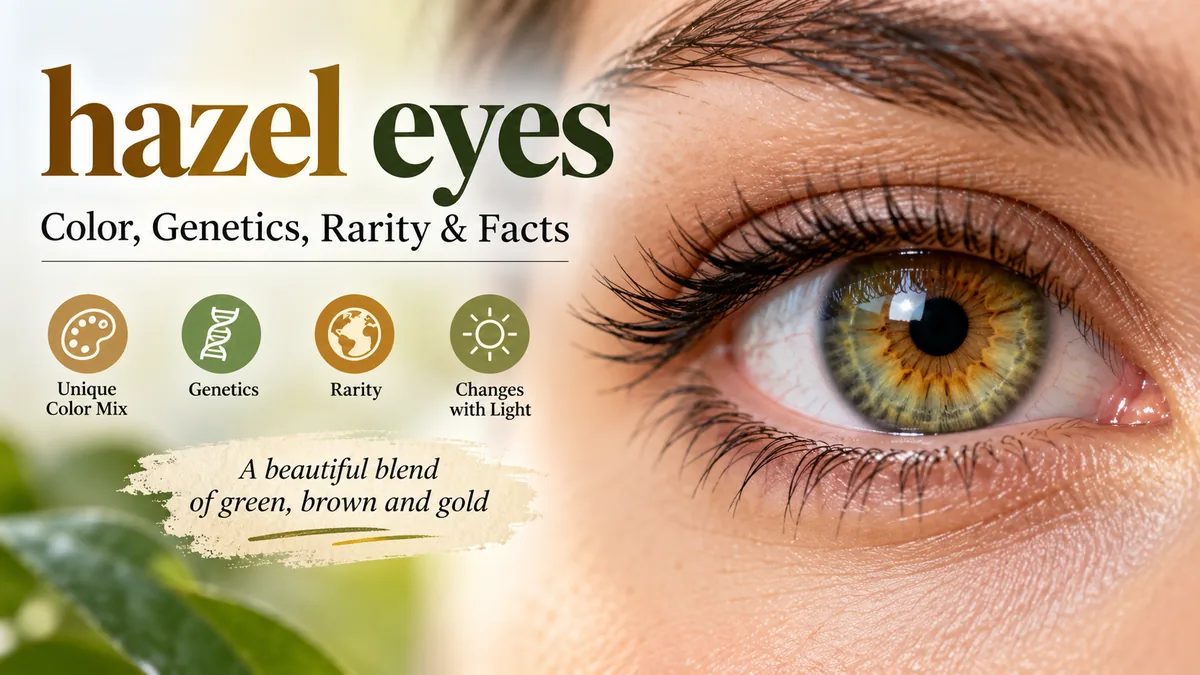
Hazel eyes can look green in bright daylight, warmer brown indoors, and almost golden from certain angles. That shifting appearance often makes people wonder whether hazel is a true eye color or simply a variation of green or brown.
Hazel eyes are a naturally occurring eye color characterized by a mixture of brown, green, gold, or amber tones within the iris. Their appearance results mainly from the amount and distribution of melanin combined with the way light scatters through the iris. The actual eye color does not repeatedly change, even when it appears different.
Understanding hazel eye color requires looking beyond simple labels. Genetics, iris structure, pigmentation, lighting, surrounding colors, and even the way we classify eye colors all influence what we see.
What Are hazel eyes?
Hazel is best understood as a mixed eye color rather than one perfectly uniform shade.
The iris may contain noticeable combinations of:
- Green
- Light or medium brown
- Gold
- Amber or honey-like tones
Some hazel irises are predominantly green with a brown area near the pupil. Others look mostly golden-brown until bright light reveals green around the outer iris.
The Cleveland Clinic describes hazel eyes as combinations of brown, gold or green, noting that the proportions differ considerably from person to person.
This variation is why two people can both accurately describe themselves as having hazel eyes while their eyes look quite different.
What does hazel eye color look like?
A common pattern is a warmer brown or golden area surrounding the pupil with greener tones farther toward the edge of the iris.
That pattern isn’t mandatory. Hazel exists on an eye-color continuum, and there is no universal color chart that draws an absolute boundary between hazel, green, amber and light brown.
A practical clue is persistent color mixing. If substantial green and brown or gold are visible within the same iris under neutral lighting, hazel is usually an appropriate description.
What Causes hazel eyes?
The basic science begins with the iris, the colored circular structure surrounding the pupil.
Within the iris is melanin, the pigment strongly involved in determining human eye color. People with brown eyes generally have more melanin in the front layers of the iris, while people with blue eyes have considerably less.
Hazel falls between these extremes.
The appearance depends on several interacting factors:
- The amount of melanin in the iris
- How that melanin is distributed
- The microscopic structure of iris tissue
- How incoming light is absorbed, scattered and reflected
This explains something that initially seems strange: the iris does not need separate green and blue pigments to produce greenish or bluish appearances.
Melanin and hazel eye color
Melanin absorbs light.
An iris containing a high concentration of melanin absorbs more incoming light and generally looks brown. With less melanin, more light can scatter within and reflect from iris tissue, contributing to lighter eye colors.
Hazel eyes typically have enough pigmentation to produce obvious warm brown or golden regions while still allowing greenish tones to become visible.
Distribution matters just as much as total pigmentation.
If melanin is distributed differently across the iris, one area can look brown while another appears green or golden. All About Vision notes that this variation can create a light-brown region near the pupil and a greener appearance toward the iris’s periphery.
The role of light scattering
Light doesn’t simply hit the iris and bounce back unchanged.
Different wavelengths interact with iris tissue differently. Light scattering, often discussed in relation to Rayleigh scattering, contributes to the appearance of lighter eye colors.
This interaction between pigmentation and reflected/scattered light helps produce the complex appearance associated with hazel.
Quick Takeaway: Hazel isn’t created by one special “hazel pigment.” Its appearance emerges from pigmentation, iris structure and the behavior of light.
Why Do hazel eyes Seem to Change Color?
One of the most recognizable characteristics of hazel eyes is their tendency to look different from one situation to another.
But the iris usually isn’t rapidly changing its underlying pigmentation.
Instead, the appearance changes.
Bright natural light might emphasize green and gold. Dimmer or warmer indoor lighting can make the same eyes look more brown or amber. Clothing and surrounding colors can also influence how observers perceive the iris.
Consider an iris containing a brown center and green outer region.
Under warm indoor lighting, the brown and gold components may dominate. Outside in indirect daylight, the green region may become much easier to see.
The eye hasn’t switched biological colors.
You are simply seeing different parts of an already multicolored iris more prominently.
Can emotions change hazel eye color?
Emotions don’t normally cause the iris to manufacture a new eye color.
They can, however, affect pupil size through the autonomic nervous system. Lighting also causes the pupil to expand and contract. Changes in pupil size alter how much of the iris is visible and may subtly change the overall visual impression.
The distinction matters:
Apparent color change is normal. A genuine new change in iris pigmentation deserves more attention.
hazel eyes vs. Green, Brown and Amber Eyes
Hazel sits close to several other categories on the eye-color spectrum, making identification surprisingly subjective.
The easiest approach is to consider the overall pattern rather than searching for one individual fleck.
| Feature | Hazel | Green | Amber | Brown |
|---|---|---|---|---|
| Overall appearance | Mixed | Predominantly green | Golden/copper | Predominantly brown |
| Common tones | Brown, green, gold | Green with variations | Honey, gold, copper | Light to dark brown |
| Color distribution | Often visibly mixed | Usually more consistently green | Usually more uniform | Usually more consistently brown |
| Lighting effect | Often very noticeable | Can vary | Can brighten or deepen | Usually less dramatically mixed |
| Brown component | Usually noticeable | Limited | Golden-brown rather than green-brown mix | Dominant |
These are useful visual guidelines rather than medical classification rules.
hazel eyes vs. green eyes
This is probably the hardest distinction.
Green eyes generally remain predominantly green across most of the iris. Hazel eyes more clearly combine green with substantial brown, gold or amber areas.
Try looking at the eyes in bright, indirect daylight without strongly colored surroundings.
If the iris remains overwhelmingly green, green is probably the more useful label. If you can clearly identify both green and brown/gold regions, hazel is more likely.
hazel eyes vs. brown eyes
Light brown eyes can sometimes be labeled hazel simply because they contain warm golden highlights.
Look for genuine green.
Brown eyes are generally brown throughout most of the iris, although natural variations and flecks can occur. Hazel typically shows a more obvious mixture of brown with green or gold.
A brown-dominant hazel iris may still look brown from several feet away. The mixed pattern becomes clearer at close range in good lighting.
hazel eyes vs. amber eyes
Amber is another commonly confused category.
Amber eyes usually have a more uniform golden, honey, copper or yellow-brown appearance. Hazel tends to combine warmer brown/gold regions with recognizable green.
The distinction isn’t always absolute because eye-color terminology varies among studies and observers.
That is why one person might call an eye amber while someone else describes the same shade as golden hazel.
Are hazel eyes Rare?
Hazel is considered an uncommon eye color globally.
A frequently cited estimate places hazel eyes at roughly 5% of the world’s population, although reliable global eye-color statistics are limited and classification methods vary.
That percentage should therefore be treated as an estimate rather than an exact biological measurement.
Eye-color prevalence also differs dramatically by ancestry and geographic region.
Brown is by far the dominant eye color worldwide, particularly across Africa and Asia. Lighter and mixed eye colors occur at higher frequencies in some populations of European ancestry.
Another complication is classification.
Research datasets may group:
- Green and hazel together
- Hazel with light brown
- Amber with hazel
So statements such as “exactly X percent of people have hazel eyes” can imply more precision than the underlying data actually provides.
Quick Takeaway: Hazel is uncommon worldwide, but there is no single global census that precisely classifies every person’s iris color.
The Genetics Behind hazel eyes
The old classroom explanation of eye color usually went something like this:
Brown is dominant. Blue is recessive.
Real human genetics is considerably more complicated.
Eye color is a polygenic trait, meaning multiple genes contribute to the final phenotype. Two especially important genes associated with eye-color variation are OCA2 and HERC2, but they aren’t the entire story. MedlinePlus explains that several genes involved in producing, transporting and storing melanin contribute to eye color.
This is important for hazel because mixed eye colors cannot be reliably explained by a simple Punnett-square model.
Can two brown-eyed parents have a hazel-eyed child?
Yes.
A child’s eye color depends on the combination of genetic variants inherited from both parents, not simply whether each parent visually has brown, green, hazel or blue eyes.
Likewise, siblings can have noticeably different eye colors.
A family could potentially include children with brown, hazel and lighter-colored eyes because each child receives a different combination of parental genetic variants.
Can you predict whether a baby will have hazel eyes?
Not reliably from parental eye colors alone.
Genetic information can improve prediction, but eye color remains complex enough that looking only at the parents’ visible eye colors cannot guarantee the child’s eventual shade.
This is one reason online “baby eye color calculators” should be viewed as estimates rather than genetic diagnoses.
Can Babies Be Born With hazel eyes?
A baby’s eye color may not immediately match the color they have later in childhood.
Melanin can continue accumulating in the iris after birth. As pigmentation develops, an eye that initially appears blue or gray may become green, hazel or brown.
The extent of this change varies among children and populations.
Eventually, eye color generally becomes much more stable.
That is different from the day-to-day apparent shifts seen in adult hazel eyes. A developing infant iris can undergo genuine pigmentation changes, while an adult hazel iris usually only looks different because of lighting and visual context.
Different Types and Patterns of hazel eyes
There is no universally accepted medical system dividing hazel into official subtypes.
Still, descriptive categories are useful.
Green-dominant hazel
These eyes look mostly green at first glance but contain obvious brown, amber or golden pigmentation, often around the pupil.
In bright daylight, they may easily be mistaken for green eyes.
Brown-dominant hazel
Brown or warm gold is the strongest overall impression, with green appearing toward the outer iris or in patches.
From a distance, these eyes can look light brown.
Golden or amber-dominant hazel
Some hazel eyes have pronounced honey, bronze or gold tones alongside green and brown.
When the iris becomes predominantly uniform gold or copper with little visible green, amber may be the more appropriate description.
Hazel with central heterochromia
Some people have a distinctly different-colored ring surrounding the pupil.
This pattern is known as central heterochromia.
It can create the classic brown-center/green-outer-iris appearance commonly associated with hazel, but central heterochromia and hazel are not synonymous. A person can have central heterochromia with other eye-color combinations as well.
How to Tell If You Have hazel eyes
Trying to identify eye color from one selfie is unreliable.
Phone cameras automatically modify exposure, white balance, contrast and saturation. Indoor bulbs can also push colors toward yellow, orange or blue.
A better method is:
- Stand near a window in bright, indirect daylight.
- Avoid direct sunlight shining into your eyes.
- Look in a neutral-colored mirror environment.
- Observe the entire iris rather than individual flecks.
- Repeat the observation under similar conditions on another day.
Then ask what colors remain consistently present.
If you repeatedly see substantial brown or gold combined with green, hazel is a reasonable description.
If green dominates almost the entire iris, consider green. If brown remains dominant without meaningful green regions, light brown may be more accurate. A relatively uniform honey or copper iris may fit amber better.
There is still room for interpretation. Human eye colors form a continuum, while labels such as hazel and green divide that continuum into convenient categories.
Are hazel eyes Associated With Health Differences?
Hazel eyes themselves are a normal variation of human pigmentation, not a disease or medical disorder.
Eye color does, however, reflect differences in iris melanin.
People with lighter irises generally have less pigment than people with dark brown irises. Melanin helps absorb light, which is one reason researchers have investigated associations between iris pigmentation and certain eye conditions.
That doesn’t mean someone with hazel eyes should expect an eye disease.
Individual risk depends on many factors, including:
- Age
- Genetics
- UV exposure
- Family history
- Overall health
- Smoking
- Previous eye conditions or injuries
Routine comprehensive eye examinations matter regardless of iris color.
Do hazel eyes need extra protection from sunlight?
Everyone should protect their eyes from excessive ultraviolet exposure.
Wear sunglasses that provide appropriate UV protection when outdoors rather than relying on eye color as natural protection.
Eye color isn’t a substitute for sunglasses.
When an eye-color change should be checked
Hazel eyes looking greener outdoors and browner indoors is usually an optical effect.
A new physical change, especially one affecting only one eye or one part of an iris, is different.
Consider professional eye evaluation if you notice a new or unexplained color change together with symptoms such as:
- Eye pain
- Redness
- Blurred or reduced vision
- Light sensitivity
- A new iris spot or lesion
- Changes following an eye injury
Medical guidance specifically distinguishes ordinary hazel color variation from sudden changes that may warrant assessment by an eye doctor.
Common Myths About hazel eyes
Because hazel can look different under changing conditions, it has accumulated plenty of folklore.
Myth: Hazel eyes actually change from green to brown
Usually false.
Lighting, surroundings and the multicolored structure of the iris change which tones appear strongest. The underlying pigmentation isn’t repeatedly switching back and forth.
Myth: Mood directly changes hazel eye pigmentation
Emotions can affect pupil size and facial appearance, which may alter how the iris looks. They don’t normally produce an immediate biological change from one iris color to another.
Myth: Hazel is simply another name for green
Not quite.
The categories overlap visually, but hazel usually contains a more obvious mixture of green with brown, gold or amber. Green eyes are generally more consistently green.
Myth: Hazel eyes have green pigment
The visible green isn’t evidence of a special green pigment comparable to green paint.
Melanin concentration, distribution and the optical behavior of light contribute to the perceived color.
Myth: Eye color follows one dominant and one recessive gene
This is an oversimplification.
Multiple genes influence iris pigmentation, with OCA2 and HERC2 among the best-known contributors. The interaction among genetic variants is why inheritance can produce outcomes that a simple brown-versus-blue model cannot accurately predict.
Why Every Hazel Iris Looks Different
Two hazel-eyed people don’t need to have the same proportions of green, brown and gold.
One person’s iris might have:
- A dark brown ring surrounding the pupil
- Golden radial streaks
- A moss-green outer region
- A darker limbal ring around the iris
Another person’s eyes may appear predominantly honey-brown with only subtle green around the edges.
Both can fall comfortably within what people call hazel.
That individual variation comes from the combined effects of genetics, melanin concentration, pigment distribution, iris anatomy and light scattering.
It also explains why rigid online eye-color charts often feel unsatisfactory. Nature doesn’t create eye colors by selecting one square from a digital palette.
The Bottom Line on hazel eyes
Hazel eyes are best recognized by their mixed appearance, usually combining green with brown, gold or amber tones. The color comes from the amount and distribution of melanin in the iris together with the way light interacts with iris tissue.
They can appear greener, browner or more golden under different lighting without actually changing pigmentation. Genetics is complex and polygenic, so hazel eye color cannot be reliably predicted using the old dominant-versus-recessive model alone.
If you’re trying to determine whether your own eyes are hazel, examine them in neutral, indirect daylight and focus on the overall iris pattern. Persistent green combined with substantial brown or gold is the strongest practical clue. And if your established eye color genuinely changes suddenly—particularly alongside pain, redness or vision symptoms—have the change evaluated by an eye-care professional.
