

Preparing for the SAT becomes much easier when you know which topics need improvement. Instead of solving hundreds of random questions, you can focus on specific skills that affect your performance.
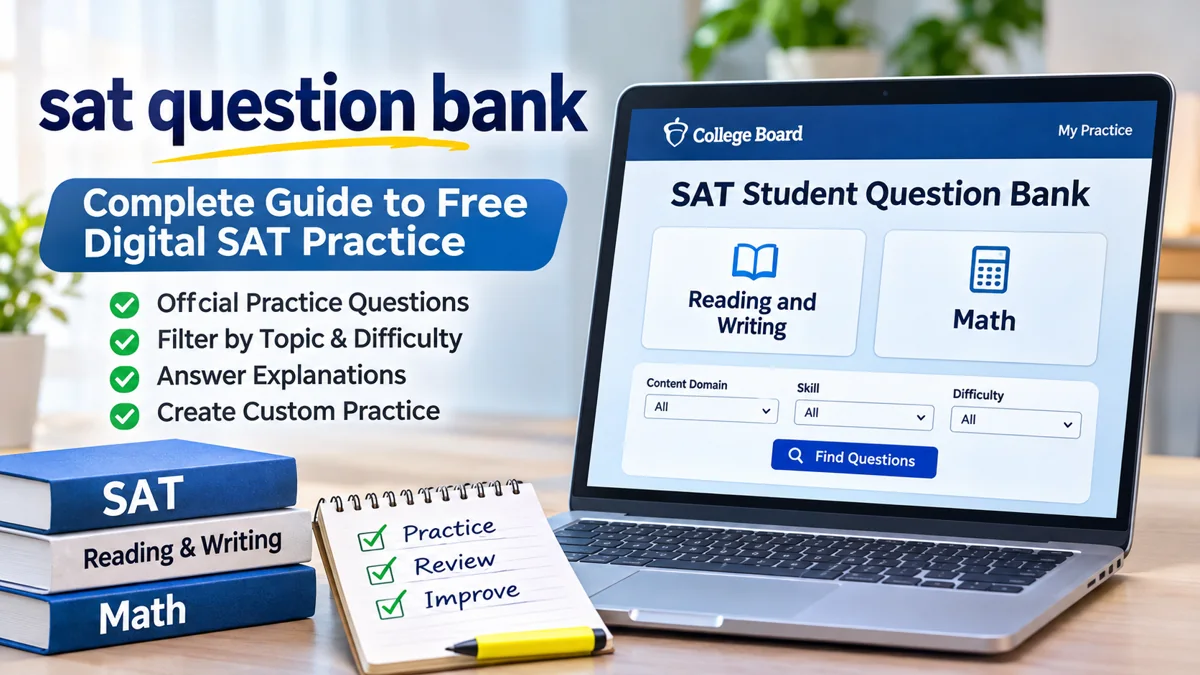
The sat question bank is a free College Board resource containing thousands of official practice questions for the digital SAT and PSAT assessments. Students can filter questions by subject, content domain, skill, and difficulty level, review answer explanations, and create personalized practice quizzes to strengthen their understanding before test day. College Board+1
Used alongside full-length practice tests and structured lessons, this resource can become an essential part of an effective SAT preparation strategy.
What Is the sat question bank?
The SAT Student Question Bank (SQB) is an online collection of official practice questions developed by College Board, the organization responsible for administering the SAT.
Unlike many unofficial test preparation resources, its questions reflect the knowledge, reasoning skills, and question styles associated with the digital SAT.
The platform supports several assessments:
- SAT
- PSAT/NMSQT
- PSAT 10
- PSAT 8/9
Students can select their preferred assessment and concentrate on individual areas of improvement rather than completing an entire practice examination every time they study.
Key Features of the SAT Question Bank
| Feature | Description |
|---|---|
| Cost | Free |
| Provider | College Board |
| Question availability | Thousands of official questions |
| Subjects | Reading and Writing, Math |
| Difficulty levels | Easy, Medium, Hard |
| Custom practice | Available |
| Answer explanations | Available |
| PDF export | Available |
| Digital SAT alignment | Yes |
| Student access | Through My Practice |
The question bank is particularly useful for students who understand their weaknesses but need additional exercises to overcome them.
How to Access and Use the sat question bank
Students can access the official resource through the College Board website.
Follow these steps:
- Visit College Board My Practice.
- Sign in using your College Board student account or supported school credentials.
- Open the Student Question Bank.
- Select SAT as your assessment.
- Choose Math or Reading and Writing.
- Select the relevant content domain.
- Apply skill and difficulty filters.
- Select your practice questions.
- Complete the questions independently.
- Review the correct answers and explanations.
College Board also provides an Educator Question Bank intended to support teachers, tutors, and instructional planning. College Board+1
How to Download SAT Question Bank PDFs
You can create customized practice worksheets for offline preparation using the export feature.
After selecting your questions, choose the export option and generate a version without answers. Complete the worksheet before exporting or reviewing the version containing solutions.
This approach prevents accidental exposure to correct answers and makes independent practice more effective.
What Does Exclude Active Questions Mean?
The Educator Question Bank includes an option called Exclude Active Questions.
Some questions overlap with currently available full-length Bluebook practice tests. Enabling this option removes those questions from the filtered results. SAT Suite Educator Question Bank
This is helpful when you want to preserve unfamiliar questions for future mock examinations. Recognizing previously answered questions can artificially increase your practice test performance.
Digital SAT Question Bank Topics and Categories
The digital SAT assesses two major subject areas: Reading and Writing, and Math.
The examination contains 98 questions and lasts 2 hours and 14 minutes, excluding the scheduled break. Its total score ranges from 400 to 1600.
| SAT Section | Questions | Duration | Score Range |
|---|---|---|---|
| Reading and Writing | 54 | 64 minutes | 200–800 |
| Math | 44 | 70 minutes | 200–800 |
| Total | 98 | 134 minutes | 400–1600 |
Both sections use a multistage adaptive testing structure. Your performance in the first module influences the difficulty of the second module.
SAT Reading and Writing Question Bank
The Reading and Writing section features four major content domains.
| Content domain | Skills assessed | Approximate weight |
|---|---|---|
| Information and Ideas | Inference, evidence and comprehension | 26% |
| Craft and Structure | Vocabulary, text structure and purpose | 28% |
| Expression of Ideas | Transitions and rhetorical synthesis | 20% |
| Standard English Conventions | Grammar and punctuation | 26% |
Information and Ideas
These questions evaluate your ability to understand written passages, identify central ideas, interpret evidence, and draw logical conclusions.
Some exercises require analyzing information presented in graphs or tables.
Craft and Structure
This category focuses on words in context, author purpose, passage organization, and connections between different texts.
Vocabulary questions assess how a word functions within a passage rather than simply testing memorized definitions.
Expression of Ideas
Students must evaluate transitions and select information that supports specific writing objectives.
These questions frequently involve organizing ideas and synthesizing research notes.
Standard English Conventions
This domain tests grammar, sentence boundaries, punctuation, verb agreement, and sentence construction.
Understanding the underlying grammatical rules can help students approach unfamiliar questions more confidently.
SAT Math Question Bank
The Math section contains four primary content domains.
| Content domain | Main topics | Approximate weight |
|---|---|---|
| Algebra | Linear equations and inequalities | 35% |
| Advanced Math | Quadratic and nonlinear equations | 35% |
| Problem-Solving and Data Analysis | Ratios, percentages and statistics | 15% |
| Geometry and Trigonometry | Triangles, circles and angles | 15% |
Algebra
Algebra questions assess linear equations, expressions, inequalities, functions, and systems of equations.
Students should practice translating written problems into mathematical expressions.
Advanced Math
This category includes quadratic equations, exponential functions, nonlinear relationships, polynomials, and equivalent expressions.
It represents a substantial portion of the Math section and deserves regular attention during preparation.
Problem-Solving and Data Analysis
Questions cover percentages, probability, ratios, proportional relationships, statistical measures, and data interpretation.
Many exercises use practical scenarios involving measurements, surveys, or financial calculations.
Geometry and Trigonometry
Students encounter questions involving area, volume, circles, angles, right triangles, and trigonometric relationships.
The digital SAT permits calculator use throughout the Math section, including access to a built-in Desmos graphing calculator.
However, understanding mathematical relationships remains essential because a calculator alone cannot determine the correct approach to every problem.
SAT Question Bank Difficulty Levels Explained
College Board categorizes questions into three difficulty levels.
| Difficulty | Question characteristics | Recommended use |
|---|---|---|
| Easy | Fundamental concepts and straightforward reasoning | Building foundations |
| Medium | Multiple steps and more detailed analysis | Developing proficiency |
| Hard | Complex reasoning and unfamiliar applications | Advanced preparation |
Easy Questions
Easy questions help students establish fundamental knowledge and identify gaps in essential concepts.
They are especially valuable for beginners and students returning to topics they have not studied recently.
Medium Questions
Medium-level questions often require combining multiple skills or completing several reasoning steps.
Students who consistently answer foundational questions correctly should gradually introduce medium-level exercises into their study sessions.
Hard Questions
Hard SAT questions often involve more complex relationships, subtle wording, or challenging problem-solving requirements.
These questions are useful for students pursuing competitive SAT scores, but practicing them exclusively is not necessarily effective.
College Board recommends selecting practice difficulty according to your performance across individual content domains. College Board
Quick takeaway: Master fundamental concepts first, improve your accuracy with medium questions, and introduce difficult exercises as your understanding develops.
SAT Question Bank Practice Questions With Answers
The following original examples demonstrate common SAT-style question formats. They are illustrative exercises, not questions copied from the official College Board database.
Example 1: SAT Algebra Question
If:
\[ 3x+7=22 \]
What is the value of \(x\)?
A. 3
B. 5
C. 7
D. 9
Correct answer: B. 5
Explanation:
Subtract 7 from both sides:
\[ 3x=15 \]
Divide both sides by 3:
\[ x=5 \]
Example 2: SAT Advanced Math Question
If:
\[ x^2-9=0 \]
What are the possible values of \(x\)?
A. 3 only
B. −3 only
C. −3 and 3
D. 0 and 9
Correct answer: C. −3 and 3
Explanation:
Rearrange the equation:
\[ x^2=9 \]
Both positive and negative 3 satisfy the equation.
\[ x=\pm3 \]
Example 3: SAT Reading and Writing Question
Choose the most appropriate word to complete the sentence.
*The scientist’s findings were supported by several independent studies, making her conclusions highly ______.*
A. Uncertain
B. Credible
C. Accidental
D. Unrelated
Correct answer: B. Credible
Explanation: The sentence indicates that independent research supports the findings. Therefore, credible, meaning trustworthy or believable, is the most appropriate choice.
Example 4: SAT Grammar Question
Which option completes the sentence according to Standard English conventions?
*Each of the students ______ responsible for completing the assignment.*
A. Are
B. Were
C. Is
D. Have
Correct answer: C. Is
Explanation: The subject is “each,” which is singular and requires a singular verb.
SAT Question Bank vs. Bluebook vs. Khan Academy
College Board provides several complementary preparation resources. Each serves a different purpose.
| Feature | Student Question Bank | Bluebook | Khan Academy |
|---|---|---|---|
| Free access | Yes | Yes | Yes |
| Targeted skill practice | Yes | Limited | Yes |
| Full-length adaptive tests | No | Yes | No |
| Educational video lessons | No | No | Yes |
| Question explanations | Yes | Through My Practice | Yes |
| Difficulty-based practice | Yes | Adaptive | Yes |
| Test-day simulation | Limited | Yes | No |
| Customized worksheets | Yes | No | No |
Student Question Bank
Best suited for practicing specific skills, creating custom question sets, and addressing recurring mistakes.
Bluebook Practice Tests
Bluebook provides full-length digital practice examinations that help students become familiar with adaptive testing, exam timing, and the official testing interface.
Khan Academy SAT Preparation
Khan Academy provides instructional resources, worked examples, and skill-building exercises.
It is especially useful when students struggle to understand the concepts behind their incorrect answers.
My Practice and Tailored Practice
My Practice connects students with their practice results and additional learning opportunities.
College Board’s Tailored Practice feature also provides targeted exercises informed by assessment performance, helping students concentrate on areas where additional preparation may be beneficial. College Board+2
The most effective approach is generally to combine these resources rather than rely on only one.
How to Improve Your SAT Score Using the Question Bank
Completing a large number of questions does not automatically produce a high SAT score. Improvement depends on identifying mistakes, understanding their causes, and developing more reliable problem-solving methods.
Start With a Diagnostic Practice Test
Complete a full-length Bluebook SAT practice test before beginning intensive preparation.
Review your results and identify your weakest content domains. This gives you a starting point for selecting questions instead of studying every topic equally.
Create an SAT Error Log
An error log helps you recognize recurring problems.
| Question ID | Topic | Error type | Improvement action |
|---|---|---|---|
| Q001 | Algebra | Calculation mistake | Check arithmetic |
| Q002 | Grammar | Subject-verb agreement | Review grammar rules |
| Q003 | Reading | Incorrect inference | Identify supporting evidence |
| Q004 | Geometry | Formula error | Review area formulas |
| Q005 | Advanced Math | Conceptual misunderstanding | Study quadratic equations |
Review your error log regularly and attempt similar questions without looking at the previous solutions.
Practice Under Time Limits
The Reading and Writing section allows approximately 71 seconds per question on average, while the Math section allows approximately 95 seconds.
Start with untimed exercises to establish accuracy. Once your skills improve, introduce timed practice sessions to develop speed and decision-making.
Set Daily Practice Targets
| Preparation level | Suggested daily questions | Study duration |
|---|---|---|
| Beginner | 10–15 | 20–30 minutes |
| Intermediate | 20–30 | 45–60 minutes |
| Advanced | 30–40 | 60–90 minutes |
These are suggested study targets rather than official College Board requirements.
Ten thoroughly reviewed questions can be more valuable than 50 questions completed without understanding the mistakes.
Four-Week SAT Question Bank Study Plan
A structured study schedule helps ensure that all major SAT topics receive sufficient attention.
| Week | Primary focus | Practice activities |
|---|---|---|
| Week 1 | Diagnostic assessment | Bluebook test and foundational exercises |
| Week 2 | Weak content domains | Targeted easy and medium questions |
| Week 3 | Advanced preparation | Difficult questions and timed sessions |
| Week 4 | Final review | Full-length tests, error analysis and revision |
Week 1: Establish Your Baseline
Complete an official practice test and determine which skills require improvement.
Focus on understanding fundamental mathematical concepts, grammar rules, and reading comprehension strategies.
Week 2: Strengthen Weak Areas
Use question bank filters to concentrate on your lowest-performing domains.
Review unfamiliar concepts through Khan Academy before attempting additional questions.
Week 3: Improve Speed and Accuracy
Introduce more challenging questions and practice mixed-topic quizzes under time limits.
Analyze whether your mistakes result from insufficient knowledge, misreading, or time pressure.
Week 4: Simulate the Real Examination
Complete another full-length Bluebook practice test using realistic testing conditions.
Revisit your error log, review important formulas, and concentrate on persistent weaknesses.
Avoid exhausting yourself with excessively long practice sessions immediately before test day.
Is the Official SAT Question Bank Enough for Preparation?
The official question bank provides substantial practice material, but it does not replace every component of an effective study strategy.
Its major advantages include:
- Authentic SAT-style questions.
- Free access to extensive practice material.
- Skill-specific and difficulty-based filtering.
- Answer explanations.
- Customized practice worksheets.
- Support for independent learning.
- Alignment with digital SAT content domains.
However, it has limitations. Individual question sets cannot fully reproduce adaptive testing, sustained concentration, examination timing, or the pressure of completing an entire assessment.
Students should also understand that official practice questions do not guarantee identical questions on their future SAT examination.
Finishing the entire database does not guarantee a score of 1500 or 1600. Your eventual performance depends on comprehension, accuracy, time management, and how consistently you apply your knowledge to unfamiliar problems.
Combining targeted exercises with Bluebook examinations, Khan Academy lessons, and systematic error analysis provides a more balanced preparation experience.
Conclusion
The sat question bank is one of the most valuable free resources available for digital SAT preparation. Its official practice questions, customizable filters, subject-specific categories, difficulty levels, and answer explanations allow students to develop a study strategy based on their individual needs.
Rather than attempting to memorize every available question, focus on understanding the reasoning behind each solution. Begin with a diagnostic assessment, identify your weakest skills, and gradually increase question difficulty as your accuracy improves.
Consistent, focused practice combined with full-length mock examinations can help you build the knowledge, confidence, and time-management skills necessary for stronger SAT performance.
