

A boiled egg can go from beautifully runny to dry and chalky in just a few minutes. The good news is that once you know when to start the timer, getting the yolk exactly how you like it becomes remarkably predictable.
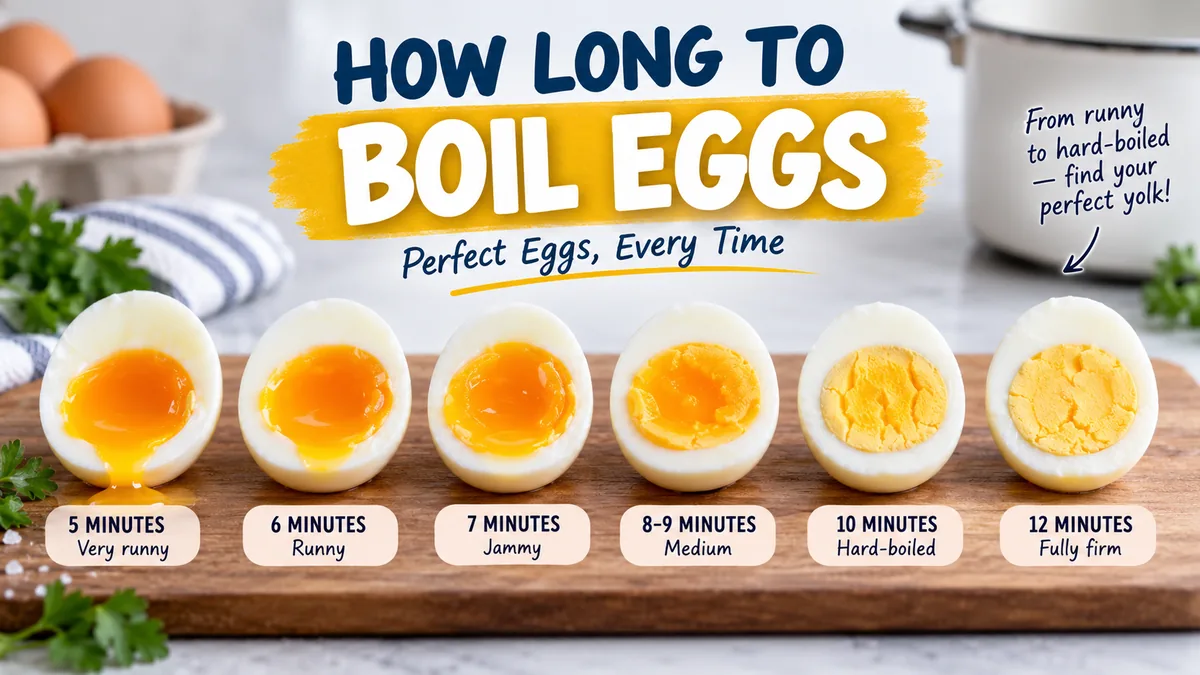
For large eggs lowered into already boiling water, cook about 6 minutes for a runny yolk, 7 minutes for a jammy center, 8–9 minutes for a medium-set yolk, and 10–12 minutes for a fully hard-boiled egg. Transfer the eggs to cold or ice water immediately afterward to stop residual cooking. These ranges align closely with current guidance from established cooking sources.
The exact result can vary slightly with egg size, starting temperature, altitude, and cooking method. This guide explains how long to boil eggs and how to adjust the process so you get consistent results rather than relying on guesswork.
how long to boil eggs for Soft, Medium, and Hard Yolks
If you’re starting with large eggs and lowering them into already boiling water, this is a practical timing chart to keep nearby.
| Cooking Time | Egg White | Yolk | Best For |
|---|---|---|---|
| 5 minutes | Mostly set | Very runny | Toast dipping |
| 6 minutes | Set | Runny and creamy | Soft-boiled eggs |
| 7 minutes | Fully set | Thick, jammy center | Ramen and grain bowls |
| 8 minutes | Fully set | Soft and mostly set | Salads, Scotch eggs |
| 9 minutes | Firm | Creamy, nearly set | Medium-boiled eggs |
| 10 minutes | Firm | Fully set but tender | Classic hard-boiled eggs |
| 11–12 minutes | Firm | Completely firm | Deviled eggs, meal prep |
Good Food, for example, recommends roughly 5 minutes for a runny large egg, 7 minutes for an almost-set sticky yolk, 8 minutes for a softly set center, and 10 minutes for a classic hard-boiled result when using a boiling-water start.
The important detail is when the timer starts. These times assume you are lowering eggs into water that is already boiling or gently simmering. A cold-water-start method follows a different timeline.
How Long to Boil Eggs for a Runny Yolk?
For a soft-boiled egg with a properly set white and liquid yolk, aim for approximately 5–6 minutes.
At five minutes, the yolk will generally be very fluid. Around six minutes, the white should be more reliably set while the center remains rich and runny.
This texture works especially well with:
- Toast soldiers
- Breakfast bowls
- Noodles
- Ramen
- Asparagus
- Rice dishes
If your eggs are extra-large or very cold, they may need roughly another 30 seconds.
How Long to Boil Eggs for a Jammy Yolk?
A 7-minute egg is a useful target when you want that popular jammy texture.
The white becomes fully cooked while the yolk thickens around the edges and remains creamy toward the center. Current cooking guides commonly place a jammy large egg around the 7-minute mark.
Jammy eggs are particularly good in ramen, noodle bowls, salads and on avocado toast because the yolk is soft without being completely liquid.
How Long to Boil Eggs for a Medium Yolk?
Cook large eggs for approximately 8–9 minutes when you want the yolk mostly set but still moist.
At eight minutes, expect a softer center. At nine minutes, the yolk becomes considerably firmer without reaching the dry texture associated with an overcooked hard-boiled egg.
This is a useful middle ground if you dislike runny yolks but still want a creamy texture.
how long to boil eggs for Hard-Boiled Eggs
For the classic hard-boiled texture, cook large eggs for approximately 10–12 minutes using the boiling-water method.
Ten minutes can produce a fully cooked yet relatively tender yolk. Extending the time toward 12 minutes creates a firmer center that works well for egg salad, sandwiches and deviled eggs.
The USDA also describes a different hard-cooking method: bring eggs in cold water just to a boil, remove the pan from the heat, cover it, and let large eggs stand for about 15 minutes. Because the cooking technique is different, its timing should not be compared directly with continuous simmering.
Quick takeaway: If you want one easy number for classic hard-boiled eggs using a boiling-water start, try 10–11 minutes, then cool immediately.
The Best Way to Boil Eggs Step by Step
There are several legitimate ways to cook eggs, which explains why recipes sometimes give surprisingly different times. For consistent soft, jammy and medium eggs, starting with boiling water makes the timing particularly easy to control.
1. Bring Enough Water to a Boil
Fill a saucepan with enough water to cover the eggs completely, ideally with roughly an inch of water above them.
Bring it to a boil.
Using enough water matters because adding several cold eggs can temporarily reduce the water temperature. A larger volume of water returns to the correct temperature more quickly.
2. Lower the Eggs in Gently
Use a spoon or slotted spoon to lower each egg into the water rather than dropping it.
This reduces the chance of the shell striking the bottom of the saucepan and cracking.
Once the eggs are in, maintain a controlled boil or gentle simmer rather than allowing them to bounce violently around the pot.
3. Start Your Timer
Timing is the key variable.
For large eggs, use approximately:
- 5–6 minutes for a runny center.
- 7 minutes for a jammy center.
- 8–9 minutes for a medium center.
- 10–12 minutes for a hard-boiled center.
Try to use eggs of similar size when cooking several at once. Mixing medium, large and extra-large eggs makes identical results harder to achieve.
4. Move the Eggs Into Cold Water
As soon as the timer finishes, remove the eggs with a slotted spoon and place them in very cold water or an ice bath.
Cooling isn’t just about making the eggs comfortable to handle. The egg retains heat after leaving the saucepan, so it can continue cooking.
Good Food specifically recommends transferring cooked eggs to very cold water to prevent further cooking.
For hard-boiled eggs that you plan to peel, leaving them in cold water for several minutes is a practical approach.
5. Peel and Serve
Tap the shell gently against a hard surface and crack it in several places.
Roll the egg carefully under your palm to loosen the shell, then start peeling around the wider end, where there is usually an air pocket.
Peeling under a small stream of running water can help separate stubborn shell fragments from the egg.
Should You Start Eggs in Cold or Boiling Water?
Both methods work. What matters is using the correct timing for the method you’ve chosen.
Boiling-Water Start
Bring the water to a boil first and then gently add the eggs.
Advantages:
- Precise starting point
- Easy to control yolk consistency
- Particularly useful for soft and jammy eggs
- Simple to repeat once you find your preferred time
The main disadvantage is that a cold egg entering hot water experiences a rapid temperature change, which can sometimes contribute to cracking.
Cold-Water Start
Put the eggs in the saucepan first, cover them with cold water and heat everything together.
This method can work particularly well for hard-cooked eggs, but the total time is less straightforward because stove strength, saucepan size, water volume and starting temperature affect how quickly the water reaches a boil.
The USDA’s method uses this approach: eggs are covered with cold water, brought just to boiling and then allowed to stand covered off the heat.
That’s why one recipe might say “10 minutes” while another says “15 minutes” and both can produce hard-cooked eggs. They’re often timing different cooking methods.
Does Egg Size Change Boiling Time?
Yes. A larger egg contains more mass, so heat takes longer to reach and cook the center.
Most general timing charts assume large chicken eggs.
Good Food suggests adjusting its boiling-water timings by roughly 30 seconds less for medium eggs and 30 seconds more for extra-large eggs.
A practical starting point is:
| Egg Size | Suggested Adjustment |
|---|---|
| Medium | About 30 seconds less |
| Large | Use standard timing |
| Extra-large | About 30 seconds more |
These adjustments aren’t absolute because starting temperature and individual egg size still vary.
If you buy the same size and brand regularly, note the timing that produces your favorite yolk. That personal reference is often more useful than changing methods every time.
Do Refrigerated Eggs Take Longer to Boil?
They can.
An egg straight from the refrigerator begins at a lower internal temperature than a room-temperature egg, so its center may take slightly longer to reach the same level of doneness.
Good Food advises adding around 30 seconds to its boiling times for fridge-cold eggs compared with room-temperature eggs.
Temperature also affects cracking. Moving a very cold egg directly into boiling water creates more thermal stress.
You don’t necessarily need to bring eggs fully to room temperature, though. The simplest approach is consistency: if you normally cook eggs directly from the refrigerator, always do so and calibrate your preferred cooking time accordingly.
Does Altitude Affect How Long Eggs Take to Boil?
Yes, especially at significantly higher elevations.
Water boils at a lower temperature as atmospheric pressure decreases. That means boiling water at high altitude isn’t as hot as boiling water at sea level.
As a result, eggs may require additional cooking time.
There isn’t one universal adjustment because altitude varies considerably. If you live well above sea level, start with the standard timing and increase it gradually until you find the result you prefer.
This is one reason an exact egg-boiling time that works perfectly in one kitchen may need a small adjustment in another.
Why Do Hard-Boiled Eggs Sometimes Get a Green Ring?
That gray-green ring around a hard-boiled yolk usually means the egg was exposed to heat longer than necessary or wasn’t cooled quickly enough.
During extended cooking, sulfur compounds from the egg white can react with iron in the yolk, producing the characteristic discoloration around the yolk’s surface.
It doesn’t automatically mean the egg is spoiled.
The easiest ways to reduce the problem are simple:
- Don’t unnecessarily extend the cooking time.
- Remove eggs promptly when the timer ends.
- Transfer them immediately to cold or ice water.
- Avoid leaving cooked eggs sitting in hot water.
A properly timed 10- to 12-minute hard-boiled egg generally gives a more attractive yellow yolk than one left boiling for 15 or 20 minutes.
Why Are Boiled Eggs Sometimes Difficult to Peel?
You’ve probably had an egg where half the white comes away with the shell. The cooking may have been perfect, yet peeling turns into a frustrating five-minute job.
Freshness plays a role.
The USDA notes that extremely fresh eggs can be more difficult to peel and suggests that eggs that have spent some time refrigerated are often better candidates for hard cooking.
Technique helps too.
After cooking:
- Cool the egg thoroughly.
- Tap it gently all over.
- Roll it to create small cracks.
- Begin peeling from the wider end.
- Work a finger underneath the thin membrane.
- Use running water if pieces remain stuck.
Don’t expect every egg to peel perfectly. Differences between individual eggs can still produce different results even when they’re cooked in the same saucepan.
How Do You Keep Eggs From Cracking While Boiling?
An occasional cracked egg isn’t necessarily evidence that you did anything wrong.
Still, a few habits reduce the likelihood.
Lower eggs gently into the saucepan with a spoon rather than dropping them. Keep the water at a controlled boil after the eggs have been added, and use a saucepan large enough that the eggs aren’t packed tightly together.
If you regularly experience cracking when using refrigerator-cold eggs, allowing them to lose some of their chill before putting them into boiling water may help reduce the temperature shock.
A tiny crack isn’t automatically disastrous. If only a small amount of white escapes, the egg can often continue cooking normally.
How Many Eggs Can You Boil at Once?
You can cook several eggs together as long as the saucepan has enough room.
Arrange them in a single layer when practical and use enough water to keep them submerged. Overcrowding can make the eggs knock together and may cause the water temperature to fall significantly when they’re added.
You don’t generally need to add several minutes simply because you’re cooking six eggs instead of two.
What matters is that the saucepan contains enough water and returns quickly to the intended cooking temperature.
For very large batches, use a larger pot rather than stacking eggs tightly in a small saucepan.
How Long Should Boiled Eggs Sit in Ice Water?
Around 5 minutes is usually enough for routine cooling and peeling, although they can remain in the ice bath longer while you prepare the rest of your meal.
For a soft-boiled egg you’re serving immediately, even a shorter cold-water rinse can halt most carryover cooking while keeping the center pleasantly warm.
For hard-boiled eggs intended for storage or peeling, a longer cooling period makes more sense.
The important part is transferring them out of the hot cooking water promptly. Otherwise, a perfectly timed 7-minute jammy egg can continue cooking toward a firmer center.
How Long Do Hard-Boiled Eggs Last in the Refrigerator?
Hard-cooked eggs should be refrigerated promptly rather than left at room temperature for extended periods.
USDA guidance says hard-cooked eggs can be kept refrigerated for up to seven days and recommends refrigerating them within two hours.
Keep them refrigerated until you’re ready to eat them.
If you’re preparing eggs for several days of breakfasts or lunches, marking the cooking date on the storage container is an easy way to keep track.
Can You Reheat a Boiled Egg?
You can warm a refrigerated hard-boiled egg, but putting a whole egg in its shell directly into a microwave is a poor approach because pressure can build inside it.
Instead, place the egg in a heat-safe bowl and cover it with hot water for several minutes.
For peeled eggs, cutting them before gentle reheating also avoids trapping pressure inside the intact egg.
Soft-boiled eggs are best eaten freshly cooked because reheating makes it difficult to preserve the exact runny or jammy center you created initially.
Common Egg-Boiling Mistakes
Most disappointing boiled eggs come down to a handful of avoidable problems.
Guessing Instead of Timing
Two minutes can make a dramatic difference to a yolk.
Use a timer from the same point every time.
Mixing Cooking Methods
Don’t use a 10-minute boiling-water recipe while following the instructions for an off-heat steeping method. Each technique has its own timing.
Boiling Too Aggressively
A violent rolling boil makes eggs bounce against the pan and each other.
Once the eggs are added, a controlled boil or simmer is enough.
Overcooking Hard-Boiled Eggs
Longer isn’t automatically safer or better.
Excessive cooking can produce rubbery whites, dry yolks and gray-green discoloration.
Skipping the Cold-Water Step
The egg doesn’t instantly become cold when it leaves the saucepan.
Residual heat continues moving toward the center, so immediate cooling gives you much better control over the final texture.
The Easiest Timing Rule to Remember
You don’t need to memorize a complicated chart every time you make breakfast.
For large eggs added to boiling water, remember this simple progression:
6 minutes = runny
7 minutes = jammy
8–9 minutes = medium
10–12 minutes = hard
From there, adjust by roughly 30 seconds if necessary for egg size, refrigerator temperature, altitude, or simply personal preference.
If your first 7-minute egg is slightly softer than you wanted, don’t change the whole method next time. Cook it for 7½ minutes. Small adjustments are the easiest way to find the exact texture that works in your kitchen.
Final Takeaway
So, how long to boil eggs depends mainly on the yolk texture you want and the method you’re using. With a boiling-water start, large eggs generally need about 5–6 minutes for a runny yolk, 7 minutes for jammy, 8–9 minutes for medium, and 10–12 minutes for hard-boiled.
Use the same egg size, starting temperature and timing method whenever possible. Then move the eggs directly into cold water when the timer ends. Once you’ve found your favorite minute mark, perfectly cooked boiled eggs become one of the easiest things to reproduce in the kitchen.
