

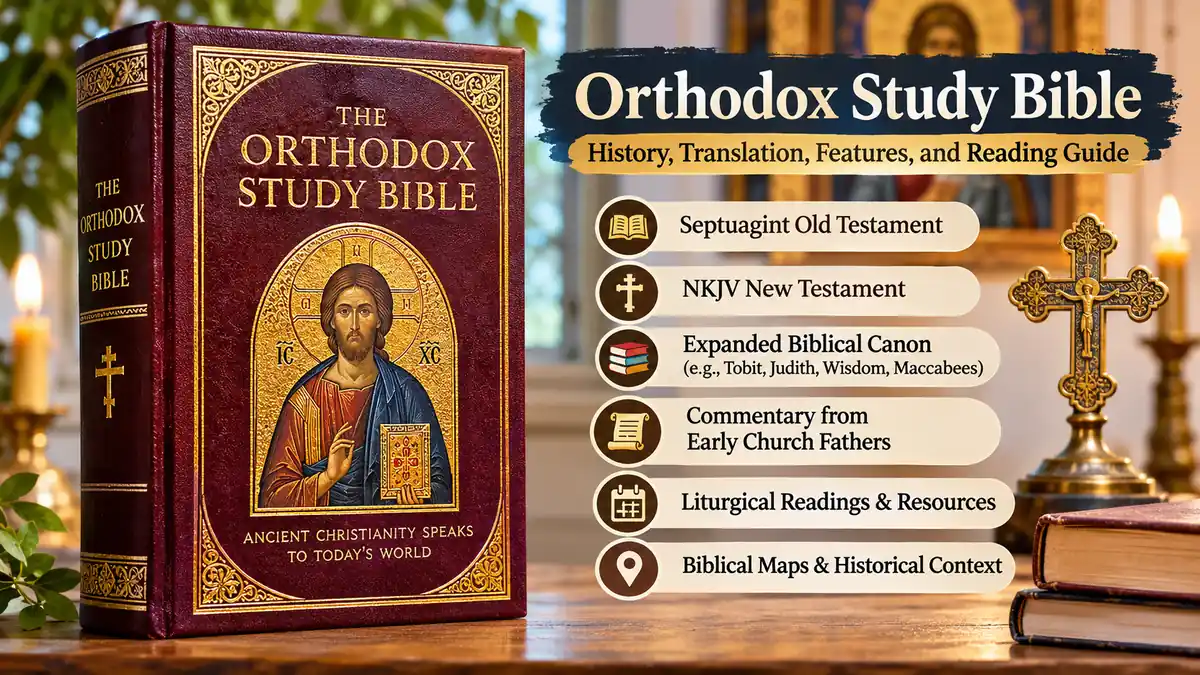
Reading Scripture becomes a different experience when you explore it alongside the teachings of early Christianity. The Orthodox Study Bible provides this perspective by connecting biblical passages with centuries of Christian theology, worship, and spiritual tradition.
The orthodox study bible (OSB) is an English-language study Bible containing a Septuagint-based Old Testament and the New King James Version of the New Testament. It includes commentary inspired by the early Church Fathers, additional Old Testament books, liturgical readings, historical explanations, prayers, and resources for understanding Eastern Orthodox Christianity.
Unlike many modern study Bibles, its emphasis extends beyond individual interpretation to the historical understanding of Scripture within the Church.
What Is the orthodox study bible?
The Orthodox Study Bible is a biblical study resource designed to present Scripture through the theological and historical traditions of the Eastern Orthodox Church.
Published by Thomas Nelson, the complete edition combines biblical text with explanatory notes, historical background, theological commentary, and devotional resources.
The Old Testament was prepared through the St. Athanasius Academy of Orthodox Theology, while the New Testament uses an existing English translation. Greek Orthodox Archdiocese of America+1
| Feature | Details |
|---|---|
| Abbreviation | OSB |
| Publisher | Thomas Nelson |
| Original edition | 1993 |
| Complete edition | 2008 |
| Language | English |
| Old Testament | St. Athanasius Academy Septuagint |
| New Testament | New King James Version |
| Religious tradition | Eastern Orthodox Christianity |
| Commentary | Patristic and Orthodox theological teachings |
| Intended audience | Christians, students, and religious researchers |
The OSB is especially useful for readers interested in understanding how ancient Christian theological traditions approach biblical interpretation.
History and development
The original edition appeared in 1993 and contained only the New Testament and Psalms. Both used the New King James Version.
A complete edition followed in 2008, introducing a Septuagint-based Old Testament and revised study material.
The project involved Orthodox clergy, theologians, and biblical scholars. Important contributors included Father Peter Gillquist, Jack Norman Sparks, Joseph Allen, Michel Najim, and Theodore Stylianopoulos. Church Comparison+1
The completed edition carries the subtitle Ancient Christianity Speaks to Today’s World, reflecting its emphasis on connecting contemporary readers with historical Christian teachings.
What Translation Does the orthodox study bible Use?
The Orthodox Study Bible uses two different biblical translations rather than a single translation throughout.
Its Old Testament follows the Greek Septuagint tradition, while its New Testament uses the New King James Version (NKJV).
The Septuagint Old Testament
The Septuagint is an ancient Greek translation of Jewish Scriptures that developed beginning around the third century BCE.
It became particularly influential among Greek-speaking Jewish communities and early Christians. Many Old Testament quotations appearing in the New Testament closely reflect Septuagint wording.
The OSB uses the St. Athanasius Academy Septuagint (SAAS), prepared with reference to several textual resources:
- The Greek Septuagint edition associated with Alfred Rahlfs.
- The English Septuagint translation by Sir Lancelot Charles Lee Brenton.
- The Old Testament text of the New King James Version.
- Biblical scholarship and Orthodox theological traditions.
The translation adapts existing English wording where necessary to reflect the Greek textual tradition. Jeff McLain+1
The New King James Version New Testament
The New Testament contains all 27 books found in mainstream Christian biblical traditions.
The NKJV updates the older English language of the King James Version while retaining many of its traditional translation choices.
Its New Testament primarily follows the Textus Receptus, with textual notes identifying certain differences found in other Greek manuscript traditions.
Although suitable for ordinary reading, the NKJV is not identical to the official Greek ecclesiastical texts used in Orthodox worship.
Septuagint vs. Masoretic Text
One of the most significant differences between the OSB and many other English Bibles concerns their Old Testament textual foundations.
| Feature | Septuagint | Masoretic Text |
|---|---|---|
| Primary language | Greek | Hebrew, with some Aramaic |
| Common abbreviation | LXX | MT |
| Religious association | Eastern Orthodox Christianity and early Christianity | Jewish tradition and many Protestant translations |
| Psalm numbering | Greek numbering system | Hebrew numbering system |
| Textual differences | Contains distinctive readings and additional material | Preserves the traditional Hebrew textual form |
These differences can affect wording, chapter numbering, book arrangement, and the interpretation of particular passages.
What Books Are Included in the Orthodox Bible?
The complete Orthodox Study Bible is commonly counted as containing 76 biblical books, although broader Orthodox canonical traditions sometimes count or arrange books differently.
It contains the familiar books of the Old and New Testaments alongside biblical writings absent from most Protestant editions.
Old Testament books and additional writings
The expanded Old Testament includes works such as:
- Tobit
- Judith
- Wisdom of Solomon
- Wisdom of Sirach
- Baruch
- 1 Esdras
- 1 Maccabees
- 2 Maccabees
- 3 Maccabees
- Psalm 151
- Prayer of Manasseh
- Additional sections of Esther and Daniel
Some of these writings are commonly described as deuterocanonical books. Orthodox Christians may also use the term Anagignoskomena, referring to writings recognized for reading within the Church.
Their classification and arrangement can vary between Orthodox jurisdictions.
What are the additional sections of Daniel?
Readers comparing different biblical editions may notice several additional passages within the Orthodox version of Daniel.
These include Susanna, Bel and the Dragon, the Prayer of Azariah, and the Song of the Three Holy Children.
These passages provide narratives and prayers concerned with faithfulness, divine justice, courage, and worship.
Why are some biblical books named differently?
The Greek biblical tradition uses different naming conventions for certain historical books.
| Orthodox Study Bible | Common Protestant name |
|---|---|
| 1 Kingdoms | 1 Samuel |
| 2 Kingdoms | 2 Samuel |
| 3 Kingdoms | 1 Kings |
| 4 Kingdoms | 2 Kings |
Psalm numbering also differs. For example, Psalm 50 in the Septuagint corresponds to Psalm 51 in most Protestant Bibles. Jeff McLain+1
These differences do not automatically indicate that passages are missing. They often reflect different methods of organizing and transmitting Scripture.
Main Features of the Orthodox Study Bible
The OSB is more than a collection of biblical books. Its supplementary material helps readers understand the relationship between Scripture, Christian history, theology, and spiritual practice.
Verse-by-verse study notes
Explain selected biblical passages through Orthodox theological interpretation and historical context.
Early Church commentary
Introduces readers to interpretations associated with influential Christian theologians and historical Church Fathers.
Liturgical readings
Connects Scripture with worship, religious seasons, feast days, and the Orthodox liturgical calendar.
Religious icons
Includes traditional Christian religious artwork that reflects important theological themes.
Biblical maps
Helps readers understand geographical locations, historical journeys, and significant biblical events.
Book introductions and subject index
Provides background information, major themes, structural outlines, and assistance locating particular topics.
These features are documented in the publisher’s descriptions and digital editions of the study resources. Accordance+2
Understanding the teachings of the Church Fathers
Patristic commentary is a major characteristic of Orthodox biblical interpretation.
The Church Fathers were influential Christian writers and theologians who helped shape early Christian teaching. Prominent figures in this tradition include:
- St. John Chrysostom
- St. Athanasius the Great
- St. Basil the Great
- St. Gregory of Nazianzus
- St. Cyril of Alexandria
- St. Gregory of Nyssa
Their writings address subjects such as the Trinity, salvation, prayer, repentance, divine grace, and Christian moral life.
Studying their interpretations allows readers to examine how biblical passages were understood during earlier periods of Christian history.
Scripture and Holy Tradition
Eastern Orthodox theology understands Scripture within the broader context of Holy Tradition.
This includes the Church’s historical teachings, liturgical practices, ecumenical councils, creeds, and inherited theological understanding.
The Orthodox Study Bible reflects this approach by connecting biblical passages with themes such as theosis, the Incarnation, baptism, the Eucharist, and spiritual transformation.
Its study notes are explanatory resources rather than inspired biblical text.
Orthodox Study Bible vs. Catholic and Protestant Bibles
Orthodox, Roman Catholic, and Protestant Christians share many foundational biblical writings. However, their biblical editions differ in their Old Testament contents, textual foundations, and interpretive frameworks.
| Feature | Orthodox | Catholic | Protestant |
|---|---|---|---|
| Typical book count | 76 in the OSB | 73 | 66 |
| Additional Old Testament books | Yes | Yes | Generally no |
| New Testament books | 27 | 27 | 27 |
| Old Testament foundation | Primarily Septuagint tradition | Hebrew and Greek sources | Primarily Hebrew tradition |
| Patristic interpretation | Strong emphasis | Significant emphasis | Varies |
| Liturgical emphasis | Strong | Strong | Varies |
| Theological perspective | Eastern Orthodox | Roman Catholic | Protestant traditions |
Book counts can vary according to canonical traditions, editions, and counting methods.
Orthodox Study Bible vs. King James Version
The King James Version (KJV), originally published in 1611, is known for its traditional English language and historical influence.
The OSB uses more contemporary English through the NKJV and contains Orthodox-specific commentary.
Most standard modern KJV editions contain 66 books, although the original 1611 edition also included a separate Apocrypha section.
The main differences therefore involve language, Old Testament sources, biblical canon, and theological interpretation.
Orthodox Study Bible vs. Catholic Study Bible
Catholic study Bibles and the OSB share several additional Old Testament writings that most Protestant editions omit.
However, the Orthodox collection includes certain additional works, such as 3 Maccabees and Psalm 151.
Catholic study notes generally reflect Roman Catholic theological traditions, while the OSB emphasizes Eastern Orthodox doctrine and spirituality.
Orthodox Study Bible vs. NKJV
The New Testament text of the OSB comes from the NKJV.
However, a standard NKJV Bible differs from the OSB in its Old Testament translation, canonical contents, supplementary material, and theological commentary.
A reader who already owns an NKJV Bible will therefore encounter much of the same New Testament wording but substantially different study resources.
Is the Orthodox Study Bible Accurate and Reliable?
The Orthodox Study Bible is a useful resource for studying Scripture from an Eastern Orthodox perspective. However, its reliability should be understood according to its intended purpose.
It is primarily a theological and devotional study Bible rather than a comprehensive academic critical edition of ancient manuscripts.
Strengths and limitations
Strengths
Accessible English language
Expanded Old Testament
Historical Christian perspective
Devotional study resources
Orthodox theological explanations
Limitations
Denominational perspective
Uneven commentary depth
Different numbering conventions
Limited textual criticism
Not a complete academic reference
Some scholars and Orthodox reviewers have questioned aspects of its translation methodology, textual choices, and commentary. These criticisms concern both the earlier edition and the complete publication. orthodoxinfo.com+1
For detailed linguistic research, readers can compare its Old Testament with the New English Translation of the Septuagint (NETS) and other scholarly editions.
Is it officially approved by the Orthodox Church?
The publication received endorsements from Orthodox hierarchs and was developed with the involvement of clergy and theological scholars.
Nevertheless, Eastern Orthodoxy consists of multiple jurisdictions, and the OSB is not a universally mandated Bible translation for every Orthodox church.
Its widespread use among English-speaking Orthodox communities does not mean every parish uses it for public worship.
Can non-Orthodox Christians read it?
Yes. Protestant Christians, Roman Catholics, religious studies students, historians, and other interested readers can use the OSB.
Reading its commentary does not require accepting every theological interpretation it presents.
Comparing different Christian perspectives can help readers distinguish between biblical wording, historical interpretation, and denominational teaching.
How to Read and Study the Orthodox Bible
The size and theological depth of the OSB can initially feel overwhelming. A structured reading approach makes the material easier to understand.
1. Begin with the Gospels
The Gospel of Mark provides a relatively concise introduction to the ministry of Jesus Christ.
Matthew introduces numerous connections between the Old and New Testaments, while Luke provides detailed narratives. John explores deeper theological themes concerning the identity and mission of Christ.
2. Read Scripture before the commentary
Read the biblical passage independently before examining its accompanying study notes.
Consider its historical setting, central message, and relationship to surrounding passages. Then use the commentary to explore how Orthodox theology interprets it.
This approach helps distinguish Scripture itself from editorial explanation.
3. Explore the Psalms
The Psalms occupy a significant place in Orthodox prayer and worship.
They address gratitude, repentance, suffering, hope, trust, and praise. Reading them regularly also introduces readers to Septuagint numbering conventions.
4. Study the additional Old Testament books
Readers unfamiliar with the expanded Orthodox canon can begin with Tobit, Wisdom of Solomon, and Sirach.
These books offer accessible introductions to themes of moral responsibility, wisdom, righteousness, prayer, and faithfulness.
5. Follow a consistent reading plan
A manageable schedule is often more effective than attempting to read large sections without reflection.
30-day Orthodox Bible reading plan
A beginner-friendly introduction to Scripture and Orthodox biblical study.
Reading stages completed
0/5
Days 1–7 — Gospel of MarkLife and ministry of Jesus Christ
Days 8–14 — Gospel of JohnFaith, divine identity, and eternal life
Days 15–21 — Selected PsalmsPrayer, repentance, and worship
Days 22–25 — TobitFaithfulness, family, and prayer
Days 26–30 — Selected chapters of Wisdom and SirachWisdom and moral living
This suggested schedule is an introductory reading plan rather than an official Orthodox lectionary.
Is the Orthodox Study Bible available online?
The OSB is available in printed and authorized digital formats. Depending on the edition or platform, digital features may include searchable commentary, bookmarks, reading plans, and Scripture references.
Some Bible-study software distributes the commentary separately from the biblical text. Readers should therefore check which resources are included in a particular digital edition.
The complete OSB translation and its editorial commentary are copyrighted. Free online copies are not necessarily authorized.
Conclusion
The orthodox study bible offers a distinctive approach to biblical study by combining the Septuagint Old Testament, New King James Version New Testament, historical Christian commentary, and Eastern Orthodox theological traditions.
Its expanded biblical canon, religious artwork, liturgical resources, and patristic explanations make it valuable for readers interested in the historical foundations of Christianity.
While it does not replace specialist academic translations or represent every Orthodox jurisdiction’s liturgical practices, it provides an accessible introduction to Orthodox biblical interpretation.
Begin with the Gospels, explore the accompanying commentary, and gradually study the Psalms and additional Old Testament writings. Comparing passages with other translations can further deepen your understanding of Scripture, Christian history, and the traditions that have shaped biblical interpretation across centuries.
