

You just got your result, and now some form is asking for your CGPA — not your percentage. Half your marksheet uses one system, the application uses another, and nobody explains how the two actually connect.
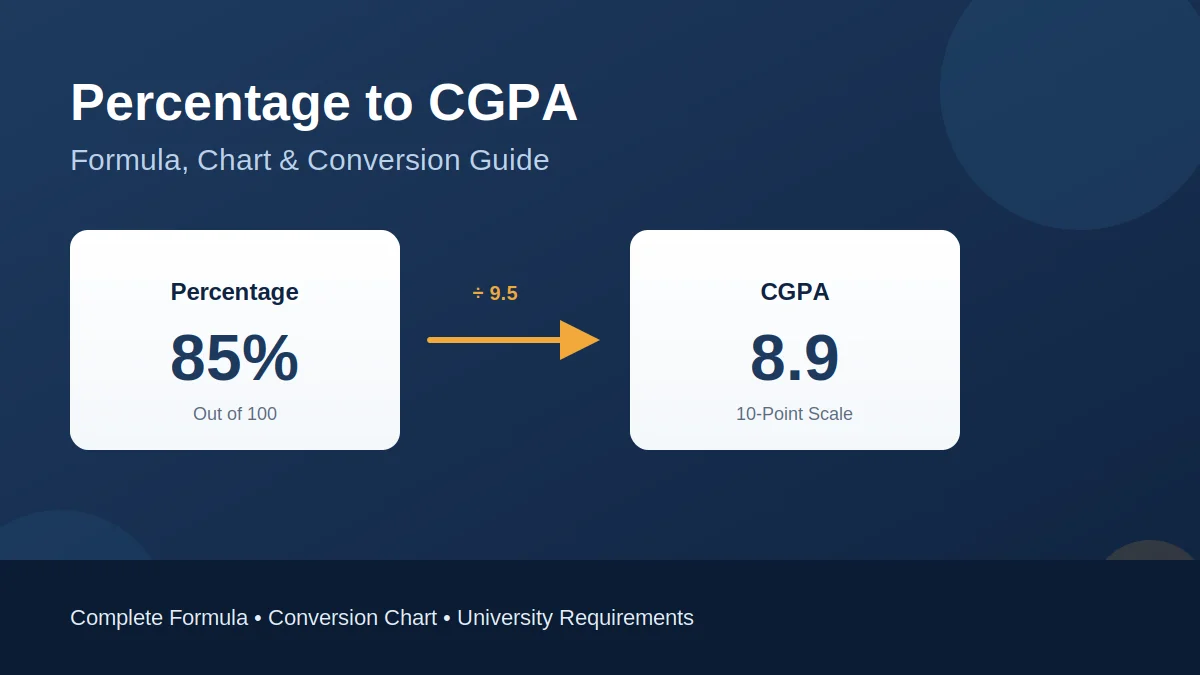
To convert percentage to CGPA on the standard 10-point scale, divide your percentage by 9.5. For example, 85% becomes 85 ÷ 9.5 = 8.9 CGPA. This is the formula CBSE and most Indian universities use by default, though some institutions apply their own multiplier, so it’s worth checking your college’s official conversion policy before submitting any form.
What Is CGPA and How Is It Different From Percentage?
Percentage tells you what portion of total marks you scored — straightforward, out of 100. CGPA, or Cumulative Grade Point Average, instead measures your performance across semesters or years on a fixed scale, usually 10, sometimes 4 or 5.
The two systems exist because percentage doesn’t travel well across borders. A 75% in one country’s board exam might reflect a completely different difficulty level than a 75% somewhere else. CGPA was built to normalize that — at least in theory. In practice, universities still ask for both, which is exactly why this conversion keeps coming up on forms, applications, and HR portals.
CGPA also accounts for credit weightage in many university systems, meaning a tougher, higher-credit course pulls more weight in your final CGPA than a light elective would. Percentage doesn’t usually do that.
The Standard Percentage to CGPA Formula
The 9.5 Divisor Method (CBSE Standard)
The most widely used formula, and the one CBSE itself popularized, is:
CGPA = Percentage ÷ 9.5
So if you scored 76%, your CGPA works out to 76 ÷ 9.5 = 8.0. This formula was originally built the other way around — CBSE told students that CGPA × 9.5 gives an equivalent percentage, and reversing it gives you this division method.
It’s an approximation, not a perfect mirror. Two students who scored 84% and 85% might both round to the same CGPA figure, which is why some scholarship committees or evaluators ask for the original percentage anyway.
Reverse Formula — CGPA to Percentage
If you already have a CGPA and need the percentage equivalent instead:
Percentage = CGPA × 9.5
An 8.2 CGPA translates to 8.2 × 9.5 = 77.9%. This direction comes up constantly for job applications where the recruiter’s form only accepts percentage figures.
Percentage to CGPA Conversion Chart
| Percentage | CGPA (÷9.5) |
|---|---|
| 95% | 10.0 |
| 90% | 9.5 |
| 85% | 8.9 |
| 80% | 8.4 |
| 75% | 7.9 |
| 70% | 7.4 |
| 65% | 6.8 |
| 60% | 6.3 |
| 55% | 5.8 |
| 50% | 5.3 |
Keep in mind this chart uses the standard 9.5 divisor. If your university follows a different scale — and several large technical universities do — these numbers will shift slightly.
How to Convert Percentage to CGPA Step by Step
- Confirm your grading scale. Most Indian boards and universities use a 10-point scale, but some colleges use 4.0 or 5.0 — check your institution’s policy document first.
- Take your total percentage. Use your overall aggregate, not a single subject score.
- Divide by 9.5 (for the standard 10-point scale). This gives your estimated CGPA.
- Round to two decimal places, matching how most transcripts display CGPA.
- Cross-check against your official transcript if one exists — some universities issue CGPA directly and won’t recalculate it from percentage at all.
Quick Takeaway: The 9.5 divisor is a widely accepted approximation, not a universal law. Treat it as a reliable estimate for forms and applications, but always trust your official transcript over a manual calculation when the two disagree.
Percentage to CGPA on Different Scales (10, 5, 4)
Not every institution uses the 10-point system.
- 10-point scale: CGPA = Percentage ÷ 9.5 (most common in India)
- 4-point scale (US-style GPA): GPA = (Percentage ÷ 100) × 4, so an 80% becomes 3.2 GPA
- 5-point scale: Some diploma and vocational programs use this, calculated as (Percentage ÷ 100) × 5
If you’re applying internationally, check which scale the destination university actually reports on — American schools almost universally want the 4.0 conversion, not the 10-point figure.
University-Specific Formulas That Don’t Follow the Standard Rule
Several universities have their own conversion logic that deviates from the 9.5 rule entirely. Some technical universities apply formulas like (CGPA − 0.5) × 10 or similar variants rather than a straight multiplier, which can shift your percentage equivalent by several points either way.
This matters most when you’re right on the edge of an eligibility cutoff — a program that needs 65% might reject a CGPA that “should” convert to 65% under the standard formula but falls short under your specific university’s actual rule. Always pull the official conversion circular from your university’s examination department rather than relying on a generic calculator when something important is riding on the number.
Common Mistakes Students Make When Converting
- Using the wrong scale. Applying the 10-point divisor to a 4.0 GPA system gives a nonsensical result.
- Assuming every university uses 9.5. Several institutions have their own multiplier — this single mismatch causes most conversion disputes.
- Rounding too early. Round only at the final step, not mid-calculation, or small errors compound.
- Ignoring credit weightage. If your CGPA is credit-weighted across semesters, a flat percentage-based conversion won’t fully reflect that.
- Skipping the official transcript. A manual conversion is an estimate. If your college issues CGPA directly, that number — not your calculated one — is what matters for admissions and jobs.
What CGPA Do You Need for Admissions Abroad?
Requirements vary meaningfully by country and program level. Broadly, <cite index=”3-1″>US master’s programs typically require around 66.5% or higher, which converts to roughly a 7.0 CGPA, with top-tier schools generally preferring 80% and above</cite>. <cite index=”3-1″>UK master’s programs generally ask for 60% or more, and merit scholarships tend to start from around 70%</cite>. <cite index=”3-1″>German public universities can accept scores from around 55%, though competitive technical universities prefer 70% or higher</cite>. <cite index=”3-1″>Canadian master’s programs typically look for 60–70%, with top schools favoring 75% and above</cite>.
These are general benchmarks, not guarantees — individual programs, your subject area, and work experience all factor into admission decisions alongside your converted score.
Quick Takeaway
Convert percentage to CGPA using the 9.5 divisor as your default — it’s the CBSE standard and works for most Indian institutions. But before submitting anything official, confirm your specific university’s formula, since several deviate from this rule in ways that can shift your final number.
GradeCalcs.com offers a full range of free tools to calculate percentage, GPA, and final grades — check it out here.
FAQ Section
1. What is the formula to convert percentage to CGPA?
The standard formula is CGPA = Percentage ÷ 9.5, used widely by CBSE and most Indian universities on a 10-point scale. Some institutions apply their own multiplier, so it’s worth confirming with your specific university before relying on this figure for official submissions.
2. Is a CGPA of 8 equal to how much percentage?
Using the standard formula, a CGPA of 8 equals 8 × 9.5 = 76%. This is an approximation based on the commonly accepted 9.5 multiplier, and the exact figure can vary slightly depending on your institution’s official conversion policy.
3. How do I calculate my CGPA from marks?
Take your overall percentage across all subjects, then divide it by 9.5 for the standard 10-point scale. If your university uses a 4.0 or 5.0 scale instead, the formula changes to (Percentage ÷ 100) × 4 or × 5 respectively.
4. Is 7.5 CGPA good?
A 7.5 CGPA converts to roughly 71.25% under the standard formula, which is generally considered a solid, above-average score for most Indian universities and many international master’s programs. Whether it’s “good enough” ultimately depends on the specific program’s cutoff requirements.
5. Does every university use the same CGPA formula?
No. While the 9.5 divisor is the most common standard, several universities and technical institutes use their own conversion formulas that can produce noticeably different results. Always check your college’s official examination policy for the exact method that applies to you.
6. Can I convert CGPA back to percentage?
Yes — multiply your CGPA by 9.5 to get the equivalent percentage under the standard formula. For example, a CGPA of 8.5 converts to 8.5 × 9.5 = 80.75%, though again this assumes the standard 10-point conversion applies to your institution.
7. What’s the difference between CGPA and SGPA?
SGPA reflects your grade point average for a single semester, while CGPA is the cumulative average across all semesters completed so far. Your final CGPA is essentially a weighted average of all your SGPA scores over the course.
8. Do US universities accept CGPA or do I need to convert to GPA?
Most US universities expect a 4.0-scale GPA rather than a 10-point CGPA, so you’ll typically need to convert using (Percentage ÷ 100) × 4, or have your transcript evaluated by a recognized credential service like WES for an official equivalent.
