

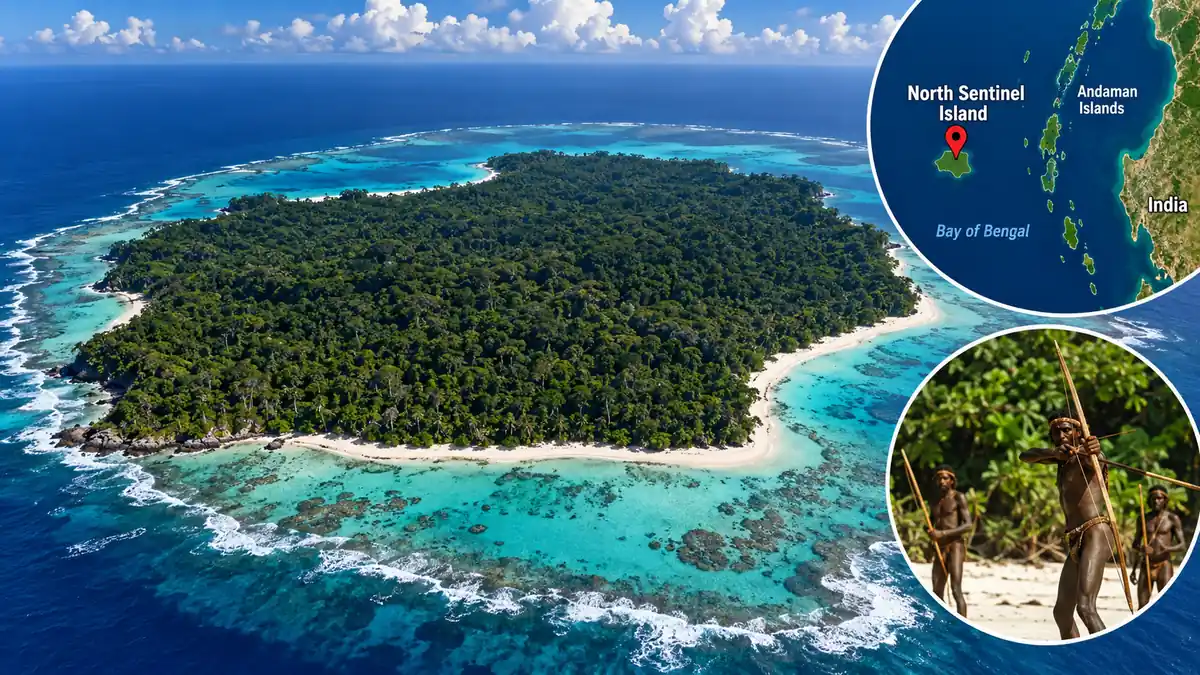
Few places on Earth remain as isolated from the outside world as north sentinel island. Hidden within the Andaman and Nicobar Islands of India, this small, forest-covered island is home to the Sentinelese, an Indigenous community that has consistently resisted contact with outsiders.
Unlike most remote destinations, the island is not a place tourists can visit. Its protected status reflects concerns about the safety, health, and autonomy of its inhabitants.
north sentinel island is a protected island in the Bay of Bengal, administered by India and inhabited by the Sentinelese, one of the world’s most isolated Indigenous communities. The island is off-limits to outsiders because unauthorized contact could expose residents to dangerous diseases, disrupt their way of life, and violate their right to remain isolated.
Understanding this island requires looking beyond sensational stories about its inhabitants. Its geography, history, legal protections, and the challenges of studying an isolated community reveal a more meaningful story about Indigenous rights and cultural survival.
Where Is north sentinel island Located?


4
north sentinel island lies in the Bay of Bengal, within India’s Andaman and Nicobar Islands archipelago. It belongs to the Andaman Islands group and is administered as part of the Andaman and Nicobar Islands Union Territory.
The island is situated west of South Andaman Island, approximately 50 kilometers from Port Blair, now officially known as Sri Vijaya Puram, although distances vary depending on the reference point.
Its approximate geographic coordinates are 11.56° north latitude and 92.24° east longitude.
Geographic characteristics
| Feature | Details |
|---|---|
| Country | India |
| Union Territory | Andaman and Nicobar Islands |
| Water body | Bay of Bengal, northeastern Indian Ocean |
| Approximate area | 60 square kilometers |
| Approximate length | 8 kilometers |
| Landscape | Tropical forests, sandy beaches, coral reefs |
| Inhabitants | Sentinelese Indigenous community |
| Public access | Prohibited without authorization |
The island is surrounded by shallow coral reefs that make approaching its shoreline difficult. Dense tropical vegetation covers much of its interior, limiting what outsiders can observe from boats or aircraft.
Unlike some other Andaman Islands, it has no known modern port, airport, hotel, road network, or publicly documented settlement infrastructure.
How big is north sentinel island?
With an area of approximately 60 square kilometers, the island is relatively small. Its shape is roughly compact, with beaches and reefs forming much of its coastal boundary.
Despite its modest size, the island supports a resident population that has maintained a distinct way of life for generations.
The surrounding marine environment is important because it provides access to fish, shellfish, and other coastal food resources.
Who Are the Sentinelese People?

The Sentinelese are the Indigenous inhabitants of north sentinel island. They are widely recognized as one of the world’s most isolated communities, although describing them as completely uncontacted requires some qualification.
There have been occasional encounters with outsiders, including colonial expeditions, government contact missions, and unauthorized visits. However, the Sentinelese have not established sustained, voluntary relations with the outside world.
Their continued isolation is best understood as a deliberate refusal of unwanted contact rather than evidence that they are unaware of other societies.
How many people live on north sentinel island?
The exact population is unknown.
Estimates have varied considerably, often ranging from a few dozen to around 150 individuals, but these figures are uncertain.
India’s 2011 Census recorded 15 Sentinelese, a figure based on limited observation rather than a complete household census. It should not be interpreted as an accurate count of the entire population.
A reliable modern census would require intrusive access that could endanger the community.
Consequently, no precise current population figure can be verified.
What language do the Sentinelese speak?
The Sentinelese speak their own language, commonly called Sentinelese.
Its vocabulary, grammar, and relationship to other languages remain largely undocumented.
Researchers have sometimes discussed possible connections with other Andamanese languages, including those spoken by the Onge and Jarawa communities. However, there is insufficient linguistic evidence to establish a definite classification.
The language has no publicly documented writing system, and outsiders do not possess a reliable dictionary or translation guide.
What is known about Sentinelese culture?
Information about Sentinelese society comes primarily from distant observations and brief historical encounters.
Observers have documented activities such as fishing, hunting, gathering, and the use of bows, arrows, and small watercraft.
The community has also been observed using metal obtained from materials that washed ashore or came from wreckage.
Yet many important aspects of Sentinelese life remain unknown, including their religious beliefs, social organization, ceremonies, family structures, and oral traditions.
It would be misleading to invent details about these subjects or assume their culture has remained unchanged for thousands of years.
The Sentinelese are a contemporary society, not a living museum of prehistoric humanity.
Why Is north sentinel island Forbidden to Visit?
India restricts access to north sentinel island to protect the Sentinelese and prevent dangerous encounters.
The restriction serves three central purposes: protecting public health, respecting Indigenous autonomy, and preventing unauthorized interference.
Legal protection under Indian law
The island is protected under the Andaman and Nicobar Islands (Protection of Aboriginal Tribes) Regulation, 1956, commonly abbreviated as ANPATR.
This legal framework allows the government to designate tribal reserves and restrict unauthorized entry.
Indian authorities have stated that north sentinel island and a surrounding coastal sea area extending five kilometers from the high-water mark form a protected tribal reserve.
Entering this area without authorization is prohibited.
The legal restrictions apply to tourists, journalists, researchers, fishermen, missionaries, and other unauthorized visitors.
Why contact could be dangerous
One of the greatest concerns is the possibility of introducing infectious diseases.
A relatively isolated population may have had limited exposure to pathogens circulating widely in other communities.
Respiratory infections, influenza, measles, and other contagious illnesses could pose serious risks, particularly when local immunity and healthcare access are unknown.
Historical experiences involving other Indigenous communities demonstrate how introduced diseases can contribute to devastating population losses.
The risk is not limited to physical illness. Forced or unwanted contact could also disrupt established cultural practices and social relationships.
Do the Sentinelese attack outsiders?
The Sentinelese have sometimes responded to approaching outsiders by displaying weapons or shooting arrows.
These actions are frequently described in sensational headlines, but the historical context matters.
Their island has experienced unwanted expeditions, attempts at contact, and unauthorized landings. Defensive behavior toward intruders should not be treated as proof that the inhabitants are inherently violent.
Not every recorded encounter has been hostile. Some government-led contact missions involved peaceful exchanges of coconuts and other items.
The central fact is that the community has repeatedly demonstrated an unwillingness to accept sustained outside contact.
The safest and most respectful response is to stay away.
History of north sentinel island and Outside Contact
Although north sentinel island is often portrayed as a place untouched by history, its inhabitants have experienced several encounters with outsiders over the past two centuries.
Some of these encounters were peaceful. Others involved coercion, violence, or serious violations of the community’s autonomy.
Early records and British colonial expeditions
One of the earliest recorded references to the island dates to 1771, when a British East India Company survey vessel reportedly observed lights along its shore.
In 1867, the merchant ship Nineveh was wrecked near the island. Survivors reached the shore and subsequently encountered Sentinelese inhabitants.
During the British colonial period, officials attempted to investigate and establish contact with various Andamanese communities.
One particularly troubling expedition occurred in 1880 under British administrator Maurice Vidal Portman.
Portman’s party captured several Sentinelese people, including an elderly couple and children, and transported them to Port Blair.
The elderly captives became ill and died. The children were eventually returned to the island with gifts.
This incident illustrates the dangers associated with forced contact and helps explain modern concerns about exposing isolated communities to unfamiliar diseases.

Smithsonian Magazine
+1
Government contact missions in the twentieth century
Following Indian independence in 1947, the Andaman and Nicobar Islands became part of independent India.
During subsequent decades, Indian authorities organized expeditions intended to establish friendly relations with the Sentinelese.
Anthropologist Triloknath Pandit, associated with the Anthropological Survey of India, participated in several such missions.
Teams sometimes approached the island by boat and left coconuts, metal objects, and other items.
Reactions varied. Some islanders accepted gifts, while others displayed weapons or indicated that visitors should leave.
The peaceful contact of 1991
One of the most significant documented encounters occurred in January 1991.
Members of an Indian expedition, including anthropologists involved in earlier contact efforts, were able to exchange coconuts with Sentinelese people without a violent confrontation.
Anthropologist Madhumala Chattopadhyay participated in the contact efforts of that period.
Photographs and eyewitness accounts helped researchers learn more about how the inhabitants responded to approaching outsiders.
However, these brief encounters did not establish ongoing communication, mutual understanding, or consent for future visits.
India eventually moved away from organized direct-contact missions.
Humanities and Social Sciences Communications
+1
The 2004 Indian Ocean tsunami
On December 26, 2004, a powerful undersea earthquake triggered a devastating tsunami across the Indian Ocean.
The Andaman and Nicobar Islands were among the affected regions, raising concerns about the Sentinelese population.
Indian authorities conducted aerial observations to determine whether inhabitants had survived.
During one reconnaissance flight, a Sentinelese man was photographed aiming a bow toward the helicopter.
The sighting provided evidence that members of the community had survived the disaster.
However, the complete impact on the island’s population, coastline, food sources, and settlements could not be established.
The earthquake also caused geological changes in parts of the Andaman region, including changes to coastal elevations and reef exposure.
The 2006 deaths of two fishermen
In January 2006, two Indian fishermen died after their boat drifted near north sentinel island.
Reports indicated that the vessel had entered restricted waters and that the fishermen were attacked by Sentinelese inhabitants.
The incident reinforced the risks associated with unauthorized entry.
It also highlighted why maritime boundaries and enforcement measures matter for protecting both the community and outsiders.
What happened to John Allen Chau in 2018?
In November 2018, American missionary John Allen Chau attempted to contact the Sentinelese despite restrictions on visiting the island.
Chau reportedly arranged transportation with local fishermen and approached the island intending to introduce Christianity.
After multiple approaches, he was killed during an encounter with inhabitants.
His body was not recovered.
The incident attracted international attention and prompted renewed discussion about missionary activity, Indigenous autonomy, and the responsibilities of visitors.
It also demonstrated why personal intentions, even when presented as benevolent, do not justify entering a protected community’s territory without consent.
Smithsonian Magazine
+1
The unauthorized visit in 2025
In March 2025, American visitor Mykhailo Viktorovych Polyakov made an unauthorized landing on north sentinel island.
According to Indian police reports, he approached the island by boat, attempted to attract attention, and briefly landed on the shore.
He reportedly left a coconut and a can of Diet Coke, collected sand, and recorded video footage.
Police arrested him on March 31, 2025.
The incident generated concern because even a short visit can introduce unnecessary health and security risks.
Indigenous rights organization Survival International criticized the intrusion, warning that unauthorized contact could endanger the Sentinelese.
The case illustrates that the island’s restrictions remain relevant in the era of social media and adventure tourism.
AP News
+2
How Do People Survive on north sentinel island?
The Sentinelese appear to maintain a subsistence-based lifestyle supported by the island’s forests, beaches, and surrounding waters.
Much of their daily life remains undocumented, so descriptions must distinguish observed practices from assumptions.
Hunting and gathering
Observers have reported the use of bows and arrows for hunting and fishing.
The island’s tropical environment potentially provides a variety of plant and animal resources.
Known or reported food sources include fish, shellfish, turtles, and wild plant foods.
However, outsiders do not possess a complete inventory of the Sentinelese diet.
The community’s knowledge of seasonal resources, weather patterns, and local habitats likely plays an important role in sustaining life on the island.
Fishing and coastal activities
The shallow waters surrounding the island provide opportunities for coastal fishing.
Sentinelese inhabitants have been observed using small, narrow boats in shallow waters.
These watercraft are generally propelled with poles rather than used for long-distance ocean voyages.
The coral reef environment creates a natural fishing area but also makes navigation hazardous for unfamiliar vessels.
Tools and metalworking
The Sentinelese use bows, arrows, spears, and other implements.
Some observed arrowheads and tools incorporate metal, indicating that the community has adapted materials acquired from outside sources.
Shipwrecks and objects washed ashore may provide usable metal.
This is an important distinction: isolation does not mean an absence of technological adaptation.
A community can selectively adopt useful materials while rejecting sustained contact with outsiders.
Do the Sentinelese use electricity or modern technology?
There is no verified evidence of an electrical grid, telecommunications network, modern road system, or industrial infrastructure on the island.
However, limited observation makes sweeping statements about every object or practice impossible.
The absence of documented modern infrastructure does not mean the inhabitants lack sophisticated practical knowledge.
Their ability to survive independently in a tropical island environment reflects familiarity with local ecological conditions and resource management.
Wildlife, Forests, and the Natural Environment

north sentinel island forms part of the tropical island environment of the northeastern Indian Ocean.
Its natural features include dense vegetation, coastal beaches, coral reefs, and shallow marine habitats.
Because access is restricted, detailed ecological surveys are limited.
Tropical vegetation
Much of the island is covered by tropical forest.
Coastal vegetation may include plant communities adapted to sandy soils, salt exposure, and seasonal tropical weather.
The forest provides shelter, materials, and potential food resources for the inhabitants.
Its ecological condition is therefore directly connected to the community’s ability to maintain an independent way of life.
Coral reefs and marine life
The surrounding reefs are among the island’s most recognizable geographic features.
Coral reef ecosystems can support diverse marine organisms, including reef fish, crustaceans, mollusks, and other coastal species.
These environments are sensitive to changes in water temperature, sedimentation, pollution, and physical disturbance.
Reefs also create navigation hazards, making the island difficult to approach by larger vessels.
Climate and natural hazards
The island experiences a tropical maritime climate influenced by the Indian monsoon.
Typical regional conditions include high humidity, warm temperatures, and seasonal rainfall.
Its geographic location exposes it to natural hazards such as cyclones, storm surges, earthquakes, and tsunamis.
The 2004 Indian Ocean tsunami demonstrated the region’s vulnerability to major geological events.
Climate change, sea-level rise, and coral reef degradation are potential long-term environmental concerns, although island-specific impacts are not comprehensively documented.
Can Tourists Visit north sentinel island?
No. Ordinary tourists cannot legally visit north sentinel island.
The island and its protected surrounding waters are restricted, and unauthorized access can result in arrest and prosecution.
India’s Ministry of Home Affairs has described its approach as an “eyes-on and hands-off” policy, combining monitoring with noninterference in the Sentinelese community’s daily life.
Press Information Bureau
+1
Can you see the island from a boat?
Approaching the island for sightseeing is not permitted within its protected area without authorization.
Tourist operators cannot lawfully treat the restricted waters as a destination for close-up encounters.
Even approaching without landing may create problems if a vessel enters the protected zone.
Can researchers enter the island?
Scientific interest alone does not provide permission to enter.
Any exceptional access would require the relevant government authorization, and contemporary protection policy strongly favors avoiding direct contact.
Researchers can study historical documents, existing photographs, satellite imagery, and regional environmental information without intruding on the community.
Can you see north sentinel island on Google Maps?
Yes. Satellite mapping services such as Google Maps and Google Earth display the island’s geographic location and general physical features.
Users can identify its coastline, vegetation, and surrounding reefs from available imagery.
However, satellite images do not provide a reliable way to determine the population, identify individuals, or understand private cultural practices.
Image resolution, cloud cover, acquisition dates, and vegetation limit what can be observed.
Why Does India Protect the Sentinelese Tribe?
The protection of north sentinel island reflects a broader principle: Indigenous communities should not be forced into contact simply because outsiders are curious about them.
India recognizes the Sentinelese among its Particularly Vulnerable Tribal Groups, or PVTGs.
Government protections are intended to safeguard their territory, resources, and well-being.
The right to remain isolated
Isolation can be a form of self-determination.
The Sentinelese have repeatedly resisted attempts by outsiders to enter their territory or establish relationships.
Respecting that resistance recognizes their ability to make decisions about contact, even when those decisions differ from the expectations of surrounding societies.
The objective is not to preserve people as historical exhibits.
It is to allow them to continue their lives without coercion or unnecessary interference.
Health protection
Communities with limited contact with outsiders may be particularly vulnerable to introduced infections.
Public health risks are among the strongest arguments against unauthorized visits.
Even a seemingly harmless exchange of food, clothing, or gifts can introduce contamination or unfamiliar pathogens.
Avoiding contact minimizes these risks.
Preventing exploitation
Historically, Indigenous communities have experienced land dispossession, coercive labor, cultural disruption, and exploitation after contact with outside groups.
Strong territorial protections help reduce the likelihood of similar harms.
They also discourage activities such as illegal fishing, unauthorized filming, intrusive tourism, and attempts to collect biological or cultural materials.
Monitoring without interference
Indian authorities use maritime and aerial surveillance to monitor the surrounding region.
The Indian Coast Guard and Marine Police have roles in patrolling nearby waters.
The purpose is to discourage unauthorized entry while avoiding routine direct contact with the inhabitants.
This approach seeks to balance territorial protection with respect for the community’s autonomy.
Press Information Bureau
+1
Myths and Facts About north sentinel island
Popular videos and online articles frequently portray the island as a frightening or supernatural destination.
Many of these descriptions exaggerate what is actually known.
| Common claim | What the evidence supports |
|---|---|
| The island is outside every country’s control | It is administered by India. |
| Nobody has ever contacted the Sentinelese | Several historical encounters are documented. |
| The tribe has remained unchanged for 60,000 years | No evidence establishes an unchanged culture over that period. |
| Everyone who approaches is immediately attacked | Reactions have varied, although unauthorized approaches are dangerous. |
| The population is exactly 50 or 150 | No reliable current population count exists. |
| The inhabitants know nothing about outsiders | Their responses demonstrate awareness of approaching people, but their understanding is undocumented. |
| Tourists can visit with a normal travel permit | Ordinary tourist access is prohibited. |
| The island has no technology | The inhabitants use specialized tools and have incorporated metal into some implements. |
Have the Sentinelese lived there for 60,000 years?
Claims that the Sentinelese have lived in complete isolation for 60,000 years are common online.
However, this precise claim is not scientifically established.
Human populations have occupied the Andaman region for a very long time, but that does not prove uninterrupted settlement of this particular island by an unchanged population for a specified number of millennia.
The Sentinelese community’s exact ancestry and settlement history remain uncertain.
Is north sentinel island the most dangerous island in the world?
There is no recognized scientific ranking that establishes it as the world’s most dangerous island.
The phrase is mainly a sensational media description.
The real dangers include unauthorized contact, potentially violent encounters, difficult navigation, legal consequences, and health risks to the inhabitants.
These risks do not justify portraying the Sentinelese as inherently dangerous people.
Why don’t authorities relocate the inhabitants?
There is no demonstrated need to relocate the Sentinelese simply because they live differently from surrounding populations.
Forced relocation could create serious health, cultural, and human rights concerns.
Their island is their home, and current protective policy prioritizes allowing them to remain there.
What Makes north sentinel island Important Today?
The significance of north sentinel island extends beyond its unusual degree of isolation.
It raises fundamental questions about how governments, researchers, journalists, and the public should treat communities that reject outside contact.
For anthropologists, it illustrates the limits of what can responsibly be studied when direct observation would threaten the people being studied.
For conservationists, it demonstrates the connection between Indigenous territorial protection and the preservation of natural habitats.
For policymakers, it highlights the importance of enforcing boundaries against illegal entry while avoiding unnecessary interference.
And for the wider public, it challenges the assumption that every place must be accessible, photographed, documented, or opened to tourism.
Modern satellite technology can reveal the island’s outline. Historical records can describe encounters. Government documents can explain legal protections.
But none of these sources gives outsiders the right to enter or demand access to its inhabitants.
The most responsible approach is to recognize the difference between learning about a community and interfering with its existence.
Conclusion
north sentinel island remains one of the world’s most distinctive protected Indigenous territories. Located in India’s Andaman and Nicobar Islands, it is home to the Sentinelese, whose population, language, and cultural traditions remain only partially understood.
Its history includes colonial expeditions, peaceful contact attempts, natural disasters, and unauthorized visits that have reinforced the need for legal protection.
The island’s greatest significance is not that it is mysterious or forbidden. It is that its inhabitants continue to exercise a choice that deserves respect: the choice to live without sustained outside contact.
Understanding north sentinel island means respecting that boundary, recognizing the limits of available knowledge, and supporting the protection of its people and environment.
