

Ever tried spelling a name over the phone, only to have someone confuse B with D or M with N? In military communications, a small misunderstanding can cause serious problems. That’s why soldiers, pilots, emergency responders, and radio operators use a standardized way to communicate letters clearly.
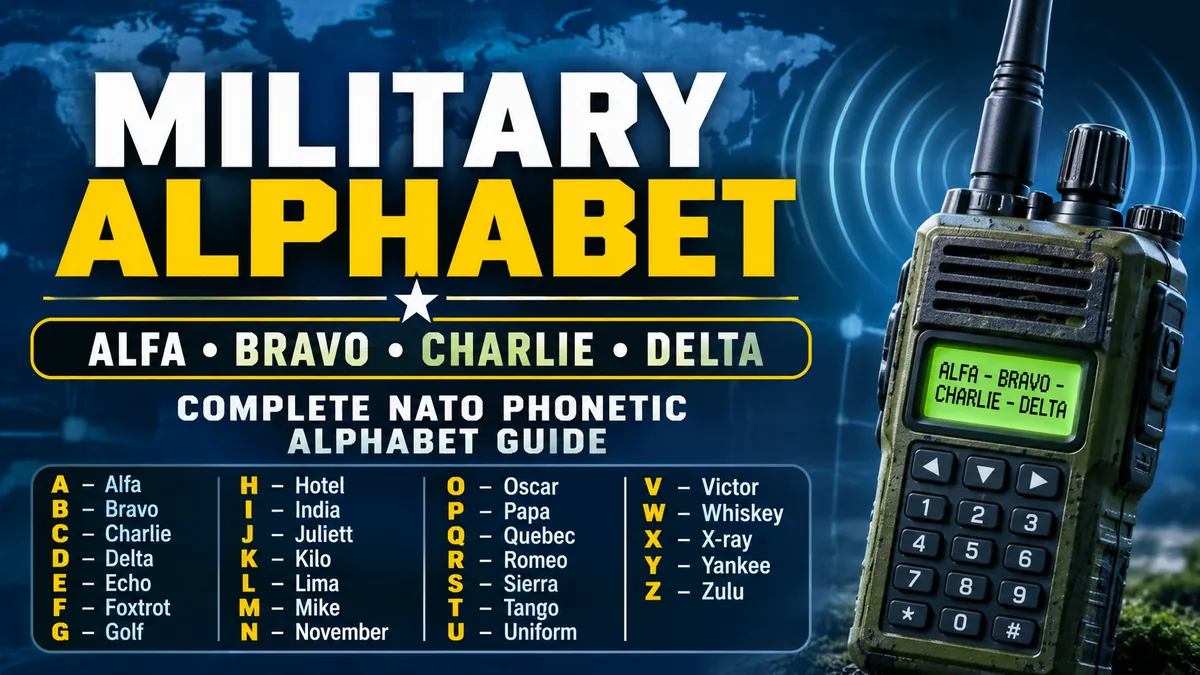
The military alphabet, commonly called the NATO phonetic alphabet, assigns a distinctive code word to each letter of the English alphabet. A becomes Alfa, B becomes Bravo, and Z becomes Zulu. This system helps people communicate names, call signs, coordinates, and other important information accurately, even over noisy radio connections.
What Is the Military Alphabet?
The military alphabet is a standardized spelling system consisting of 26 code words, one for each letter from A to Z. Its official international form is the NATO phonetic alphabet, also known as the International Radiotelephony Spelling Alphabet.
Unlike the regular English alphabet, where individual letters may sound similar, this system uses recognizable words to reduce confusion.
For example, the letters B, D, E, P, T, and V can be difficult to distinguish over a poor connection. Saying Bravo, Delta, Echo, Papa, Tango, and Victor makes their meanings much clearer.
Although often described as a phonetic alphabet, it is technically a spelling alphabet. It does not represent speech sounds in the same way as the International Phonetic Alphabet (IPA).
Complete Military Alphabet A to Z
The following chart contains all 26 official NATO spelling words, along with pronunciation guides.
| Letter | Code Word | Pronunciation |
|---|---|---|
| A | Alfa | AL FAH |
| B | Bravo | BRAH VOH |
| C | Charlie | CHAR LEE |
| D | Delta | DELL TAH |
| E | Echo | ECK OH |
| F | Foxtrot | FOKS TROT |
| G | Golf | GOLF |
| H | Hotel | HOH TELL |
| I | India | IN DEE AH |
| J | Juliett | JEW LEE ETT |
| K | Kilo | KEY LOH |
| L | Lima | LEE MAH |
| M | Mike | MIKE |
| N | November | NO VEM BER |
| O | Oscar | OSS CAH |
| P | Papa | PAH PAH |
| Q | Quebec | KEH BECK |
| R | Romeo | ROW ME OH |
| S | Sierra | SEE AIR RAH |
| T | Tango | TANG GO |
| U | Uniform | YOU NEE FORM |
| V | Victor | VIK TAH |
| W | Whiskey | WISS KEY |
| X | X-ray | ECKS RAY |
| Y | Yankee | YANG KEY |
| Z | Zulu | ZOO LOO |
Pronunciations are simplified English approximations. Official ICAO pronunciation guidance is the appropriate reference for standardized radiotelephony.
Two spellings frequently surprise beginners: Alfa, rather than Alpha, and Juliett, rather than Juliet.
These spellings are intentional. They help make the code words easier to pronounce consistently across different languages.
Why Does the Military Use a Phonetic Alphabet?
Military communication often takes place under conditions where ordinary speech is unreliable.
Radio interference, engine noise, battlefield activity, weak signals, unfamiliar accents, and stressful situations can make individual letters difficult to understand.
The spelling alphabet addresses several practical problems.
Preventing Misheard Letters
Consider a radio operator transmitting the identification code BDP.
Speaking the letters individually could create confusion because B, D, and P have similar ending sounds.
Using the military alphabet, the operator says:
Bravo – Delta – Papa
Each word is more distinguishable than the individual letter it represents.
Improving Communication Between Different Nationalities
Military operations frequently involve personnel who speak different native languages.
Standardized spelling words provide a shared communication convention, particularly during multinational exercises and joint operations.
Communicating Important Information
The system is useful for transmitting:
- Aircraft and vehicle identification codes
- Military call signs
- Names and identification numbers
- Map grid references and coordinates
- Equipment serial numbers
- Operational messages
- Locations and logistical information
The alphabet improves clarity, but it does not replace authentication, encryption, or other security procedures.
How to Use the Military Alphabet Correctly
Learning the words is only the beginning. Effective communication also depends on pronunciation, pacing, and confirmation.
Step 1: Identify the Letters
Start with the word, name, or code you want to communicate.
For example, consider the word ARMY.
Its individual letters are A, R, M, and Y.
Step 2: Replace Each Letter With Its Code Word
Using the official spelling alphabet:
A = Alfa
R = Romeo
M = Mike
Y = Yankee
The complete transmission becomes:
Alfa – Romeo – Mike – Yankee
Step 3: Speak Clearly and at a Controlled Pace
Pronounce each code word distinctly. Avoid rushing through long sequences, especially when the receiving person may be writing them down.
You do not need to shout. Consistent volume and clear articulation are more useful.
Step 4: Confirm Important Information
When accuracy matters, the receiving operator may repeat the information back.
For example:
Sender: “Call sign Bravo – Romeo – Alpha equivalent: Alfa – Victor – Oscar.”
Receiver: “Copied: Bravo – Romeo – Alfa – Victor – Oscar.”
In formal operations, the precise acknowledgment procedure depends on the applicable communications protocol.
Military Alphabet Examples for Everyday Words
Practicing familiar words helps develop confidence and recall.
| Word | Military Alphabet |
|---|---|
| CAT | Charlie – Alfa – Tango |
| DOG | Delta – Oscar – Golf |
| USA | Uniform – Sierra – Alfa |
| NATO | November – Alfa – Tango – Oscar |
| ARMY | Alfa – Romeo – Mike – Yankee |
| NAVY | November – Alfa – Victor – Yankee |
| RADIO | Romeo – Alfa – Delta – India – Oscar |
| HELP | Hotel – Echo – Lima – Papa |
| SOS | Sierra – Oscar – Sierra |
| CODE | Charlie – Oscar – Delta – Echo |
These examples illustrate spelling rather than a special coded language. Saying Sierra – Oscar – Sierra simply spells SOS; it is not the same as transmitting the Morse code distress signal.
Military Alphabet Numbers: 0–9
The 26-letter spelling alphabet is often used alongside standardized number pronunciations in radio communication.
In aviation, certain numbers are pronounced differently from ordinary conversational English to reduce misunderstandings.
| Number | Radio Pronunciation |
|---|---|
| 0 | Zero |
| 1 | Wun |
| 2 | Too |
| 3 | Tree |
| 4 | Fower |
| 5 | Fife |
| 6 | Six |
| 7 | Seven |
| 8 | Ait |
| 9 | Niner |
These pronunciations appear in Federal Aviation Administration (FAA) radiotelephony guidance. faa.gov
Why Is Nine Pronounced Niner?
The pronunciation Niner makes the number nine easier to distinguish from similar-sounding words and numbers during international radio communication.
Similarly, Fife replaces the ordinary pronunciation of five, while Tree is used for three.
These conventions are especially valuable when communicating numbers through poor-quality radio signals.
Not every military unit uses aviation number pronunciations in every situation. The correct procedure depends on the communication system and applicable operating rules.
History of the Military Alphabet
The modern NATO phonetic alphabet did not appear overnight. It developed through several earlier spelling systems designed for military, maritime, and aviation communications.
Early International Spelling Systems
In 1927, the International Telecommunication Union (ITU) introduced an internationally recognized spelling alphabet.
Many of its code words came from geographic names, including Amsterdam, Baltimore, Canada, and Denmark.
The ITU revised its alphabet in 1932, but different organizations continued to use different systems.
The Able Baker Alphabet During World War II
In 1941, the United States military adopted the Joint Army/Navy Phonetic Alphabet.
It became known as the Able Baker alphabet because its first two code words were Able and Baker.
The system included words such as Charlie, Dog, Easy, Fox, George, and How.
The British Royal Air Force also adopted this system during World War II.
Development of the NATO Alphabet in 1956
As international aviation expanded, authorities recognized the need for code words that could be understood by speakers of different languages.
The International Air Transport Association (IATA) developed a revised alphabet in 1951.
Further testing and cooperation involving NATO and the International Civil Aviation Organization (ICAO) led to the standardized alphabet adopted in 1956.
The modern version became effective for NATO on March 1, 1956. The International Telecommunication Union subsequently adopted it as well. NATO History+1
Old Military Alphabet vs. Modern NATO Alphabet
Some older military films, historical documents, and World War II accounts use spelling words that differ from today’s standard.
| Letter | WWII Able Baker Alphabet | Modern NATO Alphabet |
|---|---|---|
| A | Able | Alfa |
| B | Baker | Bravo |
| D | Dog | Delta |
| E | Easy | Echo |
| G | George | Golf |
| H | How | Hotel |
| J | Jig | Juliett |
| K | King | Kilo |
| N | Nan | November |
| P | Peter | Papa |
| S | Sugar | Sierra |
| Z | Zebra | Zulu |
The modern system is the internationally recognized standard for NATO communications, while older versions remain relevant to military history.
Who Uses the Military Alphabet Today?
Despite its name, the military alphabet is not limited to soldiers.
Its usefulness has made it common across industries where accurate verbal communication matters.
Armed Forces
Military organizations use spelling words to communicate call signs, unit identifiers, equipment references, and other information.
NATO standardization helps personnel from different member countries operate together more effectively.
Aviation and Air Traffic Control
Pilots and air traffic controllers use the ICAO radiotelephony spelling alphabet when spelling aircraft identifiers, names, and other information that requires clarification.
For example, an aircraft registration containing ABC may be spelled Alfa – Bravo – Charlie when necessary.
The alphabet is part of a wider aviation communication system that includes standardized terminology and number pronunciations.
Maritime Communication
Ship operators and maritime radio personnel use standardized spelling conventions to communicate vessel identifiers, call signs, and important details.
The International Maritime Organization (IMO) recognizes internationally standardized communication practices for maritime operations.
Police and Emergency Services
Some police departments, fire services, and emergency response organizations use the NATO alphabet.
However, certain agencies use different local spelling systems, so the exact words may vary by organization.
Amateur Radio Operators
Amateur radio enthusiasts frequently use the NATO alphabet to communicate call signs and exchange information, especially when signal quality is poor.
Customer Support and Business Communication
The alphabet is also useful outside professional radio environments.
A customer service representative may use it to confirm a complicated surname, booking reference, or email address.
For example, the code K7M can be communicated as:
Kilo – Seven – Mike
This reduces the chance of confusing K with another letter.
Military Alphabet vs. Morse Code: What’s the Difference?
The military alphabet and Morse code are both communication tools, but they work differently.
The spelling alphabet represents letters with spoken words. Morse code represents letters, numbers, and symbols using combinations of short and long signals.
| Feature | Military Alphabet | Morse Code |
|---|---|---|
| Main purpose | Clear verbal spelling | Encoding characters into signals |
| Method | Spoken code words | Dots and dashes |
| Example for A | Alfa | · — |
| Example for B | Bravo | — · · · |
| Typical medium | Voice or radio | Sound, light, or electrical signals |
| Main advantage | Reduces confusion in speech | Can transmit text without spoken language |
Morse code was particularly important in early telecommunications and remains useful in certain specialized applications.
The NATO alphabet is better suited to situations where people can speak directly to one another.
Common Military Alphabet Terms and Expressions
Some NATO spelling words also appear in military and aviation expressions. Understanding the distinction between a spelling word and an operational phrase helps avoid confusion.
What Does Bravo Zulu Mean?
Bravo Zulu, often abbreviated BZ, is a naval expression meaning well done.
It comes from maritime signaling conventions and is used to acknowledge good performance.
Although Bravo and Zulu are NATO spelling words, the complete expression has a separate meaning. NATO News
What Does Zulu Time Mean?
Zulu time refers to Coordinated Universal Time (UTC), a common time reference used in military operations and aviation.
For example, 1400Z represents 14:00 UTC.
The letter Z is represented by Zulu in the spelling alphabet, which explains the name.
Using a shared time reference helps organizations coordinate activities across different time zones.
What Does Roger Mean?
Roger is a procedural word indicating that a message has been received.
It does not automatically mean the recipient agrees with the message or has completed the requested action.
Roger was also the spelling word for R in some earlier radio alphabets. The modern NATO spelling word for R is Romeo.
What Does Wilco Mean?
Wilco is a shortened form of will comply.
It indicates that the recipient understands the instruction and intends to carry it out.
Roger and Wilco have distinct meanings, and formal communication procedures specify how they should be used.
How to Memorize the Military Alphabet Quickly
Memorizing 26 unfamiliar words may seem difficult at first, but repetition and practical use make the process manageable.
Learn Five or Six Letters at a Time
Instead of trying to remember the entire alphabet immediately, divide it into smaller groups.
For example:
- A–F: Alfa, Bravo, Charlie, Delta, Echo, Foxtrot
- G–L: Golf, Hotel, India, Juliett, Kilo, Lima
- M–R: Mike, November, Oscar, Papa, Quebec, Romeo
- S–Z: Sierra, Tango, Uniform, Victor, Whiskey, X-ray, Yankee, Zulu
Practice each group until you can recall the words without looking at the chart.
Spell Familiar Names
Start by converting your own name, your city, or everyday words into the NATO alphabet.
For example, JOHN becomes:
Juliett – Oscar – Hotel – November
This creates a practical connection between the letters and their spelling words.
Practice in Random Order
Reciting Alfa through Zulu in sequence is helpful initially, but real communication rarely follows alphabetical order.
Try identifying random letters instead.
Ask yourself which word represents Q, then F, then W, then N.
Random practice improves recall when you need a particular letter immediately.
Focus on Difficult Letters
Some code words are easier to remember than others.
Words such as Mike, Golf, and Hotel may feel familiar, while Juliett, Quebec, and Sierra may require more practice.
Pay particular attention to the official spellings of Alfa and Juliett.
Use a Short Daily Exercise
Spend five minutes a day converting words into their phonetic equivalents.
After several sessions, try spelling a full sentence one letter at a time.
Accuracy matters more than speed. Once the words become familiar, your speaking pace will naturally improve.
Common Mistakes When Using the Military Alphabet
Even experienced speakers can make errors if they rely on memory or ordinary pronunciation.
Saying Alpha Instead of Alfa
The official NATO spelling is Alfa, without the letters ph.
This spelling helps maintain consistency among speakers of different languages.
Writing Juliet Instead of Juliett
The official code word for J is Juliett, with two final t’s.
The extra letter is intentional and supports consistent pronunciation conventions.
Replacing Official Words With Personal Alternatives
Using Apple instead of Alfa or Zebra instead of Zulu may seem intuitive, but it defeats the purpose of standardization.
Informal alternatives can create confusion when speakers expect the official alphabet.
Speaking Too Quickly
Rapidly saying several code words can make them difficult to distinguish, particularly over a noisy radio connection.
Use a measured pace and repeat information when necessary.
Confusing Spelling Words With Military Commands
The NATO alphabet does not function as a complete language of commands.
Words such as Tango, Oscar, and Victor represent letters when used for spelling. Their meanings in other expressions depend on context.
Is the Military Alphabet the Same Worldwide?
The NATO phonetic alphabet is internationally standardized and widely used in aviation, maritime communication, military operations, and amateur radio.
Organizations such as NATO, ICAO, and the ITU have contributed to its international adoption.
However, not every organization uses it exclusively.
Some police departments and other agencies maintain their own spelling alphabets. Historical military organizations also used different systems.
For international communication, the modern NATO/ICAO alphabet offers a common standard designed to reduce confusion across languages and accents.
Why the Military Alphabet Still Matters
Modern technology provides digital messaging, automated identification, satellite communication, and advanced data transmission. Yet verbal communication remains essential in many situations.
A radio operator may need to spell a location. A pilot may need to clarify an aircraft identifier. An emergency dispatcher may need to confirm a name.
In each case, the NATO alphabet provides a simple and recognizable method for communicating letters accurately.
Its continued use demonstrates the value of a standardized system that does not depend on specialized software or equipment beyond a working voice connection.
Conclusion
The military alphabet is a practical communication system that replaces individual letters with standardized words, from Alfa and Bravo to Yankee and Zulu.
Developed through decades of international cooperation and standardized in its modern form in 1956, it remains widely used by armed forces, pilots, maritime operators, emergency personnel, and radio enthusiasts.
Learning all 26 words, understanding their pronunciation, and practicing them in everyday situations can make spelling over the phone or radio considerably more reliable.
Start with the complete A–Z chart, practice spelling familiar words, and gradually work toward recalling each code word without assistance.
