

Every scientific experiment begins with a question: What happens when something changes? Perhaps a student wants to know whether sunlight affects plant growth, a researcher investigates how exercise influences heart rate, or a teacher examines whether study time affects test scores.
In each situation, identifying the independent variable is essential to understanding what is being tested.
An independent variable is the factor a researcher deliberately changes or selects to investigate its relationship with another variable. In a controlled experiment, it is the factor being manipulated, while the dependent variable is the outcome being measured. Independent variables help researchers investigate cause-and-effect relationships and test scientific hypotheses.
Understanding this concept makes it easier to design experiments, interpret graphs, analyze data, and distinguish between correlation and causation.
What Is an independent variable?
An independent variable is a variable that is manipulated, categorized, or used as a predictor to examine its relationship with an outcome.
In experimental research, the independent variable is the factor that researchers intentionally change while observing its effect on the dependent variable.
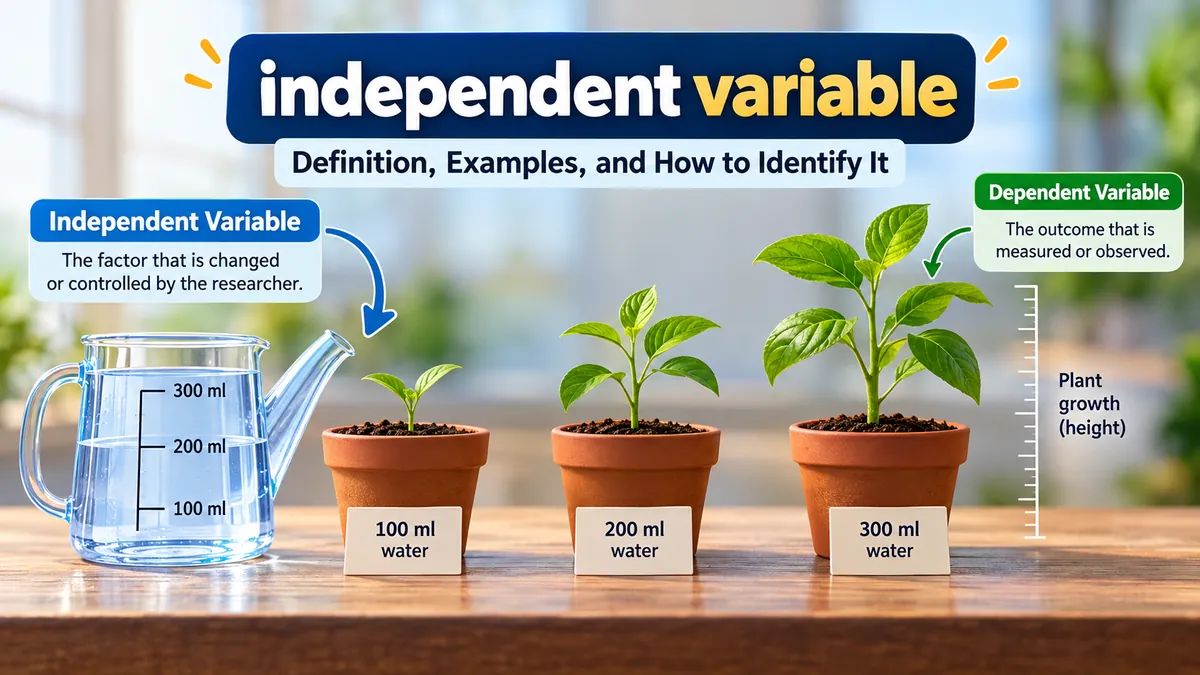
For example, imagine a researcher wants to determine whether the amount of water given to a plant influences its growth.
The researcher gives different plants varying amounts of water and measures their height after four weeks.
In this experiment:
- Independent variable: Amount of water given to each plant
- Dependent variable: Plant growth, measured in centimeters
- Controlled variables: Plant species, soil type, light exposure, temperature, and experiment duration
The amount of water is independent because the researcher determines how much each plant receives.
Plant height is dependent because it is the measured outcome that may respond to the watering conditions.
Why is it called an independent variable?
The term independent refers to the variable’s role in the research design.
In a controlled experiment, its assigned values do not depend on the measured outcome. Researchers establish the experimental conditions before collecting the dependent-variable measurements.
However, an independent variable does not necessarily operate independently of every other influence in the real world.
In observational research, researchers may study independent variables without manipulating them directly.
For instance, age can be used as an independent variable when examining differences in memory performance, even though researchers cannot assign participants their ages.
independent variable vs. Dependent Variable
The distinction between independent and dependent variables is fundamental to scientific research, statistics, and experimental design.
An independent variable represents a possible influence or predictor. A dependent variable represents the response or outcome being investigated.
| Feature | Independent variable | Dependent variable |
|---|---|---|
| Primary role | Predictor or manipulated factor | Measured outcome |
| Experimental treatment | Changed or assigned by researcher | Observed or measured |
| Main question | What is being changed or compared? | What result is being measured? |
| Graph placement | Usually horizontal (X) axis | Usually vertical (Y) axis |
| Plant experiment | Amount of water | Plant height |
| Study experiment | Hours of study | Test score |
| Exercise experiment | Exercise duration | Heart rate |
How do independent and dependent variables work together?
Consider an experiment investigating whether caffeine affects reaction time.
Participants receive different assigned doses of caffeine, and researchers measure how quickly they respond to a visual signal.
The independent variable is the caffeine dose, usually measured in milligrams.
The dependent variable is reaction time, typically measured in milliseconds.
If reaction times differ between dosage groups, the results may indicate an effect of caffeine. Researchers must still consider random variation, measurement accuracy, and other influences before drawing conclusions.
Can a variable be both independent and dependent?
Yes. A variable’s role depends on the research question.
For example, sleep duration could be:
- An independent variable when investigating whether sleep affects academic performance.
- A dependent variable when investigating whether evening screen exposure affects sleep.
A variable is not permanently classified as independent or dependent. Its classification depends on how it functions within a particular study.
Examples of an independent variable in Real Life
Independent variables appear in biology, chemistry, psychology, education, medicine, economics, and everyday decision-making.
The following examples demonstrate how they function in different research situations.
1. Plant growth and sunlight
Research question: Does sunlight exposure affect plant growth?
A researcher places similar plants under different daily light conditions.
- Independent variable: Hours of sunlight per day
- Dependent variable: Increase in plant height
- Controlled variables: Water, soil, plant species, and temperature
Sunlight duration is the independent variable because it is deliberately changed.
2. Study time and exam performance
Research question: Does additional study time improve exam scores?
Students are assigned different amounts of study time before completing the same assessment.
- Independent variable: Assigned study duration
- Dependent variable: Exam score
- Controlled variables: Assessment difficulty, study materials, and testing conditions
If students simply report how long they usually study, the research is observational rather than a controlled experiment.
3. Temperature and dissolving rate
Research question: Does water temperature affect how quickly sugar dissolves?
A researcher adds equal quantities of sugar to water at different temperatures.
- Independent variable: Water temperature
- Dependent variable: Time required for sugar to dissolve
- Controlled variables: Sugar quantity, water volume, particle size, and stirring conditions
Temperature is manipulated, while dissolving time is measured.
4. Exercise and heart rate
Research question: How does exercise intensity affect heart rate?
Participants perform exercise at several predefined intensity levels.
- Independent variable: Exercise intensity
- Dependent variable: Heart rate in beats per minute
- Controlled variables: Measurement timing, exercise duration, and relevant testing conditions
Individual fitness differences can influence results and may require additional controls or statistical adjustment.
5. Fertilizer and crop yield
Research question: Does fertilizer quantity influence crop production?
A researcher applies different fertilizer amounts to comparable plots.
- Independent variable: Fertilizer amount
- Dependent variable: Crop yield
- Controlled variables: Crop variety, irrigation, soil conditions, and growing period
This type of experiment helps agricultural researchers identify useful fertilizer application levels.
6. Advertising and consumer behavior
Research question: Does advertisement design affect click-through rates?
A business randomly displays two advertisement designs to comparable audiences.
- Independent variable: Advertisement design
- Dependent variable: Click-through rate
- Controlled variables: Placement, audience allocation, and campaign period
This is an example of an A/B test, where two conditions are compared to estimate the effect of a specific change.
7. Medication and blood pressure
Research question: Does a particular treatment affect blood pressure?
In a randomized clinical trial, eligible participants may be assigned to a treatment group or comparison group.
- Independent variable: Assigned treatment condition
- Dependent variable: Blood pressure change
- Controlled or balanced factors: Measurement procedures and relevant participant characteristics
Random assignment helps reduce systematic differences between groups, while blinding and standardized measurements can reduce bias.
8. Screen time and sleep quality
Research question: Does evening screen exposure affect sleep quality?
Researchers assign participants different evening screen-use conditions and measure subsequent sleep.
- Independent variable: Assigned screen exposure
- Dependent variable: Sleep quality or duration
- Controlled variables: Sleep schedule, room conditions, and measurement method
If researchers only survey participants about their existing habits, screen time remains a predictor variable, but the study cannot establish causation on its own.
How to Identify the independent variable in an Experiment
Identifying an independent variable becomes straightforward when you separate the factor being investigated from the result being measured.
Follow these steps.
Step 1: Read the research question carefully
Most experiments investigate a relationship between two or more factors.
Consider:
“Does the amount of sunlight affect how quickly a plant grows?”
The two main variables are sunlight exposure and plant growth.
Step 2: Find the factor being changed or compared
Ask:
What factor does the researcher change, assign, or use to predict an outcome?
In the plant experiment, the researcher changes the number of hours of sunlight.
Therefore, sunlight exposure is the independent variable.
Step 3: Identify the measured outcome
Next, ask:
What result does the researcher observe or measure?
The researcher measures plant growth, making it the dependent variable.
Step 4: Identify controlled variables
Controlled variables are conditions researchers attempt to keep consistent.
For the plant experiment, these might include soil type, water quantity, and plant species.
Keeping these conditions consistent reduces alternative explanations for the results.
Step 5: Check whether the study is experimental or observational
This distinction matters.
In a controlled experiment, researchers manipulate or assign the independent variable.
In an observational study, researchers examine naturally occurring differences without assigning them.
Both approaches can use independent variables, but their ability to support causal conclusions differs.
A simple identification test
Use the following sentence:
“If I change or compare X, what happens to Y?”
X is generally the independent variable, and Y is the dependent variable.
For example:
“If I change the water temperature, what happens to the time sugar takes to dissolve?”
Here, water temperature is the independent variable.
Quick takeaway: Identify what is being changed or used as a predictor first. Then identify what is being measured as the outcome.
Types of Independent Variables in Research
Not every independent variable is directly manipulated. Researchers distinguish between different types based on how the variable is introduced into a study.
Manipulated independent variables
A manipulated independent variable is intentionally changed by the researcher.
Examples include:
- Amount of fertilizer applied to plants
- Duration of an exercise session
- Temperature used in a chemical reaction
- Type of teaching method assigned to students
These variables are common in controlled experiments because researchers can establish different experimental conditions.
Subject or attribute variables
A subject variable is an existing characteristic of participants that researchers cannot directly assign.
Examples include age, educational background, and prior work experience.
A researcher investigating whether memory performance differs across age groups might treat age as an independent variable.
However, observing differences between age groups does not prove that age itself caused those differences.
Other characteristics may influence the results.
Continuous and categorical independent variables
Independent variables can also be classified according to the data they represent.
| Type | Description | Example |
|---|---|---|
| Continuous | Can take numerical values within a range | Temperature, time, dosage |
| Discrete | Takes countable numerical values | Number of practice sessions |
| Categorical | Represents distinct groups | Teaching method, treatment type |
| Binary | Has two possible categories | Treatment vs. placebo |
| Ordinal | Has categories with a meaningful order | Low, medium, high intensity |
Understanding the measurement scale helps researchers choose appropriate statistical methods.
How Is an independent variable Used in Scientific Experiments?
The independent variable plays a central role in experimental design because it defines the condition researchers want to investigate.
A carefully designed experiment typically involves a research question, hypothesis, experimental conditions, outcome measurements, and data analysis.
Formulating a hypothesis
A hypothesis is a testable prediction about a relationship between variables.
For example:
“Increasing the duration of daily sunlight exposure will increase plant growth under otherwise comparable conditions.”
Here:
- Independent variable: Daily sunlight exposure
- Dependent variable: Plant growth
- Prediction: Greater exposure will produce greater growth
The hypothesis provides a specific relationship that can be evaluated using evidence.
Establishing experimental and control groups
An experimental group receives a particular treatment or condition.
A control group provides a comparison baseline.
Suppose researchers want to test whether a fertilizer improves plant growth.
They could create three groups:
| Group | Fertilizer amount | Purpose |
|---|---|---|
| Control | 0 grams | Establish baseline |
| Experimental A | 5 grams | Test lower amount |
| Experimental B | 10 grams | Test higher amount |
Fertilizer quantity is the independent variable.
Plant growth is the dependent variable.
Comparing outcomes helps researchers evaluate whether different fertilizer levels are associated with different growth patterns.
Understanding levels of an independent variable
A level is a particular value or category of the independent variable.
For example, an experiment testing water temperatures of 20°C, 40°C, and 60°C has three independent-variable levels.
Using multiple levels can help researchers determine whether the relationship is linear, nonlinear, or associated with a threshold.
A two-level experiment might establish whether a treatment makes a difference. A multi-level experiment can reveal how the response varies across conditions.
Why random assignment matters
Random assignment places participants into experimental conditions using a chance-based procedure.
It helps distribute participant characteristics across groups and reduces selection bias.
Random assignment is especially valuable when researchers want to estimate causal effects.
However, it does not guarantee perfectly balanced groups in every individual experiment.
Researchers must still consider sample size, measurement reliability, adherence, and experimental procedures.
independent variable in Graphs, Mathematics, and Statistics
Independent variables are used not only in scientific experiments but also in algebra, graphing, regression analysis, and predictive modeling.
Understanding their mathematical representation makes it easier to interpret relationships between quantities.
Which axis represents the independent variable?
In most conventional graphs, the independent variable appears on the horizontal X-axis.
The dependent variable appears on the vertical Y-axis.
For example, consider an experiment measuring plant height at different fertilizer levels.
Illustrative data: Fertilizer amount vs. plant height
8 cm12 cm16 cm20 cm24 cm05101520
Hypothetical measurements for demonstration only.
Fertilizer amount is the independent variable; plant height is the dependent variable. These values are hypothetical.
The graph illustrates how plant height might increase initially before declining at a higher fertilizer amount.
This pattern is an example of a possible nonlinear relationship. It does not establish that the same response will occur with every fertilizer or plant species.
Independent variables in algebra
In mathematics, an independent variable is an input whose value can be selected within a function’s domain.
Consider the equation:
\[ y=2x+5 \]
Here:
- \(x\) is the independent variable.
- \(y\) is the dependent variable.
- The number 2 is the slope.
- The number 5 is the Y-intercept.
If \(x=3\), then:
\[ y=2(3)+5=11 \]
Changing the value of \(x\) determines the corresponding value of \(y\).
This is a mathematical relationship, not necessarily a causal relationship in the scientific sense.
Independent variables in regression analysis
Regression analysis examines relationships between a response variable and one or more predictor variables.
A simple linear regression model can be written as:
\[ Y=\beta_0+\beta_1X+\varepsilon \]
Where:
- \(Y\) represents the dependent variable.
- \(X\) represents the independent variable.
- \(\beta_0\) is the intercept.
- \(\beta_1\) represents the expected change in \(Y\) associated with a one-unit increase in \(X\).
- \(\varepsilon\) represents unexplained variation.
For example, researchers might use study hours to predict examination scores.
The regression coefficient estimates the statistical relationship between study time and performance.
However, a regression coefficient does not automatically establish causation.
Can a study have multiple independent variables?
Yes. Many research studies investigate more than one independent variable.
For example, researchers might examine whether both study duration and sleep duration predict examination performance.
The model could include:
- Independent variable 1: Study hours
- Independent variable 2: Sleep hours
- Dependent variable: Exam score
This is an example of multiple regression when both predictors are included in a linear regression model.
Researchers can also study interactions, where the relationship between one independent variable and the outcome depends on another variable.
In a factorial experiment, researchers deliberately vary multiple independent variables to examine their separate and combined effects.
Independent Variables, Control Variables, and Confounding Factors
One of the most common mistakes in experimental design is confusing independent variables with controlled variables or confounding factors.
Although these concepts are related, they serve different purposes.
What is a controlled variable?
A controlled variable is a condition researchers attempt to keep constant throughout an experiment.
For example, when testing how sunlight affects plant growth, researchers might maintain consistent watering schedules, soil types, and plant species.
These conditions are not the primary factors being tested.
Instead, controlling them helps isolate the relationship under investigation.
What is a confounding variable?
A confounding variable is an outside factor associated with both the independent variable and the dependent variable that can distort the estimated relationship between them.
Imagine researchers observe that students who study longer tend to achieve higher examination scores.
Prior academic ability might influence both study habits and examination performance.
Without accounting for relevant differences, researchers cannot confidently attribute the score differences to study duration alone.
What is an extraneous variable?
An extraneous variable is any additional factor that could influence the dependent variable but is not the primary focus of the investigation.
Not every extraneous variable is a confounder.
For example, random fluctuations in room temperature may influence experimental measurements without systematically varying alongside the independent variable.
A confounder creates a particular problem because it can offer an alternative explanation for an observed association.
Comparison of research variables
| Variable | Function | Plant experiment example |
|---|---|---|
| Independent | Factor being tested | Sunlight duration |
| Dependent | Measured outcome | Plant height |
| Controlled | Condition held consistent | Soil type |
| Extraneous | Other potential influence | Unplanned temperature variation |
| Confounding | Factor that distorts the relationship | Fertilizer differences systematically linked to sunlight groups |
Recognizing these differences improves experimental validity and makes conclusions more reliable.
Common Mistakes When Identifying Independent Variables
Even when the definition seems straightforward, students and researchers can make errors when applying it to complex situations.
Confusing the cause with the measured outcome
Suppose an experiment investigates whether music volume affects concentration.
Music volume is the independent variable.
Concentration, measured through task performance, is the dependent variable.
A useful check is to identify the factor assigned or compared before examining the outcome.
Assuming every independent variable is manipulated
Researchers often use naturally occurring characteristics as predictors.
For example, income may be an independent variable in a statistical model examining household spending.
The researcher does not need to manipulate income for it to function as a predictor.
Assuming the independent variable always causes the outcome
A statistical association does not automatically demonstrate cause and effect.
If students who sleep longer receive higher grades, other factors could explain part of that relationship.
Strong causal conclusions require an appropriate research design, careful measurement, and consideration of alternative explanations.
Changing several conditions unintentionally
Suppose researchers test whether a new teaching method improves learning outcomes.
If the experimental group also receives more instructional time and better learning materials, the results become difficult to interpret.
Differences could result from the teaching method, the additional instruction, or the materials.
A better design keeps relevant conditions comparable or explicitly investigates multiple factors.
Failing to define the variable precisely
A research question such as “Does exercise improve health?” is too broad for precise measurement.
Exercise could mean duration, intensity, frequency, or type.
Health could refer to blood pressure, cardiovascular fitness, or another outcome.
A clearer question would be:
“Does assigned weekly aerobic exercise duration affect resting heart rate over eight weeks?”
This identifies a measurable independent variable and a specific dependent variable.
Treating every relationship as linear
Increasing an independent variable does not always produce a steady increase or decrease in the outcome.
For example, moderate fertilizer quantities may support plant growth, while excessive quantities may reduce it.
Researchers should inspect the actual data rather than assuming a straight-line relationship.
Why Are Independent Variables Important?
Independent variables provide structure for scientific investigations and statistical models.
They help researchers define what they are testing, organize comparisons, and evaluate evidence.
Their importance extends across several areas.
Scientific research: Independent variables allow researchers to design controlled experiments and investigate possible causal relationships.
Education: Students use them to formulate hypotheses, complete laboratory reports, and interpret scientific results.
Healthcare: Clinical researchers study treatment conditions, doses, and intervention methods to evaluate patient outcomes.
Psychology: Researchers investigate how environmental conditions, experiences, and experimental treatments relate to behavior.
Business analytics: Analysts use predictors such as advertising exposure or pricing conditions to examine consumer responses.
Statistics: Independent variables provide explanatory inputs for regression models and other analytical methods.
The key benefit is clarity. When researchers define the independent variable precisely, they can create more focused hypotheses and interpret findings more carefully.
Practice Examples: Identify the Independent Variable
Test your understanding with these short scenarios.
Identify the independent variable
0 of 4 answered
1. A scientist changes water temperature to measure how quickly sugar dissolves.Water temperatureSugar dissolving timeAmount of dissolved sugar
2. A teacher assigns different study durations and compares test scores.Test scoreStudy durationStudent identification number
3. A researcher compares memory performance among different age groups.Memory scoreTesting accuracyAge group
4. A trial assigns participants to different treatment doses and measures blood pressure.Treatment doseBlood pressureMeasurement error
Check answers
The same principle applies to more complicated research questions: identify the factor being varied or used as a predictor, then identify the outcome being measured.
Conclusion
An independent variable is the factor researchers manipulate, compare, or use to predict an outcome. It provides the starting point for investigating relationships between variables.
In controlled experiments, researchers deliberately change the independent variable and measure the dependent variable while attempting to account for other influences.
In observational studies and statistical models, independent variables can also represent existing characteristics or predictors that researchers do not directly control.
The easiest way to identify an independent variable is to ask: What factor is being changed, assigned, or compared to understand its relationship with the measured outcome?
