

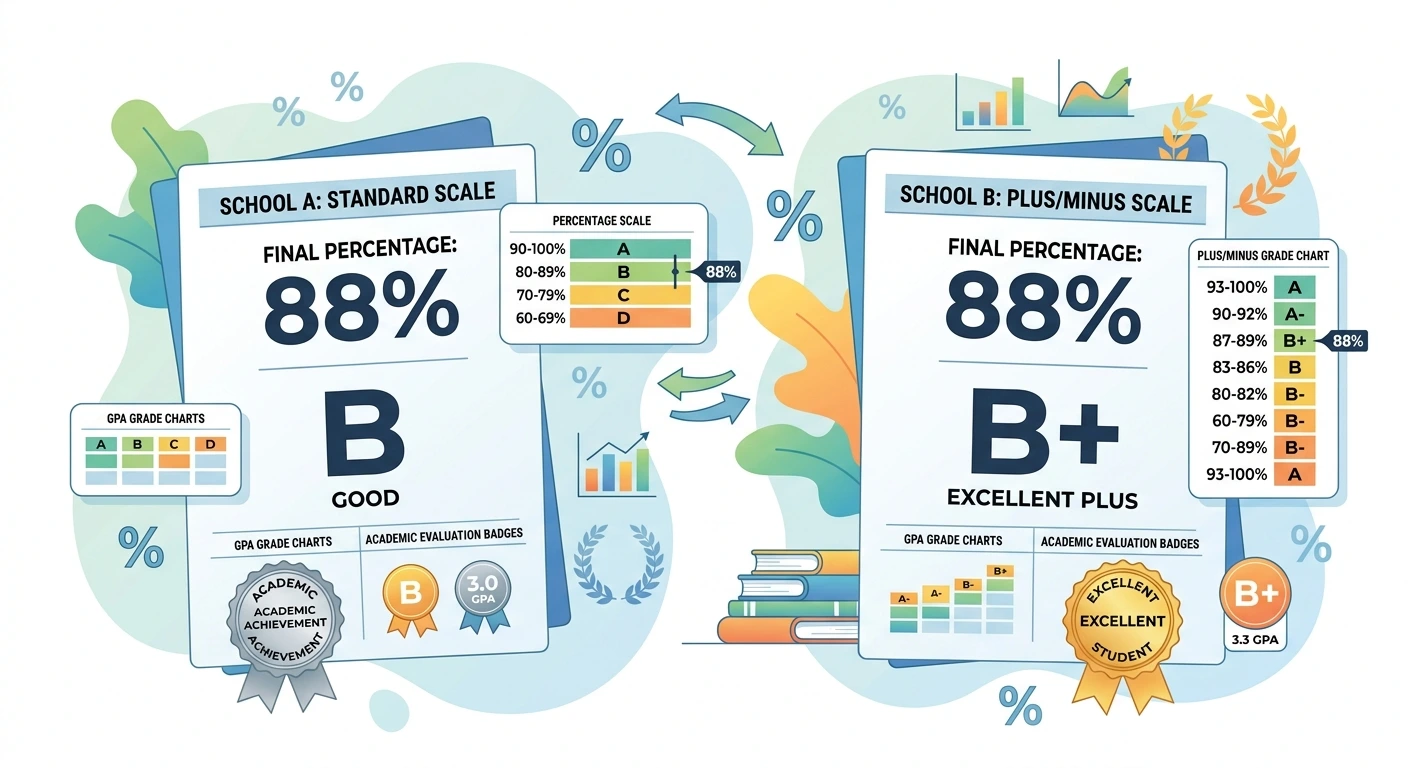
Imagine two students who both score 88% on a science exam. One receives a B, while the other receives a B+. Although their test results are identical, their final letter grades are different. How is that possible?
The answer often comes down to the grading system used by each school or teacher. Percentage scores provide a numerical measure of performance, but grading rules determine how those numbers translate into letter grades.
Understanding these differences can help students interpret their results, set realistic academic goals, and avoid confusion when comparing grades across classes or schools.
What Determines Your Letter Grade?
A letter grade is usually assigned by matching a percentage score to a defined range. For example, a school might award an A for scores between 90% and 100%, a B for scores between 80% and 89%, and a C for scores between 70% and 79%.
However, not every institution follows exactly the same system. Some schools use plus and minus grades, while others have different cutoffs for earning an A or passing a course.
Several factors can affect your final letter grade:
- Percentage boundaries: The minimum score required for each letter grade may differ.
- Plus and minus grades: Some schools distinguish between a B+, B, and B-.
- Rounding policies: Teachers may have specific rules for scores containing decimals.
- Course requirements: Some classes use weighted assignments, exams, projects, or participation scores.
- Institutional policies: A school district or college may establish its own grading rules.
These differences explain why students should check the grading policy for their particular course instead of relying entirely on a general chart.
Understanding the Common US Grading Scale
Many US schools use a basic percentage-based system that assigns a letter grade according to the student’s overall score.
The following table illustrates one commonly used grading structure.
| Percentage | Letter Grade | General Interpretation |
|---|---|---|
| 90–100% | A | Excellent |
| 80–89% | B | Good |
| 70–79% | C | Satisfactory |
| 60–69% | D | Below expectations |
| Below 60% | F | Failing |
This is a simplified example rather than a universal national standard. Some schools begin the A range at 93%, and others use more detailed plus and minus categories.
For students who want to compare different systems, understanding a grading scale can help explain how percentage scores translate into letter grades and why the same result may receive a different classification elsewhere.
Why Some Schools Use Plus and Minus Grades
A basic A-to-F system groups a wide range of scores into five categories. While this approach is simple, it may not show smaller differences in academic performance.
For example, consider two students who earn 81% and 89% on their exams. Under a basic 10-point system, both may receive a B. However, a school using plus and minus grades may assign a B- to the first student and a B+ to the second.
Here is an illustrative plus/minus grading system.
| Letter Grade | Example Percentage Range |
|---|---|
| A | 93–96% |
| A- | 90–92% |
| B+ | 87–89% |
| B | 83–86% |
| B- | 80–82% |
| C+ | 77–79% |
| C | 73–76% |
| C- | 70–72% |
The exact boundaries vary by institution. Some schools also award A+ grades, while others do not use plus or minus distinctions at all.
The main advantage of this approach is that it provides more detailed feedback about a student’s performance within a broader letter-grade category.
How Rounding Can Change a Final Grade
Rounding is another reason students may receive different letter grades for similar percentages.
Suppose a student earns 89.5% on an exam. If the course rounds this score to 90%, the student may qualify for a higher letter grade under a system where 90% is the cutoff.
However, another teacher might keep the score at 89.5% or apply a different rounding rule. In that case, the student may remain in the lower grade category.
Rounding rules should never be assumed. Teachers may calculate grades using unrounded values throughout the term and round only the final result, or they may follow another published policy.
To avoid surprises, students should review their syllabus and ask their instructor how decimal scores are handled.
How Weighted Assignments Affect Your Final Grade
Your test percentage does not always represent your overall course grade. Many teachers assign different weights to exams, homework, quizzes, projects, and other assessments.
For example, imagine a course with the following grading structure:
| Assessment Category | Weight | Student Average |
|---|---|---|
| Exams | 50% | 80% |
| Homework | 30% | 95% |
| Projects | 20% | 90% |
To calculate the final weighted grade, multiply each category’s average by its weight and add the results.
- Exams: 80 × 0.50 = 40
- Homework: 95 × 0.30 = 28.5
- Projects: 90 × 0.20 = 18
The total is:
40 + 28.5 + 18 = 86.5%
The student’s weighted course grade is 86.5%. The corresponding letter grade depends on the grading policy used by the school.
This example shows why a single test score may not accurately represent overall academic performance.
How to Find the Grade You Actually Earned
If you are unsure whether your percentage represents an A, B, or another letter grade, follow these steps.
1. Find Your Exact Percentage
Check your test results or calculate your percentage by dividing the points earned by the total possible points and multiplying by 100.
2. Check Your Course Syllabus
Look for the official grading chart provided by your teacher. It should explain the percentage boundaries and any plus or minus distinctions.
3. Review the Rounding Rules
Determine whether decimal scores are rounded and whether rounding applies to individual assignments or only to the final course grade.
4. Check for Weighted Categories
If you want your overall course grade rather than a single test grade, make sure you account for exams, homework, projects, and other weighted components.
5. Compare Your Score With the Correct Scale
Once you know which rules apply, match your percentage to the appropriate grade range. This helps you interpret your result accurately rather than relying on assumptions.
Frequently Asked Questions
Do all US schools use the same grading scale?
No. Schools, districts, colleges, and individual courses may use different percentage boundaries, letter-grade systems, and rounding rules. Students should follow the official policy for their institution.
Is an 89% an A or a B?
On a basic 10-point grading system, 89% is generally a B. On a plus/minus system, it may be a B+. The result depends on the specific grading rules.
Can two students with the same percentage receive different grades?
Yes. If students attend institutions or classes with different grading boundaries, the same percentage may correspond to different letter grades.
Does a higher letter grade always mean a higher GPA?
Not necessarily across different institutions. Schools may assign different grade-point values to letter grades, and some use weighted GPA systems for advanced courses. Always check the applicable GPA policy.
Why should I check my school’s official grading policy?
A general chart is useful for understanding common grading practices, but your school’s official policy determines the thresholds, rounding rules, and other requirements that apply to your results.
Conclusion
The same percentage can produce different letter grades because schools do not all follow identical grading rules. Percentage boundaries, plus and minus categories, rounding policies, and weighted assessments can all influence how academic performance is reported.
Students can avoid confusion by checking their course syllabus, understanding how their grades are calculated, and using the correct grading chart when interpreting results. Once you know the rules that apply to your class, it becomes easier to understand your academic progress and set realistic goals for improvement.
