

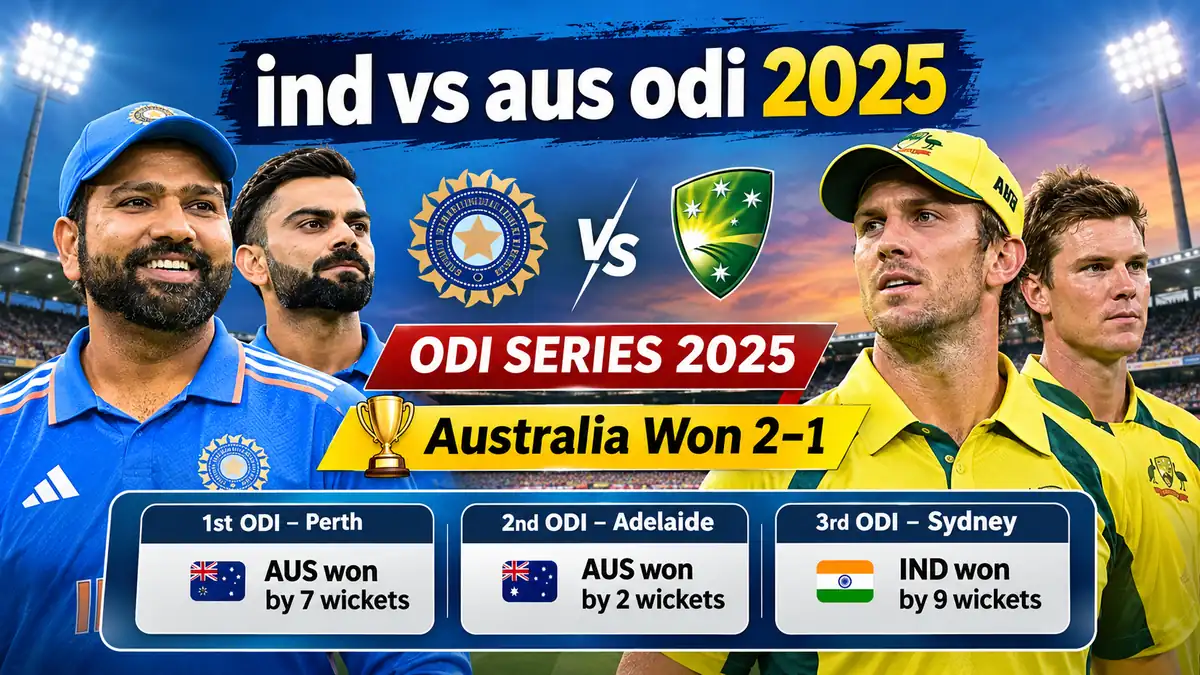
The ind vs aus odi 2025 series delivered three contrasting matches, from a rain-affected opening contest in Perth to a tense finish in Adelaide and a commanding Indian victory in Sydney. Australia ultimately secured the series, but India’s experienced batting stars ensured the final match produced a memorable finish.
Australia won the India vs Australia ODI series 2025 by 2-1. The three matches took place on October 19, 23, and 25 in Perth, Adelaide, and Sydney. Australia won the first two encounters by seven wickets and two wickets, respectively, before India claimed the final ODI by nine wickets. Cricket Australia+1
ind vs aus odi 2025 Series Overview
The three-match One Day International series formed part of India’s white-ball tour of Australia in October and November 2025. The ODI leg preceded a separate five-match T20 International series.
For India, the series featured the experienced batting combination of Rohit Sharma and Virat Kohli alongside a team led by Shubman Gill. Australia, captained by Mitchell Marsh, sought to make the most of home conditions and its established limited-overs bowling resources.
Final ODI series result
Australia won 2–1
India
1 win
Cricket Australia Confirms New Executive Appointments – Ministry of Sport
Australia
2 wins
| Series detail | Information |
|---|---|
| Format | One Day International (50 overs) |
| Dates | October 19–25, 2025 |
| Total matches | 3 |
| Host country | Australia |
| Venues | Perth Stadium, Adelaide Oval, Sydney Cricket Ground |
| India captain | Shubman Gill |
| Australia captain | Mitchell Marsh |
| Series winner | Australia, 2–1 |
The opening game was shortened by rain, while the remaining two ODIs followed the standard 50-over format. Cricbuzz+1
India vs Australia ODI 2025 Schedule and Full Results
All three matches have been completed. The following table provides the dates, venues, scores, and official results.
| Match | Date and venue | Scores | Result |
|---|---|---|---|
| 1st ODI | Oct 19, Perth | IND 136/9 (26); AUS 131/3 (21.1) | AUS by 7 wickets (DLS) |
| 2nd ODI | Oct 23, Adelaide | IND 264/9; AUS 265/8 | AUS by 2 wickets |
| 3rd ODI | Oct 25, Sydney | AUS 236; IND 237/1 | IND by 9 wickets |
Cricket Australia+1
Runs scored in each ODI
First ODI was shortened to 26 overs; other matches were scheduled for 50 overs.
India
Australia
0701402102801st ODI2nd ODI3rd ODI
These results show how the contest developed. Australia controlled the opening match, survived a much closer chase in Adelaide, and then faced India’s strongest performance of the series in Sydney.
Importantly, the score totals alone do not explain the first match. Australia’s victory was determined using the Duckworth–Lewis–Stern (DLS) method, which adjusts targets when rain reduces playing time.
ind vs aus odi 2025: Match-by-Match Highlights
First ODI – October 19, Perth: Australia Won by Seven Wickets
The series began at Perth Stadium, where rain interrupted proceedings and forced a shortened contest.
India finished on 136/9 from 26 overs. Australia’s revised target under the DLS method was lower than India’s raw total, and the hosts reached 131/3 in 21.1 overs to claim a seven-wicket victory.
The match demonstrated how interruptions can change the demands of ODI cricket. Batters must adjust their approach when fewer overs are available, while captains need to reconsider field placements and bowling rotations.
Australia handled the revised chase effectively and moved into a 1-0 series lead. For India, the opening defeat increased the importance of the next encounter in Adelaide.
Key scores: India 136/9 (26 overs); Australia 131/3 (21.1 overs).Cricket Australia+1
Second ODI – October 23, Adelaide: Australia Won by Two Wickets
The second match at Adelaide Oval was the decisive encounter of the series.
India posted 264/9 in its allotted 50 overs, giving Australia a target of 265. The hosts reached 265/8 after 46.2 overs, securing victory with two wickets remaining.
Unlike the rain-affected first match, this contest required both sides to manage a full-length ODI innings. India’s total gave its bowlers something to defend, but Australia successfully completed the chase.
A two-wicket result reflects a much tighter contest than the opening match. Australia had lost eight wickets before reaching the target, meaning another breakthrough or two could have changed the outcome.
The victory established an unassailable 2-0 advantage with one match remaining.
Key scores: India 264/9 (50 overs); Australia 265/8 (46.2 overs).Cricket Australia+1
Third ODI – October 25, Sydney: India Won by Nine Wickets
Sydney Cricket Ground (2026) – Best of TikTok, Instagram & Reddit Travel Guide
5
India produced its most convincing performance in the final ODI at the Sydney Cricket Ground.
Australia won the toss and chose to bat but was dismissed for 236 in 46.4 overs. Matt Renshaw top-scored with 56, while Mitchell Marsh contributed 41.
Harshit Rana was India’s standout bowler, collecting four wickets for 39 runs. His performance helped prevent Australia from establishing a larger total.
India’s response was dominated by Rohit Sharma and Virat Kohli.
Rohit remained unbeaten on 121 from 125 deliveries, striking 13 fours and three sixes. Kohli contributed an unbeaten 74 from 81 balls.
After Shubman Gill was dismissed for 24, Rohit and Kohli combined for an unbroken 168-run partnership. India reached 237/1 in 38.3 overs, winning with 69 balls remaining.Cricbuzz+1
THIRD ODI SCORECARD
Australia
236 all out
46.4 overs
India
237/1
38.3 overs
India won by 9 wickets
Completed
Player of the Match: Rohit Sharma
The Sydney result was significant for several reasons. India avoided a series whitewash, Rohit registered another ODI century, and Kohli recovered from two scoreless innings earlier in the series.
The experienced pair also demonstrated how effective partnership batting can make a chase straightforward even after an opponent has established a competitive-looking total.
Top Batting and Bowling Performances
Individual performances shaped the direction of the series, particularly in the final match.
Rohit Sharma’s Unbeaten Century
Rohit Sharma’s 121 not out in Sydney was the defining batting performance of India’s tour-opening ODI leg.
His innings combined boundary scoring with careful strike rotation. He maintained control throughout the chase, ensuring India did not lose momentum after Gill’s dismissal.
The century was Rohit’s 33rd in ODI cricket and his 50th international hundred across formats. At the time, only Sachin Tendulkar and Virat Kohli had scored more ODI centuries.
His performance also earned him the Player of the Match award. BBC Sport+1
Virat Kohli’s Return to Form
Kohli’s series had a difficult beginning, with ducks in both Perth and Adelaide.
However, his unbeaten 74 in Sydney demonstrated the value of experienced batting under pressure.
He scored seven boundaries and supported Rohit through a long, uninterrupted partnership. Their 168-run stand effectively removed Australia’s opportunity to recover in the final stages of the chase.
During the innings, Kohli also passed Kumar Sangakkara to become the second-highest run-scorer in men’s ODI cricket at that time, behind Sachin Tendulkar. BBC Sport
Harshit Rana’s Four-Wicket Spell
India’s bowlers deserve substantial credit for the Sydney victory.
Harshit Rana returned figures of 4/39, providing breakthroughs that restricted Australia to 236.
His wickets included Alex Carey, Cooper Connolly, Mitchell Owen, and Josh Hazlewood.
Washington Sundar also contributed by dismissing Matthew Short and Matt Renshaw, while Axar Patel removed Mitchell Marsh. Mohammed Siraj, Kuldeep Yadav, and Prasidh Krishna were among the other wicket-takers.
Together, the bowling unit ensured Australia could not turn its starts into a substantially bigger total. Cricbuzz+1
Australia’s Match-Winning Contributions
Australia’s success was built on contributions from several players rather than a single dominant batter.
In Perth, Mitchell Marsh remained unbeaten on 46, guiding Australia through the revised chase. Josh Hazlewood’s 2/20 helped limit India, while KL Rahul’s 38 was the highest score for the visitors. BBC Sport
In Adelaide, Matthew Short scored 74 from 78 balls and Cooper Connolly remained unbeaten on 61 from 53 deliveries. Adam Zampa claimed four wickets for 60 runs and received the Player of the Match award.
For India, Rohit Sharma scored 73 and Shreyas Iyer added 61 in the second ODI. However, Australia successfully chased the target despite losing eight wickets. Cricbuzz+1
Series Awards and Important Statistics
The individual awards offer another perspective on the series. Although Australia secured the overall victory, an Indian batter received the highest individual series recognition.
| Award | Player | Performance |
|---|---|---|
| Player of the Series | Rohit Sharma | 202 runs |
| 1st ODI Player of the Match | Mitchell Marsh | 46 not out |
| 2nd ODI Player of the Match | Adam Zampa | 4/60 |
| 3rd ODI Player of the Match | Rohit Sharma | 121 not out |
Match Centre+2
Rohit’s 202 runs included his half-century in Adelaide and century in Sydney. His performances underline the distinction between individual success and the overall team result.
Australia won the series because it secured victories in the first two matches. India’s dominant final performance could improve the overall impression of its tour, but it could not reverse the series outcome.
What Decided the India vs Australia ODI Series?
Australia’s Ability to Win Critical Moments
The most important factor was Australia’s execution in the opening two encounters.
In Perth, the hosts adapted better to interruptions and the reduced target. Mitchell Marsh provided stability, while the bowling attack prevented India from building a substantial total.
Adelaide presented a different challenge. Australia had to chase 265 and lost eight wickets along the way, yet its middle and lower order completed the task.
Winning both matches meant Australia had already secured the series before arriving in Sydney.
India’s Inconsistent Batting
India’s batting performances varied considerably across the three matches.
The team struggled in the rain-affected opening game and could not defend 264 in Adelaide. Rohit and Kohli also experienced contrasting fortunes during the series, with Kohli failing to score in the first two games.
Sydney demonstrated India’s potential when its bowlers established control and the experienced batters converted their starts into a match-winning partnership.
The difference was consistency. Australia delivered the required performances earlier, while India’s strongest collective display arrived after the series had been decided.
The Influence of Australian Conditions
The three venues presented different challenges.
Perth’s pace-friendly reputation and wet weather complicated the opening match. Adelaide required disciplined bowling and careful management of a substantial run chase. Sydney provided the setting for a more convincing Indian bowling-and-batting performance.
Home conditions can offer an advantage, but teams must still execute their plans. Australia’s ability to adjust to different match situations was a significant part of its success.
Understanding the ODI Rules and DLS Result
One question surrounding the ind vs aus odi 2025 series is why Australia could win the first match despite scoring fewer runs than India.
The explanation lies in the Duckworth–Lewis–Stern method.
How the DLS Method Worked in Perth
A standard men’s ODI gives each team a maximum of 50 overs. When rain interrupts play, the number of overs can be reduced, provided the minimum conditions for an official result are met.
The DLS method recalculates the chasing team’s target using the resources available, particularly overs remaining and wickets lost.
In Perth, India made 136/9 in 26 overs, but Australia’s revised target was 131. Australia reached 131/3 in 21.1 overs and therefore won by seven wickets.
The lower target was not a scoring error. It reflected the official adjustment for the rain-affected contest. BBC Sport
What Does a Nine-Wicket Victory Mean?
India’s nine-wicket win in Sydney means the team reached its target after losing only one wicket.
India needed 237 runs and finished on 237/1. Because the side completed the chase with nine wickets still available, the result was recorded as a nine-wicket victory.
The same principle explains Australia’s seven-wicket win in Perth and two-wicket win in Adelaide.
Why Are ODI Overs Written as 38.3?
Cricket scorecards use balls, not decimal fractions, when displaying partial overs.
For example, 38.3 overs means 38 complete overs and three additional legal deliveries. It does not mean 38.3 overs in decimal notation.
This distinction matters when interpreting strike rates, run rates, and the number of balls remaining in a chase.
India vs Australia ODI Rivalry and the Significance of 2025
India and Australia share one of international cricket’s most competitive rivalries. Their encounters have featured major ICC tournament matches, bilateral series, and numerous influential individual performances.
Australia’s success in the 2023 ICC Men’s Cricket World Cup final and India’s victory in the 2024 T20 World Cup, although achieved against South Africa in that final, formed part of the wider context in which the two nations continued developing their white-ball teams.
The October 2025 ODI series was particularly interesting because of the combination of established stars and emerging players.
For India, Shubman Gill’s captaincy represented an important leadership responsibility. Rohit Sharma and Virat Kohli remained central to the batting lineup, while players such as Harshit Rana and Washington Sundar offered opportunities to develop the bowling unit.
Australia balanced experienced players including Mitchell Marsh, Mitchell Starc, Josh Hazlewood, and Adam Zampa with younger contributors such as Cooper Connolly, Matthew Short, and Matt Renshaw.
The series highlighted three lessons about modern ODI cricket: early wickets can change an innings quickly, middle-order contributions are essential in difficult chases, and experienced batters remain capable of dominating when given time to settle.
It also demonstrated why a bilateral series cannot always be judged by its final match. India finished strongly, but Australia had already done enough to secure the trophy.
Where to Find the India vs Australia ODI 2025 Scorecards and Highlights
Because the ODI series concluded on October 25, 2025, searches for live scores now lead to completed match scorecards, reports, and archived highlights.
Reliable sources include the Cricket Australia series match centre, which contains official results and match reports, and the BCCI third ODI match centre for India’s Sydney victory.
For detailed batting and bowling figures, individual innings, partnerships, and ball-by-ball commentary, the Cricbuzz 2025 India tour of Australia results provides all three ODI records.
When reviewing the series, distinguish the ODI results from the subsequent T20 International matches. The two formats were played during the same tour but had separate series outcomes.
Final Verdict on ind vs aus odi 2025
The ind vs aus odi 2025 series ended with Australia winning 2-1, following victories in Perth and Adelaide before India’s impressive nine-wicket success in Sydney.
Australia’s adaptability, bowling contributions, and ability to complete a difficult chase proved decisive. India, meanwhile, finished with outstanding performances from Rohit Sharma, Virat Kohli, and Harshit Rana.
Rohit’s Player of the Series award reflected his individual excellence, but Australia’s two early victories determined the final outcome.
The series remains a useful example of how ODI cricket rewards consistency across multiple matches rather than one exceptional performance.
