

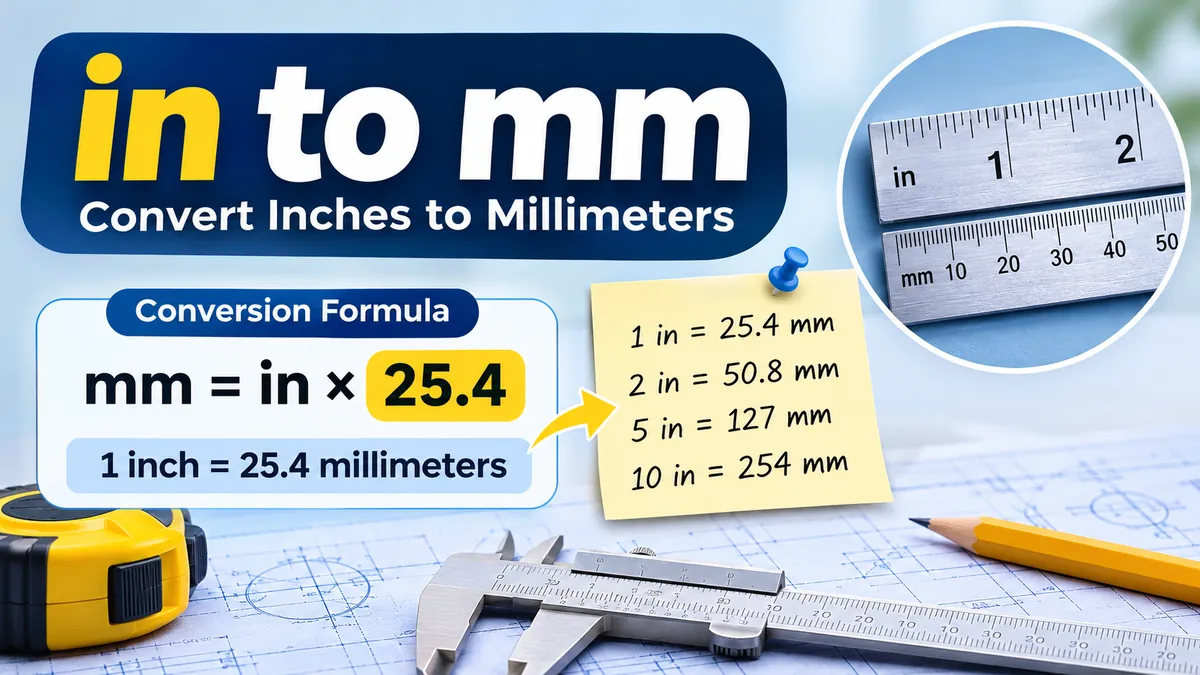
Converting inches to millimeters is a common task when measuring tools, furniture, pipes, screws, electronic components, and construction materials. Because inches and millimeters belong to different measurement systems, knowing the correct conversion factor helps you avoid costly measurement errors.
To convert in to mm, multiply the measurement in inches by 25.4. One inch equals exactly 25.4 millimeters. For example, 2 inches equals 50.8 mm, 5 inches equals 127 mm, and 10 inches equals 254 mm. This conversion works for whole numbers, decimals, and fractional inch measurements.
in to mm Conversion Formula
The standard inch-to-millimeter conversion uses a fixed relationship between the imperial and metric measurement systems.
\[ \text{Millimeters}=\text{Inches}\times25.4 \]
The conversion factor is exact:
1 inch = 25.4 millimeters
This means you do not need an estimated multiplier or a different formula for different types of measurements.
How to Convert Inches to Millimeters Step by Step
- Identify the measurement in inches.
- Multiply the number by 25.4.
- Write the result in millimeters (mm).
- Round only when the application allows it.
For example, convert 7 inches to millimeters:
\[ 7\times25.4=177.8\text{ mm} \]
Therefore, 7 inches equals 177.8 mm.
For decimal measurements, the same method applies. A measurement of 3.75 inches becomes:
\[ 3.75\times25.4=95.25\text{ mm} \]
Inches to Millimeters Conversion Chart
The following reference table shows frequently used measurements. These values are calculated using the exact conversion factor of 25.4.
| Inches (in) | Millimeters (mm) |
|---|---|
| 0.1 | 2.54 |
| 0.25 | 6.35 |
| 0.5 | 12.7 |
| 0.75 | 19.05 |
| 1 | 25.4 |
| 2 | 50.8 |
| 3 | 76.2 |
| 4 | 101.6 |
| 5 | 127 |
| 6 | 152.4 |
| 8 | 203.2 |
| 10 | 254 |
| 12 | 304.8 |
| 16 | 406.4 |
| 20 | 508 |
| 24 | 609.6 |
| 36 | 914.4 |
| 48 | 1,219.2 |
| 60 | 1,524 |
| 72 | 1,828.8 |
| 100 | 2,540 |
A useful measurement to remember is that 12 inches equals 304.8 mm. Since 12 inches make one foot, this also means one foot equals 304.8 millimeters.
Interactive in to mm Converter
Enter a measurement in inches to calculate its equivalent in millimeters instantly.
Inches to Millimeters
1 in = 25.4 mmInches (in)Millimeters (mm)
25.4
1 × 25.4 = 25.4 mmReset
The converter accepts whole numbers and decimal values, making it useful for both everyday measurements and more precise technical work.
How to Convert Fractional Inches to Millimeters
Inches are often expressed as fractions, particularly on measuring tapes and in woodworking, plumbing, and mechanical engineering.
Common fractional measurements include 1/2, 1/4, 1/8, 1/16, and 3/8 inch.
To convert a fractional inch measurement, first divide the numerator by the denominator. Then multiply the decimal result by 25.4.
For example, convert 3/8 inch to millimeters:
\[ \frac{3}{8}=0.375 \]
\[ 0.375\times25.4=9.525\text{ mm} \]
Therefore, 3/8 inch equals 9.525 mm.
Fractional Inch to Millimeter Chart
| Fraction (in) | Decimal (in) | Millimeters |
|---|---|---|
| 1/32 | 0.03125 | 0.79375 |
| 1/16 | 0.0625 | 1.5875 |
| 1/8 | 0.125 | 3.175 |
| 3/16 | 0.1875 | 4.7625 |
| 1/4 | 0.25 | 6.35 |
| 5/16 | 0.3125 | 7.9375 |
| 3/8 | 0.375 | 9.525 |
| 7/16 | 0.4375 | 11.1125 |
| 1/2 | 0.5 | 12.7 |
| 5/8 | 0.625 | 15.875 |
| 3/4 | 0.75 | 19.05 |
| 7/8 | 0.875 | 22.225 |
| 1 | 1 | 25.4 |
For mixed numbers such as 2 1/2 inches, convert the fraction to a decimal and add it to the whole number.
\[ 2+\frac12=2.5 \]
\[ 2.5\times25.4=63.5\text{ mm} \]
Thus, 2 1/2 inches equals 63.5 mm.
Understanding Inches and Millimeters
An inch and a millimeter are both units of length, but they come from different measurement systems.
What Is an Inch?
An inch, abbreviated as in and represented by the symbol ″, is a unit of length used in the US customary and imperial measurement systems.
There are 12 inches in one foot and 36 inches in one yard.
Inches are widely used for screen dimensions, construction materials, hardware, and consumer products, particularly in the United States.
The modern international inch is defined as exactly 25.4 millimeters.
What Is a Millimeter?
A millimeter, abbreviated as mm, is a metric unit of length equal to one-thousandth of a meter.
The relationships within the metric system include:
- 1 millimeter = 0.1 centimeters
- 10 millimeters = 1 centimeter
- 100 millimeters = 10 centimeters
- 1,000 millimeters = 1 meter
Millimeters are especially useful for small dimensions, manufacturing tolerances, technical drawings, and precision measurements.
Inches vs. Millimeters
| Feature | Inch | Millimeter |
|---|---|---|
| Symbol | in or ″ | mm |
| Measurement system | US customary / imperial | Metric / SI |
| Equivalent | 25.4 mm | Approximately 0.03937 in |
| Common use | Construction, screen sizes, hardware | Engineering, manufacturing, science |
| Typical subdivisions | Fractions and decimals | Decimal metric units |
The millimeter is a decimal-based unit, which makes calculations and conversions within the metric system straightforward.
How to Convert Millimeters Back to Inches
The reverse conversion is equally simple. Instead of multiplying, divide the measurement in millimeters by 25.4.
\[ \text{Inches}=\frac{\text{Millimeters}}{25.4} \]
For example, convert 100 mm to inches:
\[ 100\div25.4\approx3.937\text{ in} \]
Therefore, 100 mm is approximately 3.937 inches.
Here are other common reverse conversions:
| Millimeters | Inches (approx.) |
|---|---|
| 1 | 0.03937 |
| 5 | 0.19685 |
| 10 | 0.39370 |
| 20 | 0.78740 |
| 25 | 0.98425 |
| 50 | 1.96850 |
| 100 | 3.93701 |
| 200 | 7.87402 |
| 500 | 19.68504 |
| 1,000 | 39.37008 |
Remember that 25.4 is an exact factor for converting inches to millimeters, but the reverse conversion may produce a repeating decimal.
Where in to mm Conversion Is Used
Converting between inches and millimeters is useful across industries where metric and imperial measurements appear together.
Engineering and Manufacturing
Mechanical engineers frequently work with dimensions expressed in both systems. Technical drawings may specify shaft diameters, hole sizes, fastener dimensions, or machining tolerances in inches while manufacturing equipment displays millimeters.
For example, a component measuring 0.125 inches has a metric equivalent of 3.175 mm.
However, a 3.175 mm component should not automatically be substituted with a 3 mm component. That 0.175 mm difference may affect the fit of precision assemblies.
Construction and Woodworking
Builders and carpenters often convert dimensions when following international building plans or using imported materials.
A board measuring 6 inches across has a converted width of 152.4 mm, provided 6 inches represents its actual measured width.
One detail deserves attention: nominal lumber dimensions are not always the same as finished dimensions. A nominal 2 × 4 piece of lumber commonly measures approximately 1.5 × 3.5 inches after processing, equivalent to 38.1 × 88.9 mm.
Always convert the actual measurement when accuracy matters.
Screws, Bolts, and Drill Bits
Hardware dimensions commonly use both fractional inches and metric measurements.
For example:
- A 1/8-inch drill bit measures 3.175 mm in diameter.
- A 1/4-inch drill bit measures 6.35 mm.
- A 3/8-inch drill bit measures 9.525 mm.
- A 1/2-inch drill bit measures 12.7 mm.
Although these values may be close to standard metric drill sizes, they are not necessarily interchangeable.
Thread pitch, diameter tolerances, and fastener standards must also match.
Screen Sizes and Electronics
Television, monitor, tablet, and laptop screen sizes are often advertised in inches.
A 27-inch monitor has a diagonal measurement of:
\[ 27\times25.4=685.8\text{ mm} \]
This represents the screen’s diagonal, not its width or height.
Electronic components such as printed circuit boards, connectors, and device housings may also require conversions between the two systems.
Plumbing and Pipe Measurements
Plumbing systems use inch-based and metric pipe specifications, but nominal pipe sizes can differ from actual outside diameters.
A pipe described as 1 inch does not necessarily have an outside diameter of exactly 25.4 mm.
For accurate pipe selection, check the applicable pipe standard, nominal size, wall thickness, and actual outside diameter before converting.
How Accurate Is the Inch to Millimeter Conversion?
The conversion factor of 25.4 is exact, not an approximation.
According to the U.S. National Institute of Standards and Technology (NIST), the international inch has been defined as exactly 25.4 mm since July 1, 1959. NIST+1
However, the precision of the converted result depends on the original measurement and the number of decimal places retained.
Exact Conversion vs. Rounded Conversion
Consider a measurement of 5/16 inch.
Its exact decimal equivalent is 0.3125 inches.
\[ 0.3125\times25.4=7.9375\text{ mm} \]
Depending on the application, the result might be displayed as:
| Precision | Result |
|---|---|
| Exact | 7.9375 mm |
| Three decimal places | 7.938 mm |
| Two decimal places | 7.94 mm |
| One decimal place | 7.9 mm |
| Nearest whole millimeter | 8 mm |
All the rounded values describe the same converted measurement at different levels of precision, but they are not equally suitable for every purpose.
For general home measurements, one or two decimal places may be sufficient. Precision machining can require much tighter tolerances.
Significant Figures and Measurement Uncertainty
A conversion factor can be exact even when the original measurement is not.
For instance, a length measured as 2.5 inches using a basic ruler may have more uncertainty than a length measured as 2.5000 inches using calibrated equipment.
Both convert mathematically to 63.5 mm, but that does not mean both measurements have identical accuracy.
The number of digits in a calculator result should not be mistaken for the accuracy of the original measurement.
When working with engineering tolerances, convert the specified upper and lower dimensional limits rather than rounding the nominal measurement alone. NIST’s engineering guidance discusses preserving appropriate tolerances during unit conversion. engineering standards
Common Mistakes When Converting in to mm
Even a straightforward calculation can lead to incorrect results when measurements are interpreted improperly.
Using 25 Instead of 25.4
Rounding the conversion factor to 25 introduces an error.
For 10 inches:
- Correct: 10 × 25.4 = 254 mm
- Incorrect: 10 × 25 = 250 mm
The difference is 4 mm, which can be significant in manufacturing or installation.
Confusing Centimeters With Millimeters
One inch equals 2.54 centimeters or 25.4 millimeters.
These values differ by a factor of ten.
For example, 4 inches equals 10.16 cm or 101.6 mm.
Always check the required output unit before using a result.
Treating Fractional Inches as Decimal Inches
A measurement written as 1/4 inch equals 0.25 inches, not 0.4 inches.
Similarly, 1/8 inch equals 0.125 inches, not 0.8 inches.
Convert the fraction correctly before multiplying by 25.4.
Rounding Too Early
Suppose you need to convert 7/16 inch.
The exact value is 0.4375 inches, giving 11.1125 mm.
If you round 0.4375 to 0.44 before converting, you get 11.176 mm instead.
For accurate results, retain the original measurement throughout the calculation and round only the final answer.
Quick Mental Methods for Converting Inches to Millimeters
When a calculator is unavailable, a few techniques can help you estimate dimensions.
One approach is to remember that 1 inch is approximately 25 mm. This is convenient for rough estimates but should not replace the exact factor in technical work.
Another method is to break the measurement into familiar parts.
For example, to convert 14 inches:
\[ (10\times25.4)+(4\times25.4) \]
\[ 254+101.6=355.6\text{ mm} \]
You can also memorize several reference measurements:
- 1 inch = 25.4 mm
- 2 inches = 50.8 mm
- 4 inches = 101.6 mm
- 6 inches = 152.4 mm
- 12 inches = 304.8 mm
Knowing these reference values makes it easier to estimate other dimensions and recognize obvious calculation errors.
Frequently Needed Inch-to-Millimeter Measurements
Some conversions appear repeatedly in practical situations.
How Many Millimeters Are in Half an Inch?
Half an inch equals 12.7 mm exactly.
\[ 0.5\times25.4=12.7\text{ mm} \]
What Is 1/4 Inch in Millimeters?
One-quarter inch equals 6.35 mm.
\[ 0.25\times25.4=6.35\text{ mm} \]
What Is 3/4 Inch in Millimeters?
Three-quarter inch equals 19.05 mm.
\[ 0.75\times25.4=19.05\text{ mm} \]
How Many Millimeters Are in 12 Inches?
Twelve inches equals 304.8 mm, which is also 30.48 centimeters.
Is 25 mm Exactly One Inch?
No. One inch equals exactly 25.4 mm, so 25 mm is slightly shorter than one inch.
\[ 25\div25.4\approx0.98425\text{ in} \]
The difference is 0.4 mm.
Can Inches and Millimeters Be Used Interchangeably?
They can express the same physical length after conversion, but the numerical values are different.
In engineering and manufacturing, matching the converted dimension does not automatically guarantee compatibility between components. Tolerances, thread specifications, and nominal sizing conventions may also matter.
Conclusion
Converting in to mm requires one simple calculation: multiply the measurement in inches by 25.4. The conversion factor is exact and works for whole numbers, decimal measurements, and fractions.
For reliable results, convert fractions to decimals first, preserve the required precision, and distinguish actual measurements from nominal product sizes.
Use the conversion chart or calculator above whenever you need to convert inches to millimeters accurately for everyday measurements, construction, woodworking, engineering, or technical applications.
