

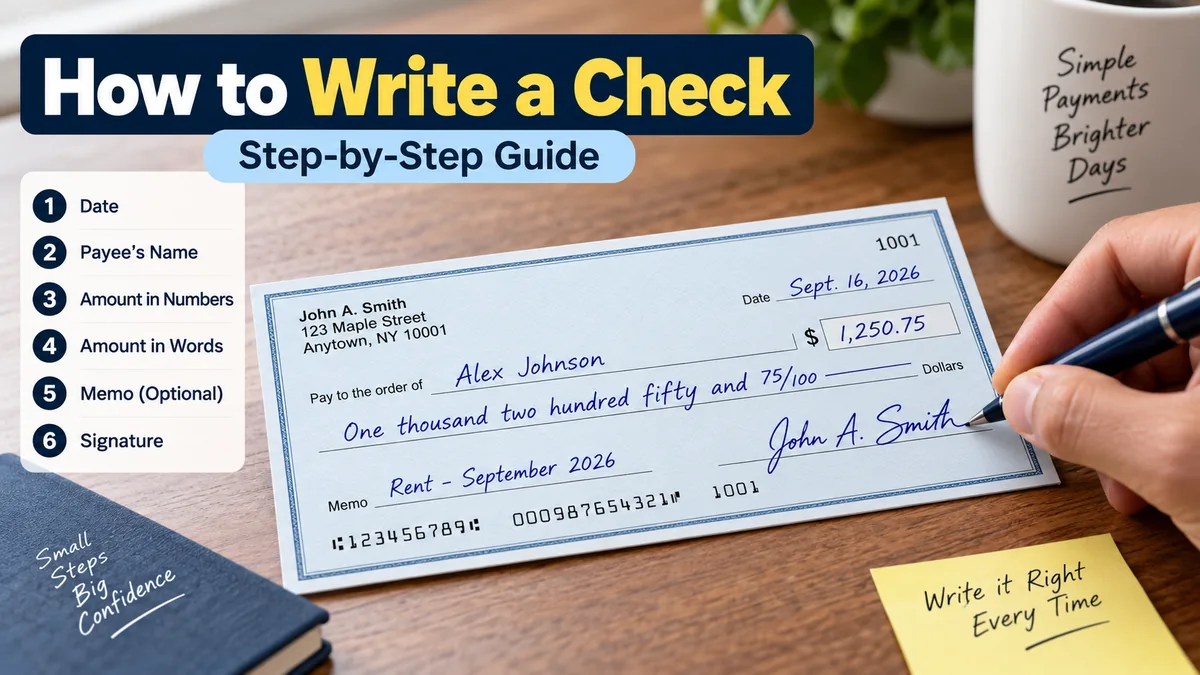
Writing a paper check may feel unfamiliar if you normally pay with a debit card, banking app, or digital wallet. But checks are still used for rent, bills, gifts, deposits, contractor payments, and other transactions. The good news is that filling one out is straightforward once you understand each field.
To write a check, enter the date, write the payee’s name, enter the payment amount in numbers, spell out the same amount in words, add an optional memo, and sign the check. Always make sure the numeric and written amounts match before giving the check to the recipient.
This guide explains how to write a check correctly, what each part means, how to handle cents and large amounts, and how to avoid mistakes that could delay payment or increase the risk of fraud.
What Is a Check and How Does It Work?
A personal check is a paper payment instrument connected to your checking account. When you write a check to another person or organization, you are authorizing your financial institution to pay the stated amount from your account when the recipient deposits or cashes it.
The person or organization receiving the payment is called the payee.
Most personal checks already contain information identifying the account and financial institution. You fill in the information specific to the payment.
Parts of a Personal Check
Before learning how to fill out a check, familiarize yourself with its main sections.
| Part of the check | What it means |
|---|---|
| Account holder information | Usually your printed name and address |
| Date line | Date you write the check |
| Payee line | Person or organization receiving the money |
| Numeric amount box | Payment amount written in numbers |
| Written amount line | Payment amount written in words |
| Memo line | Optional explanation or reference |
| Signature line | Your authorization for payment |
| Routing number | Identifies the financial institution |
| Account number | Identifies the checking account |
| Check number | Identifies that particular check |
The routing number and account number are generally printed along the bottom edge, while the check number commonly appears near the upper-right corner and along the bottom.
You normally don’t need to write or modify any of these preprinted numbers.
How to Write a Check in 6 Steps
The standard process involves six basic fields.
Suppose you need to pay Alex Johnson $1,250.75. Here’s how you would complete the check.
1. Write the Date
Find the date line in the upper-right corner.
Enter the current date, for example:
September 16, 2026
You could also use a numeric format such as:
09/16/2026
Using the current date generally allows the recipient to deposit or cash the check immediately.
Should You Postdate a Check?
Postdating means writing a future date on a check.
For example, you might write October 1 even though you’re preparing the check on September 25.
Don’t assume this guarantees that the money won’t leave your account before the future date. Banking practices and applicable rules can affect how a postdated check is handled, and financial institutions may process checks presented for payment despite a future date. If timing is important, check your bank’s policies or use an appropriate scheduled-payment option instead.
2. Write the Payee’s Name
Look for the line labeled:
Pay to the order of
Write the full name of the person, company, or organization receiving the payment.
For example:
Alex Johnson
If you’re paying a business, use the name the business has instructed you to use.
Accuracy matters. An incorrect or incomplete payee name can create problems when the recipient attempts to deposit or cash the check.
Can You Write a Check to “Cash”?
Technically, a check can sometimes be made payable to Cash, but doing so carries additional risk.
A check made out to a named payee identifies who is supposed to receive the funds. A check payable to Cash may potentially be cashed by whoever possesses it.
If that check gets lost or stolen, recovering the money can become much more difficult.
Writing the recipient’s specific name is generally safer.
3. Write the Check Amount in Numbers
Next, locate the small amount box on the right side of the check.
For a payment of one thousand two hundred fifty dollars and seventy-five cents, write:
$1,250.75
The dollars appear before the decimal point and cents after it.
For exactly $500, write:
$500.00
Writing .00 clearly indicates that there are no cents.
Start the amount close to the left side of the available space. Leaving unnecessary room before the amount could make unauthorized alteration easier.
4. Write the Amount in Words
Directly below the payee line is a longer line where the payment amount is written in words.
For:
$1,250.75
write:
One thousand two hundred fifty and 75/100
The fraction 75/100 represents 75 cents because there are 100 cents in one dollar.
For:
$500.00
you can write:
Five hundred and 00/100
Writing cents as a fraction over 100 is a common and clear way to complete this field.
How to Write Cents on a Check
Here’s a quick reference:
| Numeric amount | Written amount |
|---|---|
| $25.00 | Twenty-five and 00/100 |
| $50.25 | Fifty and 25/100 |
| $75.50 | Seventy-five and 50/100 |
| $100.05 | One hundred and 05/100 |
| $125.99 | One hundred twenty-five and 99/100 |
| $1,250.75 | One thousand two hundred fifty and 75/100 |
After writing the amount, draw a horizontal line through unused space between your wording and the end of the amount line. This reduces room for someone to add extra words or numbers.
What If the Numeric and Written Amounts Don’t Match?
Don’t knowingly issue a check with conflicting amounts.
Banks need to determine the intended payment amount, and discrepancies can lead to delays, rejection, or other processing problems. If you notice the mistake before giving the check away, the safest approach is usually to void that check and write a new one.
Double-check both amounts before signing.
5. Complete the Memo Line
The memo line is usually found in the lower-left portion of the check.
It’s generally optional, but it can be useful for identifying why you made the payment.
Examples include:
- Rent – September 2026
- Invoice #4521
- Birthday gift
- Security deposit
- Tuition payment
- Account reference number
For a bill, the company receiving the check might ask you to include an invoice, customer, or account reference number.
The memo also creates a useful reminder when you later review the transaction or check image in your banking records.
Avoid unnecessarily putting sensitive personal information on the memo line.
6. Sign the Check
The final required step is signing the check.
Find the signature line in the bottom-right corner and add your normal authorized signature.
A signature authorizes payment. An unsigned personal check generally cannot be processed normally.
Check everything before signing.
Confirm that:
- The date is correct.
- The payee’s name is correct.
- The numeric amount is correct.
- The written amount matches it.
- Any necessary reference information is included.
- You have enough available money to cover the payment.
Then sign it.
How to Write a Check Example
Imagine you’re paying Taylor Smith $825.40 for September rent.
Your completed fields would look roughly like this:
| Check field | What to write |
|---|---|
| Date | September 16, 2026 |
| Pay to the order of | Taylor Smith |
| Numeric amount | $825.40 |
| Written amount | Eight hundred twenty-five and 40/100 |
| Memo | September rent |
| Signature | Your authorized signature |
This same format works for most ordinary personal checks.
The recipient can then deposit or cash the check according to their bank’s procedures.
How to Write a Check for $100
A round number can sometimes cause confusion because people wonder what to do with the cents.
For a $100 check, enter:
Numeric box:
$100.00
Written amount:
One hundred and 00/100
Using 00/100 makes it explicit that the payment contains zero cents.
The same approach works for other whole-dollar payments.
For $1,000:
$1,000.00
One thousand and 00/100
For $5,000:
$5,000.00
Five thousand and 00/100
How to Write a Check With Cents
Cents should appear in both representations of the payment.
Suppose you’re writing a check for $247.36.
In the numeric box, write:
$247.36
On the written amount line, write:
Two hundred forty-seven and 36/100
You don’t need to spell out “thirty-six cents” when using the fraction format.
Another example is $80.05:
$80.05
Eighty and 05/100
Remember the leading zero. Writing 05/100 clearly represents five cents.
How to Write a Check for a Large Amount
The process doesn’t change when the payment becomes larger.
Suppose you’re writing a check for:
$12,750.80
The numeric field would show:
$12,750.80
The written line would read:
Twelve thousand seven hundred fifty and 80/100
The main challenge with larger checks is making sure the written amount matches the numeric amount exactly.
For particularly large or important transactions, the recipient may request a cashier’s check or another bank-issued payment rather than a personal check. Different types of checks serve different purposes, so verify the recipient’s requirements before preparing payment.
How to Write a Check Safely
Knowing how to write a check isn’t only about completing the six fields. Paper checks contain sensitive banking information and should be handled carefully.
Use Permanent Ink
Use a pen rather than a pencil.
Pencil can be erased and changed. Clear permanent writing makes unauthorized alterations more difficult.
Several banking guides specifically recommend using blue or black ink.
Don’t Leave Large Blank Spaces
Start the numeric amount close to the beginning of the amount box.
On the written amount line, start near the left edge and draw a line through unused space after the amount.
For example:
Two hundred fifty and 00/100 —————
This makes additions more difficult.
Never Sign a Blank Check
A signed check with no payee or payment amount creates unnecessary risk because someone obtaining it could potentially complete those fields.
Fill in the recipient and amount before signing.
Write Clearly
You don’t need beautiful handwriting.
You do need readable handwriting.
Printing the payee, memo, and written amount clearly can reduce confusion and processing errors.
Verify the Payee
When you’re paying a company, contractor, landlord, or other organization, confirm exactly what name should appear on the payee line.
Don’t simply assume the legal or deposit name.
Keep Your Checks Secure
Blank checks contain your account and routing information.
Keep unused checks somewhere secure, and don’t leave a checkbook unnecessarily in a vehicle, public workspace, or other easily accessible location.
Be Careful When Mailing Checks
Check theft and alteration are real risks. If you must mail a check, use a secure mailing method rather than leaving it exposed in an unsecured mailbox.
For payments that don’t specifically require a physical check, an electronic payment method offered by your bank may sometimes reduce the need to mail account information.
What Is a Routing Number?
The routing number identifies the financial institution associated with an account.
On U.S. personal checks, it is typically part of the series of machine-readable numbers printed along the bottom. Capital One describes the routing and account numbers as preprinted information typically located at the bottom of a check.
You don’t normally write the routing number yourself when preparing an ordinary personal check.
It’s already printed there.
What Is an Account Number?
Your account number identifies the specific bank account from which the payment will ultimately be drawn.
It is also generally preprinted along the bottom of the check.
Because account and routing information is sensitive financial information, don’t casually share photos of completed or blank checks online.
What Is the Check Number?
A check number is a unique sequential identifier that helps you keep track of individual checks.
For example, your checkbook might contain:
- Check 0101
- Check 0102
- Check 0103
- Check 0104
When you write check 0103, recording that number makes it easier to identify the transaction later.
Check numbers are commonly printed in the upper-right area and may also appear along the bottom of the check.
Should You Keep a Check Register?
A check register is a record of checks and other transactions affecting your checking account.
For every check, you can record the:
| Information | Example |
|---|---|
| Check number | 0103 |
| Date | 09/16/2026 |
| Payee | Taylor Smith |
| Description | September rent |
| Amount | $825.40 |
Recording checks matters because the money may remain in your bank account until the recipient actually deposits the check.
That means your displayed balance can temporarily be higher than the amount you can safely spend.
For example, suppose your account has $2,000 and you’ve written an $800 check that hasn’t cleared. You shouldn’t treat the entire $2,000 as available for new spending.
Keeping track of outstanding checks helps reduce the chance of overdrawing your account.
What Happens After You Write a Check?
Once you’ve completed and signed the check, you give or send it to the payee.
The recipient can typically deposit it into a bank or credit union account. Depending on their institution, that might be done at a branch, ATM, or through mobile check deposit.
The recipient generally endorses the check by signing the designated endorsement area on the back before depositing or cashing it. Mobile deposits may require additional wording specified by the financial institution.
The check then goes through banking systems for processing, after which the corresponding amount is debited from the payer’s checking account if the check is honored.
What Does It Mean to Endorse a Check?
Writing and endorsing are two different actions.
The writer completes and signs the front of the check.
The recipient generally endorses the back before depositing or cashing it.
The endorsement area is normally marked on the back of the check. Depending on the deposit method, the recipient may simply sign their name or follow additional instructions from their financial institution.
If you’re the person writing the check to someone else, you normally don’t endorse the back.
How to Void a Check
Mistakes happen.
Suppose you accidentally write:
$520.00
when you meant:
$250.00
Rather than trying to turn the existing numbers into something else, it’s usually cleaner and safer to void the check and start again.
Write:
VOID
clearly across the check.
When a voided check is being provided for banking purposes such as setting up direct deposit, avoid obscuring the routing and account numbers if the receiving organization needs to read them.
If the check isn’t needed for recordkeeping, dispose of it securely.
Can You Write a Check to Yourself?
Yes.
You can generally write your own name on the payee line and deposit the check into another account that accepts it.
For example:
Pay to the order of: Jordan Williams
You would then complete the amount and signature as usual.
This was historically a common method of transferring money between accounts, although electronic transfers now make it unnecessary in many situations.
Personal Check vs. Cashier’s Check
A personal check and cashier’s check aren’t the same thing.
| Personal check | Cashier’s check |
|---|---|
| Written from your checking account | Issued through a bank or credit union |
| You complete and sign it | Financial institution issues it |
| Funds come from your account when processed | Bank-issued payment mechanism |
| Common for everyday payments | Often requested for higher-value transactions |
A recipient may specifically require one type, particularly for large purchases or deposits.
If someone asks for a cashier’s check, don’t assume that an ordinary personal check will satisfy the requirement.
Common Mistakes When Writing a Check
Most check-writing problems are easy to avoid.
One common mistake is writing different amounts in the numeric and written fields. Another is misspelling the payee’s name or forgetting the signature.
Leaving excessive blank space can also create an avoidable fraud risk.
Before handing over a check, quickly review these six items:
- Date: Is it correct?
- Payee: Is the recipient’s name accurate?
- Numeric amount: Did you enter dollars and cents correctly?
- Written amount: Does it exactly match the numeric amount?
- Memo: Is any requested reference information included?
- Signature: Did you sign it?
That 10-second review can prevent a much longer banking problem.
How Long Is a Personal Check Good For?
Don’t assume an old personal check will always be accepted.
Banks may treat an older check as stale-dated. Huntington Bank, for example, notes that banks have the option to refuse payment on a personal check older than six months.
Policies and legal requirements can vary, so an old check should be handled according to the relevant bank’s rules rather than relying on a general assumption.
If you’ve found an old uncashed check, contacting the issuer for a replacement may be simpler.
Do You Still Need to Know How to Write a Check?
Paper checks are less central to everyday payments than they once were, but they’re far from useless.
You might still encounter them when paying:
- Rent
- Contractors
- Security deposits
- School expenses
- Local organizations
- Certain bills
- Gifts
- Business invoices
Checks can also provide a clear payment record because your banking history may preserve information or images associated with processed checks.
The basic skill takes only a few minutes to learn.
How to Write a Check Correctly Every Time
The easiest way to remember how to write a check is to follow the same sequence every time: date, payee, numeric amount, written amount, memo, signature.
Write clearly in permanent ink, make the two payment amounts match, fill unused spaces, and never sign a blank check. Before handing it over, check the recipient’s name and amount one final time.
Once you’ve followed those six steps a few times, filling out a personal check becomes a simple routine rather than a confusing banking task.
