

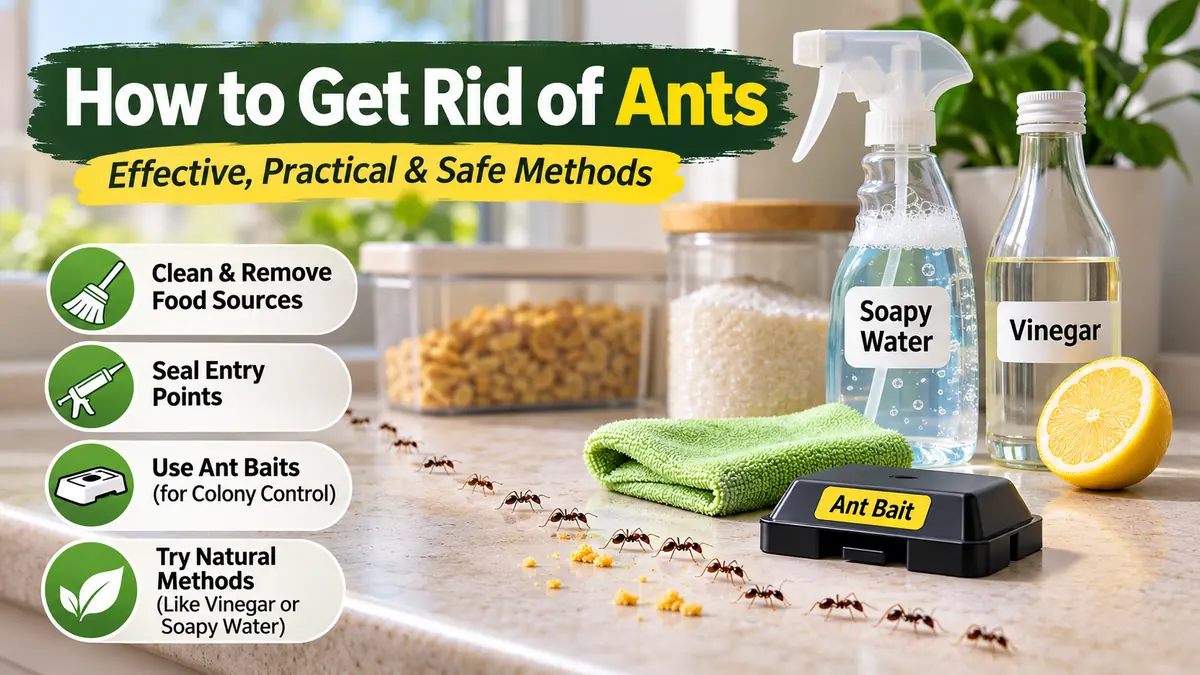
A few ants crawling across your kitchen counter can quickly turn into a steady trail leading toward your pantry, sink, or pet food bowl. Wiping them away may provide temporary relief, but unless you address what attracts them, more ants can appear.
Learning how to get rid of ants involves more than killing the insects you can see. Effective control means removing food and water sources, disrupting their trails, blocking entry points, and targeting colonies when necessary.
To get rid of ants, clean up food spills, wipe away scent trails with soapy water, seal cracks around doors and windows, and use properly placed ant bait stations when needed. Baits allow worker ants to carry insecticide back to their colony, helping control ants that surface sprays cannot reach. UC IPM+1
Why Do Ants Keep Coming Into Your House?
Ants generally enter homes in search of food, water, or suitable nesting conditions. Even a few crumbs beneath a refrigerator or a small amount of spilled juice can attract foraging workers.
Once an ant discovers a food source, it may leave a chemical trail called a pheromone trail. Other workers follow this signal, creating the familiar lines of ants moving across floors and countertops.
Common reasons ants invade homes
- Accessible food: Sugar, honey, fruit, bread crumbs, grease, and pet food attract different species.
- Water and moisture: Leaky faucets, damp cabinets, condensation, and wet soil provide moisture.
- Entry points: Tiny gaps around window frames, foundations, doors, and plumbing allow ants indoors.
- Outdoor colonies: Ants nesting in soil, mulch, tree stumps, or landscaping may forage inside.
- Seasonal conditions: Changes in rainfall, temperature, and outdoor food availability can influence ant activity.
A clean home can still experience an infestation. Ants may enter through structural gaps or follow moisture sources even when food is stored carefully.
The University of Maryland Extension recommends removing food attractants, cleaning active areas, and locating entry routes as basic household ant-management measures. University of Maryland Extension
How to Get Rid of Ants Quickly: A Step-by-Step Method
When ants suddenly appear indoors, the first goal is to remove the immediate problem without making long-term control more difficult.
Step 1: Follow the ant trail
Before cleaning everything, observe where the ants are traveling.
Look around:
- Window frames and door thresholds
- Kitchen sinks and plumbing openings
- Baseboards and wall cracks
- Electrical and utility penetrations
- Pantry shelves and food containers
Following a trail can reveal whether ants are entering from outdoors or emerging from a hidden indoor nest.
Step 2: Remove the food source
Clear away anything attracting the ants.
Wipe up sugary spills, remove crumbs, rinse food packaging, and place open foods in airtight containers.
Empty overflowing garbage bins and wash pet bowls after feeding.
Removing the attraction helps prevent additional workers from gathering in the same area.
Step 3: Clean ants and scent trails
Mix a small amount of dish soap with water and wipe the affected surface.
Soapy water removes visible ants and helps disrupt the chemical trails they use to navigate.
A vacuum cleaner can also remove groups of ants from floors and corners. Empty the vacuum contents promptly into a sealed outdoor trash container.
Step 4: Block their entry points
Once you identify an entry route, close the opening.
Silicone caulk works for many gaps around window frames, baseboards, and plumbing penetrations. Weatherstripping can help close spaces around doors.
If ants are actively feeding on bait, avoid sealing their access route until the bait has had time to work.
Step 5: Use ant bait if activity continues
For recurring infestations, place a labeled ant bait station along an active route, preferably near an outdoor entry point.
Worker ants collect the bait and carry it back to their nest.
Unlike contact sprays, slow-acting baits can affect colony members that never enter your home.
Do not spray insecticide or strong repellents directly around the bait, because this can discourage ants from feeding.
How to Get Rid of Ants Naturally Without Harsh Chemicals
Natural ant-control methods can be useful for cleaning, reducing attraction, and discouraging entry. However, not every popular home remedy has strong evidence supporting colony elimination.
The most dependable nonchemical approach combines sanitation, exclusion, and moisture control.
1. Dish soap and water
A forma inesperada de afastar formigas da cozinha sem usar químicos. – xailedavo.pt
A mild soap solution is one of the simplest ways to remove ants from household surfaces.
Add a few drops of dish soap to water, apply it to a cloth, and wipe the affected area.
This method is particularly useful around kitchen counters, floors, and washable surfaces.
Avoid spraying electrical outlets or sensitive appliances.
Best for: Immediate removal of visible ants and disruption of scent trails.
2. White vinegar solution
Diluted white vinegar can help clean surfaces and temporarily interfere with ant trails.
Mix equal parts white vinegar and water, then wipe suitable hard surfaces.
Avoid using vinegar on natural stone such as marble or limestone, because its acidity can damage the finish.
Vinegar is not a reliable way to destroy an established colony. Ants may establish another route once the odor disappears.
Best for: Cleaning washable surfaces and temporarily discouraging trail-following.
3. Peppermint oil
Peppermint oil has a strong odor, and some essential-oil compounds show repellent effects against certain insects.
However, evidence for dependable household ant control is limited.
Essential oils can irritate skin and may be hazardous to pets, particularly cats. Avoid applying concentrated oils where animals or children can contact them.
Peppermint oil should not replace sanitation, sealing, or effective baiting.
Best for: A possible short-term deterrent in carefully selected areas, rather than colony elimination.
4. Lemon juice and citrus
Lemon juice is another commonly suggested household remedy.
Its acidity and scent may temporarily interfere with ant activity on treated surfaces, but it does not reliably eliminate nests.
Using lemon juice repeatedly without removing food sources is unlikely to solve a recurring infestation.
Avoid acidic cleaners on surfaces that can be damaged by them.
5. Food-grade diatomaceous earth
Diatomaceous earth is a powder made from fossilized microscopic aquatic organisms called diatoms.
It can damage the protective outer layer of certain insects, causing them to lose moisture.
For ant control, use only a product specifically labeled for the intended pest and application area.
Apply according to its label, keeping dust away from food, children, pets, and areas where it could become airborne. Avoid breathing the powder.
Never substitute pool-filter diatomaceous earth for a pest-control product.
Diatomaceous earth can affect ants that contact it, but it does not reliably eliminate an inaccessible colony.
6. Cinnamon and coffee grounds
Cinnamon and used coffee grounds frequently appear in lists of natural ant repellents.
Their strong odors or physical presence may alter ant movement temporarily, but neither has dependable evidence as a complete household ant-control treatment.
Ants can simply travel around the material.
These remedies are less useful than sealing the actual opening through which ants enter.
Which natural ant remedies work best?
| Method | Immediate effect | Colony control |
|---|---|---|
| Soapy water | Removes visible ants and trails | No |
| Diluted vinegar | Cleans and disrupts trails temporarily | No |
| Peppermint oil | Possible short-term deterrent | Not established |
| Lemon juice | Temporary surface effect | No |
| Labeled diatomaceous earth | Can kill exposed ants | Limited |
| Cinnamon or coffee grounds | Unreliable deterrent | No |
| Sealing entry points | Prevents access through treated gaps | No, but reduces invasion |
Quick takeaway: Natural methods work best for removing visible ants and preventing entry. Persistent colonies generally require targeted baiting, nest management, or professional treatment.
How to Get Rid of Ants Permanently Using Ant Baits
개미약 강력추천 | Ant Bait | 개미 하루만에 사라지는 마법 | Terro :: Brown English
Ant baits are among the most effective tools for managing recurring household infestations.
The goal is not to kill every worker immediately. Instead, the bait uses the ants’ food-sharing behavior to deliver an active ingredient into the colony.
How ant bait works
A typical ant colony includes queens, workers, developing larvae, and other members.
Foraging workers collect food and share it with nestmates through a process called trophallaxis.
Many ant baits contain a food attractant combined with a slow-acting insecticide.
The delay allows workers to return to the nest before the active ingredient takes effect.
Depending on the species, colony structure, and bait formulation, this can substantially reduce or eliminate an infestation.
The University of California Integrated Pest Management Program explains that slow-acting baits are generally more useful for colony management than simply spraying visible ants. UC IPM
Choosing the right ant bait
Ant species have different food preferences, which can also change with colony needs.
Some prefer sweet liquids, while others respond better to protein- or grease-based bait.
Common ant-bait active ingredients include:
- Boric acid and borates
- Fipronil
- Hydramethylnon
- Abamectin or related avermectins
Availability and approved uses vary by location.
Choose a registered product labeled for the ant species and setting. Enclosed, tamper-resistant bait stations are preferable where children or pets might otherwise access the bait.
Where should you place ant bait?
Good locations include active trails, outdoor nest openings, and protected areas near entry points.
Follow the product label for placement.
Do not put exposed pesticide bait on food-preparation surfaces or anywhere children and animals can reach it.
Avoid cleaning or spraying the immediate bait-feeding area while ants are actively collecting it. Clean other surfaces and remove competing food sources instead.
How long does ant bait take to work?
Some ant populations begin declining within a few days, while others require one or two weeks or longer.
UC IPM notes that noticeable reductions can take approximately 5–10 days with suitable baiting, although results vary. UC IPM
You may initially notice more ants around a bait station because workers are recruiting others to the food source.
That activity does not automatically mean the infestation is worsening.
Replace depleted bait as directed and monitor activity.
Is homemade borax bait a good idea?
Borax and boric acid are commonly discussed in homemade ant-bait recipes.
Although borate compounds can be effective in properly formulated products, homemade mixtures introduce problems with concentration, exposure, and placement.
An overly concentrated mixture may kill workers before they return to the nest. An improperly stored mixture can also create poisoning risks for children and pets.
Commercially formulated, labeled bait stations are a safer and more consistent option than leaving homemade toxic mixtures exposed.
How to Get Rid of Ants in Different Areas of Your Home
Ant control should match the environment where the insects appear.
A kitchen infestation may be driven by food, while bathroom activity often suggests a moisture source.
How to get rid of ants in the kitchen
Kitchens provide several attractive resources: sugar, grease, crumbs, water, and food waste.
Begin by checking beneath appliances and behind storage containers.
Clean countertops after food preparation, store pantry items in sealed containers, and rinse recyclable packaging.
Inspect the area beneath the sink for leaks or damp wood.
If ants continue entering, trace the trail toward a window, pipe opening, or exterior wall.
Use bait stations according to their labels, away from food-contact areas.
How to get rid of ants in the bathroom
Bathrooms attract ants because of moisture, condensation, and plumbing gaps.
Check for dripping faucets, leaking pipes, and damp cabinet interiors.
Improve ventilation and dry standing water.
Seal gaps around plumbing penetrations after identifying any active trails.
If ants repeatedly emerge from behind tiles or wall fixtures, investigate hidden moisture or nesting conditions.
How to get rid of ants in the bedroom
Bedrooms may attract ants when food wrappers, drinks, or crumbs are left near beds and furniture.
Remove food waste and vacuum carpets, baseboards, and furniture edges.
Inspect window frames and nearby wall cracks.
Avoid applying pesticides to mattresses, bedding, pillows, or clothing.
If ants appear in bedding without an obvious food source, inspect surrounding furniture and nearby entry points rather than spraying the sleeping area.
How to get rid of ants in walls
Ants emerging from electrical outlets, baseboards, or wall openings may be traveling through structural voids.
The nest could be indoors, or the ants may simply be using the wall as a passageway.
Do not pour water, household cleaners, or pesticide liquids into electrical outlets or wall cavities.
Observe the trails and check for moisture damage.
Persistent activity from the same wall area may justify a professional inspection.
How to get rid of ants in potted plants
Ants may nest in potting soil or visit plants to feed on honeydew produced by aphids, mealybugs, and scale insects.
Inspect the leaves and stems for these plant pests.
Remove fallen fruit, spilled fertilizer, and other attractants.
Move infested pots away from indoor living areas while investigating the problem.
Use plant-safe treatments labeled for the particular pest, rather than applying household insecticides indiscriminately.
How to Get Rid of Ants Outside and Around Your Foundation
How to Get Rid of Ants in the Garden | Garden UK
Outdoor ant colonies are common and often beneficial.
Ants help decompose organic material, aerate soil, and prey on other insects.
Eliminating every ant in a yard is neither realistic nor necessary.
Instead, focus on reducing the colonies and pathways that create indoor problems.
Remove outdoor attractants
Clear fallen fruit, exposed food waste, and other materials that attract ants.
Keep garbage containers closed and clean.
Check outdoor faucets and irrigation systems for persistent leaks.
Trim plants touching the house
Branches and shrubs can create pathways between outdoor colonies and indoor entry points.
Trim vegetation away from siding, windows, and roof edges.
Keep mulch and dense vegetation away from the foundation where practical.
Manage aphids and scale insects
Some ants protect aphids and scale insects because these pests produce a sugary substance called honeydew.
This relationship can encourage ant activity around shrubs, trees, and garden plants.
Managing honeydew-producing pests may reduce the food supply supporting nearby ant populations.
Treat troublesome outdoor colonies selectively
If a colony repeatedly sends ants indoors, a labeled outdoor bait station placed near active trails may help.
Avoid broad pesticide spraying across lawns, driveways, sidewalks, or foundations.
Such treatments may harm beneficial organisms, contaminate runoff, and provide only temporary relief.
UC IPM recommends prioritizing sanitation, exclusion, and appropriately placed bait stations over routine broad-area spraying. UC IPM
Identify the Ant Species Before Choosing a Treatment
Not every ant behaves the same way.
Identifying the species helps explain where it nests, what it eats, and why certain control methods fail.
| Ant type | Common characteristics | Typical concern |
|---|---|---|
| Argentine ants | Small, dull brown, often form long trails | Large interconnected colonies |
| Odorous house ants | Small, dark ants with a strong odor when crushed | Recurring indoor foraging |
| Carpenter ants | Larger black or reddish-black ants | Nesting in wood |
| Pavement ants | Small brown to dark ants often found near paving | Entry through foundation cracks |
| Pharaoh ants | Very small, yellowish to light brown | Difficult indoor infestations |
| Fire ants | Often reddish ants associated with outdoor mounds | Painful stings |
Appearance alone may not provide a reliable identification. Regional species differ, and several ants look similar.
Carpenter ants versus termites
Carpenter ants deserve particular attention because they can excavate galleries inside wood.
Unlike termites, carpenter ants do not eat wood. They remove it to create nesting spaces.
Signs of carpenter ants may include large workers, sawdust-like material called frass, and activity near damp or damaged wood.
Termites and winged ants can also be confused.
Ants typically have elbowed antennae and a narrow waist, while termites have straighter antennae and a broader waist.
If you find wood damage or repeated piles of frass, arrange an inspection rather than assuming an ordinary kitchen ant treatment will solve the issue. UC IPM+1
Why Pharaoh ants need special care
Pharaoh ants can be particularly challenging in apartment buildings and other large structures.
They may establish multiple nests in warm indoor locations.
Certain repellent treatments can disturb colonies and encourage them to split or relocate, potentially spreading the infestation.
Professional identification and a coordinated baiting strategy are preferable to indiscriminate spraying.
Common Mistakes That Make Ant Infestations Worse
Even diligent cleaning may fail when the underlying colony remains active.
Spraying every ant you see
Contact sprays may kill exposed workers without reaching queens or developing ants inside the nest.
New workers can continue entering the home.
Repeated spraying may also interfere with baiting.
Using too many repellents together
Applying vinegar, essential oils, insecticide sprays, and bait in the same area can produce conflicting effects.
Repellents may prevent ants from approaching the bait intended to control their colony.
Choose a coordinated strategy rather than combining products randomly.
Ignoring water sources
Removing crumbs while leaving a leaking pipe untreated can allow activity to continue.
Inspect damp cabinets, plumbing connections, and areas where condensation accumulates.
Expecting overnight colony elimination
Slow-acting bait requires time.
Removing or relocating a station after only a few hours may interrupt the feeding process.
Monitor progress over several days and follow the manufacturer’s instructions.
Using pesticides incorrectly
Never mix pesticide products, increase concentrations beyond label directions, or apply outdoor-only products indoors.
Avoid foggers and broad indoor sprays for routine ant problems.
The U.S. Environmental Protection Agency advises keeping pesticide products in their original containers and ensuring children and pets cannot reach insect baits. US EPA
How to Prevent Ants From Coming Back
Long-term prevention depends on making your home less accessible and less attractive to foraging ants.
A practical routine can substantially reduce repeat invasions.
Daily prevention habits
- Wipe food-preparation surfaces after meals.
- Sweep or vacuum visible crumbs.
- Store sugar, cereal, and other dry foods in sealed containers.
- Clean pet feeding areas.
- Remove standing water and fix obvious drips.
- Keep garbage lids closed.
Weekly home maintenance
Inspect pantry shelves, appliance edges, and kitchen cabinets.
Check under sinks for moisture.
Look for new ant trails around doors and windows.
Clean outdoor trash bins and remove fallen fruit near the house.
Seasonal prevention
Before periods when ants commonly enter homes, inspect the exterior foundation and seal visible gaps.
Repair damaged weatherstripping.
Trim plants touching the building.
Address drainage problems and damp wood.
Ant prevention is an ongoing process, particularly in warm climates where colonies may remain active for much of the year.
When Should You Call a Professional Exterminator?
Many small household ant problems can be managed through cleaning, sealing, and targeted baiting.
However, professional pest management may be appropriate when:
- Ant activity continues after one to two weeks of properly applied baiting.
- Large numbers of ants repeatedly emerge from walls or structural cavities.
- Carpenter ants or possible wood damage are present.
- Multiple apartments or connected buildings are affected.
- Stinging ants create a risk around children, pets, or outdoor activity areas.
- You cannot identify the species or locate the source.
A pest management professional can inspect nesting sites, identify the species, and select treatments appropriate to the building.
Ask about an integrated pest management (IPM) approach, which combines inspection, sanitation, exclusion, monitoring, and targeted pesticide use rather than relying exclusively on routine spraying.
How Long Does It Take to Get Rid of Ants?
The time required depends on colony size, species, nesting location, and treatment method.
| Treatment | Typical expectation |
|---|---|
| Soapy-water cleaning | Removes visible ants immediately |
| Sealing entry points | Blocks treated openings once sealed |
| Natural repellents | Temporary and inconsistent effects |
| Ant bait stations | Noticeable reduction often within several days to two weeks |
| Professional colony treatment | Varies with species, infestation, and access to nests |
| Ongoing prevention | Reduces the likelihood of future invasions |
A decline in visible ants is encouraging, but it does not necessarily prove that the colony has been eliminated.
Continue monitoring previously active areas.
If ants return after a short period, investigate whether a different colony, an untreated nest, or a newly opened entry route is responsible.
Final Thoughts: How to Get Rid of Ants for Good
Understanding how to get rid of ants starts with recognizing that the insects crawling across your floor are usually only a small part of a much larger colony.
For immediate relief, remove accessible food, clean visible trails with soapy water, and identify entry points.
For persistent activity, appropriately selected ant bait can provide more effective colony control than repeated surface spraying.
Combine those measures with sealed cracks, moisture repairs, careful food storage, and regular monitoring.
The most reliable solution is not a single miracle ingredient. It is a consistent approach that removes what attracts ants, limits their access, and addresses the colony when necessary.
