

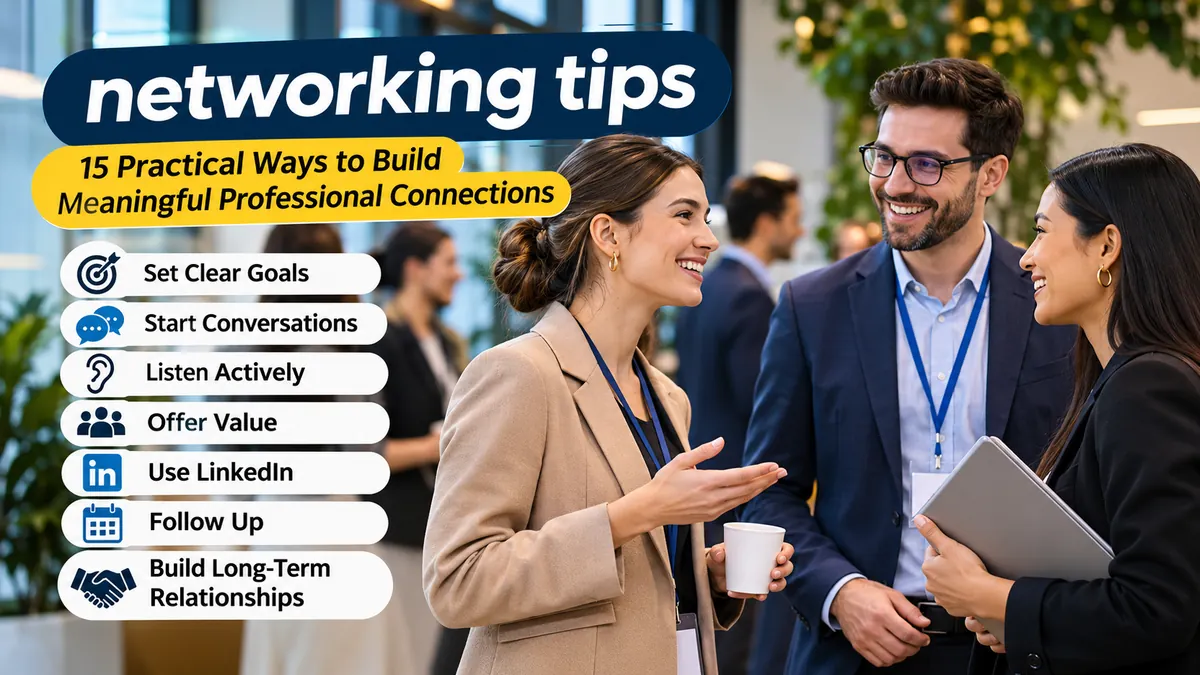
Building a professional network can feel uncomfortable, especially when you don’t know how to start a conversation or approach someone with more experience. Yet effective networking is less about impressing strangers and more about building relationships through genuine interest, trust, and consistent communication.
The best networking tips are to set clear goals, prepare a short introduction, ask thoughtful questions, listen actively, offer value, and follow up after meeting someone. Strong professional relationships develop over time through meaningful conversations, mutual support, and regular contact rather than collecting business cards or sending connection requests.
Networking matters whether you’re looking for your first job, exploring a career change, growing a business, or learning from people in your industry.
Why Professional Networking Matters
Professional networking is the process of developing and maintaining relationships with people who share professional interests, experience, or career goals. These connections can include coworkers, former classmates, mentors, recruiters, industry leaders, clients, and members of professional communities.
A strong network can help you discover opportunities that aren’t widely advertised, understand industry developments, and gain perspectives beyond your immediate workplace.
For example, someone considering a move into digital marketing might learn about SEO career paths through conversations with experienced marketers. Those discussions can reveal which skills employers value and what daily work actually involves.
Networking also creates opportunities to help others. Sharing a useful resource, introducing two professionals, or offering feedback can strengthen a relationship without expecting an immediate return.
Networking vs. Making Contacts
There is an important distinction between collecting contacts and developing a network.
| Making contacts | Building a network |
|---|---|
| Focuses on meeting more people | Focuses on meaningful relationships |
| Often involves one-time conversations | Encourages ongoing communication |
| Measures success by contact numbers | Values trust and mutual support |
| May focus on immediate benefits | Builds long-term professional connections |
| Can be largely transactional | Relies on genuine interest and reciprocity |
A smaller network of people who know your work and trust your judgment can be more useful than hundreds of connections who barely recognize your name.
networking tips for Beginners: Start With a Clear Plan
People often struggle with networking because they attend events or send messages without knowing what they want to accomplish.
A little preparation makes conversations more natural and helps you recognize relevant opportunities.
1. Define Your Networking Goals
Before attending an event or contacting someone, decide what you hope to learn or achieve.
Your goal might be to understand a new industry, meet professionals in your field, find a mentor, explore job opportunities, or exchange ideas with people facing similar challenges.
Make your goal specific enough to guide your actions.
Instead of deciding to “meet more professionals,” you could aim to speak with three people working in cybersecurity or learn how two experienced project managers entered their profession.
Clear goals help you choose appropriate events, identify relevant people, and ask better questions.
They also reduce pressure because success becomes about having useful conversations rather than impressing everyone in the room.
2. Prepare a Natural Self-Introduction
An effective introduction explains who you are, what you do, and what interests you.
You don’t need a rehearsed sales pitch. In fact, an overly polished elevator pitch can make a casual conversation feel uncomfortable.
A simple introduction might sound like this:
“I’m a recent business graduate exploring opportunities in digital marketing. I’ve been learning about content strategy and would love to hear how other professionals got started.”
This gives the other person enough information to continue the conversation.
A useful introduction generally includes your name, current professional role or background, and a relevant interest or goal.
Keep it around 20–30 seconds when possible, then let the conversation develop naturally.
3. Research People and Events Beforehand
Preparation helps you move beyond generic small talk.
If you’re attending a professional conference, review the agenda, speaker profiles, and participating organizations.
For an informational interview, look at the person’s professional background and recent public work.
You might discover that someone recently spoke about artificial intelligence, contributed to an industry report, or changed careers.
These details create natural conversation starters.
For example:
“I noticed your team recently worked on a customer experience project. What was the most interesting challenge?”
Research should help you show genuine curiosity, not demonstrate how much information you’ve collected about someone.
How to Start and Maintain Networking Conversations
One of the most valuable networking skills is making other people feel comfortable participating in a conversation.
You don’t need to be especially outgoing. Thoughtful questions, attentive listening, and an approachable attitude are often more effective than speaking constantly.
4. Start With Simple, Open-Ended Questions
Good networking conversations rarely begin with complicated questions.
Start with something relevant to the shared situation.
At a conference, you might ask:
- “What brought you to this event?”
- “Which session have you found most useful?”
- “How did you become interested in this field?”
- “What kind of projects are you currently working on?”
Open-ended questions encourage people to share experiences rather than provide one-word answers.
Once someone responds, ask a relevant follow-up question.
For example, if they mention working in product design, you might ask what they enjoy most about their current projects.
This makes the conversation feel collaborative rather than like an interview.
5. Practice Active Listening
Active listening means paying attention to understand rather than simply waiting for your turn to speak.
It involves maintaining comfortable eye contact when culturally appropriate, avoiding unnecessary interruptions, and responding to what the other person actually says.
You can demonstrate understanding by briefly reflecting on a point:
“So your biggest challenge was coordinating the project across different teams?”
This gives the speaker an opportunity to clarify or expand.
Avoid checking your phone while someone is speaking. Even a quick glance can signal that your attention is elsewhere.
People are more likely to remember a conversation in which they felt heard and respected.
6. Focus on Genuine Connections, Not Immediate Benefits
Approaching every conversation with a request for a job, referral, or favor can make networking feel transactional.
Instead, learn about the person before considering whether they can help you professionally.
Ask about their work, experiences, challenges, and interests.
Look for shared experiences, such as similar career transitions, professional communities, or areas of expertise.
If a relevant opportunity to collaborate appears, explore it naturally.
The objective isn’t to avoid asking for help. It’s to develop enough context and trust that requests are appropriate and respectful.
7. Share Your Own Experiences
Networking should be a two-way conversation.
While asking questions is useful, sharing relevant experiences helps people understand your interests and abilities.
You might discuss a project you’ve completed, a skill you’re developing, or a professional challenge you’re trying to solve.
Be specific without dominating the conversation.
For example, rather than saying, “I’m passionate about marketing,” you could explain that you recently tested different website headlines and learned how small wording changes affected visitor engagement.
Concrete examples make conversations more memorable and often encourage others to share similar experiences.
networking tips for Events and In-Person Meetings
In-person networking creates opportunities for spontaneous conversations, introductions, and shared experiences.
Professional conferences, workshops, career fairs, alumni gatherings, industry meetups, and community events all provide useful settings.
The best approach depends on the event’s purpose and atmosphere.
8. Choose Events That Match Your Interests
Attending every available networking event is rarely necessary.
Focus on gatherings where the subject matter and participants align with your professional goals.
A software developer might benefit from technical meetups, open-source community events, or developer conferences.
A university student might find career fairs, alumni networking sessions, and employer presentations more relevant.
Smaller events can sometimes make it easier to have extended conversations because participants face fewer competing demands.
Consider the event format, audience, cost, accessibility, and opportunities for interaction before attending.
9. Approach Individuals and Small Groups
Entering an established conversation can feel intimidating.
A practical starting point is to approach someone who is standing alone or a small group with an open physical arrangement.
Begin with a friendly introduction and a question related to the event.
If a group is already discussing a topic, listen briefly before contributing.
Avoid interrupting a speaker or forcing yourself into a private conversation.
Body language can help you assess whether an interaction is welcome. Relaxed posture, eye contact, and people making room in a circle may indicate openness.
If the conversation doesn’t develop, that’s normal. Thank the person and move on politely.
10. Exchange Contact Information Naturally
Once you’ve had a meaningful conversation, consider whether staying connected would be useful to both people.
You could say:
“I enjoyed hearing about your experience with project management. Would you be comfortable connecting on LinkedIn?”
Other options include exchanging email addresses or business cards.
A digital business card or QR code can make sharing contact details convenient, but technology shouldn’t interrupt the conversation unnecessarily.
Always respect someone’s preference not to share personal contact information.
Afterward, record a brief reminder about what you discussed, particularly if you met several people at the same event.
This helps you write a personalized follow-up.
Online Networking Tips for LinkedIn and Professional Communities
Online networking allows you to connect with professionals beyond your city, employer, or existing social circle.
Platforms such as LinkedIn, professional Slack communities, industry forums, and virtual events can support relationship building.
However, online networking works best when communication is personalized and participation is consistent.
11. Build a Clear Professional Profile
Your professional profile should help visitors understand your background, skills, and interests.
On LinkedIn, pay attention to your headline, About section, work experience, education, and relevant projects.
A useful headline is more informative than a vague description.
For example:
“Junior Data Analyst | Excel, SQL, and Power BI | Interested in Business Intelligence”
Use accurate information and avoid exaggerated claims.
A complete profile makes it easier for people to understand why you want to connect and what topics you might discuss.
12. Personalize Connection Requests
Generic messages give recipients little reason to engage.
A personalized request briefly explains how you found the person and why connecting makes sense.
For example:
“Hi Sarah, I enjoyed your recent discussion about content strategy. I’m developing my skills in this area and would appreciate connecting.”
Keep your message short, professional, and relevant.
Avoid immediately requesting a referral or sending a lengthy explanation of your career history.
If the person accepts, you don’t need to start another conversation immediately. A thoughtful response to their future posts can be a natural way to stay engaged.
13. Participate in Industry Discussions
Professional communities become more valuable when you contribute rather than simply observe.
You can ask thoughtful questions, share useful resources, explain lessons from projects, or respond constructively to other members.
For instance, someone learning web development might participate in GitHub discussions, contribute to open-source projects, or exchange advice in developer communities.
Professionals in marketing may engage in relevant LinkedIn discussions, webinars, or specialized forums.
Focus on adding useful information rather than posting frequently for visibility.
Avoid unsolicited promotional messages and respect community guidelines.
How to Follow Up and Build Long-Term Relationships
Meeting someone is only the beginning of networking.
Relationships develop through repeated interactions, reliability, and mutual interest.
A thoughtful follow-up can help turn a brief conversation into a lasting professional connection.
14. Send a Personalized Follow-Up Message
After a useful conversation, consider sending a short message within a day or two.
Mention something specific you discussed and, when appropriate, suggest a natural next step.
For example:
“Hi Daniel, it was great meeting you at the analytics workshop yesterday. I enjoyed our conversation about dashboard design. Thanks for sharing your perspective on presenting data clearly. I’d be happy to stay in touch.”
This message works because it identifies the context, references a shared topic, and doesn’t demand anything.
If you promised to share a resource, include it.
Avoid sending repeated messages if someone doesn’t respond. People have different workloads and communication preferences.
15. Maintain Contact and Offer Value
Long-term networking doesn’t require constant communication.
Occasional, relevant interactions are usually more meaningful than frequent generic messages.
You might congratulate someone on a professional achievement, share an article related to a previous conversation, invite them to an appropriate industry event, or introduce them to a helpful contact with both people’s permission.
Offering value doesn’t always mean providing something tangible.
Listening, sharing knowledge, giving thoughtful feedback, and acknowledging someone’s work can also strengthen professional relationships.
Consistency matters more than intensity.
A brief, meaningful exchange every few months may be enough to maintain a connection, depending on the relationship.
Networking for Introverts and People With Social Anxiety
Networking isn’t reserved for extroverts. People who prefer quieter environments can build strong professional relationships without forcing themselves into uncomfortable social situations.
The key is to choose networking methods that suit your communication style.
Start With One-on-One Conversations
Large events can feel overwhelming because multiple conversations happen simultaneously.
Consider arranging short coffee chats, virtual meetings, or informational interviews instead.
An informational interview is a conversation with someone who works in a field or position you want to understand better. It focuses on learning about their experience rather than asking directly for employment.
University career centers commonly recommend this approach for exploring careers and developing professional relationships. Case Western Reserve University+1
A simple request might be:
“I’m exploring career opportunities in UX design and found your career path interesting. Would you be open to a 15-minute conversation about your experience?”
Giving someone a clear purpose and time commitment makes the request easier to consider.
Prepare Conversation Topics in Advance
If spontaneous conversations make you nervous, prepare several questions before an event.
You don’t need to memorize a script. Having a few starting points can reduce uncertainty.
For example, ask what brought someone into their profession, which skills have helped them most, or what changes they’re noticing in their industry.
Set a manageable goal, such as having two meaningful conversations instead of speaking with everyone.
Taking short breaks is also reasonable. Networking should challenge you constructively, not leave you exhausted.
Networking for Students, Job Seekers, and Career Changers
Different career stages call for different networking approaches.
Students may need to discover career paths, while experienced professionals might focus on industry knowledge, mentorship, or opportunities to collaborate.
Networking as a Student
Students already have access to valuable professional communities through universities, professors, classmates, internship supervisors, and alumni associations.
Start with people you know.
A professor might explain how academic knowledge connects with industry work. An alumnus might describe the skills that helped them secure their first position.
Career fairs and internship programs also provide opportunities to speak directly with employers.
Rather than asking only whether a company is hiring, try asking what skills new graduates need to succeed in the role.
Networking During a Job Search
Professional relationships can provide insight into job responsibilities, workplace culture, and hiring expectations.
Start by identifying organizations and roles that interest you.
Then look for alumni, former coworkers, professional association members, or other people with relevant experience.
An informational interview can help you understand the position before applying.
Keep your questions focused on learning. If someone offers to review your résumé or explain their organization’s hiring process, appreciate the opportunity without assuming it guarantees a referral.
Networking When Changing Careers
Career changers often need to understand unfamiliar terminology, qualifications, and expectations.
Connect with people who have already made a similar transition.
Ask which existing skills transferred successfully, what they needed to learn, and what surprised them about their new industry.
Professional associations, online courses, workshops, and volunteer projects can also introduce you to people working in your target field.
These interactions help you build industry knowledge while developing relevant relationships.
Common Networking Mistakes to Avoid
Even well-intentioned professionals sometimes develop habits that make networking less effective.
| Common mistake | Better approach |
|---|---|
| Talking only about yourself | Ask questions and listen carefully |
| Requesting favors immediately | Build rapport before making significant requests |
| Sending identical messages to everyone | Personalize outreach with relevant context |
| Collecting contacts without following up | Maintain thoughtful, occasional communication |
| Attending events without preparation | Identify clear goals and conversation topics |
| Interrupting or dominating discussions | Give others space to contribute |
| Following up excessively | Respect response times and boundaries |
| Connecting only with senior executives | Build relationships with peers and professionals at different career stages |
| Exaggerating achievements | Describe your experience accurately |
| Contacting people only when you need help | Share useful information and maintain relationships consistently |
One particularly overlooked mistake is neglecting existing relationships while pursuing new ones.
Former coworkers, classmates, supervisors, and professional acquaintances may already know your abilities and interests.
Harvard Business School Online emphasizes assessing existing relationships and prioritizing relevant connections rather than simply expanding the size of a network. Harvard Business School+1
How to Measure Your Networking Progress
Networking success isn’t measured solely by how many people you meet.
A more useful approach is to evaluate the quality of your interactions and what you learn from them.
Consider tracking a few practical indicators.
- Meaningful conversations: How many discussions helped you understand another person’s experience or perspective?
- Relationships maintained: Have you stayed in touch with people you previously met?
- Knowledge gained: What new skills, career paths, or industry developments have you learned about?
- Mutual support: Have you shared useful resources or helped someone solve a problem?
- Professional opportunities: Have relationships contributed to mentoring, collaboration, interviews, or introductions?
A simple spreadsheet can help organize contacts, conversation notes, and appropriate follow-up dates.
Avoid storing sensitive personal information unnecessarily, and respect confidentiality when recording professional discussions.
A Simple 30-Day Networking Plan
If you’re unsure how to begin, use this four-week framework.
| Week | Focus | Practical action |
|---|---|---|
| Week 1 | Prepare | Update your professional profile and identify five relevant contacts |
| Week 2 | Connect | Send three personalized messages and arrange one conversation |
| Week 3 | Participate | Attend an event, webinar, or professional community discussion |
| Week 4 | Strengthen | Follow up with contacts, share a useful resource, and review what you’ve learned |
This is an illustrative plan, not a required target. Adjust the activities according to your schedule and comfort level.
What matters is developing a repeatable habit.
How Often Should You Network?
There is no universal rule for how frequently professionals should network.
Someone actively exploring a new career may benefit from several conversations each month. A person maintaining an established network might need only occasional check-ins.
The appropriate frequency depends on the relationship, shared interests, and whether you have something meaningful to discuss.
For example, after an informational interview, sending a thank-you note within 24 hours is a commonly recommended practice. For ongoing relationships, occasional updates or useful resources may be appropriate. The University of Chicago+1
Avoid contacting people simply to meet a numerical target.
Instead, reach out when you have a relevant question, an interesting update, or something helpful to share.
Final Thoughts on networking tips
Effective professional networking comes from curiosity, preparation, communication, and consistent relationship building.
You don’t need a large social circle, an impressive job title, or exceptional public speaking skills to begin.
Start with people you already know, approach new conversations with genuine interest, and focus on understanding others rather than seeking immediate benefits.
The most useful networking tips are often the simplest: listen carefully, respect people’s time, follow through on commitments, and offer support when possible.
Choose one person in your existing professional circle this week and start a thoughtful conversation. That small interaction can be the beginning of a valuable long-term relationship.
