

Boiling eggs sounds simple until you crack one open and discover a runny yolk when you wanted it firm, or a dry, chalky center when you expected something creamy. The difference often comes down to just a minute or two.
Learning how to boil eggs correctly makes it easier to prepare a quick breakfast, protein-rich snack, egg salad, or meal-prep ingredient without guessing.
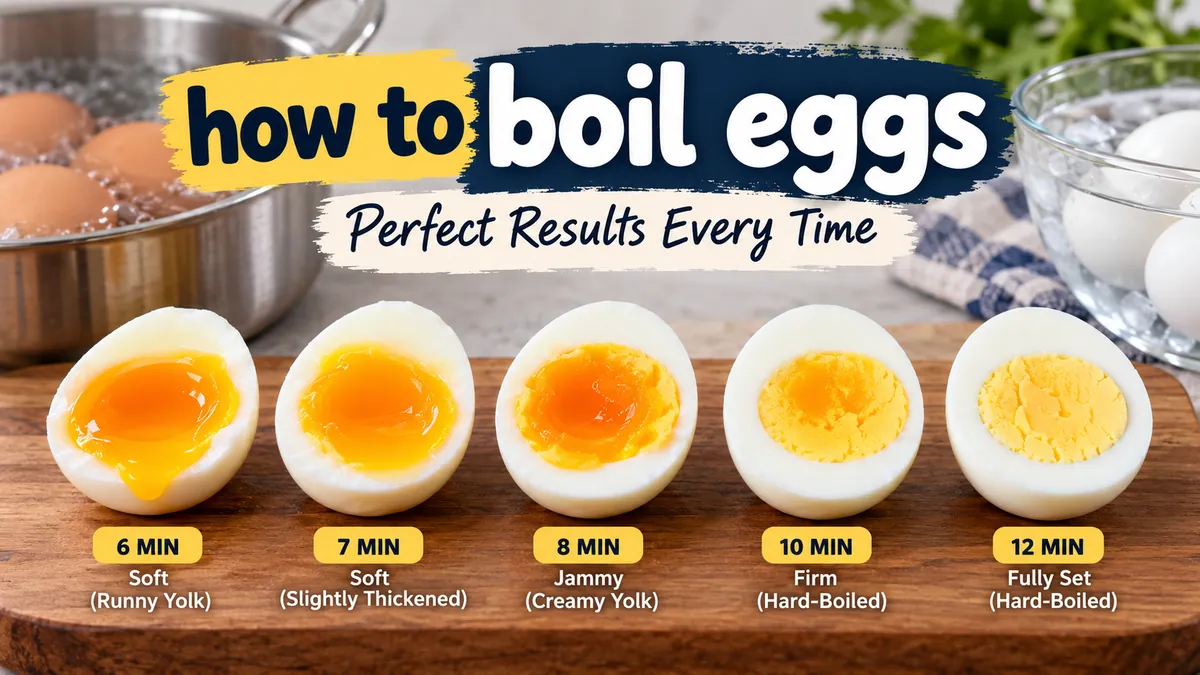
To boil eggs, bring a pot of water to a gentle boil, carefully lower in the eggs, and cook for 6–7 minutes for soft yolks, 8–9 minutes for jammy centers, or 10–12 minutes for hard-boiled eggs. Transfer them immediately to ice water to stop cooking and make peeling easier.
The best results depend on the size and temperature of your eggs, your cooking method, and how quickly you cool them afterward.
How to Boil Eggs Step by Step
The boiling-water method is one of the easiest ways to control yolk consistency. Unlike starting with cold water, placing eggs into already-boiling water gives you a clear starting point for your timer.
What You’ll Need
You don’t need any specialized kitchen equipment. Gather these basic items:
- Fresh, clean, uncracked chicken eggs
- A medium saucepan or cooking pot
- Enough water to cover the eggs
- A slotted spoon
- A kitchen timer
- A bowl of cold water and ice cubes
A lid is optional, although it can help bring the water to a boil faster.
For consistent results, use large eggs of approximately the same size. Different egg sizes can require slightly different cooking times.
Step 1: Bring Water to a Boil
Fill a saucepan with enough water to cover the eggs by approximately one inch.
Place the pot over medium-high heat and bring the water to a full boil.
Using enough water helps maintain a relatively stable temperature when you add the eggs.
Avoid overcrowding the saucepan. Eggs should have enough space to sit comfortably without being stacked on top of one another.
Step 2: Carefully Add the Eggs
Remove the eggs from the refrigerator just before cooking.
Using a slotted spoon, gently lower each egg into the boiling water.
Adding eggs carefully reduces the likelihood of shells cracking against the bottom of the saucepan.
The water may briefly stop boiling when the cold eggs enter. Allow it to return to a gentle boil, then adjust the heat to maintain a steady simmer rather than violent bubbling.
Step 3: Set the Cooking Timer
Start timing as soon as the eggs enter the boiling water.
The cooking duration determines the texture of both the egg white and the yolk.
For large, refrigerated eggs, use these approximate times:
| Cooking time | Yolk consistency | Best use |
|---|---|---|
| 6 minutes | Runny center | Toast, breakfast bowls |
| 7 minutes | Soft, slightly thickened | Ramen, breakfast |
| 8 minutes | Jammy and creamy | Salads, grain bowls |
| 9 minutes | Mostly set, slightly soft | Sandwiches, snacks |
| 10 minutes | Firm but moist | Egg salad |
| 11–12 minutes | Fully hard-boiled | Deviled eggs, meal prep |
These are starting points rather than universal guarantees. Egg size, initial temperature, altitude, and the strength of the simmer all influence the result.
Step 4: Transfer Eggs to an Ice Bath
While the eggs cook, prepare a large bowl filled with cold water and ice.
Once the timer finishes, remove the eggs with a slotted spoon and place them directly into the ice bath.
Leave them submerged for approximately 5–10 minutes, or until sufficiently cool to handle.
This step helps prevent carryover cooking, which happens when residual heat continues to cook the yolk after the egg leaves the pot.
Cooling also makes the shells more comfortable to handle and can help with peeling.
Step 5: Peel and Serve
Gently tap the cooled egg against a countertop to crack its shell.
Roll it lightly under your palm to create small cracks across the surface.
Start peeling near the wider end, where an air pocket often provides an easier starting point.
If the shell sticks, peel the egg under cool running water. Water can help separate the shell membrane from the cooked egg white.
Your boiled eggs are now ready to eat or use in a recipe.
How Long to Boil Eggs for Different Yolk Textures
One of the most common questions is how long eggs should boil to achieve a particular consistency.
There isn’t one perfect cooking time for everyone. Some people prefer a liquid yolk, while others want the entire egg completely firm.
Understanding the differences makes it easier to choose the right method.
Soft-Boiled Eggs: 6–7 Minutes
Soft-boiled eggs have cooked whites and a liquid or partially thickened yolk.
At approximately six minutes, the yolk is usually runny. By seven minutes, it begins to thicken while remaining soft.
These eggs work particularly well with:
- Buttered toast or toast soldiers
- Breakfast bowls
- Noodle dishes
- Rice bowls
- Lightly seasoned vegetables
Soft-boiled eggs are best served shortly after cooking because their delicate centers can become firmer as they cool.
Food safety note: Runny yolks are undercooked. The U.S. Food and Drug Administration recommends cooking eggs until both the whites and yolks are firm to reduce foodborne illness risk. For dishes requiring undercooked eggs, use appropriately pasteurized eggs.

FDA
Jammy Eggs: 7–9 Minutes
Jammy eggs fall between soft-boiled and hard-boiled eggs.
Their whites are fully set, while the yolks have a thick, creamy consistency.
An eight-minute egg often produces a particularly appealing jammy center, although results vary slightly.
Jammy eggs are commonly used in Japanese ramen, rice bowls, salads, and savory breakfast dishes.
They also work well when sliced in half and sprinkled with salt, black pepper, or chili flakes.
Hard-Boiled Eggs: 10–12 Minutes
Hard-boiled eggs have firm whites and yolks that are set throughout.
They are convenient for preparing ahead because they can be refrigerated and used in several meals.
A cooking time of 10–12 minutes often works for large eggs lowered into boiling water.
For especially large eggs, a slightly longer cooking time may be necessary.
The goal is a firm yolk that remains pleasantly tender rather than dry or crumbly.
How to Boil Eggs Using the Cold-Water Method
Although starting with boiling water gives precise timing, the traditional cold-water method is another reliable option.
This technique involves heating the eggs and water together, then allowing the eggs to finish cooking in the hot water.
Instructions for the Cold-Water Method
- Arrange the eggs in a single layer at the bottom of a saucepan.
- Add enough cold water to cover them by at least one inch.
- Cover the saucepan and bring the water just to a boil.
- Turn off the heat and leave the pan covered.
- Allow large eggs to stand in the hot water for approximately 15 minutes.
- Transfer the eggs to cold water to stop cooking.
The USDA Food Safety and Inspection Service recommends approximately 12 minutes for medium eggs, 15 minutes for large eggs, and 18 minutes for extra-large eggs using this covered, off-heat method.

Ask USDA
These timings are different from the boiling-water method because the eggs heat gradually and then continue cooking in hot water.
Boiling Water vs. Cold Water: Which Is Better?
Both methods can produce excellent eggs, but they offer different advantages.
| Feature | Boiling-water start | Cold-water start |
|---|---|---|
| Timing | Easy to measure precisely | Depends on heating and resting |
| Yolk control | Excellent for different textures | Particularly convenient for hard-boiled eggs |
| Cracking risk | Can crack if added roughly | Gentle initial heating |
| Peeling | Often easier | Can be more variable |
| Best for | Soft, jammy, and hard eggs | Traditional hard-boiled eggs |
Cooking tests reported by The Kitchn found advantages in both approaches, including easy peeling with a boil-then-simmer technique and versatility with a cold-water start.
The Kitchn
For beginners who want multiple yolk textures, the boiling-water method is a practical starting point.
How to Boil Eggs So They Peel Easily
Peeling can be more frustrating than cooking, especially when pieces of egg white come away with the shell.
The problem usually involves the relationship between the shell membrane and the cooked egg white.
A few adjustments can make the process easier.
Use Eggs That Aren’t Extremely Fresh
Very fresh eggs can be more difficult to peel.
As eggs age under proper refrigeration, changes occur inside the shell that can make the membrane easier to separate from the white.
The USDA also notes that eggs stored in the refrigerator for a while generally peel more easily than extremely fresh eggs.
Ask USDA
This doesn’t mean you should use old or spoiled eggs. Always use properly refrigerated eggs that remain safe to eat.
Cool Eggs Immediately After Cooking
An ice bath is useful for controlling the final texture and preparing eggs for peeling.
Place cooked eggs directly into ice water rather than leaving them in the hot saucepan.
For eggs intended for cold salads or meal preparation, allow them to cool thoroughly before peeling.
Crack the Entire Shell
Instead of removing one large piece of shell at a time, gently crack the egg all over.
Small, connected cracks make it easier to remove the shell and membrane together.
Start near the broad end and work slowly.
Peel Under Running Water
A gentle stream of cool water can help loosen stubborn shell fragments.
If the membrane remains attached to the egg white, slide a fingertip beneath it and carefully lift it away.
This technique is especially useful when preparing several eggs for egg salad or deviled eggs.
Do Salt, Vinegar, or Baking Soda Help?
Several traditional kitchen tips recommend adding salt, vinegar, or baking soda to boiling water.
However, none is a guaranteed solution for easy peeling.
Salt does not consistently prevent shells from sticking. Vinegar may help egg whites coagulate if a shell cracks, but it does not reliably improve peeling.
Baking soda changes the alkalinity of the water, although its effects on peeling are inconsistent.
For most home cooks, using the right cooking method, cooling the eggs promptly, and peeling carefully are more useful than relying on additives.
Common Mistakes When Boiling Eggs
Even a simple recipe can produce disappointing results when a few details are overlooked.
Understanding why problems happen makes them easier to prevent.
Why Do Boiled Eggs Have a Green Ring?
A gray-green ring sometimes appears around the yolk of an overcooked hard-boiled egg.
This happens when sulfur compounds from the egg white react with iron in the yolk, producing iron sulfide.
The discoloration is generally harmless, but it often indicates excessive cooking.
To reduce the chance of a green ring:
- Avoid cooking eggs longer than necessary.
- Use a timer instead of estimating.
- Transfer cooked eggs immediately to cold water.
- Avoid leaving eggs sitting in hot cooking water after the intended cooking time.
A properly cooked hard-boiled yolk should be yellow and tender rather than dry and chalky.
Why Do Eggs Crack While Boiling?
Eggshells can crack because of sudden temperature changes, collisions with the saucepan, or vigorous boiling.
Small cracks may allow some egg white to escape into the water.
To minimize cracking, lower eggs gently with a spoon and maintain a moderate simmer.
Avoid dropping cold eggs directly into a rapidly bubbling saucepan.
An egg that cracks during cooking is not automatically spoiled, but eggs with cracks before cooking should be avoided because bacteria may have entered through the damaged shell.
Why Are My Hard-Boiled Eggs Rubbery?
Rubbery egg whites usually result from excessive heat or prolonged cooking.
Egg proteins tighten as they cook. Too much heat can make the whites tough and squeeze out moisture.
Use a consistent timer and avoid keeping eggs at a vigorous boil longer than necessary.
Why Is the Yolk Still Runny?
A runny yolk usually means the egg did not cook long enough for the intended result.
This can happen when:
- The egg is larger than expected.
- The water temperature drops significantly.
- The cooking time is too short.
- The simmer is unusually weak.
If you need fully hard-boiled eggs, adjust the cooking time slightly on your next batch.
Why Are Some Eggs Harder to Peel Than Others?
Egg freshness, cooking technique, cooling, and individual shell characteristics can all influence peeling.
Even eggs from the same carton may behave differently.
Consistent results are more likely when you use eggs of similar sizes, follow the same cooking procedure, and cool each batch in the same way.
How to Boil Eggs for Different Sizes and Conditions
Cooking times are not identical for every egg.
Egg size, refrigerator temperature, altitude, and the number of eggs in the pot can affect how quickly heat reaches the center.
Small, Medium, Large, and Extra-Large Eggs
Larger eggs generally require more time because heat takes longer to penetrate the thicker contents.
For the boiling-water method, use the following approximate adjustments:
| Egg size | Soft-boiled | Hard-boiled |
|---|---|---|
| Small | 5–6 minutes | 9–10 minutes |
| Medium | 6–7 minutes | 10–11 minutes |
| Large | 6–7 minutes | 10–12 minutes |
| Extra-large | 7–8 minutes | 12–14 minutes |
These are practical estimates, not standardized guarantees.
If you regularly use the same brand and size of eggs, testing one batch can help you identify your preferred cooking time.
Should Eggs Be at Room Temperature Before Boiling?
Eggs do not need to reach room temperature before cooking.
You can boil eggs directly from the refrigerator.
Refrigerated eggs may take slightly longer than eggs that start warmer, so use timings designed for cold eggs whenever possible.
For food safety, avoid leaving refrigerated eggs on the counter unnecessarily.
Does High Altitude Affect Boiling Time?
Yes. Water boils at a lower temperature as altitude increases.
At sea level, water normally boils at approximately 100°C (212°F). At higher elevations, the boiling temperature decreases.
Because the water is cooler at its boiling point, eggs may take longer to reach the desired consistency.
If you live in a mountainous area, begin with the standard timing and make small adjustments based on the results.
A covered saucepan can help maintain a stable cooking environment, but it cannot raise the normal boiling point of water to its sea-level value.
Can You Boil Several Eggs at Once?
Yes. You can cook multiple eggs in the same saucepan.
Arrange them in a single layer and use enough water to cover them.
Avoid overcrowding, which can make the water temperature harder to maintain and increase the likelihood of shells knocking together.
When cooking a large batch, use a sufficiently large pot and cool the eggs in a spacious ice bath.
You generally do not need to multiply the cooking time by the number of eggs. Instead, maintain a consistent cooking temperature and avoid overloading the saucepan.
How to Store Boiled Eggs Safely
Proper storage matters just as much as cooking technique, especially when preparing eggs in advance.
Hard-boiled eggs are convenient for meal prep, but they do not last indefinitely.
How Long Do Hard-Boiled Eggs Last in the Refrigerator?
According to the FDA and USDA, hard-cooked eggs can be stored in the refrigerator for up to seven days, whether peeled or unpeeled.
Refrigerate them within two hours after cooking and keep the refrigerator at 40°F (4°C) or below.
FDA
+1
For easier organization, write the cooking date on the storage container.
Should You Store Boiled Eggs Peeled or Unpeeled?
Both methods are acceptable.
Unpeeled eggs are convenient for preparing several days of snacks because their shells help protect the surface from drying out.
Peeled eggs should be placed in a clean, covered container and refrigerated promptly.
Regardless of whether the shells are removed, use hard-cooked eggs within one week.
Can You Leave Boiled Eggs Out Overnight?
No.
Hard-boiled eggs should not remain at room temperature for more than two hours.
When temperatures exceed 90°F (32°C), the safe unrefrigerated period is reduced to one hour.
Eggs left out overnight should be discarded rather than refrigerated for later use.
Can You Freeze Hard-Boiled Eggs?
Freezing whole hard-boiled eggs is generally not recommended.
The cooked whites tend to become watery, rubbery, or unpleasantly textured after thawing.
For best quality, refrigerate hard-boiled eggs and consume them within the recommended storage period.
Are Soft-Boiled Eggs Safe for Everyone?
Soft-boiled and jammy eggs may contain undercooked yolks, which carry a greater food safety risk than fully cooked eggs.
The FDA advises cooking eggs until both the whites and yolks are firm.
Pregnant people, young children, older adults, and people with weakened immune systems should be especially cautious about undercooked eggs because of the risk of Salmonella infection.
When a recipe requires a runny yolk, pasteurized eggs can help reduce the risk.
FDA
Nutritional Benefits and Ways to Use Boiled Eggs
Boiled eggs provide a combination of protein, vitamins, minerals, and dietary fat without requiring added cooking oil.
A typical large hard-boiled egg contains approximately:
| Nutrient | Approximate amount |
|---|---|
| Calories | 78 kcal |
| Protein | 6.3 g |
| Total fat | 5.3 g |
| Carbohydrates | 0.6 g |
| Cholesterol | 186 mg |
Values vary slightly with egg size and composition.
Eggs also provide vitamin B12, selenium, riboflavin, phosphorus, and choline.
Choline supports several important bodily functions, including normal cell membrane structure and nervous system activity.
Although eggs contain dietary cholesterol, their role in a healthy diet depends on a person’s overall eating pattern and individual health needs.
Easy Ways to Eat Boiled Eggs
Boiled eggs are versatile enough for breakfast, lunch, snacks, and dinner.
Some practical options include:
- Egg salad: Chop hard-boiled eggs and combine them with mayonnaise or yogurt, mustard, and seasonings.
- Deviled eggs: Halve hard-boiled eggs and mix the yolks with a creamy filling.
- Ramen eggs: Use jammy eggs as a topping for noodle soup.
- Breakfast toast: Slice eggs over whole-grain toast with black pepper.
- Green salads: Add quartered eggs for extra protein.
- Rice bowls: Serve sliced eggs alongside vegetables and grains.
- Quick snacks: Sprinkle a peeled hard-boiled egg with salt and paprika.
Hard-boiled eggs are particularly useful when preparing meals ahead of time because they can be cooked in batches and stored safely in the refrigerator.
Is Boiling Healthier Than Frying?
Boiling eggs requires no added butter or oil.
That makes it a useful preparation method when you want to avoid additional cooking fat.
Frying can also be part of a balanced diet, but the nutritional content changes depending on how much oil, butter, or other ingredients you add.
The egg itself provides similar core nutrients regardless of whether it is boiled or fried.
How to Boil Eggs Perfectly Every Time: Final Tips
Once you understand the relationship between cooking time and yolk texture, boiling eggs becomes a repeatable kitchen skill rather than a guessing game.
For the most consistent results, use eggs of similar sizes, lower them gently into boiling water, start a timer immediately, and cool them promptly when cooking is complete.
Remember these basic timing guidelines for large, refrigerated eggs:
- 6–7 minutes: Soft-boiled with a runny or partially thickened yolk.
- 8–9 minutes: Jammy eggs with a creamy center.
- 10–12 minutes: Hard-boiled eggs with a firm yolk.
If you prefer the cold-water method, remember that its timing is different because the eggs heat gradually and continue cooking after the burner is turned off.
The simplest way to master how to boil eggs is to choose one method, use a timer, and make small adjustments until the texture matches your preference.
For your next batch, start with 11 minutes for hard-boiled eggs or 8 minutes for jammy eggs, then transfer them straight into ice water. Once you’ve found the timing that works with your eggs and saucepan, repeat it for dependable results.
