

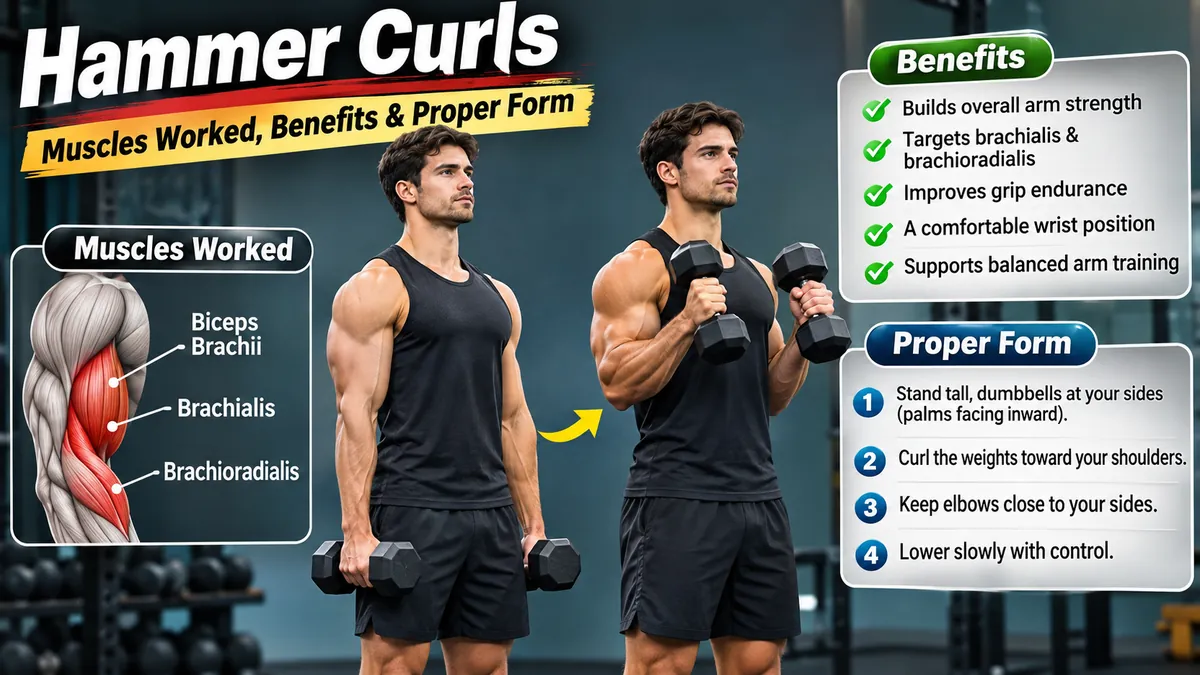
Hammer curls are a simple but effective dumbbell exercise for building stronger arms. Unlike traditional biceps curls, they use a neutral grip, with your palms facing each other throughout the movement. This changes how the elbow flexors work and makes the exercise a useful addition to upper-body strength training.
Hammer curls are a resistance-training exercise that primarily works the biceps brachii, brachialis, and brachioradialis muscles. To perform them, hold dumbbells with your palms facing inward, bend your elbows to lift the weights toward your shoulders, and lower them slowly. Keep your upper arms relatively still and avoid swinging your body.
Although the movement looks straightforward, grip position, elbow control, range of motion, and weight selection can all influence its effectiveness.
What Are Hammer Curls?
Hammer curls are a variation of the dumbbell curl performed using a neutral grip. The name comes from the way you hold the weights, similar to gripping a hammer.
During the exercise, your elbows bend while your hands maintain their inward-facing position. The movement strengthens several muscles responsible for elbow flexion and helps develop the upper arms and forearms.
Hammer curls are classified as an isolation-style exercise because the main movement occurs at the elbow joint. However, multiple muscles contribute to the lift, while the shoulders, wrists, and trunk provide stability.
They are commonly included in bodybuilding, general fitness, strength training, and athletic conditioning programs.
Hammer Curls at a Glance
| Feature | Description |
|---|---|
| Exercise type | Resistance training |
| Primary movement | Elbow flexion |
| Equipment | Dumbbells |
| Grip | Neutral, palms facing inward |
| Main muscles | Biceps brachii, brachialis, brachioradialis |
| Difficulty | Beginner-friendly |
| Common repetitions | 8–15 per set |
| Typical sets | 2–4 |
| Variations | Standing, seated, alternating, cable, cross-body |
| Main purpose | Arm strength and muscular development |
Hammer curls can be performed standing or seated, with both arms simultaneously or one arm at a time.
What Muscles Do Hammer Curls Work?
Hammer curls recruit three major elbow-flexing muscles: the biceps brachii, brachialis, and brachioradialis.
Understanding their roles explains why this exercise feels different from a standard supinated biceps curl.
Biceps Brachii
The biceps brachii is the prominent muscle on the front of the upper arm. It has two heads: the long head and the short head.
Its functions include elbow flexion and forearm supination, which is the movement of rotating your palm upward.
During hammer curls, the biceps brachii contributes to bending the elbow. However, because the forearm remains in a neutral position, the exercise does not emphasize the biceps’ supination function in the same way as a traditional curl.
Both heads participate in elbow flexion. Claims that hammer curls exclusively isolate one biceps head are an oversimplification.
Brachialis
The brachialis lies beneath the biceps brachii and is a powerful elbow flexor.
Unlike the biceps, its primary function does not depend substantially on whether the forearm is supinated, pronated, or neutral.
Hammer curls train the brachialis through resisted elbow flexion. Developing this muscle can contribute to overall upper-arm thickness.
Brachioradialis
The brachioradialis is a prominent muscle on the thumb side of the forearm.
It helps flex the elbow and is particularly relevant during neutral-grip movements.
Because hammer curls maintain a neutral forearm position, they are commonly used to strengthen the brachioradialis alongside the upper-arm flexors.
Supporting Muscles
Other muscles assist with stabilization, including the wrist flexors and extensors, shoulder stabilizers, and core muscles.
Your forearm muscles help maintain a secure grip, while your trunk resists unnecessary movement when lifting standing dumbbells.
Importantly, hammer curls do not isolate the forearms or brachialis completely. They train several muscles together.
How to Do Hammer Curls Correctly
[근육이 자산이다] 해머 컬 (Hammer Curl) – 헬린이를 위한 팔/어깨 운동 ④
Dumbbell Hammer Curl: Guide, Muscles Worked, Tips | Athlemove
How to Do Hammer Curls: Form, Mistakes & Progressions (2026) | FitCraft
9
Proper technique allows the elbow flexors to perform the movement without relying on excessive momentum.
Step 1: Choose Your Dumbbells
Select two dumbbells you can control for at least eight repetitions without swinging or straining.
For beginners, lighter weights are generally preferable while learning the movement.
The correct starting weight varies according to individual strength, experience, and injury history.
Step 2: Establish Your Starting Position
Stand upright with your feet approximately hip-width apart.
Hold a dumbbell in each hand with your arms hanging naturally beside your body.
Keep your palms facing inward toward your thighs. Maintain a neutral wrist position and avoid bending your wrists backward.
Relax your shoulders while keeping your torso stable.
Step 3: Curl the Weights Upward
Bend your elbows and lift the dumbbells toward your shoulders.
Keep your upper arms close to your sides rather than allowing your elbows to move dramatically forward.
Maintain the neutral grip throughout the repetition.
Exhale naturally during the lifting phase without holding your breath unnecessarily.
Step 4: Control the Top Position
Raise the weights as far as your comfortable elbow range of motion allows without forcing your shoulders forward.
You do not need to touch the dumbbells to your shoulders.
Briefly control the top position rather than bouncing or jerking the weights.
Step 5: Lower the Dumbbells Slowly
Lower the dumbbells in a controlled motion until your elbows are nearly straight or reach your comfortable full extension.
Avoid dropping the weights or abruptly locking your elbows.
Inhale during the lowering phase.
The downward, or eccentric, phase is an important part of the exercise because your muscles continue producing force while lengthening.
Step 6: Repeat With Consistent Technique
Complete your planned repetitions while keeping your shoulders, wrists, and torso controlled.
Stop the set when you can no longer maintain proper technique.
A useful starting prescription is two or three sets of 8–12 repetitions, adjusted to your training experience and recovery.
Benefits of Hammer Curls
Hammer curls offer several benefits for people seeking stronger arms, better muscular development, and greater exercise variety.
1. Develop Overall Arm Strength
Hammer curls strengthen muscles responsible for elbow flexion.
These muscles contribute to many pulling movements, including rows, pull-ups, and carrying objects.
Although hammer curls alone cannot maximize total upper-body strength, they can complement compound exercises.
2. Build the Brachialis and Brachioradialis
Traditional biceps curls and hammer curls both train elbow flexion, but their grip positions influence muscle contributions.
The neutral grip makes hammer curls a practical way to train the brachioradialis and brachialis alongside the biceps.
Over time, progressive resistance training may increase the size and strength of these muscles.
3. Improve Grip Endurance
Holding dumbbells requires the forearm and hand muscles to maintain grip.
Regular hammer curls can contribute to grip endurance, particularly as weights increase.
However, dedicated grip exercises such as loaded carries and timed holds may provide a more direct grip-strength stimulus.
4. Offer a Comfortable Wrist Position
Some lifters find the neutral grip more comfortable than a fully supinated grip.
The inward-facing hand position can reduce the need to rotate the forearm during the curl.
This does not mean hammer curls are automatically safe for every wrist or elbow condition. Pain should guide exercise modification.
5. Support Balanced Arm Training
Using different curl variations exposes the elbow flexors to resistance in different forearm positions.
Combining hammer curls with standard curls and other pulling exercises can provide a more varied training stimulus.
This is especially useful when designing a balanced upper-body workout.
Hammer Curls vs. Biceps Curls
The main difference between hammer curls and traditional dumbbell biceps curls is the position of the forearm.
Muốn tay khỏe đẹp, hãy tập thêm động tác này
Hammer curl — neutral grip
Сгибание предплечья с гантелями – 62 фото
Standard curl — supinated grip
| Feature | Hammer Curls | Traditional Biceps Curls |
|---|---|---|
| Grip | Neutral | Supinated |
| Palm direction | Facing inward | Facing upward |
| Biceps brachii | Active | Active, with favorable supination position |
| Brachialis | Active | Active |
| Brachioradialis | Strong contributor | Contributes |
| Wrist rotation | Minimal | Supinated throughout or rotated during lift |
| Primary goal | Overall elbow-flexor development | Elbow-flexor development with greater biceps emphasis |
| Equipment | Dumbbells, cables, bands | Dumbbells, barbells, cables, bands |
Are Hammer Curls Better Than Biceps Curls?
Neither exercise is universally better.
Traditional curls may be preferable when emphasizing the biceps brachii in a supinated position. Hammer curls are useful for training the elbow flexors with a neutral grip and providing variety.
For general arm development, both can be included in a training program.
Do Hammer Curls Make Your Arms Bigger?
Yes, hammer curls can contribute to arm hypertrophy when performed with sufficient training effort, progressive overload, adequate nutrition, and recovery.
Muscle growth is not determined by exercise selection alone.
Total training volume, proximity to muscular failure, consistency, and individual response all influence results.
Common Hammer Curl Mistakes to Avoid
Small technique errors can shift work away from the intended muscles or increase unnecessary joint stress.
Swinging the Dumbbells
Using your hips or lower back to propel the weights upward reduces control.
This commonly occurs when the dumbbells are too heavy.
Correction: Reduce the weight and keep your torso relatively still throughout each repetition.
Moving Your Elbows Too Far Forward
Some shoulder movement is natural, especially near the top of a curl.
However, deliberately driving the elbows forward can change the movement and allow the shoulders to assist excessively.
Correction: Keep the upper arms generally close to your sides without forcing them into an uncomfortable position.
Curling With Bent Wrists
Allowing your wrists to flex or extend excessively can create unnecessary discomfort.
Correction: Keep your knuckles aligned with your forearms and maintain a comfortable, neutral wrist position.
Lowering the Weight Too Quickly
Dropping the dumbbells removes much of the controlled eccentric portion of the exercise.
Correction: Lower each weight deliberately while maintaining muscular tension.
Using an Incomplete Range of Motion
Short repetitions may be useful in certain training methods, but consistently shortening the movement unintentionally can limit the range being trained.
Correction: Use the fullest comfortable range of motion you can control.
Training Through Sharp Pain
Muscle effort and mild fatigue are normal during resistance training. Sharp, sudden, or worsening joint pain is not something to ignore.
Correction: Stop the painful movement and seek qualified medical or rehabilitation advice when symptoms persist.
Best Hammer Curl Variations
Several variations can help accommodate different equipment, training goals, and preferences.
Alternating Hammer Curls
Alternating hammer curls involve lifting one dumbbell while the other arm remains lowered.
This variation allows you to concentrate on one side at a time.
It can be useful for beginners who find simultaneous repetitions difficult to coordinate.
Seated Hammer Curls
Seated hammer curls are performed while sitting upright on a bench.
The seated position can make it easier to notice unnecessary torso movement, although swinging is still possible.
This variation works well for people who prefer additional stability.
Cross-Body Hammer Curls
Cross-body hammer curls involve lifting the dumbbell diagonally toward the opposite side of the upper chest.
The forearm remains approximately neutral while the arm follows a slightly different path.
This can provide a comfortable alternative to straight-ahead repetitions, depending on shoulder and elbow mechanics.
Incline Hammer Curls
Incline hammer curls are performed while sitting against an inclined bench with the arms hanging beside or slightly behind the torso.
The shoulder position changes the starting length of the biceps brachii compared with an upright curl.
Use lighter dumbbells initially because the setup can make the exercise more challenging.
Rope Cable Hammer Curls
Cable hammer curls use a rope attachment connected to a cable machine.
The rope allows a neutral grip, while the cable provides resistance throughout the movement according to the machine’s line of pull.
They can be useful for lifters who prefer cables or want a different resistance profile.
Resistance Band Hammer Curls
Resistance bands offer a portable alternative to dumbbells.
The resistance generally increases as the band stretches, although the exact loading depends on band characteristics and setup.
This variation is useful for home workouts and travel.
How Many Hammer Curls Should You Do?
The appropriate number of repetitions and sets depends on your goals, experience, and other exercises in your program.
| Training goal | Sets | Repetitions | General approach |
|---|---|---|---|
| Learning technique | 1–3 | 10–15 | Light weight, controlled movement |
| Muscle growth | 2–4 | 8–15 | Challenging sets with good form |
| Strength emphasis | 3–4 | 6–10 | Heavier controlled repetitions |
| Muscular endurance | 2–3 | 15–20 | Lighter loads and sustained control |
These are practical programming examples, not rigid scientific thresholds. Muscle growth can occur across a broad repetition range when sets provide sufficient stimulus.
How Often Should You Train Hammer Curls?
For many healthy adults, training the elbow flexors two or three times per week is a reasonable starting approach.
Allow sufficient recovery between demanding sessions, especially when your routine also includes rows, chin-ups, and other pulling exercises.
Beginners can often start with two weekly sessions.
More experienced lifters may distribute their weekly arm-training volume across additional sessions.
How Heavy Should Hammer Curls Be?
Choose a weight that makes the final few repetitions challenging while allowing consistent technique.
For example, if your target is 12 repetitions, you might finish with approximately two repetitions left before you would be unable to complete another controlled repetition.
This is commonly described as two repetitions in reserve, or 2 RIR.
There is no universal dumbbell weight that all beginners should use.
Should You Train to Failure?
Training to absolute muscular failure is not required for every set.
Stopping approximately one to three repetitions before failure can provide a useful training stimulus while helping manage fatigue.
The appropriate effort level depends on the exercise, training experience, and total workload.
How to Add Hammer Curls to Your Workout
Hammer curls are commonly performed after larger compound movements because those exercises typically demand more total-body energy and coordination.
A simple upper-body pulling session might include:
- Lat pulldowns or assisted pull-ups — 3 sets of 8–12 repetitions.
- Dumbbell or cable rows — 3 sets of 8–12 repetitions.
- Traditional dumbbell curls — 2 sets of 10–12 repetitions.
- Hammer curls — 2 sets of 10–12 repetitions.
This example is not a complete individualized program, but it demonstrates how hammer curls can complement other pulling movements.
If your primary goal is improving hammer curl performance, you can perform them earlier in the session when your arms are less fatigued.
Progressive Overload for Hammer Curls
Progressive overload means gradually increasing the training challenge as your body adapts.
One straightforward method is double progression.
Suppose you perform three sets of hammer curls using a target range of 8–12 repetitions.
You might begin with:
| Session | Set 1 | Set 2 | Set 3 |
|---|---|---|---|
| 1 | 10 | 9 | 8 |
| 2 | 11 | 10 | 9 |
| 3 | 12 | 11 | 10 |
| 4 | 12 | 12 | 12 |
Once all sets reach the upper end of the range with controlled technique, increase the dumbbell weight by the smallest practical increment.
Your repetitions may temporarily decrease after increasing the load. Build them up again gradually.
Progress will not necessarily occur every workout, particularly as you become more experienced.
Are Hammer Curls Good for Beginners?
Hammer curls are generally beginner-friendly because the movement is easy to understand and requires little equipment.
The neutral grip may also feel natural for people who find forearm rotation uncomfortable.
However, beginners should focus on learning elbow control and selecting manageable resistance rather than lifting the heaviest dumbbells possible.
Start with one or two light practice sets. Pay attention to how your wrists, elbows, and shoulders feel throughout the movement.
A mirror or video recording can help identify excessive torso swinging or inconsistent arm movement.
If you have an existing elbow, wrist, or shoulder injury, exercise selection should be guided by a qualified healthcare professional.
Can Hammer Curls Help With Forearm Size?
Hammer curls can contribute to forearm development, particularly through their involvement of the brachioradialis.
The brachioradialis is visible along the upper portion of the forearm and contributes to elbow flexion.
However, forearm development also depends on muscles responsible for wrist flexion, wrist extension, finger flexion, and grip.
For comprehensive forearm training, hammer curls can be combined with exercises such as wrist curls, reverse wrist curls, and loaded carries.
You do not need to train every forearm movement in every workout. A balanced program can distribute these exercises throughout the week.
Hammer Curls vs. Reverse Curls
Reverse curls are another elbow-flexion exercise, but they use a pronated grip, meaning the palms face downward.
Hammer curls maintain a neutral grip, while reverse curls place the forearms in pronation.
Both train the brachioradialis and brachialis, along with contributions from the biceps brachii.
Reverse curls may require lighter loads because the pronated position changes muscle leverage and grip demands.
Neither variation completely isolates a single forearm muscle.
If your goal is broader elbow-flexor development, including both movements occasionally can add variety without requiring excessive training volume.
How Long Does It Take to See Results From Hammer Curls?
Strength improvements can begin within the first several weeks of consistent resistance training, partly because of neural adaptations and improved exercise coordination.
Visible muscle growth usually takes longer and depends on factors such as training experience, genetics, nutrition, sleep, and overall workload.
Some beginners may notice changes after several weeks, while more noticeable differences often require months of consistent training.
A useful way to track progress is to record your dumbbell weights, repetitions, and technique quality rather than relying only on visual changes.
Does Nutrition Matter?
Adequate energy and protein intake support recovery and muscle adaptation.
For many healthy adults performing resistance training, approximately 1.4–2.0 grams of protein per kilogram of body weight per day is a commonly used evidence-based range for supporting muscle development.
Individual needs vary, and people with certain medical conditions may require different recommendations.
Sleep and sufficient recovery are also important because muscle adaptation occurs between training sessions, not only during exercise.
Safety Tips for Effective Hammer Curls
Hammer curls are generally well tolerated when performed with appropriate loads and controlled technique.
Before lifting, warm up with light upper-body movement and a few easy repetitions.
Avoid gripping the dumbbells so tightly that unnecessary hand or wrist tension interferes with the exercise.
Keep your breathing steady and avoid prolonged breath-holding, especially if you have a condition that makes heavy resistance exercise risky.
If you experience persistent elbow discomfort, review your training volume, grip position, and load selection.
Pain near the elbow can have several causes, including tendon-related conditions, and should not automatically be attributed to ordinary muscle soreness.
Seek professional assessment for persistent pain, swelling, weakness, numbness, or symptoms that worsen during exercise.
Final Thoughts on Hammer Curls
Hammer curls are a practical exercise for strengthening the biceps brachii, brachialis, and brachioradialis using a neutral grip.
They can support upper-arm and forearm development, complement traditional curls, and fit into both beginner and advanced resistance-training programs.
The most effective approach is to use a comfortable range of motion, control the lifting and lowering phases, choose an appropriate weight, and increase the challenge gradually.
For a balanced routine, combine hammer curls with compound pulling exercises and other arm movements while allowing enough time for recovery.
