

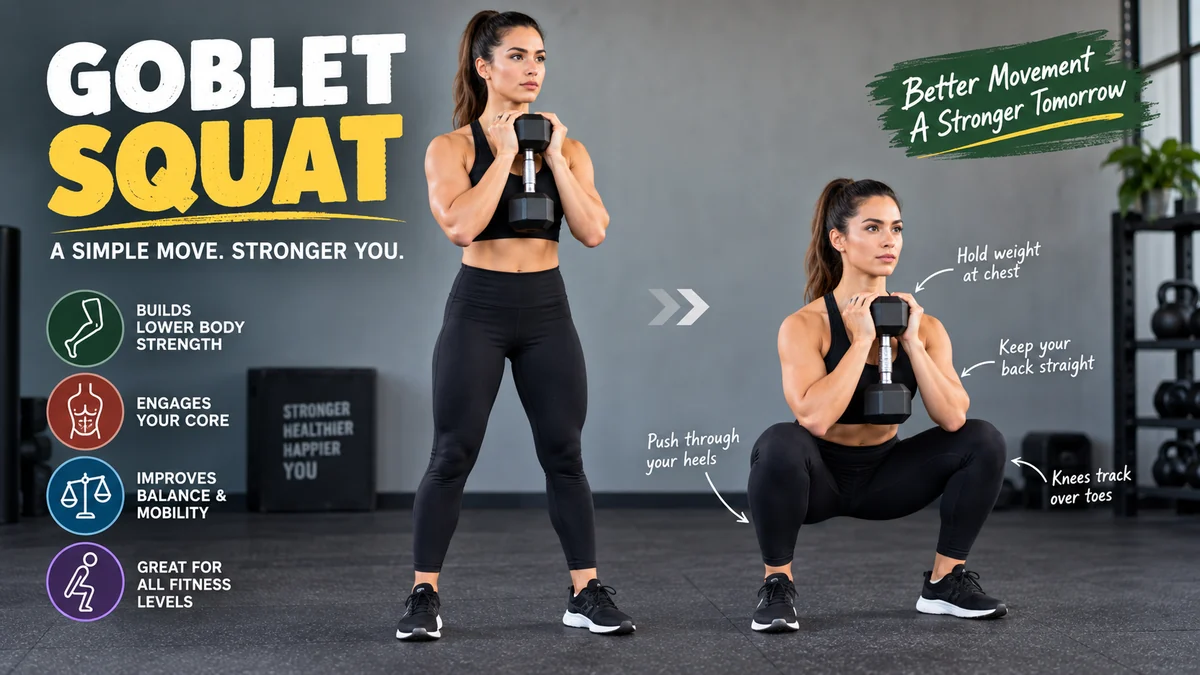
The goblet squat looks simple: hold a dumbbell or kettlebell at your chest and squat. Yet the placement of that weight changes the movement in a useful way. The front-loaded resistance acts as a counterbalance, encourages a more upright torso, and can make proper squat mechanics easier to learn.
That combination makes the exercise useful well beyond the beginner stage. It can build your quads and glutes, challenge your core, improve squat control, and serve as a bridge toward heavier front squats and other loaded squat variations.
Quick answer: A goblet squat is a front-loaded squat performed while holding a kettlebell or dumbbell close to the chest with both hands. It primarily trains the quadriceps and glutes while also involving the hamstrings, adductors, hip stabilizers, calves, and core.
What Is a Goblet Squat?
The goblet squat is a compound lower-body exercise in which you hold a single weight vertically or in front of your chest while performing a squat.
The name comes from the position of your hands and the weight. When performed with a kettlebell, you typically grasp the horns with both hands, creating a position somewhat like holding a large goblet.
You can also perform a dumbbell goblet squat by holding one end of a dumbbell securely with both hands.
Strength coach Dan John is widely credited with developing and popularizing the goblet squat as a way to teach people better squat mechanics. NASM describes it as an especially useful squat-teaching exercise because the anterior load provides a counterbalance as the hips descend.
Unlike a barbell back squat, where the resistance sits behind or across the shoulders, the goblet position puts resistance in front of your center of mass. That changes how you balance yourself.
For many people, this makes it easier to keep the chest relatively upright while descending into a comfortable squat.
Goblet Squat at a Glance
| Feature | Goblet Squat |
|---|---|
| Exercise type | Compound resistance exercise |
| Movement pattern | Squat |
| Primary muscles | Quadriceps and glutes |
| Secondary muscles | Hamstrings, adductors, hip stabilizers, core |
| Common equipment | Dumbbell or kettlebell |
| Load position | In front of chest |
| Typical skill level | Beginner to advanced |
| Useful for | Learning squat mechanics, strength, muscle, warm-ups and accessory work |
The goblet squat shouldn’t be viewed only as a “beginner squat.” Experienced lifters can use paused repetitions, slower tempos, heel elevation, deeper ranges of motion, and heavier resistance to make it challenging.
How to Do a Goblet Squat With Proper Form
The goal isn’t simply to move down and up. You want your hips, knees, ankles, torso, and weight to work together as one controlled movement.
1. Pick up the weight securely
Choose a dumbbell or kettlebell you can comfortably control.
For a kettlebell goblet squat, hold the kettlebell by its horns with both hands.
For a dumbbell version, hold one end of the dumbbell securely between your palms or use another stable two-handed grip.
Bring the resistance close to your chest rather than holding it several inches in front of you.
Keeping the load close reduces unnecessary demand on your shoulders and arms.
2. Find your squat stance
Start with your feet approximately hip- to shoulder-width apart.
Turn your toes slightly outward if that feels natural.
There isn’t one universally perfect foot position. Hip anatomy, limb proportions, ankle mobility, and personal comfort can all influence the stance that works best for you.
3. Brace your trunk
Before descending, tighten your abdominal muscles as though you’re preparing for someone to press against your stomach.
Keep your rib cage controlled and your spine in a comfortable neutral position.
You don’t need to exaggerate a “chest up” posture by aggressively arching your lower back.
4. Squat between your legs
Bend your knees and hips together.
Allow your knees to travel in the same general direction as your toes while lowering your hips.
Keep the weight close to your sternum.
Your torso may lean forward somewhat. That’s normal. The exact torso angle depends partly on your individual proportions.
5. Descend to a controllable depth
Lower yourself as far as you can while maintaining control, balance, and a stable foot position.
NASM suggests reaching roughly parallel or going deeper when your mobility allows it.
Don’t force an arbitrary depth if reaching it causes your heels to lift, your balance to disappear, or your position to break down significantly.
6. Stand back up
Push the floor away and extend your knees and hips together.
Keep your feet planted and your knees tracking naturally over your feet.
Finish tall rather than leaning backward at the top.
Then reset your brace and begin the next repetition.
Quick Goblet Squat Form Checklist
Before adding more weight, check these basics:
- Weight remains close to your chest.
- Feet stay firmly planted.
- Knees track naturally with your toes.
- Core remains braced.
- Descent is controlled rather than dropped.
- You reach a depth you can control.
- Hips and knees extend together as you stand.
- Each repetition looks reasonably similar.
If several of those disappear when you increase the resistance, the weight is probably too heavy for your current technique.
Goblet Squat Muscles Worked
The goblet squat is primarily a lower-body movement, but calling it a “leg exercise” doesn’t tell the whole story.
Your lower body produces most of the movement while your trunk and upper body stabilize the load.
Quadriceps
The quadriceps are major contributors to the exercise.
They extend your knees as you rise from the bottom of the squat. The four muscles collectively known as the quadriceps femoris are heavily involved whenever substantial knee flexion and extension occur under resistance.
A deeper, controlled squat can place considerable demand on the quads, particularly when the torso remains relatively upright.
Glutes
Your gluteus maximus contributes strongly to hip extension as you rise.
Your other gluteal muscles also contribute to controlling your hips and lower limbs.
The combination of knee and hip extension is why squatting movements can train both the quadriceps and glutes effectively rather than isolating one muscle group.
Hamstrings
The hamstrings cross the hip and knee joints and contribute to lower-body stability during the movement.
They participate in the squat, although the goblet squat generally isn’t used as a primary hamstring-building movement in the same way as Romanian deadlifts or other hip-hinge exercises.
Adductors and Hip Stabilizers
The muscles around your inner thighs and hips help control your femur and stabilize the pelvis.
The adductors can contribute significantly during deeper squatting positions.
NASM specifically identifies hip stabilizers and adductors among the muscles involved in goblet squats.
Core
Your abdominal muscles and spinal stabilizers must resist unwanted movement while you hold the resistance in front of your body.
The front-loaded position increases the demand on your trunk to keep the weight controlled.
That doesn’t make the goblet squat a replacement for every direct core exercise, but core stability is an important part of good technique.
Upper Body
Your forearms, hands, biceps, shoulders, and upper back help support the dumbbell or kettlebell.
As the resistance gets heavier, this becomes increasingly noticeable.
In fact, upper-body holding strength can eventually become the factor that limits how heavy you can goblet squat.
Goblet Squat Benefits
The goblet squat’s biggest advantage is that it combines relatively simple equipment with a movement pattern that can be adjusted for many training goals.
It Can Make Squat Mechanics Easier to Learn
Bodyweight squats aren’t automatically easy to perform well.
Some beginners struggle with balance and feel as though they’re falling backward when trying to reach a deeper position.
Holding resistance in front of your torso provides a counterbalance. NASM notes that this front-loaded position can help people achieve a deeper, more upright squat than they might manage with an unloaded or back-loaded variation.
That immediate feedback is one reason trainers often use goblet squats to teach the squat pattern.
It Builds Lower-Body Strength
The exercise simultaneously trains several major muscle groups instead of isolating one joint.
Progressively increasing the resistance, repetitions, range of motion, or movement difficulty can create a meaningful strength stimulus for the legs and hips.
For newer lifters, one dumbbell or kettlebell may provide plenty of resistance.
It Can Build Muscle
Goblet squats aren’t only a technique drill.
Performed through an appropriate range of motion with sufficient resistance and progressive overload, they can contribute to hypertrophy of the quadriceps and glutes.
Higher-repetition sets can become particularly demanding because the legs, core, and upper body must continuously support the resistance.
It Challenges Your Core
Because the resistance sits in front of you, your trunk must stabilize against its forward pull.
Verywell Fit lists the abdominals and spinal erectors among the muscles involved in the movement.
Keeping the weight close to your body while maintaining trunk stiffness is therefore part of the exercise—not merely a way to hold the dumbbell.
It Requires Minimal Equipment
You don’t need a squat rack, barbell, or large training area.
A single kettlebell or dumbbell is enough.
That makes the movement practical for home workouts, small gyms, hotel gyms, and crowded commercial gyms.
It Can Help You Practice Squat Depth
The counterbalance created by the resistance can make deeper squatting positions easier to explore for some people.
However, “deeper” isn’t automatically “better.”
Your useful depth is the range you can achieve with control and without pain. Anatomy and mobility differ from person to person, so squat depth doesn’t need to look identical across lifters.
It Transfers Well to Everyday Movement
Squatting is a fundamental movement pattern.
Sitting down, standing from a chair, and lowering yourself toward the floor all involve similar combinations of hip, knee, and ankle motion.
Verywell Fit notes this connection between goblet squats and everyday movements such as rising from a chair.
Goblet Squat vs. Regular Squat
“Regular squat” can mean either a bodyweight squat or a barbell back squat, so the distinction matters.
Compared with a bodyweight squat, the goblet version adds external resistance and a counterbalance.
Compared with a barbell back squat, the most obvious difference is where the load sits.
| Feature | Goblet Squat | Barbell Back Squat |
|---|---|---|
| Resistance | Dumbbell/kettlebell | Barbell |
| Load position | Front of chest | Across upper back |
| Equipment needs | Minimal | Rack, barbell and plates |
| Learning curve | Generally simpler | Greater |
| Maximum loading | Limited | Very high |
| Core demand | High | High |
| Best suited to | Technique, general strength, muscle, accessory work | Heavy strength and muscle training |
| Typical limiting factor | Holding the weight | Lower-body/trunk strength and technique |
The goblet squat is usually easier to set up and learn.
The back squat has a much higher loading ceiling because you’re not required to support the entire resistance with your hands in front of your chest.
That makes goblet squats excellent for learning and moderate loading, while barbell squats are generally more practical when maximal squat strength becomes the primary objective.
Dumbbell Goblet Squat vs. Kettlebell Goblet Squat
Both versions use essentially the same squat pattern.
The biggest differences involve grip and how the resistance sits against your body.
Dumbbell Goblet Squat
Hold a dumbbell vertically, typically supporting one end securely with both hands.
Dumbbells are available in almost every gym, making this the most accessible variation.
The main disadvantage appears as you get stronger. Large dumbbells can become awkward to hold at chest height.
Kettlebell Goblet Squat
Hold the kettlebell by the horns and position it close to your chest.
Many people find the handle configuration comfortable because it provides a natural two-handed grip.
Neither version is inherently superior.
Choose the implement that lets you hold the load securely and perform clean repetitions.
Common Goblet Squat Mistakes
A goblet squat can feel forgiving, but several technique errors reduce its effectiveness.
Holding the Weight Too Far Away
This is one of the quickest ways to make a moderate weight feel unnecessarily heavy.
The farther the resistance moves from your torso, the greater the demand on your arms, shoulders, and trunk.
Fix: Keep the dumbbell or kettlebell close to your chest throughout the repetition.
Letting the Knees Collapse Inward
Some inward movement can occur naturally, but uncontrolled knee collapse is different.
NASM identifies excessive knee valgus as a common goblet squat error.
Fix: Maintain stable feet and allow the knees to track in a comfortable direction consistent with your toes.
Excessive Forward Lean
Some torso inclination is normal in a squat.
The problem occurs when you lose balance or fold forward excessively because the resistance is too heavy, your stance isn’t suitable, or you can’t control the available range.
Fix: Reduce the weight, experiment with your stance, and use only the depth you can control.
Heels Coming Off the Floor
If your heels consistently rise, ankle mobility, balance, stance, or squat depth may be contributing.
Don’t simply force your heels downward while continuing to lose control.
Try adjusting your stance or reducing depth first.
A small heel elevation can also make squatting more comfortable for some lifters and typically shifts the exercise toward greater knee flexion and quadriceps emphasis. BarBend includes heel-elevated goblet squats as a useful variation.
Dropping Into the Bottom
Don’t let gravity perform half the repetition.
A controlled eccentric—or lowering phase—keeps tension on the working muscles and helps you maintain position.
Try taking roughly two or three seconds to descend if you’re struggling with control.
Forcing Excessive Depth
You don’t have to reach an “ass-to-grass” squat for a repetition to count.
Depth depends on mobility, anatomy, experience, goals, and comfort.
Use the deepest range you can control without pain rather than trying to copy someone else’s squat.
Should Your Knees Go Past Your Toes?
You’ve probably heard the cue, “Never let your knees pass your toes.”
That isn’t a universal rule.
Forward knee travel naturally occurs during many squatting movements, especially when performing a deeper squat with a relatively upright torso. Trying to prevent all forward movement of the knees can unnecessarily alter the movement.
A better approach is to focus on balance, control, comfortable joint motion, and stable foot contact rather than treating your toes as an invisible barrier.
Your individual proportions also matter. Someone with long femurs may squat differently from someone with shorter femurs.
If a particular range causes knee pain, reduce the load or range and address the underlying issue rather than forcing the position.
How Deep Should You Goblet Squat?
A common target is approximately thigh-parallel depth, but it isn’t mandatory.
NASM recommends descending to approximately parallel or farther if your mobility permits.
A useful depth allows you to maintain:
- Stable foot contact
- Controlled knee movement
- A secure grip
- Trunk control
- No sharp or increasing joint pain
Beginners can use a box goblet squat to establish a repeatable target.
As mobility, strength, and confidence improve, the box can gradually become lower if greater depth is appropriate.
How Heavy Should a Goblet Squat Be?
There is no single correct goblet squat weight.
Your training experience, body size, available equipment, repetition target, and goals all matter.
A beginner should start with a weight light enough to learn the pattern without fighting the dumbbell.
Instead of choosing a load based on what someone else lifts, use performance as your guide.
The weight is appropriate when you can complete your target repetitions with consistent technique while the final few repetitions feel meaningfully challenging.
If you’re losing balance, dropping uncontrollably, rounding excessively, or holding the weight away from your chest just to finish the set, reduce the resistance.
How Many Goblet Squats Should You Do?
Your sets and repetitions should match your goal rather than following one universal prescription.
| Goal | Practical Starting Approach |
|---|---|
| Learn technique | 2–3 sets of 8–12 controlled reps |
| Build muscle | 3–4 sets of roughly 8–15 reps |
| General strength | 3–5 sets of roughly 5–10 reps |
| Warm-up | 1–3 light sets of 5–10 reps |
| Muscular endurance | 2–4 sets of 12–20+ reps |
These aren’t rigid rules.
NASM gives 3 sets of 10–15 repetitions as a general goblet squat recommendation, while other programming approaches use heavier sets with fewer repetitions depending on the training goal.
Progress matters more than chasing one “perfect” repetition range.
How to Progress the Goblet Squat
Eventually, doing the same number of repetitions with the same dumbbell will stop providing much of a challenge.
That’s where progressive overload matters.
You can progress by:
- Increasing the weight.
- Performing more repetitions.
- Adding another set.
- Increasing your controlled range of motion.
- Slowing the lowering phase.
- Pausing at the bottom.
- Improving technique with the same resistance.
- Moving to a harder squat variation.
Adding weight is only one form of progression.
For example, turning normal repetitions into three-second eccentric goblet squats can dramatically increase the difficulty without changing the dumbbell.
Useful Goblet Squat Variations
Changing the movement slightly can help emphasize different qualities or work around equipment and mobility limitations.
Heel-Elevated Goblet Squat
Place your heels on an appropriate wedge or use weightlifting shoes.
Heel elevation can make it easier to achieve greater knee flexion while maintaining a more upright position. It’s commonly used when the goal is greater quadriceps emphasis or when ankle range of motion makes flat-footed squatting difficult.
Don’t treat heel elevation as a substitute for addressing ankle mobility when mobility itself is your goal.
Paused Goblet Squat
Descend normally and pause for two or three seconds at the bottom.
Don’t relax completely.
Maintain tension, then stand.
Paused repetitions develop positional control and make relatively light resistance considerably harder.
Tempo Goblet Squat
Slow the eccentric phase.
For example:
3 seconds down → brief pause → controlled drive up.
Verywell Fit suggests slowing the movement as one method of increasing control and difficulty.
Box Goblet Squat
Place a box or bench behind you and squat until you make controlled contact with it.
A box provides a consistent depth target and can help someone become comfortable with the squat pattern.
Avoid crashing onto the box or rocking backward before standing.
Sumo Goblet Squat
Use a wider stance with the toes turned outward to a comfortable degree.
This changes the hip position and can increase the involvement of muscles such as the hip adductors.
“Wider” doesn’t mean as wide as possible. Choose a stance that allows comfortable hip and knee movement.
Goblet Squat Alternatives
The goblet squat eventually runs into one unavoidable problem: you can only comfortably hold so much weight in front of your chest.
When grip or upper-body support becomes the limiting factor rather than your legs, another exercise may make more sense.
Front Squat
The barbell front squat preserves front-loaded resistance while allowing substantially heavier loads.
It’s a logical progression for lifters who have developed solid squat mechanics but need more loading potential.
Barbell Back Squat
The back squat provides an even larger loading ceiling and is widely used for strength and muscle development.
It requires more equipment and technical familiarity than a goblet squat.
Landmine Squat
A landmine squat provides external support through the angled barbell path and allows progressive loading without requiring you to hold a large dumbbell against your chest.
Bulgarian Split Squat
The Bulgarian split squat trains one leg at a time and can create a substantial lower-body stimulus with comparatively little external weight.
It’s particularly useful when heavy goblet loading is limited by your grip.
Bodyweight Squat
If you’re not yet comfortable controlling an external load, return to bodyweight squats.
Develop a comfortable squat pattern first, then introduce resistance.
How to Use Goblet Squats in a Workout
Where you place the exercise depends on why you’re doing it.
As a Main Lower-Body Exercise
Beginners may use goblet squats as the primary squat in a full-body or lower-body workout.
For example, perform several challenging sets and progressively increase the resistance as technique improves.
As a Warm-Up
Experienced lifters can use light goblet squats before barbell squatting.
A few controlled repetitions can help rehearse knee tracking, bracing, squat depth, and overall movement pattern before heavier work.
As an Accessory Exercise
Perform goblet squats after heavier compound movements.
This works particularly well when you want additional quadriceps and glute training without adding another heavily loaded barbell exercise.
In a Home Workout
Goblet squats pair naturally with movements that train different patterns.
For example, a balanced session might combine:
- Goblet squat
- Romanian deadlift
- Push-up or press
- Row
- Split squat
- Direct core exercise
The squat provides the knee-dominant lower-body component while the remaining exercises cover hip hinging and upper-body movements.
When the Goblet Squat Becomes Too Easy
This is where experienced lifters sometimes misuse the exercise.
They keep adding heavier dumbbells even when getting the dumbbell into position becomes harder than squatting it.
At that point, your arms, grip, or available dumbbell sizes may be limiting your training rather than your legs.
You have several options.
Use slower tempos or pauses if you want to keep the goblet squat. Use unilateral exercises if limited equipment is the problem. Or move to front squats, back squats, landmine squats, or another variation if your goal requires substantially heavier resistance.
An exercise doesn’t need to remain your primary lift forever to remain useful.
Are Goblet Squats Good for Beginners?
Yes. The goblet squat is particularly well suited to beginners because the front-loaded resistance can act as a counterbalance and reinforce useful squat mechanics. NASM describes the movement as accessible across fitness levels and useful for establishing squat technique.
But “beginner-friendly” doesn’t mean everyone should immediately add weight.
Start with a bodyweight squat or supported squat if you can’t yet perform the movement comfortably.
Once that feels controlled, introduce a light dumbbell or kettlebell.
Are Goblet Squats Safe for the Knees and Back?
No exercise can be described as universally safe for every person or every medical situation.
For generally healthy lifters, goblet squats can be scaled by adjusting resistance, stance, range of motion, and tempo. The front-loaded position also encourages an upright posture and is commonly used as a teaching progression before heavier barbell squatting.
Pain changes the situation.
Normal muscular effort and fatigue are different from sharp, worsening, or persistent joint pain. Don’t repeatedly force painful repetitions because you’ve been told a squat must reach a particular depth.
Reduce the load or range of motion and seek assessment from an appropriate healthcare or qualified exercise professional if pain persists, follows an injury, or interferes with everyday movement.
The Bottom Line
The goblet squat earns its place in strength programs because it’s simple without being simplistic.
Holding a dumbbell or kettlebell at chest height provides a useful counterbalance, encourages controlled squat mechanics, and trains the quadriceps, glutes, core, hamstrings, adductors, and hip stabilizers together.
Start with a resistance you can control. Keep the load close, brace your trunk, let your knees and hips move naturally, and squat only as deep as you can manage comfortably.
From there, progress gradually through additional repetitions, heavier resistance, pauses, slower tempos, or more advanced squat variations. The goal isn’t to create a textbook-perfect squat—it is to build a strong, repeatable movement you can continue improving over time.
