

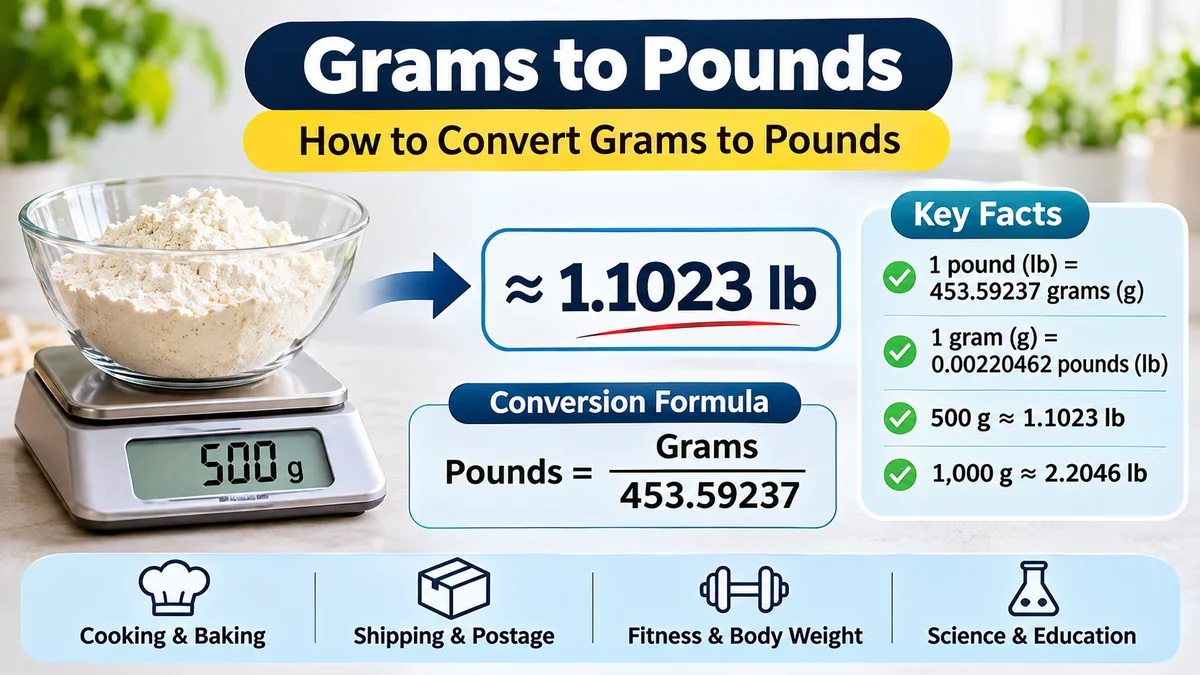
Need to convert a weight from grams to pounds? Whether you’re following a recipe, weighing a package, or comparing product specifications, knowing the correct conversion makes the calculation simple.
To convert grams to pounds, divide the weight in grams by 453.59237. One pound equals exactly 453.59237 grams, so one gram is approximately 0.00220462 pounds. For example, 500 grams equals about 1.10231 pounds, while 1,000 grams equals approximately 2.20462 pounds.
GRAMS TO POUNDS CONVERTERGrams (g)Pounds (lb)
1.102311
1 g = 0.00220462262 lb Copy result
What Is the Formula for grams to pounds?
The formula for converting grams to pounds is:
\[ \text{Pounds}=\frac{\text{Grams}}{453.59237} \]
Alternatively, multiply the number of grams by approximately 0.00220462262.
\[ \text{Pounds}=\text{Grams}\times0.00220462262 \]
Both methods give the same result, apart from minor rounding differences.
Step-by-step conversion example
Suppose a food package weighs 750 grams, and you want to express that weight in pounds.
- Start with the weight: 750 grams.
- Divide 750 by 453.59237.
- The result is approximately 1.65347 pounds.
- Round to 1.65 lb if two decimal places are sufficient.
The weight has not changed; only its unit of measurement has.
Why is 453.59237 used?
The value comes from the internationally agreed definition of the avoirdupois pound. Since 1959, the international pound has been defined as exactly 0.45359237 kilograms.
Because one kilogram contains 1,000 grams, one pound equals exactly 453.59237 grams.
This relationship is also recognized in measurement references maintained by the U.S. National Institute of Standards and Technology (NIST).
grams to pounds Conversion Chart
The following reference table shows common gram measurements converted into pounds.
| Grams (g) | Pounds (lb) |
|---|---|
| 1 | 0.002205 |
| 5 | 0.011023 |
| 10 | 0.022046 |
| 25 | 0.055116 |
| 50 | 0.110231 |
| 100 | 0.220462 |
| 150 | 0.330693 |
| 200 | 0.440925 |
| 250 | 0.551156 |
| 300 | 0.661387 |
| 400 | 0.881849 |
| 500 | 1.102311 |
| 750 | 1.653467 |
| 1,000 | 2.204623 |
| 1,500 | 3.306934 |
| 2,000 | 4.409245 |
| 2,500 | 5.511557 |
| 5,000 | 11.023113 |
| 10,000 | 22.046226 |
All values in the pounds column are rounded to six decimal places.
For everyday use, two or three decimal places are generally enough. Scientific measurements, laboratory calculations, and precise shipping specifications may require more digits.
Common grams to pounds Conversions Explained
How many pounds is 100 grams?
100 grams equals approximately 0.22046 pounds.
\[ 100\div453.59237\approx0.22046\text{ lb} \]
This is a useful reference when comparing food portions or small product weights.
How many pounds is 250 grams?
250 grams equals approximately 0.55116 pounds.
A 250-gram package is slightly heavier than half a pound because half a pound equals approximately 226.796 grams.
How many pounds is 500 grams?
500 grams equals approximately 1.10231 pounds.
A common mistake is assuming 500 grams equals exactly one pound. In reality, it is about 10.23% heavier than one pound.
How many pounds is 1,000 grams?
1,000 grams equals one kilogram, which is approximately 2.20462 pounds.
\[ 1000\div453.59237\approx2.20462 \]
This conversion is especially useful for luggage, body weight, groceries, and international shipping.
How many grams make one pound?
Exactly 453.59237 grams make one international avoirdupois pound.
For quick mental calculations, you can use approximately 454 grams per pound. However, the exact value is preferable when precision matters.
Understanding Grams, Pounds, and Other Weight Units
Grams and pounds are commonly described as weight units in everyday language, although technically they are units of mass.
What is a gram?
A gram (g) is a metric unit of mass equal to one-thousandth of a kilogram.
It belongs to the metric system, which uses decimal relationships between units.
Grams are commonly used for food ingredients, nutritional labels, small packages, jewelry, and laboratory measurements.
What is a pound?
A pound (lb) is a unit of mass in the imperial and U.S. customary measurement systems.
The commonly used pound is the international avoirdupois pound, which contains 16 avoirdupois ounces.
Pounds are widely used in the United States for body weight, groceries, parcels, and household measurements.
How do grams compare with kilograms and ounces?
| Unit | Equivalent |
|---|---|
| 1 gram | 0.001 kilogram |
| 1 kilogram | 1,000 grams |
| 1 pound | 453.59237 grams |
| 1 pound | 16 ounces |
| 1 ounce | 28.349523125 grams |
| 1 kilogram | Approximately 2.20462 pounds |
The abbreviation for pound is lb, derived from the Latin word libra. The plural abbreviation is also lb, although lbs is common in informal writing.
How to Convert Grams to Pounds and Ounces
Sometimes a weight is easier to understand when expressed in pounds and remaining ounces rather than decimal pounds.
For example, 750 grams equals approximately 1.65347 pounds.
The whole-number part represents one pound. Convert the remaining 0.65347 pounds into ounces by multiplying by 16.
\[ 0.65347\times16\approx10.46 \]
Therefore, 750 grams is approximately 1 pound and 10.46 ounces.
For a general conversion:
- Divide grams by 453.59237 to obtain decimal pounds.
- Take the whole-number portion as the number of pounds.
- Multiply the fractional portion by 16 to obtain ounces.
This format is useful for recipes, postal parcels, and weight measurements written in pounds and ounces.
How to Convert Pounds Back to Grams
The reverse conversion is equally straightforward.
To convert pounds to grams, multiply by 453.59237.
\[ \text{Grams}=\text{Pounds}\times453.59237 \]
For example, converting 3 pounds into grams:
\[ 3\times453.59237=1360.77711\text{ g} \]
Therefore, 3 pounds equals 1,360.77711 grams.
If you need to convert pounds into kilograms instead, multiply the pounds value by 0.45359237.
The two conversions are consistent because one kilogram contains exactly 1,000 grams.
Where Are Gram-to-Pound Conversions Used?
Cooking and baking
Recipes from different countries often use different measurement systems. European recipes frequently specify ingredients in grams, while some American recipes use pounds and ounces.
For example, a recipe requiring 900 grams of flour calls for approximately 1.98416 pounds.
Using a digital kitchen scale and converting between units can help maintain ingredient proportions, particularly when baking bread, cakes, or pastries.
However, mass and volume are not interchangeable. Converting grams into pounds does not tell you how many cups of an ingredient you need without considering its density.
Shipping and postage
International shipments may have weight specifications in kilograms or grams, while domestic shipping services in the United States often display pounds.
Suppose a parcel has a mass of 2,500 grams:
\[ 2500\div453.59237\approx5.51156\text{ lb} \]
Its weight is approximately 5.51 pounds.
When preparing a shipment, also check the carrier’s rounding rules, packaging weight, and dimensional-weight policies. The converted mass alone may not determine the shipping charge.
Fitness and body weight
Some fitness equipment and health records use metric measurements, while others use pounds.
For example, a 5,000-gram weight plate has a mass of 5 kilograms, or approximately 11.02 pounds.
Converting these values helps compare exercise equipment and weight measurements recorded in different units.
Science and education
Grams are commonly used in chemistry, physics, and classroom experiments because they are part of the metric system.
Pounds may appear in engineering references, equipment specifications, and everyday measurement examples.
When working on scientific problems, distinguish between mass and force. A pound-mass is not the same as a pound-force, and the gram is not a unit of force.
How Accurate Should a Grams-to-Pounds Conversion Be?
The number of decimal places you need depends on how the result will be used.
| Application | Suggested precision |
|---|---|
| Everyday estimates | 1–2 decimal places |
| Cooking and groceries | 2–3 decimal places |
| Shipping comparisons | 2–3 decimal places |
| Engineering calculations | Based on required tolerance |
| Laboratory measurements | Based on instrument precision |
The conversion factor is exact, but the original measurement may not be.
For instance, a scale displaying 500 grams might have a measurement uncertainty of several grams. Converting the reading into 1.102311 pounds does not make the original measurement more accurate.
Rounding versus measurement accuracy
Rounding is the process of reducing the number of displayed digits. Measurement accuracy describes how closely a measured value represents the actual quantity.
These concepts are related but not identical.
For example:
- 500 g = 1.102311 lb when rounded to six decimal places.
- 500 g ≈ 1.102 lb when rounded to three decimal places.
- 500 g ≈ 1.10 lb when rounded to two decimal places.
Each result represents the same converted measurement at a different level of numerical precision.
For calculations involving multiple measurements, retain additional digits during the calculation and round the final result.
Common Mistakes When Converting grams to pounds
Assuming 500 grams equals one pound
This is one of the most common conversion errors.
One pound is approximately 453.59 grams, not 500 grams. Using 500 grams as an exact equivalent introduces an error of about 10.23% relative to one pound.
Confusing pounds with ounces
One pound contains 16 ounces, but one ounce contains approximately 28.35 grams.
If you accidentally use the ounce conversion factor when calculating pounds, the result will be incorrect by a factor of 16.
Always check the unit symbol before converting:
- g = grams
- kg = kilograms
- lb = pounds
- oz = ounces
Using the wrong pound definition
The international avoirdupois pound is the standard pound used for everyday weight measurements.
However, the troy pound is a different historical unit associated with precious-metal measurement systems. One troy pound contains approximately 373.24 grams, rather than 453.59 grams.
When converting ordinary food, luggage, body weight, or parcel measurements, use the avoirdupois pound.
Rounding too early
Suppose you convert several ingredient weights separately and round every result to one decimal place before adding them.
The accumulated rounding differences can make the final total less accurate.
A better method is to add the original gram measurements first, convert the total, and then round the final answer.
Mixing mass and fluid measurements
Grams measure mass, whereas milliliters and fluid ounces measure volume.
A 100-gram quantity of water occupies approximately 100 milliliters under common reference conditions, but that relationship does not apply to all substances.
Cooking oil, flour, honey, and other ingredients have different densities. Use an ingredient-specific conversion when moving between mass and volume.
Quick Mental Math for Grams and Pounds
You do not always need a calculator to estimate a weight.
One useful approximation is:
\[ 1\text{ kg}\approx2.2\text{ lb} \]
Because 1,000 grams equals one kilogram, divide the grams value by 1,000 and multiply by 2.2.
For example, to estimate 3,000 grams in pounds:
\[ (3000\div1000)\times2.2=6.6\text{ lb} \]
The more accurate result is approximately 6.61387 pounds.
Another quick method is to divide grams by 454 instead of 453.59237. This provides a close approximation for everyday calculations.
For precise results, use the full conversion factor.
Final Thoughts on grams to pounds
Converting grams into pounds is straightforward once you know the exact relationship: 1 pound = 453.59237 grams.
Divide grams by 453.59237 to obtain pounds, or multiply by approximately 0.00220462 for the same result. Remember that 500 grams is about 1.10 pounds, while 1,000 grams is about 2.20 pounds.
Use the conversion chart or calculator whenever you need a quick answer, and choose the appropriate rounding precision for your measurement.
The exact conversion factor is documented in the NIST Handbook 44 (2026), Appendix C, which provides standardized mass conversion tables. NIST Publications
