

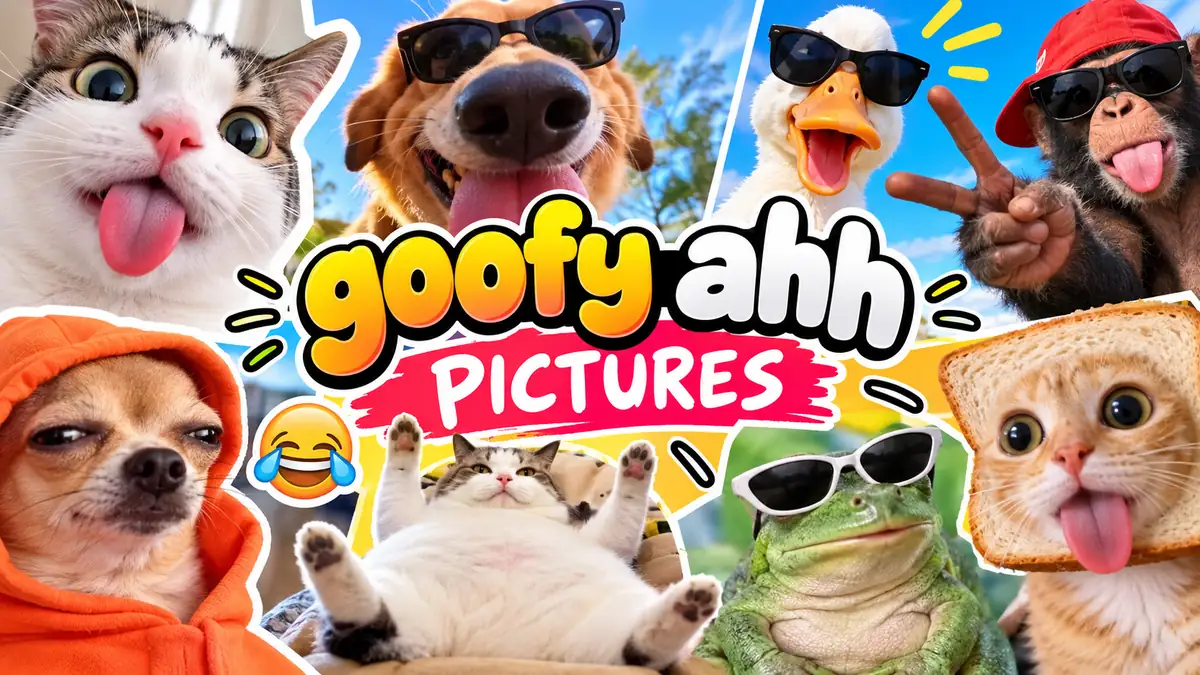
Some internet pictures are funny because they contain a clever joke. Others make you laugh because the face is stretched beyond recognition, the camera is practically touching someone’s nose, or a completely ordinary animal suddenly looks like a creature from another dimension.
That second category is where goofy ahh pictures live.
Goofy ahh pictures are absurd, distorted, awkward, or deliberately low-quality images shared for their chaotic humor. They commonly feature fisheye perspectives, exaggerated facial features, strange selfies, Photoshop edits, blurry screenshots, animals caught at unfortunate moments, and bizarre characters. The style is closely connected with TikTok, Reddit, 21st Century Humor, shitposting, and modern brainrot meme culture.
The pictures rarely need a traditional punchline. Looking ridiculous is the punchline.
What Are goofy ahh pictures?
The simplest definition is this:
Goofy ahh pictures are intentionally or accidentally ridiculous-looking images that become funny through distortion, strange perspective, exaggerated expressions, awkward timing, poor image quality, unexpected editing, or pure visual absurdity.
A normal selfie might become one after someone stretches the person’s forehead. A dog photographed with a wide-angle lens can qualify because its nose suddenly appears enormous. Even an ordinary screenshot can fit the style if its composition, expression, or context looks bizarre enough.
Know Your Meme specifically associates the format with photoshopped images, fisheye-perspective selfies, bizarre camera angles, 21st Century Humor, brainrot, and shitposting. Its entry dates the recognizable “Goofy Ahh Pictures” image format to 2023, although the slang behind it is considerably older.
The category is deliberately loose. There is no checklist that an image must pass.
If a picture looks so unnecessarily strange that your immediate reaction is “why does this exist?”, it probably has the right energy.
What Does “Goofy Ahh” Mean?
To understand the pictures, it helps to understand the phrase.
“Goofy ahh” is an internet spelling related to “goofy ass,” with “goofy” describing something silly, ridiculous, awkward, or absurd. The expression has roots in African American Vernacular English (AAVE) and existed online before becoming a mainstream TikTok meme.
The “ahh” spelling eventually became heavily associated with internet slang and meme culture.
Online, people began attaching the expression to almost anything:
- goofy ahh haircut
- goofy ahh sound
- goofy ahh dog
- goofy ahh name
- goofy ahh face
- goofy ahh meme
- goofy ahh photo
- goofy ahh character
The phrase therefore became more than a description of one particular meme. It developed into a flexible way of labeling something as unusually silly.
That flexibility is one reason goofy ahh pictures can look completely different from one another.
Where Did goofy ahh pictures Come From?
There are really two histories involved: the history of the phrase “goofy ahh” and the later development of goofy ahh pictures as an identifiable image-meme format.
The slang came first
Documented online uses of “goofy ahh” or closely related phrasing go back many years. Meme historians have traced the expression on Twitter/X to the late 2000s, long before TikTok turned it into mainstream meme vocabulary.
The phrase remained relatively niche for years.
That changed dramatically around 2021 and 2022.
TikTok creators started using “goofy ahh” alongside bizarre videos, cartoon noises, ridiculous edits, and intentionally chaotic humor. Producer @proddadood’s “goofy ahh remixes,” which combined music with exaggerated cartoon sound effects, were among the notable pieces of content associated with the phrase’s wider spread.
Quandale Dingle joined the chaos
Another important piece of the meme’s history was Quandale Dingle.
The name became a meme after appearing on a computer login screen and circulating online in 2021. It quickly developed into a much larger collection of absurd stories, edited faces, exaggerated voices, and intentionally nonsensical characters.
Quandale Dingle and goofy ahh humor became closely associated as both trends spread through TikTok’s absurdist meme culture.
The result was an increasingly recognizable style: strange images, strange names, cartoon noises, distorted faces, unexpected edits, and jokes that deliberately refused to behave like conventional jokes.
The picture format became recognizable in 2023
The specific goofy ahh pictures format became more identifiable in 2023.
Know Your Meme records a June 7, 2023 Tenor upload by user @averagenutsenjoyer as an early example carrying the “Goofy Ahh Pictures Meme” title. The image involved an edited Staring Fish meme featuring a beret, mustache, and baguette.
During the same year, TikTok users circulated collections of strange profile pictures and distorted images under “goofy ahh” labels. The format also appeared on Reddit and other meme communities.
There probably wasn’t a single moment when somebody officially invented the visual style.
Instead, existing forms of absurd internet humor gradually converged under a new name.
Why Do goofy ahh pictures Look So Weird?
A surprisingly consistent visual language appears once you’ve seen enough of these images.
The humor frequently depends on taking something recognizable and pushing one visual characteristic too far.
| Visual feature | What it does |
|---|---|
| Fisheye lens | Makes noses, foreheads, and nearby objects disproportionately large |
| Extreme close-up | Removes normal personal space and makes expressions more intense |
| Face stretching | Turns familiar faces into absurd caricatures |
| Large lips or eyes | Creates deliberately unnatural proportions |
| Low resolution | Gives an image a cheap, chaotic meme quality |
| Motion blur | Makes normal movement look inexplicable |
| Bad cropping | Removes context and focuses attention on something strange |
| Photoshop edits | Adds impossible proportions, objects, or combinations |
| Strange perspective | Makes ordinary subjects appear physically distorted |
| Awkward expression | Captures someone or something at exactly the wrong moment |
None of these techniques is automatically funny.
Context matters.
A professionally corrected wide-angle photograph isn’t particularly goofy. Keep the distortion, crop it badly, compress it repeatedly, zoom directly into the face, and add an absurd caption—and suddenly the entire mood changes.
Fisheye distortion is especially common
Fisheye and wide-angle perspectives are almost perfect for this style because objects closest to the lens appear disproportionately large.
Put a camera close to a dog’s nose and the dog suddenly looks like it consists of 70 percent nose.
Move it toward someone’s forehead and their head can appear enormous while the rest of the body recedes into the background.
That mismatch between what we know something should look like and what the camera shows creates an immediate visual joke.
Common Types of goofy ahh pictures
There isn’t one official taxonomy, but most examples fall into a handful of recognizable styles.
Distorted face pictures
This is probably the most recognizable category.
A normal portrait gets stretched, compressed, widened, enlarged, or manipulated until the person’s proportions become impossible.
Typical edits include huge foreheads, tiny chins, enormous mouths, widened eyes, stretched smiles, and faces compressed into unusually narrow shapes.
The funniest versions usually preserve enough of the original face for it to remain recognizable.
Fisheye selfies
These rely less on editing and more on perspective.
The camera gets extremely close to the subject, producing a giant nose or central facial feature while everything farther away appears smaller.
Because the distortion can happen naturally through the lens, the result sometimes looks even stranger than Photoshop.
Goofy animal pictures
Animals are perfect meme material because they have no idea they’re participating.
Dogs with their noses pressed against cameras, cats photographed mid-yawn, fish staring directly into a lens, birds standing at strange angles, and pets sitting like humans can all become goofy images without digital manipulation.
Timing does most of the work.
Cursed-looking images
“Cursed image” and “goofy ahh picture” aren’t exact synonyms, although they overlap.
A cursed image tends to create discomfort or confusion. It might show an unexplained object, eerie room, impossible situation, or deeply strange photograph.
A goofy image is usually more openly comedic.
When an image manages to be confusing, uncomfortable, and ridiculous simultaneously, the categories collide.
Badly edited pictures
Traditional photo editing tries to hide the manipulation.
Goofy editing often does the opposite.
The badly cut-out object, mismatched lighting, stretched head, ridiculous accessory, or obviously pasted element can be part of the joke.
Polishing the edit too much may actually make it less funny.
Low-quality reaction pictures
Sometimes all an image needs is aggressive JPEG compression.
Repeated screenshots, tiny crops, pixelation, blur, and poor resolution can strip away the polished appearance of an ordinary photograph.
Meme communities have long used this kind of deliberate degradation. With goofy ahh pictures, ugly image quality can function almost like a visual sound effect.
Weird profile pictures
The format naturally works as a profile picture, or PFP.
A tiny circular avatar rewards exaggerated features because subtle details disappear at small sizes. An enormous nose, wide stare, stretched smile, or strange animal face remains recognizable even when reduced to an icon.
Collections of “goofy ahh pfp” images became part of the trend’s spread on TikTok.
goofy ahh pictures and 21st Century Humor
To someone unfamiliar with modern meme culture, the pictures can look like random nonsense.
That is partly the point.
21st Century Humor is an internet comedy style built around aggressive editing, unexpected references, distorted images, sound effects, abrupt cuts, and intentionally weak connections between one joke and the next.
Instead of the familiar:
setup → expectation → punchline
you might get:
distorted face → Vine boom → cartoon boing → random animal → bass-boosted sound → another distorted face
The lack of conventional structure becomes part of the entertainment.
Goofy ahh pictures fit naturally into this ecosystem because they work immediately. A viewer doesn’t need a paragraph of context to understand that an enormous fisheye nose looks ridiculous.
This is also where shitposting enters the picture.
Shitposts deliberately ignore the expectation that online content should be polished, meaningful, or even sensible. Low effort can become the aesthetic rather than a flaw.
Goofy images inherit that attitude.
How Brainrot Humor Changed the Style
The word brainrot is now frequently used for repetitive, absurd, highly internet-specific content that becomes lodged in online culture.
Goofy ahh memes were part of that broader movement before “brainrot” became an everyday label for seemingly endless waves of intentionally ridiculous internet humor.
The connection makes sense.
Both styles favor:
- repetition
- exaggeration
- recognizable meme references
- surreal characters
- compressed or distorted media
- nonsensical captions
- intentionally juvenile jokes
- rapid remixing
An image doesn’t need a deep meaning to survive in this environment.
It needs to be instantly recognizable, remixable, and funny enough to send to somebody else.
Quick Takeaway
Goofy ahh humor isn’t random merely because creators don’t know how to make conventional jokes. Randomness itself is often the comedic technique. The viewer recognizes that the image breaks normal expectations, and that violation becomes the joke.
Why Are goofy ahh pictures Funny?
There is a basic psychological mechanism underneath all the internet slang.
Humor often comes from incongruity—something violates the pattern you expected to see.
Imagine a normal photograph of a cat.
You already know approximately how a cat’s face should be proportioned. If a wide-angle lens makes its nose enormous while its body looks tiny in the background, your expectation is suddenly broken.
Nothing dangerous happened.
The mismatch is harmless.
So it becomes funny.
Exaggeration makes the joke instant
Visual exaggeration is one of the oldest comedic devices around.
Cartoonists have always enlarged noses, ears, hairstyles, muscles, expressions, and other distinctive features. Goofy ahh memes essentially apply the same principle using phone cameras, editing software, screenshots, filters, and compression.
The internet didn’t invent visual exaggeration.
It simply made it much faster.
Bad quality can make a picture funnier
This sounds backward, especially when modern phones compete on camera quality.
Yet an ultra-sharp professional photograph can sometimes feel too intentional for absurd meme humor.
A terrible screenshot has a different energy.
Its blur and compression suggest that the image has been copied, reposted, screenshotted, edited, and passed around repeatedly.
The imperfections become part of the meme’s personality.
Surprise matters
The strongest goofy images often reveal their joke immediately.
You open a message expecting something normal and encounter a fish wearing an absurd accessory or a face stretched across the entire screen.
The surprise happens before you have time to analyze it.
That makes the format particularly effective in group chats, reaction threads, Discord servers, TikTok slideshows, and Reddit posts.
Goofy Ahh Memes vs. Cursed Images vs. Reaction Memes
These categories overlap, but they aren’t interchangeable.
| Type | Main effect | Typical characteristics |
|---|---|---|
| Goofy ahh picture | Absurd amusement | Distortion, fisheye faces, silly edits, weird perspectives |
| Cursed image | Confusion or discomfort | Unexplained situations, unsettling objects, eerie context |
| Reaction meme | Communicates a response | Recognizable facial expression or character |
| Shitpost | Deliberate nonsense | Low effort, randomness, irony, broken context |
| Brainrot meme | Repetitive absurdity | Recurring characters, phrases, sounds, remixing |
| Surreal meme | Dreamlike absurdity | Impossible scenarios and intentionally strange logic |
A single picture can belong to several categories.
A stretched reaction face could simultaneously be a reaction meme, shitpost, brainrot image, and goofy ahh picture.
These labels describe internet usage more than strict artistic genres.
The Role of TikTok, Reddit, Tenor, and Other Platforms
The format grew because modern social platforms make visual jokes incredibly easy to remix.
TikTok
TikTok played a major role in turning “goofy ahh” from slang into a recognizable meme aesthetic.
The phrase became associated with cartoon sound effects and absurd videos during its major 2021–2022 expansion. Image collections and goofy PFP posts followed, with the specific picture format becoming visible in 2023.
TikTok also encouraged combinations of still images and sound.
A distorted photograph becomes dramatically different when paired with a Vine boom, metallic clang, cartoon spring, scream, or other exaggerated audio cue.
Reddit’s meme communities were already comfortable with surreal humor, cursed images, shitposting, and intentionally terrible edits.
That made goofy ahh pictures an easy fit.
Reddit also encourages reposting and mutation: someone finds an image, somebody else crops it, another person adds text, and eventually the edited version becomes more recognizable than its original source.
Tenor and GIF culture
Tenor matters because reaction GIF platforms turn individual images and animations into reusable responses.
Know Your Meme identifies Tenor as an early source associated with the named Goofy Ahh Pictures format and documents the June 2023 Staring Fish edit.
A meme stored as a GIF becomes easy to drop into conversations repeatedly, extending its life beyond the original post.
X and earlier internet culture
The slang itself predates the picture trend.
Historical references place forms of “goofy ahh” online years before TikTok existed, demonstrating an important distinction: TikTok helped popularize the modern meme, but it did not invent the linguistic roots behind the expression.
How to Recognize a Good Goofy Ahh Picture
There is no official standard, but the strongest examples usually have one thing in common:
They look naturally wrong.
Not dangerous. Not necessarily ugly. Just wrong enough to be hilarious.
Several characteristics help.
1. You understand the joke instantly
Visual humor works best when it doesn’t require extensive explanation.
A dog’s nose filling 80 percent of the frame is immediately readable.
2. One feature dominates
The image often has a visual focal point:
an enormous mouth, bizarre forehead, stretched face, tiny body, extreme expression, or unexpected object.
Trying to make everything weird can weaken the effect.
3. The imperfection feels intentional
Bad cropping can help.
Pixelation can help.
Awkward lighting can help.
The difference between a boring bad photograph and a funny bad photograph is usually whether those imperfections contribute to the visual joke.
4. It remains recognizable
Complete abstraction isn’t always as effective.
If you distort a familiar subject while leaving just enough information for viewers to recognize the original, the contrast becomes funnier.
5. It works without a caption
Captions can improve the meme, but the picture should ideally contain some visual humor already.
The best examples make you laugh before reading anything.
How People Make goofy ahh pictures
You don’t need professional editing skills.
In fact, excessive polish can work against the aesthetic.
Start with an ordinary image
Choose something visually recognizable:
- a selfie
- pet photo
- stock-style portrait
- cartoon character
- object with a face-like appearance
- reaction image
- public-domain artwork
- your own photograph
Using your own photos or images you have permission to modify avoids unnecessary copyright and privacy problems.
Distort one feature
Try enlarging the forehead, nose, mouth, eyes, ears, or another distinctive feature.
Don’t immediately distort everything.
One ridiculous change often works better.
Experiment with perspective
You can create distortion before editing anything.
Put a wide-angle camera close to the subject. Position the most important feature near the lens and let everything else fall into the background.
For pets, the nose is an obvious choice.
For objects, move one recognizable component extremely close to the camera.
Crop aggressively
Normal photography usually gives the subject comfortable space.
Meme photography doesn’t have to.
Crop unusually close to the eyes, mouth, or face. Remove information the viewer would normally expect to see.
This creates visual tension with almost no editing.
Reduce the quality carefully
A little compression can strengthen the meme aesthetic.
Repeated screenshots, resizing, and mild blur can create the familiar low-resolution internet look.
Don’t reduce the quality so far that viewers can no longer tell what’s happening.
Add text only when it improves the joke
A caption shouldn’t explain why the picture is funny.
It should add another layer.
Short, understated captions frequently work better than long explanations because the visual remains the main event.
What Usually Doesn’t Work
The easiest mistake is trying too hard.
If you add enormous eyes, five filters, a stretched mouth, twelve stickers, multiple captions, and random objects to the same picture, viewers don’t know where to look.
Chaos still needs a focal point.
Another common mistake is copying an existing meme without changing anything. Meme culture thrives on mutation. The same recognizable format becomes interesting again when a creator introduces an unexpected variation.
There’s also a difference between laughing at an intentionally ridiculous edit and humiliating a real person.
Using somebody’s private or embarrassing photograph without permission can turn harmless meme-making into harassment. Avoid exposing personal information, targeting vulnerable people, or presenting manipulated images as genuine photographs.
The joke works perfectly well without hurting anyone.
Are goofy ahh pictures the Same as Goofy Memes?
Not exactly.
A goofy meme can be any silly meme.
Goofy ahh pictures, in the narrower internet-culture sense, refer to a recognizable style connected with absurdist meme humor, distorted photography, fisheye selfies, bizarre edits, strange perspectives, and brainrot or shitposting culture.
The distinction is useful because someone searching for “goofy pictures” might simply want amusing photos.
Someone searching for goofy ahh pictures is much more likely to expect chaotic internet humor.
That difference is small linguistically but significant culturally.
Why Faces Appear So Often
Humans are unusually sensitive to faces.
We notice tiny differences in expressions, proportions, eye direction, and mouth position. That’s why changing a face by only a little can produce a surprisingly strong reaction.
Goofy ahh edits exploit that sensitivity.
A slightly enlarged forehead might look unusual.
Double its size and the face becomes ridiculous.
Move the eyes too close together and the effect changes again.
Stretch the mouth while leaving everything else untouched and viewers immediately recognize that something is wrong.
This is also why extreme close-ups work so well. Normal social interaction involves a comfortable viewing distance. A camera positioned centimeters from somebody’s nose violates that expectation.
The picture feels invasively close—but harmlessly so.
Why Animals Work So Well
Animals provide another shortcut to visual comedy.
People naturally interpret animal expressions through a human lens. A dog glancing sideways can look suspicious. A cat with half-closed eyes can appear judgmental. A bird facing directly into a camera may seem confrontational.
Of course, the animal isn’t actually performing the human emotion viewers assign to it.
That projection is part of the joke.
Perspective exaggerates it further.
Wide-angle dog photographs are especially effective because the nose is already positioned in front of the rest of the face. Move it closer to the lens and the proportions become dramatically distorted without any Photoshop.
The resulting image looks edited even when it isn’t.
How goofy ahh pictures Became Part of Internet Language
Memes don’t only communicate jokes.
They communicate reactions.
A strange picture sent after a friend’s questionable message might mean:
“What did I just read?”
A distorted face can communicate disbelief.
A fisheye animal can express confusion.
An absurd character can signal that the conversation has stopped being serious.
That gives goofy ahh pictures a practical function in digital communication. Instead of typing an emotional response, people send an image whose visual absurdity conveys the mood.
This isn’t particularly new.
Reaction GIFs, rage comics, image macros, emoji, Wojaks, and countless earlier formats performed similar roles.
The visual vocabulary changes. The human behavior doesn’t.
Why the Trend Lasted Beyond One Viral Meme
Internet trends often disappear because they depend on one joke.
Once everybody understands the punchline, there isn’t much left to do.
Goofy ahh pictures are more flexible.
The format is based on an aesthetic rather than a single template. There isn’t one mandatory face, caption, character, or photograph.
Anything can potentially become goofy.
That means creators can continually introduce:
- new animals
- new faces
- new characters
- new Photoshop edits
- new AI-generated absurdities
- new reaction images
- new camera distortions
- new combinations with current memes
The label survives even as individual pictures disappear.
That’s an important reason broad meme categories such as brainrot, shitposting, cursed images, and absurdist humor can persist longer than individual templates.
Can AI Images Be goofy ahh pictures?
Yes.
Generative AI added another source of deliberately impossible imagery to meme culture. Strange anatomy, exaggerated characters, impossible objects, bizarre combinations, and intentionally absurd prompts can produce images that fit the aesthetic.
But AI isn’t required.
Some of the funniest examples come from ordinary cameras catching exactly the wrong expression at exactly the right moment.
The defining feature isn’t the software.
It’s the visual result.
If an image produces the combination of surprise, absurdity, recognition, and harmless ridiculousness associated with the format, people may label it goofy ahh regardless of how it was created.
Are goofy ahh pictures Still Relevant?
Internet slang changes quickly, and individual meme formats constantly rise and fall.
The original “goofy ahh” explosion is tied strongly to the early-2020s TikTok era, while the specifically named picture format became visible later. Yet the underlying visual style remains familiar because it overlaps with much larger traditions: reaction images, cursed pictures, absurdist edits, shitposting, distorted selfies, and brainrot humor.
Even when terminology changes, people continue laughing at distorted faces and badly timed photographs.
The label may evolve faster than the joke itself.
The Bigger Story Behind goofy ahh pictures
At first glance, goofy ahh pictures can look like some of the least serious content ever created online.
In a way, they are.
But they’re also a good example of how internet culture evolves.
A phrase with older linguistic roots enters social media. TikTok creators attach it to cartoon noises and ridiculous videos. Characters such as Quandale Dingle become associated with the same style. Fisheye photographs, distorted faces, Photoshop edits, GIFs, and strange profile pictures get folded into the aesthetic. Reddit, TikTok, Tenor, and other platforms help remix and redistribute everything.
Eventually, viewers recognize the style without needing anybody to define it.
That’s how many meme genres develop.
They aren’t designed by committee. They mutate.
Final Thoughts on goofy ahh pictures
goofy ahh pictures are essentially visual absurdity distilled into an image: distorted faces, fisheye selfies, ridiculous animals, awkward screenshots, bizarre Photoshop edits, low-resolution reaction pictures, and anything else that looks inexplicably funny.
Their roots connect older AAVE-derived internet slang with TikTok’s “goofy ahh” meme wave, Quandale Dingle, cartoon sound effects, 21st Century Humor, Reddit shitposting, cursed-image culture, and the broader brainrot aesthetic.
What makes the format work isn’t technical sophistication. It’s the opposite.
Take something familiar. Make one part of it unexpectedly wrong. Leave enough of the original for viewers to understand what they’re seeing.
Then let the absurdity do the rest.
