

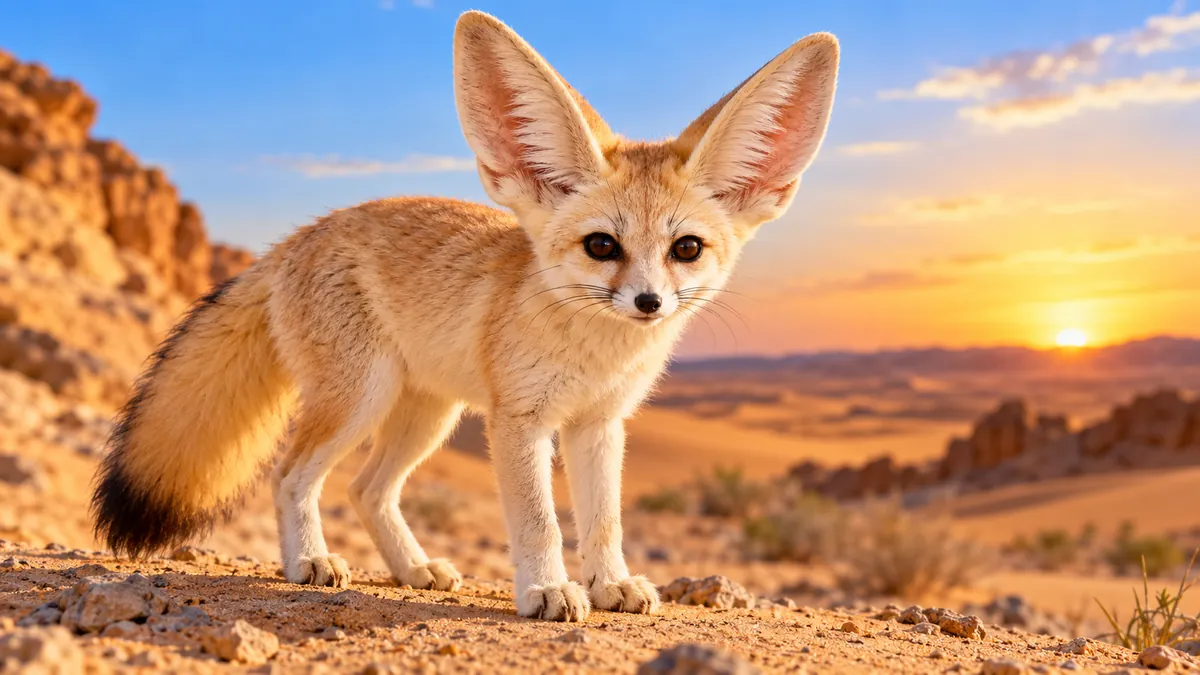
The fennec fox looks almost unreal: a tiny sandy-colored fox with enormous ears, dark eyes, and a bushy tail. Yet every striking feature of this animal has a practical purpose in one of the harshest environments on Earth.
The fennec fox (Vulpes zerda) is a small desert canid native mainly to North Africa and the Sahara. It is the smallest fox species, generally weighing only a few pounds. Its oversized ears help detect prey beneath the sand and release excess body heat, while furry feet, pale fur, nocturnal behavior, and underground burrows help it survive extreme desert conditions. National Zoo
What Is a Fennec Fox?
The fennec fox belongs to the family Canidae, the same mammalian family that includes wolves, dogs, jackals, and other foxes. Its scientific name is Vulpes zerda, and it is classified within the order Carnivora. National Zoo
Despite belonging to Carnivora, the fennec is actually an omnivore. It eats both animal prey and plant material.
Its unusually small body and disproportionately large ears make it easy to distinguish from most other fox species. Adults generally have sandy, cream, or light-fawn fur that blends naturally with their desert surroundings.
Fennec Fox Size and Appearance
Fennecs are the smallest members of the canid family. Smithsonian reports a body length of approximately 14–16 inches (35.6–40.6 cm), plus a tail measuring roughly 7–12 inches (18–30 cm). Typical weight is around 2–3 pounds (0.9–1.4 kg). National Zoo
| Feature | Typical Description |
|---|---|
| Scientific name | Vulpes zerda |
| Family | Canidae |
| Body length | About 14–16 inches |
| Tail length | About 7–12 inches |
| Weight | About 2–3 pounds |
| Ear length | About 4–6 inches |
| Diet | Omnivorous |
| Activity | Primarily nocturnal |
| Main habitat | Desert and arid regions |
The coat varies from reddish cream and pale fawn to nearly white. The underside is lighter, while the bushy tail typically ends in a dark tip. National Zoo
Those colors aren’t simply attractive. Pale fur provides useful camouflage against sand and reflects sunlight, while the dense coat also offers insulation during cold desert nights. San Diego Zoo Animals
Where Do Fennec Foxes Live?
The natural fennec fox habitat consists primarily of deserts and other arid environments.
Fennecs are strongly associated with the Sahara Desert and North Africa. Smithsonian describes their distribution as extending through North Africa and east toward Sinai and Arabia, with the animals favoring sandy deserts containing grasses or scrub vegetation. National Zoo
Animal Diversity Web also describes the species as highly specialized for arid, sandy habitats, with populations across a broad geographic range that includes parts of Morocco, the central Sahara, and areas extending eastward and southward. Animal Diversity Web
Why Burrows Matter
A fennec does not spend the hottest part of a desert day sitting in direct sunlight.
Instead, it shelters underground.
Fennecs dig burrows in sandy ground, creating cooler refuges where they can sleep during daylight hours and avoid extreme surface temperatures. Some tunnel systems can extend roughly 32 feet (10 meters) and may have several entrances and exits. National Zoo
Multiple exits can also provide escape routes when danger approaches.
The fox generally becomes active around dusk, when desert temperatures begin to fall.
Quick Takeaway: A fennec’s burrow is more than a sleeping place. It provides temperature control, shelter, security, and an environment where young can be raised.
Why Does a Fennec Fox Have Such Big Ears?
Its ears are arguably the animal’s most famous feature.
They can reach approximately 4–6 inches (10.2–15.2 cm) long. Relative to body size, Smithsonian describes them as the largest ears among canids. National Zoo
Those ears perform two particularly important jobs.
1. Finding Prey
Fennecs possess excellent hearing.
When hunting at night, they can listen for small animals moving underneath the sand. Once prey is located, the fox can rapidly dig to uncover it. National Zoo
That gives the fennec an important advantage because potential meals may be difficult to see in darkness or hidden below the surface.
2. Managing Desert Heat
The ears also help dissipate excess body heat.
Large ears provide considerable surface area through which heat can escape, supporting the fox’s ability to cope with its hot environment. San Diego Zoo Animals
The animal can also pant intensely when temperatures rise. Smithsonian reports that during extreme heat, breathing can increase dramatically from around 23 breaths per minute to as many as 690. National Zoo
Fennec Fox Adaptations for Desert Survival
Large ears are only one part of an impressive collection of fennec fox adaptations.
Living successfully in an environment where daytime heat, cold nights, loose sand, scarce surface water, and limited food are normal requires several complementary traits.
Fur-Covered Feet
The soles of a fennec’s paws are protected by thick fur.
This provides traction on loose sand while helping protect the footpads from extremely hot ground. National Zoo
Think of this fur as natural insulation between sensitive paws and the desert surface.
Pale, Thick Coat
Sandy-colored fur helps the animal blend into its environment. This camouflage makes the fox less conspicuous against dunes and desert terrain.
Its coat also plays a role in coping with temperature extremes. San Diego Zoo notes that the thick sandy coat helps keep the fox warm at night while reflecting sunlight during daytime conditions. San Diego Zoo Animals
Nocturnal Lifestyle
Being nocturnal is another effective behavioral adaptation.
Rather than hunting through the hottest hours, fennecs usually rest underground during the day and become active after temperatures fall. San Diego Zoo Animals
This reduces exposure to extreme heat and lowers unnecessary water loss.
Ability to Live With Little Free Water
One of the most remarkable questions is: How does a fennec fox survive with so little water?
Part of the answer comes from its food.
Fennecs can obtain moisture from prey and from plant foods such as roots, fruits, and leaves. Smithsonian notes that they are capable of going for long periods without directly consuming water. National Zoo
This doesn’t mean water has no value to them. Rather, their physiology and diet are adapted to an environment where dependable drinking water may be scarce.
What Do Fennec Foxes Eat?
The fennec fox diet is remarkably varied for such a small desert animal.
In the wild, its menu can include:
- Grasshoppers, locusts, and other insects
- Small rodents
- Lizards
- Birds
- Bird eggs
- Roots
- Fruits
- Leaves
San Diego Zoo also lists foods such as snails and other plant material among their potential diet. National Zoo
Eating both animals and plants gives fennecs flexibility when individual food sources become scarce.
How Do Fennec Foxes Hunt?
Most hunting happens at night.
A fennec often hunts alone, moving through its territory while listening carefully for prey. Its sensitive hearing can reveal movement below the sand.
Once the sound has been pinpointed, the fox digs rapidly with its feet to expose the hidden animal. National Zoo
This hunting strategy combines three desert adaptations: powerful hearing, digging ability, and nocturnal activity.
Despite their tiny size, fennecs are capable hunters. Smithsonian even reports documented cases of them killing fully grown rabbits. National Zoo
Fennec Fox Behavior and Social Life
A common assumption is that these little foxes are entirely solitary because they often hunt alone.
Their social lives are more complicated.
Fennecs can live in family groups, sometimes containing as many as about ten individuals. Separate family groups may occasionally occupy connected or complex den systems. National Zoo
They are generally described as monogamous.
How Do Fennec Foxes Communicate?
Fennecs can be surprisingly vocal.
Their sounds include:
- Barks
- Whimpers
- Squeaks
- Shrieks
- Growls
- Howls
- Chatters
They also communicate through scent. Like many canids, fennecs use urine and feces to mark territory. National Zoo
This explains another commonly searched question: Why do fennec foxes scream?
The dramatic sounds are part of a broader vocal communication system rather than evidence that something is necessarily wrong.
Fennec Fox Reproduction and Life Cycle
Fennecs generally reproduce once per year.
After mating, pregnancy lasts approximately 50–53 days, and a female commonly gives birth to around two to five kits. National Zoo
Newborn kits are furred but initially blind. According to Smithsonian, their eyes typically open after approximately 8–11 days, and they begin walking at around two weeks old. National Zoo
The family structure is important during this vulnerable period.
The male can provide food while the female remains with and nurses the young. Smithsonian reports that pups commonly nurse for about their first ten weeks and reach maturity at approximately 9–11 months. National Zoo
San Diego Zoo similarly places sexual maturity at around ten months. San Diego Zoo Animals
How Long Do Fennec Foxes Live?
Reported fennec fox lifespan varies depending on environment and source.
Smithsonian states that fennecs may live for up to approximately 11 years in human care. San Diego Zoo gives figures of around 10 years in the wild and 13 years in zoos. National Zoo
Differences between estimates are normal because lifespan depends on individual health, predation, food availability, veterinary care, environmental conditions, and other factors.
Rather than treating one age as an absolute limit, it is better to regard roughly a decade as a useful general reference.
Fennec Fox vs. Bat-Eared Fox
The fennec is sometimes confused with the bat-eared fox because both African canids have conspicuously large ears.
They are not the same animal.
| Characteristic | Fennec Fox | Bat-Eared Fox |
|---|---|---|
| Scientific name | Vulpes zerda | Otocyon megalotis |
| Typical habitat | Sandy deserts | Savannas and grasslands |
| Size | Very small | Larger than fennec |
| Diet | Omnivorous | Strongly insect-focused |
| Famous feature | Huge ears relative to body | Large ears and insect hunting |
| Main African environment | Sahara/arid regions | Eastern and southern grasslands |
Smithsonian notes that bat-eared foxes occupy open savannas and shrublands, whereas fennecs are adapted to the sandy Sahara. National Zoo
Bat-eared foxes are also much larger. Adults typically weigh around 6–10 pounds, compared with roughly 2–3 pounds for many fennecs. National Zoo
The similarity in ear size reflects a useful principle of adaptation: different species can develop comparable features that help them detect prey and regulate heat even while occupying different ecological niches.
Can a Fennec Fox Be a Pet?
Their appearance inevitably leads to the question: Can you keep a fennec fox as a pet?
Physically fitting inside a home does not make an animal domesticated.
Fennecs remain wild animals with behaviors and needs that differ substantially from domestic dogs and cats. Smithsonian specifically warns that they do not make good pets and notes that keeping one is illegal in many jurisdictions. National Zoo
Practical difficulties can include territorial behavior, destructive digging, high activity levels, specialized nutrition, veterinary requirements, social needs, and problems with house training.
Their natural routine creates another challenge. A nocturnal fox may become active just when its human household wants to sleep.
Legality also varies between countries, states, provinces, and municipalities. Wildlife ownership rules can change, so local regulations need to be checked directly rather than assuming that exotic-animal ownership is permitted.
Most importantly, “cute” and “domesticated” are not interchangeable concepts.
Domestic dogs have undergone thousands of years of selection alongside humans. A fennec retains the behavioral adaptations of a desert-dwelling wild canid.
Are Fennec Foxes Endangered?
The fennec fox is currently described by major zoo conservation resources as Least Concern under the IUCN Red List classification. National Zoo
Least Concern does not mean the species faces no threats.
Human activity remains an issue. Fennecs may be captured for commercial purposes, tourism displays, fur, or the exotic pet trade. Habitat disturbance and expansion of human settlements can create additional pressure in parts of their natural range. National Zoo
Smithsonian also notes that the species receives legal protection in countries including Morocco, Algeria, Tunisia, and Egypt. National Zoo
Avoiding wildlife products and animals obtained through questionable trade channels is one practical way individuals can avoid contributing to exploitation.
Predators and Threats in the Desert
Small size has obvious advantages in terms of food requirements and shelter, but it also leaves the fennec vulnerable to larger predators.
Staying inside a burrow during daylight provides protection as well as relief from heat. San Diego Zoo notes that larger daytime predators, including birds of prey and hyenas, can pose danger when fennecs are outside their shelters. San Diego Zoo Animals
Their survival strategy therefore combines concealment, camouflage, nocturnal activity, sharp hearing, speed, and access to underground shelter.
Humans, however, are among their significant threats because trapping and wildlife trade can bypass many of the defenses that work against natural predators.
Interesting Fennec Fox Facts
Several features make this tiny fox exceptional even within the diverse Canidae family.
It is the smallest fox species. Its compact body contrasts dramatically with its enormous ears. San Diego Zoo Animals
Its ears may be nearly half its body length. San Diego Zoo notes that the ears can reach 4–6 inches and may be half as long as the animal’s body. San Diego Zoo Animals
It can jump surprisingly high. Smithsonian reports that an adult can jump as high as approximately 3 feet (1 meter) from a standing position. National Zoo
It is faster than its appearance suggests. San Diego Zoo reports speeds of around 20 miles per hour. San Diego Zoo Animals
Its feet have natural protection from hot sand. Dense fur covers the paws, improving traction and insulating them from extreme surface temperatures. National Zoo
It gets moisture from food. Plants and prey contribute water, reducing its dependence on finding open water sources. National Zoo
Its underground home can be extensive. Burrow systems may contain several entrances and tunnels extending up to approximately 32 feet. National Zoo
Why the Fennec Fox Is Built for the Sahara
Few animals demonstrate the relationship between habitat and anatomy as clearly as the fennec.
Start with the challenge of heat. Large ears help release excess body heat, pale fur reflects sunlight, and daytime shelter prevents prolonged exposure.
Then consider hot sand. Fur-covered paws provide insulation and traction.
Water is scarce, so food contributes valuable moisture. Visible prey may also be scarce, so exceptional hearing allows the fox to detect animals hidden underground.
Finally, cold desert nights demand insulation—the same thick coat that contributes to daytime protection helps retain warmth after sunset.
None of these characteristics works entirely in isolation. Together, they create a highly specialized desert animal.
Quick Takeaway
The fennec’s oversized ears, furry feet, pale coat, nocturnal schedule, flexible omnivorous diet, efficient use of dietary moisture, and burrowing behavior all support the same objective: surviving in a dry environment with extreme temperatures and unpredictable resources.
Fennec Fox: A Small Animal With Remarkable Adaptations
The fennec fox is much more than a miniature fox with oversized ears. Vulpes zerda is a highly specialized desert canid whose anatomy and behavior reveal how effectively mammals can adapt to extreme environments.
Its ears help it hear hidden prey and dissipate heat. Its furry paws protect it from scorching sand. Its pale coat provides camouflage, while underground burrows offer shelter from daytime temperatures. An omnivorous diet and ability to obtain moisture from food further support life where water can be difficult to find. National Zoo
Understanding those adaptations is the best way to appreciate the fennec: not as an exotic version of a household pet, but as a wild animal exceptionally well designed for life in the desert.
