

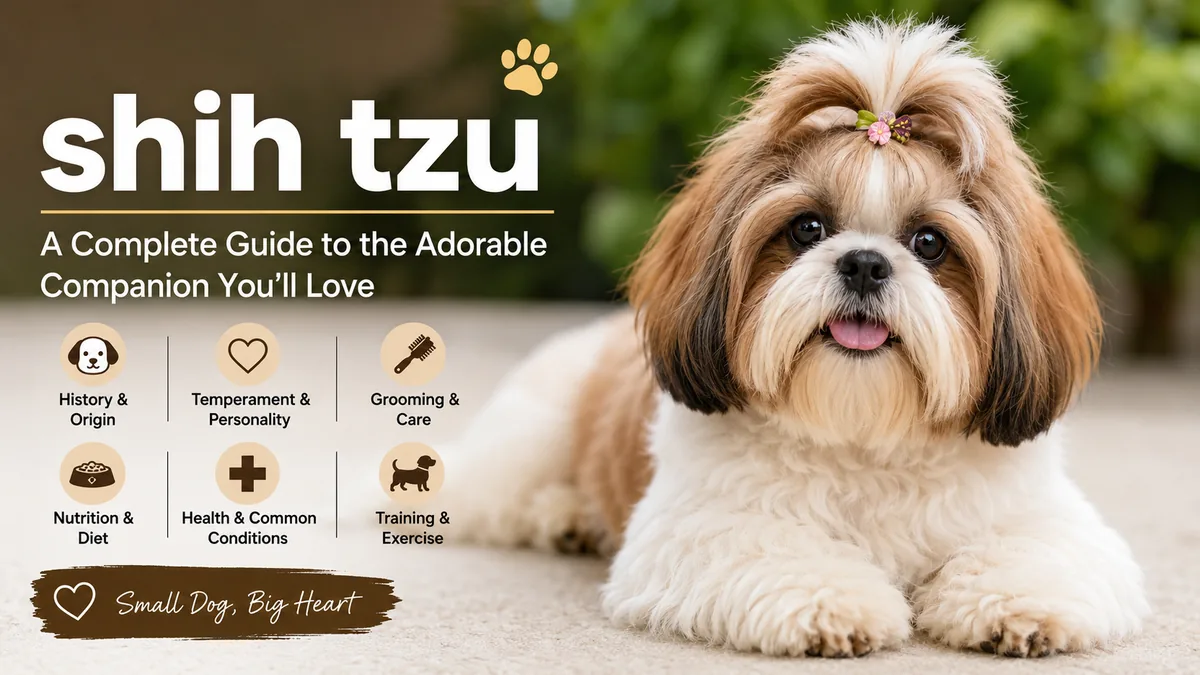
Small enough for apartment living but sturdy enough to have a surprisingly bold personality, the shih tzu has spent centuries doing what it does best: living close to people. Behind the flowing coat and expressive face is an alert, affectionate companion with specific grooming, training, eye-care, dental, and heat-safety needs.
A shih tzu is a small companion dog typically weighing 9–16 pounds and standing about 8–11 inches tall. The breed is known for its affectionate, outgoing temperament, long double coat, short muzzle, prominent eyes, and curled tail. Most need moderate daily activity, regular training, frequent grooming, and extra protection from heat and eye injuries.
shih tzu Breed Overview: Size, Appearance, and Characteristics
The American Kennel Club classifies the Shih Tzu in the Toy Group. Despite the word “toy,” this is not an especially fragile-looking breed when correctly built. The official standard describes a compact, solid dog with good substance, a long flowing double coat, a head carried high, and a tail curved over the back.
| Characteristic | Typical Shih Tzu |
|---|---|
| Height | 8–11 inches |
| Weight | 9–16 pounds |
| Breed group | Toy |
| Coat | Long, dense double coat |
| Temperament | Affectionate, playful, outgoing, alert |
| Exercise needs | Low to moderate |
| Grooming needs | High |
| Living environment | Well suited to indoor and apartment life |
| Common lifespan range | Roughly 10–18 years depending on source and individual health |
Breed references vary somewhat on longevity. Purina lists a lifespan of approximately 10–18 years, while other major references give narrower ranges. Genetics, body condition, preventive veterinary care, dental health, and management of breed-related conditions all influence how long an individual dog lives.
What does a Shih Tzu look like?
The most recognizable feature is the face. Shih Tzus have a broad, rounded head, large dark eyes, a short muzzle, dropped ears covered with hair, and an undershot bite characteristic of the breed.
The long coat can appear in many colors rather than one defining shade. Black, white, gold, liver, red, silver, blue, brindle, and combinations of these colors occur. AKC breed information notes that all colors can be found in the breed.
Their facial hair grows outward around the muzzle, which helped inspire the traditional description “chrysanthemum-faced dog.”
shih tzu Temperament: What Are These Dogs Really Like?
The typical Shih Tzu is affectionate, lively, friendly, and intensely people-oriented. The breed was developed primarily for companionship rather than hunting, guarding livestock, or performing heavy physical work, and that history remains visible in its behavior today.
Most enjoy following family members around the house, sitting beside them, playing short games, and investigating whatever is happening nearby. They may happily spend part of the day on someone’s lap but should not be mistaken for an ornament. A healthy Shih Tzu still needs walks, play, mental stimulation, training, and opportunities to explore.
Are Shih Tzus good family dogs?
They often are.
AKC describes the breed as people-loving and particularly affectionate with children. Their small size also makes them manageable in homes where a larger dog would be impractical.
Supervision remains important around young children. A child should learn not to pull the coat, grab the face, pick the dog up incorrectly, or disturb it while eating or sleeping. Even an affectionate small dog can become frightened or defensive when handled roughly.
Do Shih Tzus get along with other dogs?
Many live successfully with other dogs and household pets, particularly when introduced carefully and socialized early.
Individual temperament matters more than the breed label alone. A puppy exposed positively to different people, friendly dogs, sounds, surfaces, grooming procedures, car rides, and everyday household activity usually has a better foundation for adult confidence.
Do Shih Tzus bark a lot?
They can be fairly alert.
Their historical role included notifying people when someone approached, and modern Shih Tzus may bark at visitors, hallway sounds, doorbells, unfamiliar animals, or activity outside a window. PetMD notes that alert barking remains characteristic of the breed.
That does not mean constant barking is inevitable. Rewarding quiet behavior, reducing window-triggered excitement, providing adequate activity, and teaching cues such as “quiet” can keep vocal behavior manageable.
Can a Shih Tzu be left alone?
Occasional periods alone are normal, but this is a strongly companion-oriented breed. Dogs that spend almost all their time with people can struggle when suddenly left alone for many hours.
Teach independence gradually. Give the puppy short, calm periods in a safe area while you are still nearby, then slowly extend the duration. Avoid creating a pattern in which the dog receives attention every second it demands it.
Shih Tzu History: From Tibet and Imperial China to Modern Homes
The breed’s history stretches back centuries and involves both Tibet and China.
Modern breed histories generally connect the Shih Tzu with Tibetan lion-type dogs that later became highly valued in Chinese imperial households. The precise development of the breed is not completely documented, but Lhasa Apso and Pekingese ancestry is repeatedly associated with its development.
During the Ming Dynasty, small lion-like dogs were kept in the imperial court. Later, Empress Dowager Cixi maintained dogs associated with the development of several Chinese companion breeds.
The Shih Tzu remained comparatively little known outside Asia until dogs reached Europe during the first half of the 20th century. The breed was eventually distinguished from the Lhasa Apso, developed through a relatively small foundation population, and established internationally.
The American Kennel Club admitted the Shih Tzu to its Stud Book in 1969.
Its historical purpose is unusually relevant to modern ownership: this dog was bred mainly to keep people company. That helps explain its love of human interaction, manageable exercise requirements, and ability to adapt to relatively small living spaces.
Shih Tzu Grooming: Coat, Eyes, Ears, Nails, and Teeth
Grooming is the biggest routine commitment for many owners.
The dramatic show coat does not maintain itself. Long hair tangles easily, particularly behind the ears, around the legs, under the collar or harness, beneath the front legs, and anywhere friction occurs.
Long coat versus puppy cut
Owners essentially have two practical choices.
A full-length coat requires very frequent—usually daily—brushing and combing. The brush must reach through the coat rather than simply smooth the surface. A metal comb is useful for finding small tangles that a brush has missed.
The alternative is a shorter “puppy cut.” It dramatically reduces coat-management time but does not eliminate grooming. The face, ears, feet, nails, skin, and areas prone to tangling still require regular attention, and the coat must be clipped repeatedly as it grows.
AKC guidance states that a long double coat requires daily brushing and that the coat can also be maintained in a shorter trim.
How often should a Shih Tzu be bathed?
There is no universal calendar that works for every dog.
A long-coated dog may require more frequent bathing than one kept short. Activity level, skin health, coat length, climate, and how quickly the face becomes dirty also matter.
Use a canine shampoo appropriate for the dog’s skin and rinse thoroughly. Dry the coat completely rather than leaving the dense hair damp against the skin.
The practical rule is simple: bathe often enough to keep the skin and coat clean, but base the schedule on the individual dog and veterinary or professional grooming advice rather than blindly following a fixed number of days.
Facial and eye care deserves special attention
The prominent eyes and short facial structure deserve daily observation.
Hair that rubs against the cornea can cause irritation. Brachycephalic dogs such as the Shih Tzu can also experience eyelid and corneal problems associated with their facial anatomy. Conditions documented in the breed include dry eye, abnormal eyelashes, exposure-related corneal disease, glaucoma, and other ocular disorders.
Keep facial hair out of the eyes with careful trimming or an appropriate topknot. Clean discharge gently rather than allowing dried material to accumulate.
Squinting, persistent redness, cloudiness, keeping an eye closed, pawing at the face, sudden heavy tearing, or visible injury should be treated as reasons for prompt veterinary attention. Eye problems can worsen quickly.
Dental care matters more than many owners expect
Small dogs can pack many teeth into a relatively compact mouth, and the shortened skull adds another anatomical challenge. VCA notes that brachycephalic breeds, including Shih Tzus, commonly have altered tooth alignment and may also be more susceptible to unerupted teeth.
Regular tooth brushing with dog-safe toothpaste is one of the most useful habits an owner can establish.
Veterinary dental examinations remain necessary because brushing cannot identify every problem below the gumline.
Nail, ear, and paw care
Trim nails before they become long enough to alter normal walking.
Check ears routinely for excessive wax, redness, odor, irritation, or discharge. Hair between the paw pads may also need trimming, especially when it becomes long enough to collect debris or affect traction.
The goal is not simply cosmetic grooming. Good grooming allows you to notice skin lumps, sores, parasites, eye changes, ear inflammation, dental problems, and painful mats before they become harder to manage.
Quick Takeaway: A short haircut makes Shih Tzu ownership easier, but it does not turn the breed into a maintenance-free dog. Eye checks, brushing, face cleaning, nail trimming, dental care, and regular professional grooming still matter.
Shih Tzu Health Problems Owners Should Understand
Shih Tzus can live long, active lives, but their body shape predisposes them to certain conditions. Understanding those risks is more useful than assuming either that the breed is unhealthy or that every dog will be completely problem-free.
Brachycephalic obstructive airway syndrome
The Shih Tzu is brachycephalic, meaning it has a relatively short skull and muzzle. Some brachycephalic dogs develop brachycephalic obstructive airway syndrome, usually shortened to BOAS.
Signs can include unusually noisy breathing, heavy respiratory effort, reduced exercise tolerance, gagging, sleep disturbances, or difficulty coping with warm weather. VCA describes BOAS as a collection of upper-airway abnormalities that increase resistance to airflow.
Not every snort automatically means severe disease, but struggling to breathe should never be dismissed as “normal for the breed.”
An important recent development is respiratory health screening. In April 2026, the OFA announced that Shih Tzus were among the additional brachycephalic breeds eligible for certification through the Respiratory Function Grading Scheme developed by the Royal Kennel Club and University of Cambridge.
Eye disorders and injuries
Prominent eyes with relatively shallow protection from the surrounding skull are one of the breed’s major health considerations.
Problems reported in Shih Tzus include:
- corneal ulcers or trauma;
- keratoconjunctivitis sicca, commonly called dry eye;
- abnormal eyelashes such as distichiasis or ectopic cilia;
- eyelid abnormalities;
- cataracts;
- retinal disorders;
- glaucoma;
- exposure-related corneal disease;
- prolapse of the third-eyelid gland, commonly called cherry eye.
OFA/ACVO and American Shih Tzu Club resources document multiple ocular disorders associated with the breed.
Cherry eye is also seen in Shih Tzus. The third-eyelid gland contributes significantly to tear production, which is why veterinary treatment generally focuses on preserving and repositioning the gland rather than simply removing it.
Patellar luxation
Patellar luxation occurs when the kneecap moves out of its normal position. It is a familiar concern in many small breeds.
A dog may suddenly skip on one hind leg, briefly carry the leg, then return to normal. More significant cases can cause persistent lameness or eventually contribute to joint problems.
The American Shih Tzu Club’s Canine Health Information Center recommendations require OFA patella evaluation, along with eye certification, for a Shih Tzu to receive a CHIC number under its breed-specific program.
Hip problems
Hip dysplasia receives more attention in large dogs, but smaller breeds are not automatically exempt from hip disorders. Purina includes hip dysplasia among conditions that may occur in Shih Tzus, while the American Shih Tzu Club lists OFA hip certification as an optional component of its CHIC recommendations.
Keeping a dog lean helps reduce unnecessary stress on joints regardless of genetic risk.
Kidney disease
Juvenile renal dysplasia has historically been reported in the breed. In affected dogs, the kidneys do not develop normally. Possible warning signs can include poor growth and excessive thirst or urination. The American Shih Tzu Club identifies it as an uncommon but serious health concern.
Those symptoms can have many causes, however, so diagnosis belongs to a veterinarian rather than an online checklist.
Heat intolerance
Heat safety is especially important.
A short muzzle reduces the efficiency with which some dogs can cool themselves through panting, while a heavy coat adds another challenge. AKC specifically cautions that Shih Tzus do not tolerate heat well.
Walk during cooler parts of the day in hot weather. Provide shade, water, and air-conditioned or otherwise cool indoor space. Stop activity when breathing becomes excessive rather than waiting for a dog to collapse.
Never leave a Shih Tzu in a parked vehicle.
Are Shih Tzus good swimmers?
They should not be assumed to be.
The combination of a short muzzle, relatively heavy coat, short legs, and body structure makes swimming potentially hazardous. AKC advises that Shih Tzus are not good swimmers.
Supervise them closely around pools, ponds, boats, and other open water.
Shih Tzu Exercise Needs: How Much Activity Is Enough?
A Shih Tzu does not need the exercise schedule of a Border Collie or Siberian Husky, but “low energy” should not mean “no exercise.”
A healthy adult usually benefits from daily walks plus indoor or outdoor play. Exact requirements vary with age, fitness, temperature, breathing ability, body condition, and personality.
Major breed resources give different numerical recommendations, which illustrates why rigid exercise formulas are not particularly useful. Purina characterizes the breed as relatively low-energy, while PDSA recommends considerably more accumulated daily activity.
For most pet owners, several manageable periods of movement work better than one exhausting outing.
Short neighborhood walks, sniffing sessions, food puzzles, gentle games, trick training, and supervised exploration can provide both physical and mental exercise.
Puppies and senior dogs need different routines
Puppies need frequent activity but should not be pushed through forced endurance exercise. Their training sessions are best kept short because attention spans are limited.
Senior dogs may move more slowly but still benefit from regular movement and mental enrichment. Veterinary advice becomes especially valuable if arthritis, heart disease, airway problems, or other medical conditions affect exercise tolerance.
Quick Takeaway: Watch the dog, not just the clock. Comfortable breathing, enthusiasm, temperature, age, fitness, and recovery after exercise tell you more than a generic daily-minute target.
Training a Shih Tzu: What Actually Works
Shih Tzus are intelligent enough to learn household manners, obedience cues, tricks, and dog sports, but their reputation for selective cooperation did not appear from nowhere.
They quickly learn which behaviors get results.
If whining earns attention, refusing food produces tastier alternatives, or ignoring a cue causes the human to give up, the dog has learned a lesson—even if it was not the lesson the owner intended.
AKC recommends early socialization, puppy training, praise, and reward-based methods, noting that harsh training is poorly suited to the breed.
House-training can require patience
Small dogs have small bladders, and house-training mistakes become habits when supervision is inconsistent.
A useful routine is to take a puppy to the correct toilet area:
- immediately after waking;
- after meals and drinking;
- after vigorous play;
- after naps;
- before bedtime;
- at regular intervals throughout the day.
Reward success immediately. Indoor accidents should prompt better management rather than punishment after the fact.
Start handling exercises early
Because grooming will be part of the dog’s entire life, training should include calm handling.
Touch paws, examine ears, briefly lift facial hair, handle the muzzle gently, introduce a toothbrush, and reward the dog for remaining relaxed.
A puppy that learns “being handled predicts something pleasant” is considerably easier to groom and examine as an adult.
Train with food carefully
Treats work well for many Shih Tzus, but calories add up quickly in such a small dog. PetMD specifically warns that frequent training treats can contribute to excess weight in this breed.
Use tiny rewards and subtract substantial training calories from the day’s food allowance when necessary.
Feeding and Maintaining a Healthy Weight
There is no single correct serving size for every Shih Tzu.
Food requirements change according to the dog’s weight, age, reproductive status, metabolism, activity level, health, and calorie density of the diet. Feeding exactly the same number of cups to every 12-pound dog makes little nutritional sense because foods vary substantially in calories per cup.
Choose a nutritionally complete diet appropriate for the dog’s life stage and use the manufacturer’s feeding recommendation as a starting point, not an unchangeable rule.
Then monitor body condition.
You should be able to feel the ribs beneath a modest layer of tissue without pressing through a thick layer of fat, while the dog should have a visible waist when viewed from above.
Weight management becomes particularly valuable in a brachycephalic breed because extra body fat can make physical activity and breathing more difficult.
Fresh water should always be available.
Is a Shih Tzu Hypoallergenic?
The breed is frequently described as low shedding, and its continuously growing coat releases less loose hair around the home than the coats of many heavy-shedding breeds.
That does not guarantee that someone with dog allergies will tolerate one.
People may react to proteins found in canine dander, saliva, and urine—not simply visible hair. No individual dog should therefore be considered allergy-safe based solely on breed reputation.
Someone with significant allergies should spend meaningful time around adult Shih Tzus before bringing one home and seek medical guidance for serious reactions.
Is a Shih Tzu a Good Apartment Dog?
Usually, yes.
Their small size, moderate exercise requirements, and companion-oriented personality make Shih Tzus adaptable to apartments and urban homes. AKC specifically identifies them as suitable for city dwellers and families without large yards.
A garden is convenient, not essential.
Apartment success depends more on routine than square footage. A dog still needs toilet breaks, walks, play, training, mental stimulation, and opportunities to experience the outside world.
Barking is another consideration in shared buildings. Teaching calm responses to doors, lifts, footsteps, neighboring dogs, and hallway noise early can prevent future conflict.
Choosing and Raising a Healthy Shih Tzu Puppy
Appearance should not be the only consideration when evaluating a puppy.
Because eye, patella, and respiratory health matter in this breed, health information about the parents is valuable. The American Shih Tzu Club’s CHIC protocol calls for OFA patella certification and CAER eye certification, with cardiac and hip evaluations listed as optional.
Prospective owners should also pay attention to breathing. A short muzzle should not be interpreted as permission for chronic respiratory distress.
A healthy puppy should be active, curious, appropriately social, and able to breathe comfortably during ordinary activity.
The updated Respiratory Function Grading Scheme now provides another objective tool for evaluating respiratory function in eligible Shih Tzus.
Regardless of where a puppy comes from, schedule a veterinary examination soon after bringing it home and maintain appropriate vaccinations, parasite prevention, dental care, weight monitoring, and routine health checks.
Living With a Shih Tzu: The Daily Reality
The appealing part is easy to understand. Shih Tzus are portable, affectionate, expressive dogs that can fit remarkably well into ordinary family life. They do not require acres of land or hours of high-intensity exercise.
The trade-off is maintenance.
Expect to deal with coat care, facial cleaning, dental hygiene, eye monitoring, regular grooming appointments if you do not groom at home, patient house-training, and careful management during hot weather.
Their people-oriented temperament also means they tend to thrive in homes where companionship is part of everyday life rather than something available for only a few minutes at the beginning and end of each day.
For many owners, a practical routine works best: keep the coat at a manageable length, brush before mats develop, clean and inspect the face daily, brush the teeth regularly, maintain a lean weight, provide several periods of activity, use reward-based training, and pay attention to changes in breathing or the eyes.
Those small habits prevent many larger problems.
Is a Shih Tzu the Right Dog for You?
A shih tzu can be an excellent match for someone who wants a small, affectionate companion and is prepared for significant grooming. They often suit apartments, families, older adults, and first-time dog owners who are willing to learn consistent training and coat care.
They are less suitable for someone wanting a low-maintenance coat, a long-distance running companion, a dog that routinely spends most of the day alone, or a breed naturally equipped for hot-weather endurance.
The defining feature of the Shih Tzu is not its topknot or palace-dog history. It is companionship. Give this breed close human interaction, sensible exercise, patient training, careful grooming, heat protection, dental care, and prompt attention to eye or breathing problems, and you have the foundation for the long, comfortable life these little dogs are capable of enjoying.
