

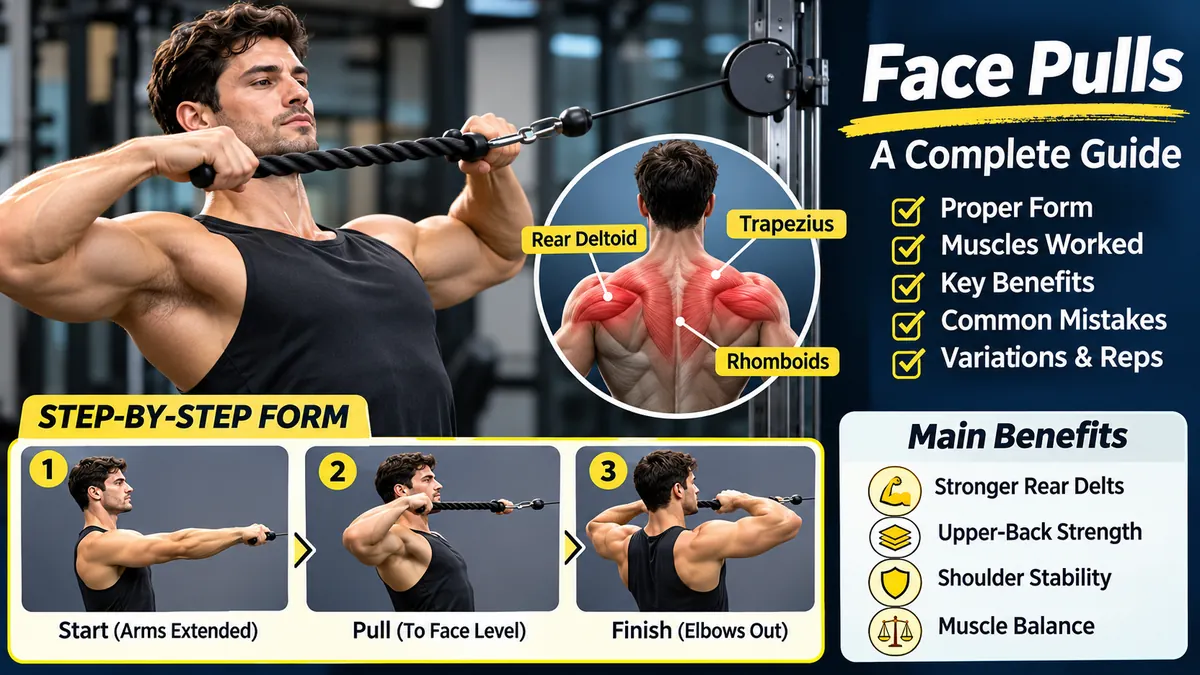
Face pulls look simple: pull a rope toward your face, squeeze your upper back, and return to the starting position. Yet small changes in elbow position, cable height, and shoulder rotation can turn an effective upper-body exercise into an awkward movement that barely targets the intended muscles.
Face pulls are a resistance exercise that primarily trains the rear deltoids, upper back, and shoulder external rotators. Usually performed with a cable machine and rope attachment, they involve pulling toward the face while spreading the hands apart. Proper technique can improve shoulder strength, muscular balance, and control during pulling movements.
The exercise is popular in bodybuilding, strength training, rehabilitation-oriented programs, and general fitness routines. Its value comes from training muscles that may receive less direct attention in programs dominated by pressing exercises.
What Are Face Pulls?
A face pull is an upper-body pulling exercise performed with a cable machine, resistance band, or similar equipment. Unlike a standard seated row, which typically brings the hands toward the torso, a face pull directs the resistance toward the upper face while the elbows move outward.
The movement combines three important shoulder actions:
- Horizontal abduction: Moving the upper arms outward and backward.
- Scapular retraction: Bringing the shoulder blades toward each other.
- External rotation: Rotating the upper arms outward, particularly when the exercise is performed with the hands moving beside the head.
These actions help recruit the posterior shoulder and upper-back muscles.
Face pulls are generally considered an accessory exercise rather than a primary strength lift. They complement movements such as bench presses, overhead presses, pull-ups, and rows.
Why Are Face Pulls Popular?
Many gym programs emphasize the chest, front shoulders, and larger back muscles. The rear deltoids and smaller shoulder stabilizers may receive less direct training.
Face pulls offer a practical way to address that imbalance while using relatively light resistance.
They are also easy to adapt for different training levels, making them useful for beginners and experienced lifters alike.
What Muscles Do Face Pulls Work?
Face pulls recruit several muscles around the shoulder joint and upper back. The exact emphasis depends on technique, grip, resistance direction, and how much external rotation is included.
| Muscle | Main role during face pulls |
|---|---|
| Rear deltoids | Move the upper arms backward and outward |
| Middle trapezius | Assist with shoulder blade retraction |
| Rhomboids | Help retract and stabilize the scapulae |
| Infraspinatus | Supports shoulder external rotation and stability |
| Teres minor | Assists external rotation of the humerus |
| Lower trapezius | Helps control scapular positioning |
| Upper trapezius | Assists with scapular stabilization |
| Biceps brachii | Assist elbow flexion during the pull |
Rear Deltoids
The posterior deltoids, commonly called rear delts, are among the main muscles targeted by face pulls.
Located at the back of the shoulders, they contribute to horizontal abduction and shoulder extension.
When the elbows move outward and backward, the rear delts help generate the pulling motion.
This makes face pulls useful for developing the back of the shoulders, particularly when combined with reverse flyes and rear-delt rows.
Trapezius and Rhomboids
The trapezius is a broad muscle extending across the upper back and neck region. Its middle fibers help retract the shoulder blades, while the lower fibers contribute to scapular control.
The rhomboid major and rhomboid minor also assist with scapular retraction.
During a controlled face pull, these muscles help stabilize the shoulder blades as the arms move backward.
Rotator Cuff Muscles
The rotator cuff consists of four muscles:
- Supraspinatus
- Infraspinatus
- Teres minor
- Subscapularis
The infraspinatus and teres minor are especially relevant to external rotation.
Face pulls performed with an appropriate outward rotation component can challenge these muscles, although the exercise does not isolate them.
For people requiring targeted rotator cuff rehabilitation, specific external rotation exercises may be more suitable.
Do Face Pulls Work the Traps?
Yes. Face pulls recruit the trapezius, particularly the middle fibers involved in shoulder blade retraction.
However, they are not the same as shrugs, which place greater emphasis on scapular elevation.
If the upper traps dominate and the shoulders rise toward the ears throughout the movement, the weight may be too heavy or the pulling technique may need adjustment.
How to Do Face Pulls With Proper Form
The cable rope face pull is the most common version because a cable machine provides consistent resistance and allows the hands to separate naturally.
Step-by-Step Cable Face Pull Instructions
- Set the cable height. Position the pulley around upper-chest to forehead height. A slightly higher setting is also commonly used.
- Attach a rope handle. Use a rope long enough to let your hands separate comfortably.
- Grip the rope. Hold one end in each hand with a neutral grip.
- Step backward. Move away from the machine until the cable is taut and your arms are extended.
- Establish a stable stance. Stand with feet approximately shoulder-width apart, knees slightly bent, and abdominal muscles engaged.
- Pull toward your face. Bend your elbows and bring the rope toward your forehead or upper face.
- Separate your hands. As you pull, move the hands apart so they finish near the sides of your head.
- Control your shoulder blades. Allow them to retract naturally without aggressively shrugging.
- Pause briefly. Hold the contracted position for approximately one second.
- Return slowly. Extend your arms under control without letting the weight stack crash.
The goal is controlled shoulder movement, not moving the heaviest possible load.
What Should the Finish Position Look Like?
At the end of a typical rope face pull:
- The hands are separated near the ears or temples.
- The elbows point outward and generally remain around shoulder height.
- The torso stays upright without excessive backward leaning.
- The shoulders remain comfortable rather than forced into an extreme position.
- The shoulder blades move naturally without excessive shrugging.
Individual shoulder mobility and anatomy can affect the most comfortable finish position.
How High Should the Cable Be?
There is no single pulley height that works best for everyone.
A cable positioned around face height is a practical starting point. A slightly higher cable can create a downward pulling angle, while a lower cable changes the resistance direction.
Experiment with small adjustments until the movement feels smooth and the intended shoulder and upper-back muscles are working.
Avoid forcing the shoulders into an uncomfortable angle merely to match a particular setup.
Should You Pull Toward Your Forehead or Chin?
For a traditional face pull, aim toward the forehead, nose, or upper-face region rather than the lower chest.
Pulling toward the chin can still recruit the upper back, but it may change the shoulder mechanics and reduce the external rotation component.
The best endpoint is one that allows controlled movement without shoulder discomfort.
Benefits of Face Pulls
Face pulls provide several potential training benefits, especially when included in a balanced upper-body strength program.
1. Build Stronger Rear Deltoids
The rear deltoids contribute to shoulder development and upper-body strength.
Face pulls challenge these muscles through horizontal abduction, making them a useful addition to programs containing pressing and rowing exercises.
For muscle growth, sufficient training volume, progressive overload, and recovery remain important.
2. Strengthen the Upper Back
The rhomboids and trapezius help control shoulder blade movement.
Training these muscles can improve their capacity to handle resistance during pulling and stabilization tasks.
However, face pulls should complement rather than replace heavier rowing and pulling exercises.
3. Train Shoulder External Rotation
The infraspinatus and teres minor contribute to shoulder external rotation and glenohumeral stability.
Face pulls that incorporate external rotation provide a way to train these functions alongside upper-back movement.
This can be particularly useful in programs that otherwise contain little direct external rotation work.
4. Support Shoulder Control
The shoulder is a highly mobile joint that depends on coordinated muscular activity.
Face pulls can improve strength and control in some of the muscles involved in shoulder positioning.
They are not a guaranteed method of preventing shoulder injuries, and stronger muscles alone cannot eliminate injury risk.
5. Complement Pressing Exercises
Bench presses, push-ups, and overhead presses involve substantial work from the chest, triceps, and anterior deltoids.
Face pulls provide a different movement pattern that emphasizes the posterior shoulder.
Including both pressing and pulling exercises supports a more comprehensive upper-body program.
6. Encourage Awareness of Shoulder Position
Face pulls require attention to scapular movement, arm position, and trunk stability.
This may help lifters become more aware of how their shoulders move under resistance.
Nevertheless, the exercise does not automatically correct rounded shoulders or permanently improve posture. Posture depends on multiple factors, including habits, mobility, strength, and individual anatomy.
Common Face Pull Mistakes and How to Fix Them
Poor technique can shift resistance away from the intended muscles and make the exercise less comfortable.
| Common mistake | Why it matters | How to correct it |
|---|---|---|
| Using excessive weight | Encourages momentum and trunk movement | Reduce the load and control each repetition |
| Pulling toward the chest | Changes the exercise into more of a row | Aim toward the upper face |
| Keeping hands too close | Limits the intended finishing position | Separate the rope ends as you pull |
| Excessive backward leaning | Uses body weight to move the resistance | Maintain a stable, mostly upright torso |
| Shrugging excessively | Can shift emphasis toward the upper traps | Keep the neck relaxed and avoid unnecessary elevation |
| Rushing the return | Reduces control during the eccentric phase | Return the rope slowly |
| Forcing external rotation | May create shoulder discomfort | Use a comfortable range of motion |
Are Heavy Face Pulls Better?
Not necessarily.
Heavier loads can be useful when technique remains consistent, but face pulls are usually most productive with a resistance level that allows deliberate movement.
If you need to lean far backward, jerk the rope, or dramatically shorten the range of motion, the weight is probably excessive.
For many lifters, moderate or light resistance with consistent technique is a better starting point.
Why Do Face Pulls Hurt My Shoulders?
Shoulder discomfort during face pulls can have several causes, including excessive resistance, an unsuitable pulling angle, restricted comfortable range of motion, or an existing shoulder problem.
Try reducing the weight and adjusting the pulley height and elbow position.
If the exercise causes sharp pain, catching, instability, numbness, or persistent symptoms, stop and seek assessment from a qualified healthcare professional.
Do not use face pulls as a substitute for an individualized rehabilitation program.
Face Pull Variations for Different Training Goals
The traditional cable face pull is effective, but it is not the only way to train the rear shoulders and upper back.
Different variations change the resistance profile, stability requirements, and available range of motion.
Resistance Band Face Pulls
Band face pulls are an accessible alternative for home workouts.
To perform them:
- Secure a resistance band to a sturdy anchor around face height.
- Hold both ends and step backward to create tension.
- Extend your arms in front of your shoulders.
- Pull toward your face while separating your hands.
- Pause briefly before returning slowly.
Unlike a cable machine, a resistance band generally becomes more resistant as it stretches.
Check the band for damage and ensure the anchor cannot slip or open. Avoid attaching it to an unsecured door handle, particularly because the band is under tension near your face.
Seated Cable Face Pulls
Seated face pulls reduce the opportunity to generate momentum through the legs.
Sit upright facing a cable pulley, maintain a stable torso, and pull the rope toward your upper face.
This variation can be useful for lifters who find themselves leaning backward during standing repetitions.
Single-Arm Cable Face Pulls
A single-arm face pull allows each shoulder to work independently.
Using one cable handle, pull toward the side of your face while controlling shoulder rotation.
This variation may help identify differences in strength or coordination between sides. However, small left-to-right differences are common and do not automatically indicate a problem.
Face Pulls With External Rotation
Some face pull variations deliberately emphasize the external rotation phase.
After pulling the upper arms backward, rotate the forearms upward so the hands move beside or slightly above the head.
Use light resistance and avoid forcing the shoulder into its end range.
This variation may be useful when external rotation strength is a training priority, provided the movement is comfortable.
Face Pulls vs. Other Rear Delt Exercises
Face pulls are often compared with reverse flyes, rear-delt rows, and band pull-aparts.
Although these exercises overlap in muscle recruitment, their movement patterns are different.
| Exercise | Main emphasis | Equipment | Key difference |
|---|---|---|---|
| Face pulls | Rear delts, upper back, external rotators | Cable or band | Combines pulling with optional external rotation |
| Reverse pec deck | Rear deltoids | Machine | Provides supported horizontal abduction |
| Dumbbell reverse fly | Rear deltoids, upper back | Dumbbells | Requires more control against gravity |
| Rear-delt row | Rear delts, upper back | Dumbbells or cable | Uses a rowing motion with elbows out |
| Band pull-apart | Rear shoulders, scapular retractors | Resistance band | Arms remain relatively straight |
Face Pulls vs. Reverse Flyes
Reverse flyes primarily emphasize horizontal shoulder abduction.
Face pulls also involve elbow flexion and can include substantial external rotation.
For lifters focused on rear-delt hypertrophy, both exercises can be useful. Neither is universally superior; exercise selection depends on comfort, resistance progression, and individual response.
Face Pulls vs. Rear-Delt Rows
Rear-delt rows use a pulling motion with the elbows flared outward, usually toward the upper torso.
Face pulls bring the hands closer to the head and may involve more deliberate external rotation.
Rows can often accommodate greater resistance, while face pulls are commonly performed with lighter loads and more attention to shoulder positioning.
Are Face Pulls Better Than Band Pull-Aparts?
Neither exercise is automatically better.
Band pull-aparts are simple and portable, while cable face pulls allow convenient load adjustments and a different movement pattern.
A person training at home may prefer band pull-aparts or band face pulls. Someone with access to a cable station may prefer rope face pulls for consistent setup and progression.
How Many Sets and Reps of Face Pulls Should You Do?
The appropriate training volume depends on your experience, goals, and existing upper-body workload.
For most healthy adults, starting with two or three controlled sets is reasonable.
| Training goal | Sets | Reps | Suggested frequency |
|---|---|---|---|
| Learning technique | 2 | 10–12 | 2 times weekly |
| Rear-delt muscle growth | 3–4 | 10–20 | 2–3 times weekly |
| General shoulder strength | 2–3 | 12–15 | 2–3 times weekly |
| Light warm-up | 1–2 | 10–15 | Before relevant workouts |
These are practical starting recommendations, not mandatory prescriptions. The National Academy of Sports Medicine also describes three sets of 12–15 repetitions as one useful approach. NASM+1
What Weight Should You Use?
Choose a resistance that allows every repetition to look similar.
A useful starting load should permit a brief pause at the finish without swinging, shrugging excessively, or leaning backward.
There is no universal ideal weight because cable machines differ in pulley ratios, resistance, and friction.
Judge the load by movement quality rather than the number displayed on the weight stack.
How Often Should You Train Face Pulls?
Two or three weekly sessions are a reasonable starting point for many lifters.
For example, face pulls can be included after a back workout on Monday and after an upper-body workout on Thursday.
Allow enough recovery between challenging sessions, particularly if your program already contains significant rear-delt and upper-back work.
Should Face Pulls Be Done Before or After a Workout?
Both approaches can work, but they serve different purposes.
Before a workout: Use light resistance and controlled repetitions as part of a general shoulder warm-up.
After a workout: Use more challenging sets to develop strength or muscular endurance.
If rear-delt development is a major goal, placing face pulls earlier in the session may help you perform them with less accumulated fatigue.
How Do You Progress With Face Pulls?
Progressive overload does not always require adding weight.
You can improve by increasing repetitions, controlling the eccentric phase, adding a brief pause, or gradually increasing resistance.
For example, begin with three sets of 12 repetitions. Once you can perform three sets of 15–20 with consistent form, consider a small resistance increase.
Avoid sacrificing shoulder position simply to achieve a heavier lift.
Who Should Include Face Pulls in Their Workouts?
Face pulls can fit into many resistance-training programs, although they are not essential for everyone.
Beginners
Beginners can use light cable or band face pulls to practice controlled shoulder movement.
Start with a manageable range of motion and learn to distinguish shoulder blade movement from excessive neck and torso movement.
A qualified trainer can help if the movement feels confusing.
Bodybuilders and Strength Athletes
Bodybuilders may use face pulls as supplementary rear-delt work.
Powerlifters and recreational strength athletes may include them alongside bench presses, overhead presses, rows, and pull-ups.
However, face pulls should not replace the heavier compound movements needed to develop overall upper-body strength.
People Who Spend Long Hours Sitting
Face pulls can provide a useful upper-body strengthening activity for people who spend substantial time at desks.
They may strengthen muscles involved in shoulder blade control, but they cannot independently reverse every effect of prolonged sitting.
Regular movement breaks, general exercise, and a comfortable workstation are also relevant.
People With Shoulder Injuries
Face pulls are sometimes included in shoulder rehabilitation programs, but their suitability depends on the diagnosis and stage of recovery.
Someone recovering from rotator cuff surgery, shoulder instability, or persistent shoulder pain should follow individualized clinical guidance.
A painful face pull is not something to push through in the hope that it will strengthen the shoulder.
Do Face Pulls Really Improve Posture and Prevent Injuries?
Face pulls are frequently described as exercises for fixing rounded shoulders or preventing shoulder injuries.
Those claims need qualification.
Strengthening the rear deltoids, trapezius, rhomboids, and external rotators can contribute to a balanced exercise program. However, the evidence does not establish that face pulls alone reliably correct posture or prevent shoulder injuries.
Posture is influenced by anatomy, habitual positions, movement variability, comfort, and multiple muscle groups.
Likewise, shoulder injuries have many potential causes, including training load, previous injury, fatigue, and sport-specific demands.
The most reasonable approach is to treat face pulls as one useful exercise within a broader strength and conditioning program, not as a guaranteed corrective treatment.
How to Add Face Pulls to Your Training Routine
A simple weekly arrangement can make the exercise easier to perform consistently.
| Workout day | Exercise placement | Suggested volume |
|---|---|---|
| Monday — Upper body | After rows or presses | 3 × 15 |
| Wednesday — Lower body | Optional light accessory work | 2 × 12 |
| Friday — Back and shoulders | Near the end of the workout | 3 × 12–15 |
This is an example, not a requirement. Beginners may prefer just two weekly sessions.
For a balanced upper-body program, face pulls can accompany horizontal rows, vertical pulls, presses, and lateral raises.
The goal is to train multiple shoulder and back functions rather than relying on one exercise for complete development.
Final Thoughts on face pulls
Face pulls are a practical accessory exercise for strengthening the rear deltoids, upper back, and shoulder external rotators. They require relatively little equipment, can be adapted to different training levels, and complement common pressing and pulling exercises.
The most important factors are a comfortable pulling angle, controlled repetitions, appropriate resistance, and consistent technique.
Start with light resistance, learn the movement, and progress gradually. Used as part of a balanced strength program, face pulls can help develop stronger posterior shoulder muscles without requiring heavy weights or complicated equipment.
