

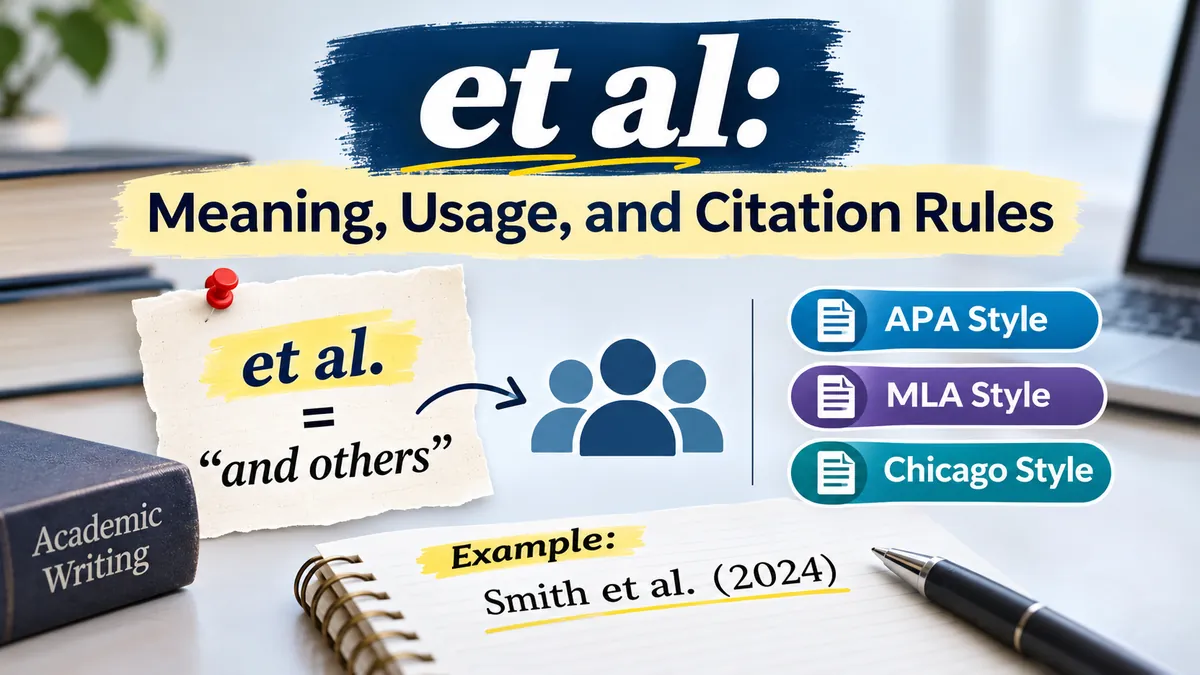
You have probably seen et al. in a research paper, academic article, or reference list and wondered what it means. This short Latin abbreviation appears frequently in scholarly writing, particularly when a publication has multiple authors.
Et al. means “and others.” It is an abbreviation of the Latin phrase et alia and is used to shorten a list of names, especially in academic citations. For example, “Smith et al. (2024)” refers to a work written by Smith and additional authors. The exact rules depend on the citation style.
Although the meaning is straightforward, using the abbreviation correctly requires understanding punctuation, author counts, citation formats, and differences between academic style guides.
What Does et al Mean?
The abbreviation et al. comes from Latin and is commonly translated as “and others.” It allows writers to refer to a group of authors without repeatedly listing every contributor.
For example, imagine a scientific study written by four researchers:
- James Smith
- Maria Johnson
- David Brown
- Emily Wilson
Instead of mentioning all four authors every time, a citation style may allow the shortened form:
Smith et al. (2024)
Here, Smith is the first author, while et al. represents the remaining authors.
The Latin origin of et al.
The expression is traditionally associated with three Latin forms:
| Latin expression | Meaning | Context |
|---|---|---|
| Et alia | And other things | Neuter plural |
| Et alii | And other people | Masculine or mixed plural |
| Et aliae | And other people | Feminine plural |
All three can be abbreviated as et al.
In contemporary academic English, the abbreviation functions as a conventional expression rather than requiring writers to choose among the Latin grammatical forms.
Why is et al used in academic writing?
Academic research frequently involves collaboration. Some publications have three or four authors, while large scientific projects may involve dozens or hundreds of contributors.
Repeating every author’s name in each citation would make academic writing unnecessarily lengthy.
The abbreviation helps by:
- Keeping in-text citations concise.
- Improving readability.
- Reducing repetitive author lists.
- Supporting consistent scholarly referencing.
- Making complex research discussions easier to follow.
However, it does not replace the requirement to acknowledge authors correctly in a bibliography or reference list.
How to Use et al Correctly in a Sentence
The abbreviation usually follows the surname of the first author when a work has enough contributors to qualify under the selected citation style.
Consider these examples:
Narrative citation:
Smith et al. (2024) examined how sleep patterns influence student performance.
Parenthetical citation:
Sleep quality may affect academic performance (Smith et al., 2024).
Sentence discussing a study:
The research conducted by Smith et al. suggests that consistent sleep schedules may support learning.
These examples demonstrate how the abbreviation integrates into ordinary academic sentences.
Does et al need a period?
Yes. The standard spelling is et al., with a period after al.
The reason comes from Latin grammar:
- Et is a complete Latin word meaning “and.”
- Al. is an abbreviation of a longer Latin word.
- The period indicates that abbreviation.
Correct: Smith et al. (2024)
Incorrect: Smith et. al (2024)
Incorrect: Smith et al (2024)
The period belongs after al, not after et.
Should et al be italicized?
In most modern academic citation styles, et al. is written in regular type rather than italics.
For example:
Smith et al. (2024)
Some publishers may apply different editorial conventions, so writers should follow the requirements of their institution, journal, or publisher.
Is there a comma before et al?
Generally, no comma separates the first author’s surname from et al.
Correct: Johnson et al. (2023)
Incorrect: Johnson, et al. (2023)
A comma may appear after the complete abbreviation when required by the citation format:
(Johnson et al., 2023)
The comma in this example separates the author information from the publication year.
et al in APA Style (7th Edition)
The American Psychological Association (APA) citation system is widely used in psychology, education, nursing, social sciences, and related research disciplines.
Under APA 7th edition guidelines, works with three or more authors generally use et al. from the first in-text citation onward. Purdue University
APA in-text citation examples
| Number of authors | APA citation |
|---|---|
| One | (Smith, 2024) |
| Two | (Smith & Johnson, 2024) |
| Three | (Smith et al., 2024) |
| Four | (Smith et al., 2024) |
| Five or more | (Smith et al., 2024) |
For narrative citations, the author information becomes part of the sentence:
Smith et al. (2024) investigated the relationship between physical activity and mental well-being.
For parenthetical citations, the author information appears inside parentheses:
Regular physical activity has been associated with improved psychological outcomes (Smith et al., 2024).
These are illustrative examples rather than references to specific published studies.
Using et al in an APA reference list
APA distinguishes between in-text citations and reference-list entries.
Under APA 7:
- For 1–20 authors, include every author in the reference entry.
- For 21 or more authors, include the first 19 authors, an ellipsis, and the final author.
- Do not substitute et al. for the omitted names in that 21-author reference format.
This distinction ensures that shortened in-text citations still connect to sufficiently detailed bibliographic records. Support
What if two APA citations look identical?
Suppose two different papers have the following author groups:
Paper A: Smith, Johnson, Brown, and Wilson (2024)
Paper B: Smith, Taylor, Miller, and Davis (2024)
Both would ordinarily become Smith et al. (2024), making it impossible to distinguish them.
APA resolves this by including enough additional surnames to make each citation unique:
(Smith, Johnson, et al., 2024)
(Smith, Taylor, et al., 2024)
This exception prevents confusion when several publications share a first author and publication year. Purdue University
et al in MLA Style (9th Edition)
The Modern Language Association (MLA) style is commonly used in literature, language studies, cultural studies, and humanities research.
MLA generally uses et al. when a source has three or more authors.
Unlike APA, MLA in-text citations typically identify page numbers rather than publication years.
MLA in-text citation examples
For a publication with three authors:
(Smith et al. 45)
This citation indicates that the relevant information appears on page 45 of a source whose first listed author is Smith.
Notice two differences from APA:
- There is no comma between the author information and page number.
- The publication year is not included in the ordinary parenthetical citation.
When the author’s name is already part of the sentence, only the page number may be needed:
Smith and colleagues describe the relationship between language and identity (45).
MLA Works Cited example
Consider a hypothetical book written by four authors:
Smith, James, Maria Johnson, David Brown, and Emily Wilson.
An MLA Works Cited entry would normally begin:
Smith, James, et al. Understanding Modern Communication. Example Academic Press, 2024.
The publisher and title in this example are fictional and illustrate formatting only.
Unlike APA, MLA commonly uses the shortened author form in both parenthetical citations and Works Cited entries for sources with three or more authors.
et al in Chicago Style
The Chicago Manual of Style is used in history, publishing, humanities, and interdisciplinary academic writing.
Chicago offers two main citation systems:
- Notes and bibliography, which uses footnotes or endnotes.
- Author-date, which uses parenthetical references.
An important detail is that the 18th edition changed the author-count threshold compared with older Chicago guidance.
In Chicago 18, citations with more than two authors generally use the first author’s name followed by et al. In bibliographies and reference lists, up to six authors are listed; works with more than six generally list the first three followed by et al. Massey University
Chicago author-date example
For a hypothetical three-author publication:
(Smith et al. 2024, 52)
Here:
- Smith identifies the first author.
- Et al. represents the additional authors.
- 2024 indicates the publication year.
- 52 identifies the cited page.
Chicago footnote example
A hypothetical note might appear as:
1. James Smith et al., Research Methods and Society (Example Academic Press, 2024), 52.
The note includes bibliographic information and the page being cited.
Writers should check which edition their university or publisher requires, because Chicago 17th-edition guides often give different author-count rules.
APA vs MLA vs Chicago: Key Differences
The following comparison summarizes how these citation systems handle multiple authors.
| Feature | APA 7 | MLA 9 | Chicago 18 |
|---|---|---|---|
| In-text threshold | 3+ authors | 3+ authors | 3+ authors |
| Example | (Smith et al., 2024) | (Smith et al. 45) | (Smith et al. 2024, 45) |
| Publication year in citation | Yes | Usually no | Yes in author-date |
| Page number | When needed | Usually included for cited passages | When needed |
| Reference-list rules | Up to 20 names | First author + et al. for 3+ | Up to 6 names |
The appropriate format depends on the assigned citation system, not simply on personal preference.
Common et al Mistakes and How to Avoid Them
Although the abbreviation is short, several formatting errors occur repeatedly in student essays, dissertations, and journal manuscripts.
Mistake 1: Writing et. al.
The period should appear after al, not after et.
Correct: Smith et al.
Incorrect: Smith et. al.
Mistake 2: Forgetting the period
Because al. is abbreviated, the period is necessary.
Correct: Johnson et al. (2024)
Incorrect: Johnson et al (2024)
Mistake 3: Using et al for two authors
In APA, MLA, and Chicago, two-author works normally identify both authors rather than replacing the second with et al.
For example, APA uses:
(Smith & Johnson, 2024)
Not:
(Smith et al., 2024)
Mistake 4: Using et al for only one omitted author
The expression is plural, so it should represent multiple additional people.
A two-author publication should not ordinarily be shortened using et al. This is particularly important in APA, where the guidance explicitly treats the abbreviation as replacing more than one name. Purdue University
Mistake 5: Assuming all citation styles follow the same rules
APA, MLA, and Chicago use different conventions for author names, dates, punctuation, and reference entries.
Copying the formatting from one style into another can create inconsistent citations.
Mistake 6: Replacing every author list with et al
The abbreviation is useful in citations, but it should not automatically replace full author information in every context.
A journal’s submission guidelines, a university’s dissertation requirements, or a publisher’s house style may require complete author lists in specific locations.
When Should You Use et al Instead of Listing All Authors?
The answer depends on the purpose of the writing and the citation style.
Use et al. when a citation format permits or requires shortening an author list. This most often happens in academic in-text citations, footnotes, and certain bibliography entries.
However, full names may be preferable when identifying individual researchers is important.
For example, a historical discussion about the contributions of several scientists may need to identify each scientist rather than referring vaguely to a group.
Similarly, an acknowledgments section may need to name specific contributors.
Does et al refer only to authors?
No. Although scholarly authorship is its most familiar application, the expression can also refer to other groups of people.
It may appear in contexts involving:
- Editors of a collective publication.
- Translators or other creative contributors.
- Researchers working on a shared project.
- Parties named in certain legal documents.
The abbreviation always depends on context. Its appearance does not automatically mean that the people being omitted are academic authors.
Can et al be used in legal writing?
Yes. In legal documents, the expression may appear when multiple parties are involved in a case.
For example:
Smith et al. v. Johnson
This hypothetical case caption indicates that Smith is named along with other parties.
Legal citation conventions differ from academic citation rules. Lawyers and legal researchers generally follow the applicable court rules or legal citation guides, such as The Bluebook, rather than automatically applying APA or MLA conventions.
et al vs etc.: What Is the Difference?
The expressions et al. and etc. are both derived from Latin, but they serve different purposes.
| Expression | Meaning | Typical use |
|---|---|---|
| et al. | And others | People, especially authors |
| etc. | And other things | Items in a list |
Consider these examples.
Using et al.:
Smith et al. published a study on renewable energy.
Using etc.:
The laboratory purchased microscopes, thermometers, measuring cylinders, etc.
The first expression replaces additional people. The second indicates that a list of items continues.
Using etc. in place of additional authors would be inappropriate in standard academic citations.
Is et al the same as et cetera?
No.
Et cetera means approximately “and the rest” or “and other things,” whereas et al. is conventionally used to indicate additional people in citation contexts.
The distinction matters because citation abbreviations communicate specific information about authorship.
How to Cite Multiple Authors Step by Step
When preparing an academic assignment or research manuscript, use the following process to decide whether et al. belongs in a citation.
- Identify the citation style. Check whether your assignment requires APA, MLA, Chicago, or another format.
- Count the authors. Use the authors credited on the original publication.
- Check the relevant author threshold. Determine when the required style introduces et al.
- Use the first listed author’s surname. Preserve the publication’s author order rather than choosing a different author.
- Add et al. with correct punctuation. Place the period after al.
- Complete the citation. Add the year, page number, or other required information.
- Check the reference entry separately. In-text and bibliography rules are not always identical.
- Resolve ambiguous citations. If two shortened references would look identical, follow your style guide’s disambiguation rules.
Example: Converting a full author list into APA format
Imagine a paper credited to:
- Michael Carter
- Sarah Evans
- Daniel Roberts
- Olivia Harris
Publication year: 2025.
The APA in-text citation becomes:
(Carter et al., 2025)
A narrative version would read:
Carter et al. (2025) investigated the topic.
The reference-list entry would still include all four authors, along with the publication’s title and other required bibliographic details.
This is one of the most useful distinctions for students learning academic referencing.
How et al Works in Scientific Research
Scientific publishing often involves extensive collaboration between researchers, laboratories, universities, and research institutions.
A medical research article may have contributors responsible for study design, data collection, statistical analysis, laboratory procedures, and manuscript preparation.
In fields such as particle physics or genomics, collaborative publications can include exceptionally large author groups.
The abbreviation makes it practical to discuss these studies without repeating long author lists.
For example:
Garcia et al. (2025) developed a model for analyzing genetic variation.
This hypothetical citation tells readers that Garcia is the first listed author and that the work has additional contributors.
It does not indicate exactly how many people participated.
Does et al mean the first author did most of the work?
Not necessarily.
In some disciplines, the first author is typically associated with a major contribution to the research and manuscript. However, authorship conventions vary considerably.
Some fields use alphabetical author ordering. Others recognize joint first authors or specify different responsibilities for corresponding authors.
Therefore, et al. should not be interpreted as proof that the first author performed the majority of the research.
Can you find all authors from an et al citation?
Yes, provided you can identify the original publication.
The complete author information may be available through the article’s reference entry, journal website, publisher record, or bibliographic database.
Useful research tools include Google Scholar, PubMed, and Crossref.
A DOI, or Digital Object Identifier, can also help locate the original scholarly record.
The shortened citation is designed to make reading easier, not to conceal the identities of other contributors.
Should et al Be Used in Titles, Headings, and Everyday Writing?
The abbreviation is primarily associated with formal references, but it can occasionally appear in ordinary prose.
For example:
The findings of Smith et al. have influenced subsequent research.
In this sentence, the expression identifies a group of researchers whose work is already known from the surrounding context.
However, et al. is usually unnecessary in casual writing.
A sentence such as “John et al. are coming to dinner” sounds overly formal. “John and the others are coming to dinner” is more natural.
Is et al singular or plural?
The expression means “and others,” so it refers to multiple people collectively.
When the abbreviated author group is the grammatical subject, plural agreement is generally appropriate:
Smith et al. argue that the results are significant.
Rather than:
Smith et al. argues that the results are significant.
However, a singular noun such as study still takes a singular verb:
The study by Smith et al. shows a consistent pattern.
The grammatical subject determines the verb form.
Can a sentence begin with et al?
The abbreviation itself normally follows a name, so beginning a sentence with the standalone words Et al. would generally be unclear.
A sentence can, however, begin with a citation containing the expression:
Smith et al. (2024) examined the available evidence.
This is a normal construction in academic writing.
Final Thoughts on et al
Understanding et al makes academic reading and citation writing considerably easier. The abbreviation means “and others” and allows writers to refer to publications with multiple authors without repeatedly listing every name.
The most important rules are simple: write et al. with a period after al, place it after the first author’s surname, and follow the author-count and reference-format requirements of the relevant citation style.
Before submitting an essay, dissertation, or research article, check that your in-text citations match the required style guide and that your reference entries identify the original publications correctly. Consistent formatting helps readers trace evidence, recognize contributors, and understand the research being discussed.
