

You’ve probably written a sentence, stopped, and wondered whether to use effect or affect. The words look similar, sound similar, and both describe changes. Yet choosing the wrong one can change the grammatical meaning of your sentence.
The good news? One simple rule solves most cases.
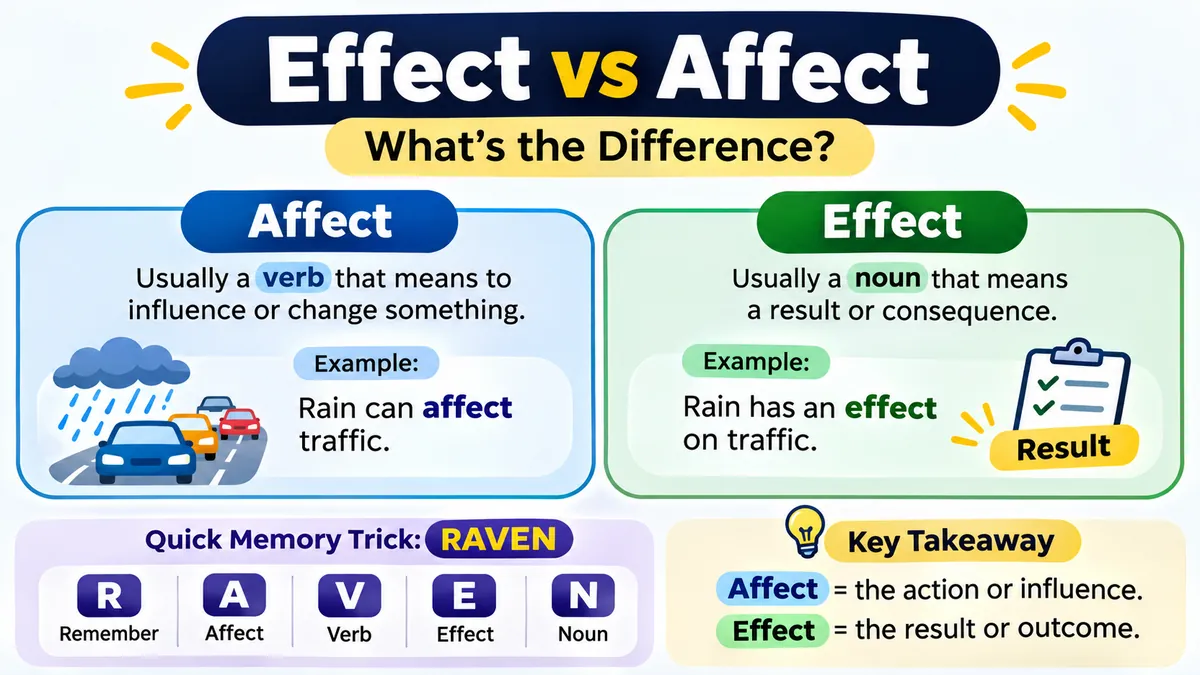
The main difference between effect vs affect is that affect is usually a verb meaning to influence or change something, while effect is usually a noun meaning a result or consequence. For example, “Stress can affect your sleep” describes an influence, while “Poor sleep is an effect of stress” describes a result.
effect vs affect: Quick Comparison
The easiest way to understand these commonly confused words is to compare their functions in a sentence.
| Feature | Affect | Effect |
|---|---|---|
| Most common part of speech | Verb | Noun |
| Primary meaning | To influence or change | A result or consequence |
| Main question | What influences something? | What happened as a result? |
| Example | Rain affects traffic. | Rain has an effect on traffic. |
| Common phrase | Affect performance | Have an effect on performance |
| Less common use | Noun in psychology | Verb meaning to bring about |
Consider these two sentences:
- The weather can affect your mood.
- The weather can have an effect on your mood.
Both sentences express nearly the same idea, but they use different grammatical structures.
In the first sentence, affect describes an action. In the second, effect names the result or influence.
This distinction works in everyday conversation, academic writing, professional communication, and most English grammar exercises.
What Does Affect Mean?
Affect as a verb
Affect is most commonly a verb meaning to influence, change, or have an impact on someone or something.
It describes what one thing does to another.
Examples:
- Lack of sleep can affect your concentration.
- High temperatures affect plant growth.
- The new policy will affect thousands of employees.
- Social media can affect how people communicate.
- Exercise positively affects physical health.
In each example, something influences another thing.
The word can also describe an emotional response.
For instance:
“The documentary deeply affected the audience.”
Here, affected means the documentary had a strong emotional impact.
Different forms of affect
Because affect functions as a regular verb, its form changes according to tense and subject.
| Verb form | Example |
|---|---|
| Affect | Noise can affect productivity. |
| Affects | Pollution affects air quality. |
| Affected | The storm affected several towns. |
| Affecting | Rising prices are affecting families. |
The past tense affected is especially common in news reporting, research papers, and workplace communication.
Affect as a noun in psychology
Although affect is usually a verb, it can also function as a noun in psychology and psychiatry.
In this context, affect refers to an observable expression of emotion.
For example:
“The clinician observed a flat affect during the interview.”
A flat affect means that a person displays little outward emotional expression.
Other psychological terms include blunted affect, restricted affect, and inappropriate affect.
In clinical terminology, affect is often distinguished from mood. Mood describes a person’s sustained emotional state, while affect describes their observable emotional expression.
This specialized meaning is an exception to the everyday rule that affect is a verb.
What Does Effect Mean?
Effect as a noun
Effect is most commonly a noun describing a result, outcome, or consequence produced by an action or event.
It answers the question: What happened because of something else?
Examples:
- The medication had a positive effect on her symptoms.
- The new law produced several unexpected effects.
- Regular exercise has beneficial effects on health.
- The movie’s special effects impressed the audience.
- The economic slowdown had a significant effect on employment.
Notice that effect often follows words such as an, the, positive, negative, significant, or lasting.
These words frequently help identify its role as a noun.
Effect as a verb
There is an important exception: effect can also be a verb.
As a verb, effect means to bring about, accomplish, or cause something to happen.
For example:
“The new leadership hopes to effect meaningful change.”
This means the leadership hopes to bring about meaningful change.
Compare:
- Affect change: Influence a change that is already happening or influence the process of change.
- Effect change: Bring about or accomplish change.
The expression effect change is particularly common in formal writing, government, business, and discussions of social reform.
Other examples include:
- The organization worked to effect policy reform.
- The negotiations helped effect a peaceful transition.
- The committee introduced measures to effect improvements.
This usage is less common in everyday English, but it is grammatically correct.
effect vs affect: How to Remember the Difference
You do not need to memorize dozens of complicated rules. A few memory techniques make the distinction much easier.
The RAVEN memory trick
One popular mnemonic is RAVEN:
R
Remember
A
Affect
V
Verb
E
Effect
N
Noun
RAVEN: Remember Affect Verb, Effect Noun
This mnemonic covers the most common uses of both words.
The action-versus-result trick
Think of affect as the action and effect as the result.
For example:
“Too much sunlight can affect your skin.”
The sunlight influences your skin.
“Sunburn is one possible effect of too much sunlight.”
Sunburn is the result.
Another helpful comparison:
- Affect = Influence
- Effect = Result
If replacing the word with influence works as a verb, affect is often correct.
If replacing it with result works as a noun, effect is usually correct.
The sentence replacement test
Try substituting a simpler word before making your choice.
Original sentence:
“The decision will ___ the entire department.”
Replace the blank with influence:
“The decision will influence the entire department.”
Because influence works as a verb, the correct choice is affect.
Now consider:
“The decision had a lasting ___.”
Replace the blank with result:
“The decision had a lasting result.”
The grammar works, so effect is appropriate.
These tests are useful shortcuts, although specialized uses of both words require additional attention.
Common effect vs affect Examples in Everyday English
Seeing the words in realistic contexts makes their meanings easier to recognize.
Health and medicine
Affect:
“Dehydration can affect your energy levels.”
Effect:
“Fatigue is a common effect of dehydration.”
In medical writing, side effect is also a standard expression.
For example:
“Drowsiness is a possible side effect of this medication.”
The expression side affect would be incorrect when referring to an unintended reaction to treatment.
Education and learning
Affect:
“Poor attendance may affect a student’s grades.”
Effect:
“Poor attendance can have a negative effect on academic performance.”
The first sentence focuses on the influence. The second identifies the resulting impact.
Business and economics
Affect:
“Inflation affects household purchasing power.”
Effect:
“One effect of inflation can be reduced purchasing power.”
Economic writing frequently uses related expressions such as economic effects, market effects, and factors affecting demand.
Environment and climate
Affect:
“Air pollution affects human health and ecosystems.”
Effect:
“Respiratory problems are among the possible effects of air pollution.”
The same distinction applies when discussing climate change, environmental damage, and public health.
Technology and social media
Affect:
“Software updates can affect device performance.”
Effect:
“The update had an unexpected effect on battery life.”
In technical documentation, affect often describes a system change, while effect describes the outcome of that change.
Relationships and emotions
Affect:
“His words deeply affected her.”
Effect:
“His apology had a calming effect.”
These examples demonstrate that affect can describe emotional influence, not just physical or measurable changes.
Common Grammar Mistakes With Affect and Effect
Even experienced writers sometimes confuse these terms, particularly when using familiar expressions.
Mistake 1: Using effect after can or will
Incorrect: “The weather can effect your plans.”
Correct: “The weather can affect your plans.”
Here, the intended meaning is that the weather can influence your plans.
The modal verb can does not automatically require affect, however. Effect is also possible when the intended meaning is to bring something about, as in “The committee can effect change.”
Mistake 2: Writing side affect
Incorrect: “The medicine caused a side affect.”
Correct: “The medicine caused a side effect.”
A side effect is an additional consequence of a treatment or action, especially one that was not the primary intended outcome.
Mistake 3: Confusing affected and effected
These two past-tense verbs have different meanings.
- Affected: Influenced or changed something.
- Effected: Brought something about or accomplished it.
Compare:
“The reforms affected local businesses.”
This means the reforms influenced those businesses.
“The government effected major reforms.”
This means the government successfully brought the reforms about.
Mistake 4: Using effect instead of effect on
Incorrect: “The policy had a positive affect on employees.”
Correct: “The policy had a positive effect on employees.”
The phrase have an effect on is standard when describing influence or consequences.
Mistake 5: Confusing affect with effective
Effective is an adjective meaning successful in producing the intended result.
For example:
“The new teaching method is effective.”
Effectiveness is the corresponding noun describing how well something achieves its purpose.
These words belong to the same word family as effect, but they have different grammatical functions.
Affect vs Effect in Formal and Academic Writing
In academic writing, precise word choice matters because research often examines causes, relationships, and outcomes.
Consider:
“The study examined how sleep duration affects memory performance.”
Here, affects identifies a possible relationship between sleep duration and memory.
Now compare:
“The researchers measured the effect of sleep duration on memory performance.”
In this sentence, effect identifies the outcome or relationship being measured.
Both constructions are grammatically valid, although they emphasize different aspects of the research.
Cause and effect
The expression cause and effect describes a relationship in which one event or condition produces another.
For example:
“Researchers investigated the cause-and-effect relationship between exercise and cardiovascular health.”
The phrase uses effect because it refers to a result.
However, a grammatical sentence does not automatically establish scientific causation. An observed association may require additional evidence before researchers can conclude that one factor caused another.
Effect size in statistics
In statistics, effect size describes the magnitude of a measured relationship, difference, or association.
For example:
“The researchers reported a moderate effect size.”
This term is common in experimental research, psychology, education, and meta-analysis.
It is written effect size, not affect size, because it refers to the magnitude of a measured effect.
Adverse effect versus adverse affect
An adverse effect is an unwanted or harmful outcome.
For example:
“The treatment produced an adverse effect in some participants.”
In clinical psychology, an adverse event might also affect someone’s emotional state, but that does not make adverse affect interchangeable with adverse effect.
The correct expression depends on whether the writer means an outcome or an emotional presentation.
Tricky Exceptions and Related Expressions
The basic noun-versus-verb rule is reliable in most situations, but understanding the exceptions makes your writing more accurate.
Affect change versus effect change
This distinction is especially useful in professional and formal communication.
To affect change means to influence the nature, direction, or progress of change.
To effect change means to make change happen.
Example:
“Public opinion can affect changes in government policy.”
This means public opinion can influence those changes.
“Community leaders worked to effect change.”
This means they worked to bring change about.
When the intended meaning is to create meaningful change, effect change is usually the better expression.
Take effect versus take affect
The correct phrase is take effect.
It means to begin operating, applying, or producing a result.
Examples:
- The new regulations will take effect in January.
- The medication may take effect within an hour.
- The revised policy takes effect next week.
Take affect is not the standard expression.
In effect versus in affect
In effect can mean currently operating, in force, or essentially.
Examples:
“The restrictions remain in effect.”
“The decision was, in effect, a rejection of the proposal.”
In affect is not a substitute for this expression.
Affect someone’s mood versus emotional affect
These expressions use different grammatical meanings.
“Music can affect someone’s mood.”
Here, affect is a verb meaning influence.
“The patient’s affect appeared restricted.”
Here, affect is a noun referring to observable emotional expression.
The distinction is especially relevant in psychological assessments.
Affected versus unaffected
Affected describes something that has been influenced or changed.
Unaffected means not influenced or not changed in the relevant way.
For example:
“The northern region was affected by flooding, while the southern region remained largely unaffected.”
The word unaffected can also describe a natural, unpretentious manner, depending on context.
How to Choose the Correct Word Every Time
When you’re uncertain, follow this quick decision process.
Does the sentence describe an influence or a result?
An action or influence
Affect
The noise affects my sleep.
A result or outcome
Effect
The noise has an effect on my sleep.
For uncommon cases, check whether effect means “bring about” or affect refers to emotional expression.
Start by identifying the word’s grammatical role.
If it describes an action that influences something, use affect.
If it names a consequence, use effect.
Then check whether the sentence uses a specialized meaning, such as effect change or flat affect.
This method is more dependable than choosing a word based only on how the sentence sounds.
Practice: Test Your Understanding of effect vs affect
Try selecting the correct word in each sentence before revealing the answer.
Grammar practice
0 of 5 answered
1. The new schedule will ___ our working hours.affecteffect
2. The treatment had a noticeable ___ on her symptoms.affecteffect
3. The organization hopes to ___ lasting change.affecteffect
4. The therapist described the patient’s ___ as flat.affecteffect
5. The new regulations will take ___ next month.affecteffect
Check answersReset
These examples reinforce the most common rules while also testing the less familiar exceptions.
Final Thoughts on effect vs affect
The distinction between effect vs affect becomes straightforward once you recognize the difference between an influence and its result.
In most everyday sentences, affect is a verb meaning to influence, while effect is a noun meaning a result. The RAVEN mnemonic provides a quick reminder, and the replacement test helps when you’re unsure.
Remember the exceptions: effect can be a verb meaning to bring about change, while affect can be a noun describing observable emotional expression in psychology. Affect can also mean to pretend or adopt a manner, as in “He affected a confident tone.” Cambridge Dictionary+2
When proofreading your next email, assignment, or report, ask whether you’re describing an action that influences something or the outcome of that action. That simple question will help you choose the correct word in nearly every situation.
