

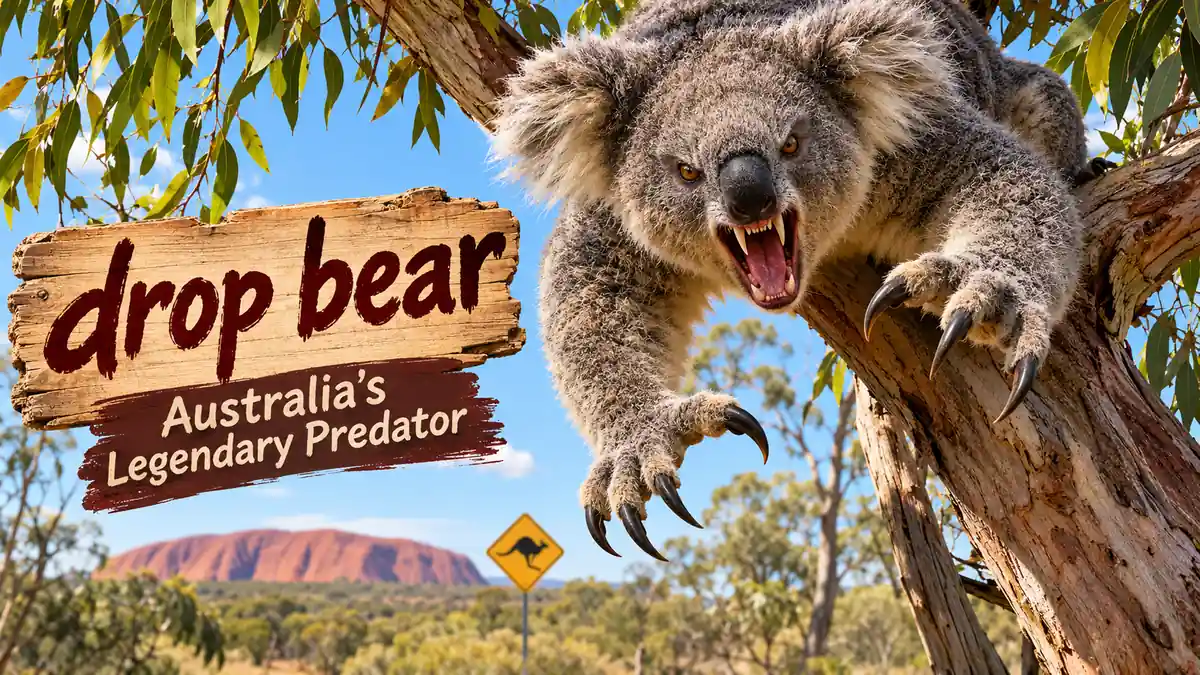
Imagine walking through the Australian bush when someone warns you to watch the trees. Apparently, a dangerous animal resembling a giant koala could drop onto your head without warning. It sounds terrifying, but there’s a distinctly Australian joke behind the warning.
The drop bear is a fictional Australian creature described as a large, aggressive, carnivorous relative of the koala. According to the legend, it hides in eucalyptus trees and ambushes unsuspecting people from above. Although no such animal exists, the story remains one of Australia’s most recognizable examples of folklore, humor, and tourist pranks.
The legend has become so widespread that even respected Australian institutions have joined in on the joke.
What Is a drop bear?
A drop bear is a mythical Australian animal supposedly found in forests and bushland across the country. It resembles a koala but is described as larger, heavier, more aggressive, and equipped with sharp teeth and powerful claws.
The creature’s defining behavior is its alleged hunting technique: waiting high in a tree before dropping onto a person or animal passing underneath.
Unlike ordinary koalas, which primarily eat eucalyptus leaves, the fictional predator supposedly hunts meat.
The story is usually told to visitors unfamiliar with Australian wildlife. Locals may describe the creature with complete seriousness, making it difficult for newcomers to recognize the joke.
Is the drop bear real or fake?
The drop bear is not real. It is an invented creature belonging to Australian folklore, and there is no scientific evidence supporting its existence.
No living specimen, verified fossil, genetic sample, or credible wildlife observation establishes the existence of the legendary animal.
The myth survives because it combines believable elements of Australian wildlife with exaggerated details about dangerous animals.
Australia genuinely has venomous snakes, dangerous spiders, crocodiles, and other wildlife that visitors should understand. Adding an imaginary tree-dwelling predator to that list creates a joke that can sound surprisingly convincing.
What Does a drop bear Look Like?
Descriptions vary depending on who tells the story, but most versions portray the creature as a monstrous version of a koala.
Typical fictional characteristics include:
- Size: Considerably larger and heavier than an ordinary koala.
- Fur: Thick gray or brown fur that provides camouflage.
- Teeth: Large, sharp canine teeth designed for biting prey.
- Claws: Powerful claws supposedly used for climbing and attacking.
- Eyes: Sometimes described as glowing or unusually intimidating.
- Behavior: Aggressive, territorial, and capable of ambushing animals from trees.
These details are not biological facts. They are elements of a fictional description designed to make the animal sound plausible.
The Australian Museum’s fictional scientific description
The Australian Museum has helped popularize the legend through a humorous animal profile.
Its fictional classification identifies the creature as Thylarctos plummetus, a scientific-sounding name that reinforces the illusion of a genuine zoological discovery.
The museum’s description portrays it as a large, arboreal predator with a habit of dropping from trees onto unsuspecting prey.
The use of scientific terminology is part of the humor. The museum is not claiming that the species exists.
Where Do drop bears Supposedly Live?
According to the legend, these creatures inhabit wooded regions throughout Australia, particularly forests with tall trees.
Eucalyptus forests are especially common settings because they are associated with koalas.
Some storytellers place the animals in eastern Australia, including Queensland, New South Wales, and Victoria. Others claim they inhabit remote bushland, national parks, or popular hiking destinations.
The locations change depending on the storyteller.
Why eucalyptus trees feature in the legend
Eucalyptus trees provide a believable setting because real koalas spend much of their lives in them.
Koalas use strong limbs and sharp claws to climb trunks and branches. Their gray fur can make them difficult to notice among leaves and bark.
The fictional creature borrows these recognizable characteristics and transforms them into the attributes of an imaginary predator.
This connection makes the story especially effective when told during bushwalks, camping trips, or wildlife tours.
How Did the drop bear Legend Begin?
The exact origin of the story remains uncertain, but its development is connected to Australian humor, military storytelling, and practical jokes played on visitors.
The legend appears to have evolved gradually rather than emerging from one identifiable event.
Early stories and military folklore
According to Australian Geographic, fictional accounts of aggressive koalas appeared in Australian newspapers during the 1920s and 1930s.
Military storytelling may have helped the idea develop during and after World War II.
Stories about dangerous animals in the bush were particularly effective among soldiers unfamiliar with Australia’s wildlife.
The earliest known newspaper appearance of the expression “drop bear” dates to July 31, 1982, in The Canberra Times. However, the underlying stories may be considerably older. Australian Geographic+1
How Australian television popularized the myth
Australian comedian Paul Hogan helped bring the concept of aggressive, tree-dropping koalas into popular entertainment.
A sketch on The Paul Hogan Show parodied adventure films and featured dangerous koalas attacking from above.
Although the sketch did not explicitly establish the modern name, it helped spread the image of a frightening koala-like creature.
As international tourism expanded, the story became a convenient way to introduce visitors to Australia’s distinctive sense of humor.
Why Australians tell tourists about drop bears
The joke works because it exaggerates something visitors already associate with Australia: dangerous wildlife.
Many tourists arrive knowing that the country is home to crocodiles, venomous snakes, and unusual spiders.
A story about a giant carnivorous koala therefore sounds just believable enough to cause uncertainty.
The humor often depends on maintaining a completely serious expression while describing increasingly absurd details.
The story also reflects larrikinism, an Australian cultural tradition associated with irreverence, playful mischief, and resistance to excessive seriousness.
How Does a drop bear Supposedly Attack?
The legendary hunting method is simple: the creature waits in a tree, identifies a target below, and drops onto it.
In fictional accounts, it may remain motionless for hours before attacking.
The Australian Museum’s humorous profile describes a predator capable of using its weight and powerful bite to overpower prey.
Some versions claim the animal targets kangaroos and wallabies. Others suggest tourists are particularly vulnerable because they are unfamiliar with the bush.
None of these descriptions represent documented animal behavior.
Do drop bears attack humans?
No. There are no verified human attacks because the creature does not exist.
Stories about injuries, fatalities, and mysterious disappearances are fictional additions to the legend.
In one particularly elaborate version, the creature is supposedly attracted to foreign accents.
This claim was featured in an April Fools’ article published by Australian Geographic in 2021. The publication explicitly identified the article as humorous fiction. Australian Geographic
Can Vegemite protect you from a drop bear?
One of the most famous versions of the joke recommends applying Vegemite behind the ears or onto exposed skin.
Other fictional precautions include placing forks in your hair, using toothpaste as a repellent, or speaking with an Australian accent.
These suggestions are part of the prank.
There is no biological reason to believe Vegemite or toothpaste protects against an imaginary predator.
The advice is often deliberately ridiculous, providing another opportunity for locals to see how far a visitor will go to avoid a nonexistent threat.
drop bear vs. Koala: What Is the Difference?
The strongest visual inspiration for the mythical animal is the real Australian koala.
However, the two are fundamentally different: one is an actual species, while the other is fictional.
| Feature | drop bear (legend) | Koala (real animal) |
|---|---|---|
| Scientific name | Thylarctos plummetus (invented) | Phascolarctos cinereus |
| Existence | Mythical | Real |
| Diet | Supposedly carnivorous | Primarily eucalyptus leaves |
| Habitat | Fictional Australian forests | Eucalyptus woodlands and forests |
| Behavior | Ambushes prey from trees | Rests, feeds, and climbs |
| Teeth | Fictional large fangs | Adapted mainly for processing leaves |
| Threat to humans | Imaginary attacks | Can scratch or bite if threatened |
Are koalas actually dangerous?
Koalas are not predators, but they are wild animals capable of defending themselves.
Their sharp claws help them climb trees, while their strong jaws and teeth are adapted for feeding.
A frightened or stressed koala may scratch or bite if someone attempts to handle it.
For this reason, visitors should observe koalas from an appropriate distance and avoid touching or feeding wild individuals.
Why koalas are not bears
Despite the popular nickname “koala bear,” koalas are marsupials rather than true bears.
They belong to the family Phascolarctidae and are more closely related to wombats than to bears.
Female koalas give birth to highly underdeveloped young that continue developing in a pouch.
True bears belong to the mammalian family Ursidae, which is evolutionarily distant from koalas.
The misleading nickname contributes to the humor of the drop bear legend, making the invented creature sound like an unfamiliar variety of bear.
Was There Ever a Real Prehistoric drop bear?
Although the modern creature is fictional, prehistoric Australia was home to an extraordinary carnivorous marsupial that shares some characteristics with the legend.
That animal was Thylacoleo carnifex.
Commonly known as the marsupial lion, it lived during the Pleistocene and was among Australia’s most formidable prehistoric mammalian predators.
Meet Thylacoleo carnifex
Unlike the imaginary drop bear, Thylacoleo carnifex is supported by fossil evidence.
It possessed several unusual adaptations:
- Powerful jaws and specialized cutting teeth.
- Strong forelimbs capable of gripping prey.
- Large claws, including an impressive thumb claw.
- Anatomical features consistent with climbing ability.
- A robust body adapted for powerful movements.
Fossils and anatomical studies suggest that this extinct predator could climb, although its precise hunting behavior remains uncertain.
Researchers have discussed the possibility that it used elevated positions during hunting, but there is no proof that it routinely dropped from trees onto prey.
Could the marsupial lion have inspired the legend?
The resemblance is intriguing, but a direct historical connection has not been established.
The modern drop bear story emerged long after the extinction of Thylacoleo.
A 2017 academic study from James Cook University examined how prehistoric marsupial evidence has been incorporated into contemporary storytelling about the fictional animal.
The researchers treated the drop bear as an urban legend rather than an undiscovered species. journals.jcu.edu.au+1
The prehistoric animal provides an interesting scientific comparison, not evidence that the mythical creature once existed.
Why the drop bear Myth Became So Popular
The legend has survived for decades because it combines storytelling, national identity, and a recognizable tourist experience.
It is easy to explain, requires no elaborate props, and works especially well when someone is unfamiliar with Australian wildlife.
A famous Australian tourist prank
One widely reported example involved Scottish journalist Debi Edward during coverage of Australia’s 2019–2020 bushfire crisis.
While visiting Kangaroo Island, she was persuaded that a koala she was holding was a dangerous drop bear.
The encounter became a viral demonstration of how convincingly Australians can maintain the joke.
ABC News subsequently explored the origins and cultural significance of the hoax. ABC News
The role of social media and internet culture
Online platforms have given the legend a much wider audience.
Memes, manipulated photographs, fictional warning signs, and humorous wildlife descriptions allow the story to circulate beyond Australia.
The Australian Museum’s deliberately scientific presentation adds another layer of credibility for readers who encounter the story without recognizing its humorous purpose.
The internet also allows different versions of the myth to develop.
Some portray the creature as a giant koala, while others give it monstrous teeth, exaggerated claws, or supernatural abilities.
Despite these variations, the central idea remains consistent: a dangerous animal supposedly waits in trees to attack unsuspecting people.
An urban legend studied by researchers
The legend has attracted genuine academic attention.
In their 2017 paper, Man-Eating Teddy Bears of the Scrub: Exploring the Australian Drop Bear Urban Legend, Catherine Livingston, Felise Goldfinch, and Rhian Morgan examined its place in contemporary folklore.
The study discusses how the creature functions as a uniquely Australian expression of the vampire motif and how digital media perpetuates the story.
This illustrates an important distinction: although the creature is fictional, its cultural significance is real.
Other Australian Myths Similar to the drop bear
Australia has a rich collection of strange creatures, local legends, and humorous animal stories.
Some are longstanding traditions, while others are modern jokes.
Bunyip
The Bunyip is a mysterious creature associated with Australian waterways and wetlands.
Descriptions vary widely, and bunyip traditions have important connections to Aboriginal storytelling.
Unlike the modern tourist prank, bunyip stories have deeper cultural histories that should not be reduced to practical jokes.
Hoop snake
The hoop snake is a fictional animal supposedly capable of gripping its own tail and rolling like a wheel.
The story is another example of an implausible animal presented as a genuine danger.
Its unusual movement is the defining feature of the legend.
Yowie
The Yowie is generally described as a large, hairy, humanlike creature reportedly seen in remote Australian environments.
Unlike the drop bear, which is usually presented as a deliberate joke, yowie stories are often framed as mysterious sightings or cryptid encounters.
These legends demonstrate the different ways folklore can develop around unfamiliar landscapes and wildlife.
What Should Visitors Actually Watch Out for in Australia?
Although there is no reason to fear an imaginary animal falling from a tree, Australian bushland presents genuine environmental and wildlife hazards.
Visitors should pay attention to established safety advice rather than fictional warnings.
Real wildlife and environmental risks
Depending on the region, practical concerns may include:
- Venomous snakes, particularly in warm weather.
- Crocodiles in suitable waterways in northern Australia.
- Marine stingers in certain coastal regions.
- Dangerous surf conditions and rip currents.
- Heat exposure, dehydration, and bushfires.
- Falling branches in forests and camping areas.
Not every region has the same hazards, and most wildlife encounters can be managed by following local guidance.
Practical bushwalking safety
Before entering a national park or remote walking area, check the weather, trail conditions, and official park notices.
Carry adequate drinking water, wear appropriate footwear, remain on marked trails, and avoid approaching wild animals.
In remote areas, tell someone where you are going and when you expect to return.
Looking upward occasionally is sensible because real tree branches can fall, particularly during strong winds or after storms.
However, you do not need Vegemite, forks, or an Australian accent to protect yourself from a drop bear.
Why the drop bear Remains Part of Australian Culture
The enduring appeal of the story comes from the relationship between the storyteller and the listener.
For Australians familiar with the joke, it offers a playful way to introduce visitors to local humor.
For tourists, discovering the truth can become a memorable part of their experience.
The legend also highlights how easily credible-sounding descriptions can influence beliefs.
Scientific names, museum-style profiles, maps, and fabricated research can make an invented creature appear authentic.
That makes the story a useful example of why readers should examine evidence and context, even when information appears to come from an authoritative source.
The Australian Museum’s fictional animal profile is particularly effective because it combines genuine zoological language with an unmistakably humorous premise.
Final Thoughts on the drop bear Legend
The drop bear is one of Australia’s most entertaining modern myths: a fictional carnivorous koala that supposedly attacks people from trees.
It has no scientific basis, and there is no reason for travelers to fear encountering one.
Nevertheless, its cultural history is worth understanding. From military folklore and television comedy to academic research and internet memes, the story demonstrates how an imaginary animal can become a recognizable part of national humor.
The next time someone warns you about a drop bear while walking through the Australian bush, you can appreciate the joke, enjoy the storytelling, and concentrate on the real wildlife around you.
