

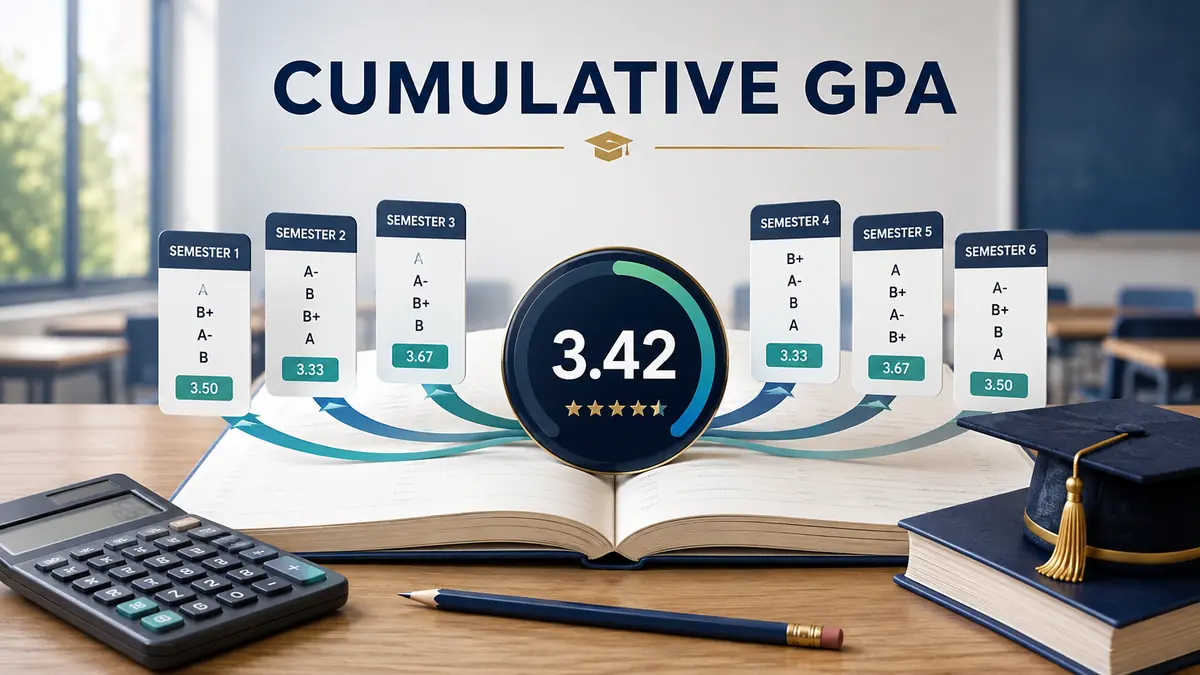
One semester can change your grades, but it does not tell your entire academic story. Schools combine performance across multiple terms into one figure that reflects your overall progress.
A cumulative gpa is the credit-weighted average of the grades included in your academic record across all completed terms. To calculate it, multiply each course’s grade-point value by its credit hours, add the resulting quality points, and divide that total by all GPA-counted credit hours.
What Does cumulative gpa Mean?
GPA stands for grade point average. A cumulative GPA combines eligible grades from more than one grading period, such as several semesters or every term completed in a degree program.
Depending on the institution, the calculation may cover:
- Every completed high school semester
- All undergraduate courses taken at one college
- Coursework completed within a particular degree
- Grades earned at multiple institutions
- Only courses accepted into a specific academic program
The number is usually displayed on a report card, unofficial transcript, or official transcript. In the United States, the most familiar unweighted GPA scale runs from 0.0 to 4.0, although schools may use different scales.
A cumulative result is not necessarily permanent. It changes whenever a new GPA-counted grade is added or an institutional policy changes which grade is included.
Cumulative GPA vs. semester GPA
A semester GPA measures academic performance during one term. A cumulative GPA measures performance across all included terms up to the current point.
| Measure | Courses included | Main purpose |
|---|---|---|
| Course grade | One course | Shows performance in a specific subject |
| Semester GPA | One academic term | Measures recent term performance |
| Annual GPA | One academic year | Summarizes multiple terms in a year |
| Cumulative GPA | All included terms | Shows overall academic performance |
| Major GPA | Courses within the major | Measures performance in the primary field of study |
A student could earn a 3.80 semester GPA while holding a 3.25 cumulative GPA. The recent semester is stronger, but earlier coursework remains part of the cumulative calculation.
How to Calculate cumulative gpa
The standard calculation is based on quality points, sometimes called grade points, and GPA credit hours.Cumulative GPA=Total GPA Credit HoursTotal Quality Points
Follow these steps:
- Find the grade-point value assigned to each letter grade.
- Multiply each value by the course’s credit hours.
- Add the quality points from all included courses.
- Add the corresponding GPA credit hours.
- Divide total quality points by total GPA credit hours.
- Round only the final result according to your school’s policy.
Common grade points on a 4.0 scale
The following conversion is common, but it is not universal:
| Letter grade | Grade-point value |
|---|---|
| A | 4.0 |
| A− | 3.7 |
| B+ | 3.3 |
| B | 3.0 |
| B− | 2.7 |
| C+ | 2.3 |
| C | 2.0 |
| C− | 1.7 |
| D+ | 1.3 |
| D | 1.0 |
| F | 0.0 |
Some schools use 3.67 for an A− or 3.33 for a B+. Others do not use plus and minus grades at all. Always use the grading scale shown in your academic catalog or transcript system.
Cumulative GPA calculation example
Suppose a college student completed these courses:
| Course | Letter grade | Grade value | Credits | Quality points |
|---|---|---|---|---|
| English Composition | A | 4.0 | 3 | 12.0 |
| College Algebra | B+ | 3.3 | 4 | 13.2 |
| Biology | B | 3.0 | 4 | 12.0 |
| World History | A− | 3.7 | 3 | 11.1 |
| Art | C+ | 2.3 | 2 | 4.6 |
| Total | 16 | 52.9 |
Now divide the total quality points by the total credits:52.9÷16=3.30625
Rounded to two decimal places, the student’s cumulative GPA is 3.31.
Quick takeaway: Courses with more credit hours have more influence. A grade in a four-credit laboratory course normally affects the average more than the same grade in a one-credit seminar.
How to Combine Multiple Semester GPAs
A common mistake is to add semester GPAs and divide by the number of semesters. That method is accurate only when every semester contains the same number of GPA credit hours.
Use this credit-weighted formula instead:Total Credits(Term 1 GPA×Term 1 Credits)+(Term 2 GPA×Term 2 Credits)
Consider this example:
| Term | Term GPA | GPA credits | Quality points |
|---|---|---|---|
| Fall | 3.20 | 15 | 48.0 |
| Spring | 3.70 | 12 | 44.4 |
| Total | 27 | 92.4 |
92.4÷27=3.42
The correct combined GPA is 3.42. Simply averaging 3.20 and 3.70 would produce 3.45, which gives both terms equal weight despite their different course loads.
Updating an existing cumulative GPA
If you already know your current GPA and completed credits, you do not need to re-enter every previous course.
Use:New Cumulative GPA=Completed Credits+New Credits(Current GPA×Completed Credits)+(New Term GPA×New Credits)
For example, a student has a 3.10 GPA across 45 credits and earns a 3.60 over the next 15 credits:60(3.10×45)+(3.60×15)=60193.5=3.225
The updated result is approximately 3.23.
Weighted vs. Unweighted cumulative gpa
An unweighted GPA generally uses a 4.0 scale and assigns grade points without changing them for course difficulty. An A in a standard course and an A in an Advanced Placement course may both receive 4.0 points.
A weighted GPA adds value for academically demanding classes such as:
- Advanced Placement (AP)
- International Baccalaureate (IB)
- Honors
- Dual-enrollment or advanced courses
A high school might award 5.0 for an A in an AP class, 4.5 in an honors class, and 4.0 in a standard class. Another school might use a different system entirely.
| Feature | Unweighted GPA | Weighted GPA |
|---|---|---|
| Typical maximum | 4.0 | Often 4.5, 5.0, or higher |
| Course rigor included | Usually no | Yes |
| Easy to compare directly | Relatively easier | Harder across schools |
| Common use | General academic average | Academic rigor and class rank |
A weighted cumulative GPA above 4.0 is therefore possible. It does not mean the calculation is wrong; it usually means advanced-course bonuses are included.
When reporting a GPA on an application, identify both the number and its scale. Writing “4.18 weighted on a 5.0 scale” is more useful than writing “4.18” alone.
What Counts Toward the Calculation?
Not every course or transcript mark necessarily affects GPA. Institutional policy determines what is included.
Pass/fail courses
A passing grade in a pass/fail course often earns academic credit without adding quality points or GPA hours. A failing grade may count as zero quality points at some institutions.
Because policies differ, excluding every pass/fail course automatically can produce the wrong answer.
Withdrawals and incomplete grades
A standard withdrawal marked W commonly appears on the transcript but does not affect GPA. A punitive withdrawal, such as WF, may be treated as a failing grade.
An incomplete grade marked I is usually temporary. It may remain outside the calculation until the required work is completed, after which it is replaced with a final grade. Unresolved incompletes can sometimes convert to failing grades.
Repeated courses
Grade-replacement rules are one of the biggest sources of calculation errors. A school may:
- Replace the original grade with the new grade
- Include both attempts in the GPA
- Average the two attempts
- Replace the grade only for a limited number of credits
- Show both attempts while using one in the institutional GPA
Even when a college replaces an earlier grade internally, a graduate or professional program may recalculate the application GPA using every attempt.
Transfer credits
Transfer courses can appear on a transcript without affecting the GPA at the receiving institution. A university might accept the credits toward graduation but calculate its institutional GPA using only courses taken there.
Admissions offices, scholarship committees, and graduate programs may create an all-institution GPA by combining coursework from every college attended. That result can differ from the cumulative figure displayed by the current school.
Developmental, audited, and noncredit courses
Audited courses and noncredit classes generally do not generate GPA hours. Developmental or remedial courses may count for some academic-progress decisions but not toward degree requirements. Consult the relevant policy instead of assuming that transcript placement determines inclusion.
Is cumulative gpa the Same as Overall GPA?
The terms are often used interchangeably, but they can mean different things in a particular academic system.
A cumulative GPA typically covers all eligible work across a defined period. An overall GPA may describe all work completed at one school, all work from multiple institutions, or a recalculated admissions average.
Other GPA labels include:
- Institutional GPA: Courses completed at the current institution
- Transfer GPA: Grades from transferable coursework
- Major GPA: Courses required for a student’s major
- Core GPA: Selected academic subjects such as English, mathematics, science, social studies, and world languages
- Program GPA: Courses included in a specific professional program
- All-institution GPA: Combined work from multiple colleges
Read the definition attached to the number. Two GPAs can both be accurate while covering different sets of courses.
What Is a Good cumulative gpa?
There is no universal “good” GPA. The answer depends on the grading scale, course rigor, institution, academic program, and purpose for which the number is being evaluated.
On a typical unweighted 4.0 scale:
| GPA range | General interpretation |
|---|---|
| 3.7–4.0 | Mostly A-level work |
| 3.3–3.69 | Strong B+ to A− performance |
| 3.0–3.29 | Approximately B-level performance |
| 2.0–2.99 | Passing at many institutions, but context matters |
| Below 2.0 | May trigger academic-progress concerns |
These ranges are descriptive, not admission guarantees. A 3.5 may be competitive for one college or scholarship and below the typical range for another. Selective programs also evaluate course rigor, grade trends, class rank, essays, recommendations, and other parts of the academic record.
For college students, a 2.0 is commonly associated with minimum good standing or graduation requirements, but individual schools and majors can require a higher result. Financial-aid eligibility is tied to each institution’s Satisfactory Academic Progress (SAP) policy, which may assess both GPA and the rate at which attempted credits are completed.
Why cumulative gpa Matters
The calculation condenses a large academic record into a familiar measurement. Schools and organizations may use it for:
- College and graduate-school admission
- Transfer applications
- Scholarships and honors
- Academic probation or good standing
- Financial-aid progress reviews
- Entry into competitive majors
- Internship eligibility
- Graduation requirements
- Class rank
Its simplicity is useful, but it is also a limitation. GPA does not fully show course difficulty, improvement over time, unusual personal circumstances, or differences among grading systems.
Admissions offices may therefore recalculate an applicant’s record. Some use only academic core courses, remove school-specific weighting, or evaluate each year separately. The number on a transcript is not always the exact number used in an admission decision.
How One Grade Changes Your cumulative gpa
The more credits you have already completed, the harder it becomes for a single course to move your average.
Suppose a first-year student has a 3.00 across 15 credits. Earning an A in a three-credit course changes the result to:18(3.00×15)+(4.00×3)=3.17
Now suppose a senior has the same 3.00 but has completed 105 credits:108(3.00×10⁵)+(4.00×3)=3.03
The A helps both students, but it creates a larger change for the student with fewer accumulated credits.
How to find the semester GPA needed for a target
Use this formula:Required Term GPA=Planned Term Credits(Target GPA×Credits After Term)−(Current GPA×Current Credits)
Imagine you have a 3.20 across 60 credits and want a 3.30 after completing 15 more:15(3.30×75)−(3.20×60)=3.70
You would need about a 3.70 semester GPA.
If the required result exceeds the maximum available on your scale, the target cannot be reached within that term. You can still calculate a longer-term plan over several semesters.
Common Calculation Mistakes
Most incorrect GPA estimates come from a few predictable errors.
Averaging term GPAs without weighting credits
A 12-credit semester and an 18-credit semester should not have equal influence. Convert each term GPA back into quality points before combining them.
Counting attempted credits incorrectly
Failed courses may add GPA hours even when they earn no degree credit. Withdrawals, audits, and pass/fail classes may follow separate rules.
Mixing weighted and unweighted scales
Do not combine a 4.0 unweighted semester GPA with a 4.6 weighted semester GPA. All included grades must use the same scale and weighting method.
Ignoring repeated-course rules
A basic calculator may include both attempts even when the school replaces the original grade. Use the institution’s official repeat policy.
Rounding too early
Keep the original precision throughout the calculation. Rounding individual grade values, term GPAs, or quality points can shift the final result.
Treating percentages as GPA points
An 85% is not automatically a 3.4 because 85÷100×4=3.4. Letter-grade boundaries and percentage-to-GPA conversions vary by school.
How to Improve Your cumulative gpa
Improvement comes from earning stronger grades in future GPA-bearing courses. The most effective approach is to focus on both academic performance and credit weight.
- Check the official calculation first. Confirm the scale, repeat policy, and excluded grades before setting a target.
- Identify high-impact courses. More-credit courses usually have greater influence, though they should not be chosen solely for GPA manipulation.
- Use office hours and tutoring early. Waiting until the final weeks leaves less time to correct misunderstandings.
- Track grades throughout the term. Use assignment weights to estimate what is needed on remaining work.
- Balance the course load. Combining several demanding courses can create avoidable pressure.
- Ask about legitimate retake options. Repeating a low grade may help, depending on the institution’s policy.
- Protect academic progress. Withdrawing can sometimes be preferable to failing, but it may affect completion rate, aid, or time to graduation.
Strong recent grades create an upward trend even when the overall number moves slowly. That trend can provide useful context in applications and academic reviews.
How to Report cumulative gpa Correctly
For an application, use the GPA exactly as it appears on the official transcript unless the instructions request a recalculation.
Include:
- The GPA value
- The grading scale
- Whether it is weighted or unweighted
- The reporting period, if requested
- The type of GPA, such as cumulative, institutional, or major
If a high school reports both weighted and unweighted figures, follow the application platform’s directions. Do not convert the result to a 4.0 scale unless the college specifically instructs you to do so.
International grading systems require extra care. Universities worldwide may use percentage grades, 5.0 scales, 10-point systems, degree classifications, or other frameworks. A direct mathematical conversion can misrepresent academic performance. Use the receiving institution’s stated conversion procedure or an approved credential evaluation service when required.
Final Takeaway
Your cumulative gpa represents the combined, credit-weighted outcome of the courses your institution includes in its GPA policy. The dependable calculation is total quality points divided by total GPA credit hours—not a simple average of semester GPAs.
Start with your official transcript and grading policy. Verify how repeated, transferred, pass/fail, incomplete, and withdrawn courses are treated, calculate without premature rounding, and compare your result only with benchmarks that use the same scale and definition.
