

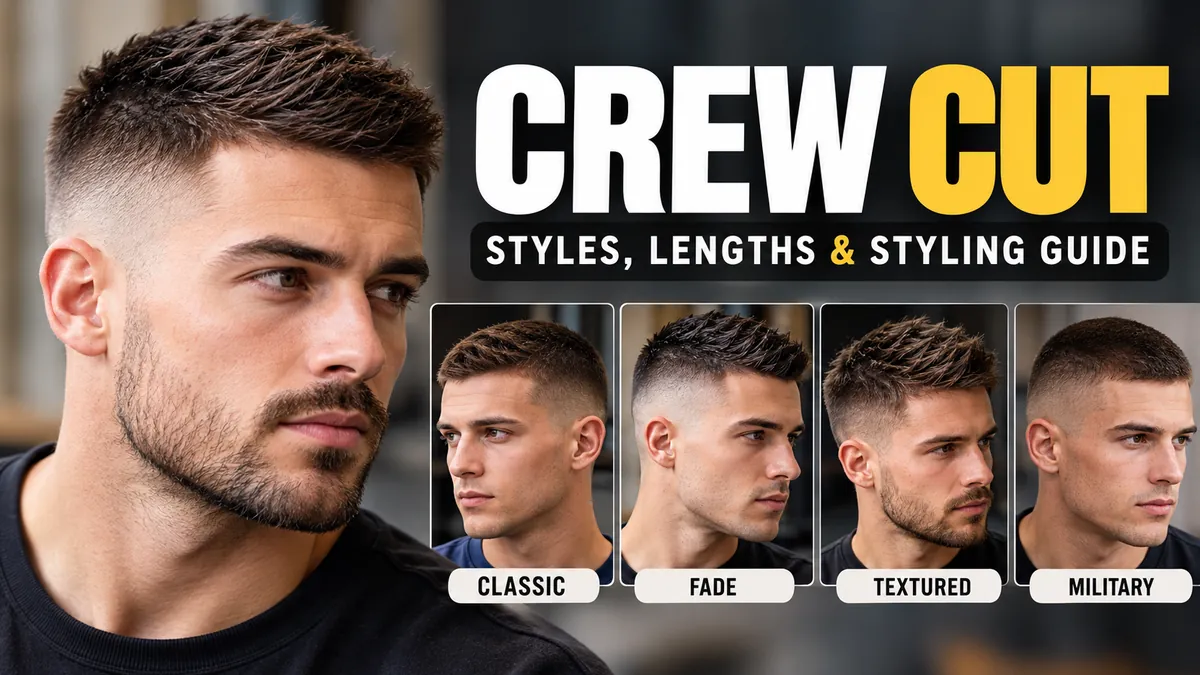
The crew cut is one of the most recognizable men’s haircuts, but not every version looks the same. A traditional military-inspired style, a textured modern cut, and a skin-fade variation can create surprisingly different results.
The appeal is simple: short hair, a clean silhouette, and enough flexibility to suit different hair textures, face shapes, and personal styles.
A crew cut is a short men’s hairstyle featuring tapered or faded sides and back, with slightly longer hair on top. The top is usually longest near the front and gradually becomes shorter toward the crown. It offers a neat, low-maintenance appearance while allowing more styling flexibility than a buzz cut.
What Is a crew cut?
A crew cut is a classic short hairstyle characterized by a relatively short top and closely trimmed sides and back. Unlike a haircut with one uniform length throughout, the traditional crew cut uses graduated lengths to create a balanced shape.
Its defining characteristics include:
- Short top: Usually around ½ to 2 inches, depending on the variation.
- Tapered sides: Hair becomes progressively shorter toward the ears and neckline.
- Slightly longer front: The front may be styled upward, forward, or into a subtle side sweep.
- Clean outline: The haircut emphasizes a tidy, structured appearance.
- Minimal styling: Many versions need only a small amount of product or no product at all.
The crew cut is often associated with military grooming standards, athletics, and traditional barbershop hairstyles. However, modern versions have expanded well beyond those origins.
Today, barbers combine this classic shape with skin fades, textured tops, disconnected transitions, and contemporary styling techniques.
Why Is It Called a crew cut?
The name is commonly linked to rowing crews at American colleges. Short hair was practical for athletes, and the style became associated with collegiate sporting culture during the early twentieth century.
Over time, the haircut gained popularity beyond rowing teams. Its clean appearance and practical length made it a familiar choice among servicemen, athletes, students, and professionals.
Although military hairstyles helped popularize short men’s haircuts, the crew cut has its own history and is not exclusively a military haircut.
Popular crew cut Haircut Styles
The biggest difference between modern variations is how the barber handles the sides, neckline, top length, and transition between sections.
1. Classic crew cut
The classic crew cut keeps the sides short and the top slightly longer, with a gradual transition between them.
The front usually has enough length to create a subtle upward shape, while the crown remains relatively short.
This version works particularly well for someone who prefers a traditional haircut without dramatic contrast.
Best for: Straight or slightly wavy hair, conservative workplaces, and simple daily grooming.
2. crew cut fade
A crew cut fade combines the familiar short top with sides that progressively blend into much shorter hair.
Unlike a traditional taper, which typically concentrates the shortest lengths around the edges, a fade can extend higher up the sides and back.
Common fade placements include low, mid, and high.
The result is sharper and more contemporary than the traditional version.
Best for: Men who prefer defined edges and a fresh barbershop appearance.
3. Textured crew cut
A textured crew cut introduces movement and separation through the top.
Rather than cutting every strand into a perfectly uniform shape, the barber uses point cutting or other texturizing techniques to create a less rigid finish.
A small amount of matte clay or styling paste can emphasize the texture.
Best for: Thick hair, slightly wavy hair, and anyone who prefers a relaxed, modern hairstyle.
4. Short crew cut

The short crew cut keeps the top closely cropped, often around ¼ to ½ inch.
There is still some difference between the top and sides, but the overall haircut remains compact.
This style offers a practical alternative to the buzz cut for people who want a little more shape without significant styling.
Best for: Active lifestyles, hot weather, and minimal grooming routines.
5. Long crew cut
A long crew cut maintains the basic silhouette while allowing additional length on top, sometimes approaching 2 inches.
This makes it possible to add volume, brush the hair forward, or create a subtle side part.
The style begins to overlap with the Ivy League haircut when the front becomes long enough to comb sideways.
Best for: Men who want a short hairstyle without sacrificing styling options.
6. Military crew cut
The military-inspired version emphasizes a very short top and closely trimmed sides.
It generally avoids elaborate styling, visible product, or excessive volume.
Specific grooming requirements differ between military organizations, so no single haircut automatically meets every service’s standards.
Best for: Those who prefer a disciplined, uncomplicated appearance.
7. crew cut with low fade
A low fade begins near the ears and neckline, preserving more visible hair along the upper sides.
It creates a softer transition than a high fade and generally retains the traditional shape.
Best for: Professional settings and people who want a modern haircut without a dramatic fade.
8. crew cut with mid fade

The mid fade starts approximately around the middle of the sides of the head.
It creates a stronger contrast between the top and lower sections while maintaining balance.
Best for: Men looking for a versatile combination of classic structure and modern definition.
9. crew cut with high fade
A high fade transitions into shorter hair farther up the sides, leaving a smaller area of visible length beneath the top.
This produces a bold, high-contrast silhouette.
Best for: People who prefer sharp outlines and a distinctive contemporary look.
10. crew cut with taper fade

A taper fade focuses the shortest lengths around the temples, sideburns, and neckline while preserving more hair through the sides.
It is generally more understated than a full skin fade.
Best for: A natural appearance that grows out relatively smoothly.
crew cut vs Buzz Cut vs Ivy League
These three hairstyles are frequently confused because all involve relatively short hair. Their shapes and styling possibilities are different.
| Feature | crew cut | Buzz cut | Ivy League |
|---|---|---|---|
| Top length | Short, graduated | Usually very short | Short to medium |
| Sides | Tapered or faded | Often uniform or faded | Usually tapered |
| Front length | Slightly longer | Usually minimal | Longer, combable |
| Styling | Minimal | Usually none | Light to moderate |
| Overall appearance | Structured | Close-cropped | Classic, polished |
Is a crew cut the same as a buzz cut?
No. A buzz cut is commonly created with clippers and may have a nearly uniform length across the head.
A crew cut uses deliberate graduation on top, often leaving the front longer than the crown.
Some very short crew cuts resemble buzz cuts, but their cutting techniques and finished silhouettes differ.
How Is It Different From an Ivy League Haircut?
The Ivy League, sometimes called a Harvard clip or Princeton haircut, is closely related to the crew cut.
The main distinction is the longer front section.
An Ivy League usually provides enough length to form a visible side part or comb the hair to one side. A traditional crew cut has less length and a more compact shape.
Choosing the Right crew cut for Your Face Shape
The right variation depends on facial proportions, head shape, hair density, and personal preference.
A haircut cannot change bone structure, but it can influence how the face appears by adding or reducing visual height and width.
| Face shape | Suggested variation | Why it may work |
|---|---|---|
| Oval | Classic or textured | Maintains balanced proportions |
| Round | Mid fade with slight top height | Creates a more elongated appearance |
| Square | Classic taper or low fade | Complements a defined jawline |
| Long or rectangular | Low fade with modest top volume | Avoids excessive vertical emphasis |
| Heart-shaped | Textured top with fuller sides | Can balance a wider forehead |
| Diamond | Low taper with natural texture | Preserves some width near the temples |
These are styling guidelines, not strict rules. A person’s preferred look matters more than following a face-shape formula.
Is a crew cut Good for a Round Face?
Yes. A crew cut can complement a round face when the top retains a little height and the sides are kept relatively neat.
A mid fade or subtle taper may create a more vertical impression.
Extremely flat styles can emphasize facial roundness, although that may be desirable depending on the look someone prefers.
Does a crew cut Suit a Receding Hairline?
A short crew cut can work well with a receding hairline because it reduces the contrast between longer hair and thinner areas.
The best approach is often to keep the front natural rather than attempting to create a heavy fringe.
A textured top may help soften the appearance of uneven density.
However, a very high skin fade can sometimes draw more attention to the upper hairline or temples.
crew cut Lengths and Barber Guard Numbers
Hair length is one of the most important details to communicate when requesting this haircut.
Barber clipper guards are typically numbered according to their approximate cutting lengths, although measurements may vary slightly by manufacturer and blade configuration.
| Clipper guard | Approximate length | Typical application |
|---|---|---|
| #0 | Very close, varies by clipper | Skin-close transitions |
| #1 | ⅛ inch (3 mm) | Very short sides |
| #2 | ¼ inch (6 mm) | Short sides or compact top |
| #3 | ⅜ inch (10 mm) | Short top or fuller sides |
| #4 | ½ inch (13 mm) | Traditional short top |
| #5 | ⅝ inch (16 mm) | Moderate top length |
| #6 | ¾ inch (19 mm) | Longer top |
| #7 | ⅞ inch (22 mm) | Fuller top |
| #8 | 1 inch (25 mm) | Longer clipper-cut top |
Longer versions may require scissors rather than a single clipper guard.
What Is the Best Length for a crew cut?
There is no universal best length.
For a balanced starting point, a top length of approximately ½ to 1 inch with shorter tapered sides works for many people.
Someone with thick, coarse hair may prefer additional length to prevent the top from standing too rigidly.
Fine hair may benefit from a shorter, more controlled shape that avoids visible separation.
Curly hair needs extra consideration because curl shrinkage makes the finished length appear shorter than the hair’s stretched measurement.
How to Ask Your Barber for a crew cut
Clear instructions help prevent misunderstandings, especially because different barbers may interpret the term differently.
A useful request is:
I’d like a classic crew cut with about an inch on top, slightly longer at the front, and a low taper on the sides and back. Please keep the hairline natural.
It helps to specify the following details:
- Desired top length in inches or centimeters.
- Whether the sides should have a taper, low fade, mid fade, or high fade.
- Whether the fade should reach skin level.
- How much length to preserve at the front.
- Whether the finish should look textured or smooth.
A reference photograph can communicate proportions more accurately than a haircut name alone.
How to Style a crew cut
A major advantage of this hairstyle is that daily styling can take only a few minutes.
The exact routine depends on the top length and natural hair texture.
Step 1: Start With Clean, Slightly Damp Hair
Wash your hair according to your scalp’s needs rather than assuming it requires shampoo every day.
After washing, towel-dry gently until the hair is slightly damp.
Avoid aggressive rubbing, which can create tangles and frizz.
Step 2: Choose the Right Styling Product
Different products produce different finishes.
| Product | Finish | Suitable hair |
|---|---|---|
| Matte clay | Natural, textured | Thick or straight |
| Styling paste | Flexible, controlled | Most short styles |
| Pomade | Smooth or shiny | Neat, defined looks |
| Lightweight cream | Soft, natural | Wavy or dry hair |
| Sea salt spray | Textured, airy | Some fine or wavy styles |
| Light-hold gel | Defined, firmer | Hair needing extra control |
Start with a pea-sized amount of product and add more only if necessary.
Using too much can make short hair appear greasy, stiff, or separated.
Step 3: Shape the Front
For a classic appearance, use your fingers or a comb to direct the front slightly upward.
For a textured finish, distribute the product through the top and gently separate small sections.
A longer version can be brushed forward or to the side.
Step 4: Use a Hair Dryer Only When Needed
Very short styles often air-dry without difficulty.
If additional lift is desired, use a hair dryer on low or medium heat while directing the hair upward with your fingers.
Avoid excessive heat, particularly on dry or chemically treated hair.
Step 5: Keep the Finish Natural
A crew cut generally looks best when the shape remains visible.
Heavy product buildup can flatten the top and make the hairstyle appear less defined.
For most variations, less product produces a cleaner result.
How to Maintain a crew cut
A crew cut is low-maintenance, but it is not completely maintenance-free.
Short hairstyles reveal new growth relatively quickly, especially around the ears and neckline.
How Often Should You Get a crew cut?
Most people benefit from a trim approximately every 2–4 weeks.
The ideal interval depends on the haircut:
| Style | Typical trim interval |
|---|---|
| Skin-fade variation | 1–3 weeks |
| Classic crew cut | 3–4 weeks |
| Short military-inspired cut | 2–3 weeks |
| Longer textured version | 4–6 weeks |
These are approximate intervals, not requirements.
Someone comfortable with a softer, grown-out appearance can wait longer.
Everyday Maintenance Tips
- Keep the scalp clean without overwashing.
- Use a gentle shampoo suited to your scalp.
- Apply conditioner when the hair feels dry or coarse.
- Avoid excessive wax, gel, or pomade.
- Protect exposed scalp areas from strong sunlight.
- Trim the neckline carefully between appointments if needed.
Sun protection deserves particular attention with very short hair. Exposed scalp skin can burn, especially when hair is thin or closely shaved.
A hat or suitable broad-spectrum sunscreen can help protect exposed areas.
Can You Cut a crew cut at Home?
Yes, although achieving a professional-looking graduation and fade requires practice.
A basic home haircut may involve clippers, several guard attachments, a hand mirror, and scissors.
The main challenge is blending the top into the sides while preserving the slightly longer front.
Beginners often find a simple tapered version easier than a high skin fade.
Common home-cutting mistakes include removing too much hair from the crown, creating uneven transitions, and pushing the neckline too high.
crew cut for Different Hair Types
Hair texture affects how a short haircut sits, how much volume it creates, and how often it needs styling.
Straight Hair
Straight hair makes the graduated top of a crew cut relatively easy to see.
Fine, straight hair may lie flat, while coarse, straight hair may naturally stand upward.
A small amount of matte paste can help control the front without making the haircut look overly styled.
Thick Hair
Thick hair provides natural fullness but may create unwanted bulk around the crown.
A barber can reduce excess weight using careful layering and texturizing techniques.
Removing too much weight, however, may cause short sections to stick out.
A slightly longer top often provides better control.
Wavy Hair
Wavy hair adds movement and can make a textured crew cut appear fuller.
Leaving enough length for the wave pattern to develop is useful.
Very short cutting may remove much of the visible wave.
A lightweight styling cream can control frizz without eliminating natural movement.
Curly Hair

A curly crew cut typically leaves enough hair on top to display the natural curl pattern.
The sides may be tapered or faded for definition.
Because curls shrink as they dry, a barber should consider both the stretched and natural lengths before cutting.
A moisturizing leave-in conditioner or light curl cream may help preserve definition.
Coily Hair
A short crew-inspired shape can also work with tightly coiled or Afro-textured hair.
The top may be shaped into a compact, natural silhouette with tapered sides.
Depending on the cutting approach, the result may resemble a short Afro taper rather than a traditional straight-hair crew cut.
Maintaining moisture and avoiding unnecessary tension are particularly useful for tightly coiled textures.
Thin or Thinning Hair
A shorter, consistent shape can make differences in hair density less noticeable.
A textured top may create the appearance of additional volume, although styling cannot increase the actual number of hair follicles.
Keeping the sides relatively short can reduce the visual contrast between thicker and thinner sections.
Haircuts are cosmetic choices and do not treat the underlying causes of hair loss.
Advantages and Disadvantages of a crew cut
Understanding the practical trade-offs helps set realistic expectations.
| Advantages | Disadvantages |
|---|---|
| Quick daily styling | Requires regular trims to stay sharp |
| Comfortable in warm weather | Limited styling variety at shorter lengths |
| Works with many hair textures | Exposes more of the scalp and head shape |
| Suitable for many dress codes | Very short versions offer little coverage |
| Easy to wash and dry | Poorly blended fades are noticeable |
| Can complement thinning hair | Some hair types need product to control the top |
Is a crew cut Low-Maintenance?
Yes, particularly when compared with longer hairstyles that require blow-drying, brushing, and regular styling.
However, low daily maintenance does not necessarily mean fewer barber visits.
A sharp skin fade may require more frequent trimming than a medium-length hairstyle.
The classic tapered version usually offers a good balance between easy styling and manageable upkeep.
Does a crew cut Make You Look Younger?
A crew cut can create a clean, fresh appearance, but its effect on perceived age varies.
A slightly longer, textured top may produce a softer look, while an extremely close military-style cut may emphasize facial features and scalp contours.
Facial hair, hairline, clothing, and personal grooming also influence the overall impression.
There is no single haircut that consistently makes everyone look younger.
Common crew cut Mistakes to Avoid
Even a simple haircut can look unbalanced when the proportions are wrong.
Cutting the Top Too Short
Removing too much length from the top can eliminate the graduated shape that distinguishes a crew cut from a uniform buzz cut.
If you want visible texture or a slightly raised front, leave enough length for the hair to respond to styling.
Choosing the Wrong Fade Height
A high fade changes the silhouette more dramatically than a low taper.
On some head shapes, taking the fade too high can make the top appear narrow or disconnected.
Discuss the desired contrast before the barber begins cutting.
Ignoring the Crown and Cowlicks
Hair growth patterns matter, particularly with short hairstyles.
A cowlick near the crown can cause hair to stand in an unexpected direction. Cutting that section too short may make it harder to control.
An experienced barber can adjust the length and graduation around the natural growth pattern.
Using Too Much Styling Product
Short hair needs less product than longer hairstyles.
Excessive pomade, wax, or gel can weigh down the front, exaggerate separation, and create an unnatural finish.
Begin with a small amount and distribute it evenly.
Expecting Every crew cut to Look Identical
The same haircut can look different on two people because of hair density, growth direction, curl pattern, forehead shape, and head contours.
Reference photographs are useful, but the cut should be adapted to the individual rather than copied without adjustment.
Is the crew cut Still in Style in 2026?
Yes. The crew cut remains a relevant short hairstyle in 2026, particularly as classic, cleanly structured haircuts continue to appear alongside more textured men’s styles.
Contemporary barbershop coverage highlights the return of traditional cuts such as the crew cut, Ivy League, and Caesar, often updated with softer texture or modern fades.

Gentleman’s Cuts Barbershop
+1
The main modern interpretations include natural matte texture, subtle low fades, and slightly longer tops.
However, a traditional tapered version remains equally valid. The haircut’s appeal comes from its practicality and adaptable proportions rather than dependence on a particular trend.
Final Thoughts on the crew cut
The crew cut combines a short, structured shape with practical everyday grooming. Its graduated top, tapered sides, and clean outline distinguish it from a basic buzz cut, while modern fades and textured finishes provide additional variety.
For a traditional appearance, choose a classic taper with modest length on top. For more contrast, consider a mid or high fade. If your hair is thick, wavy, or curly, preserving a little extra top length can help accommodate its natural texture.
The most useful next step is to identify your preferred top length, fade height, and styling finish before your next haircut. Those three decisions will help you get a crew cut that suits your hair and is comfortable to maintain.
