

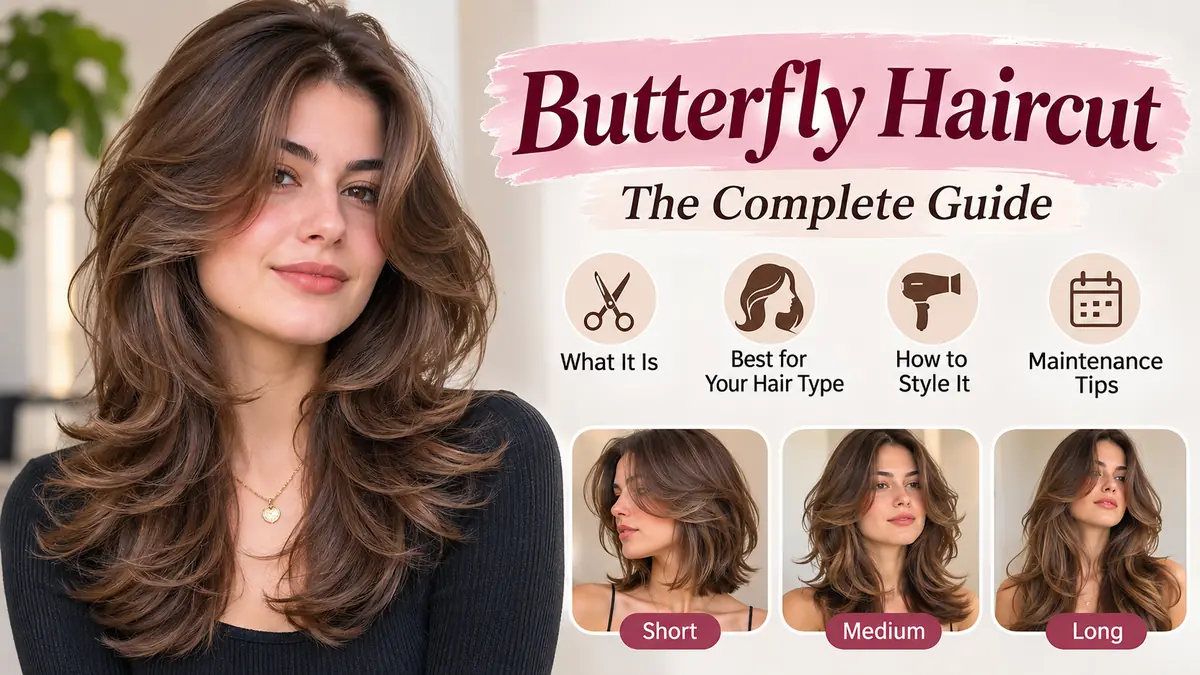
Want the movement and volume of a shorter hairstyle without sacrificing your long hair? The butterfly haircut offers a way to achieve both. Its signature layers create the appearance of a shorter, bouncy cut while keeping much of the length intact.
The butterfly haircut is a layered hairstyle featuring shorter, face-framing sections that blend into longer layers throughout the hair. Inspired by the volume of 1970s blowouts and modern layered cuts, it creates movement, dimension, and a fuller-looking shape. It works especially well on medium to long hair and can be adapted for different textures and face shapes.
The appeal lies in its versatility. You can wear the shorter layers forward for a soft, face-framing effect or style everything together for flowing, voluminous hair.
What Is a Butterfly Haircut?
A butterfly haircut is a heavily layered hairstyle designed to create two visually distinct lengths without cutting the entire head of hair short.
The upper layers typically fall around the cheekbones, jawline, or shoulders, depending on the overall length. Longer layers flow beneath them, preserving the appearance of long hair.
When styled with a round brush or large rollers, the shorter sections curve outward and away from the face. This creates a wing-like shape that gives the hairstyle its name.
Key Features of the Butterfly Cut
- Face-framing layers: Shorter pieces soften the appearance of the face and draw attention to facial features.
- Long, flowing layers: The lower sections retain length while creating movement.
- Crown volume: Strategic layering can help lift hair around the upper head.
- Feathered ends: Soft, blended ends prevent the haircut from looking excessively blunt.
- Versatile styling: The cut can be worn sleek, wavy, curly, or with a bouncy blowout.
Unlike a traditional one-length haircut, the butterfly style uses graduation and weight removal to create a more dynamic silhouette.
Why Is the Butterfly Haircut So Popular?
The butterfly haircut combines elements of classic layered hairstyles with contemporary styling preferences.
Its popularity has been reinforced by social media tutorials, celebrity-inspired blowouts, and renewed interest in 1970s and 1990s hair trends.
The style is frequently associated with the voluminous, face-framing looks seen on celebrities such as Jennifer Aniston and Farrah Fawcett, although their signature hairstyles are not identical to the modern butterfly cut.
It Creates the Illusion of Shorter Hair
One distinctive advantage is the ability to experiment with shorter-looking front sections without committing to an all-over short haircut.
When the longer sections are pulled back, the shorter layers can resemble a bob or shoulder-length style from the front.
This illusion depends on the placement of the layers and the original hair length.
It Adds Movement to Long Hair
Very long hair can sometimes appear heavy, especially when the ends are cut to a single length.
Butterfly layers interrupt that solid outline, allowing different sections to move more independently.
The result can look lighter and more dimensional, particularly when the hair has enough density to support several layers.
It Offers Multiple Styling Options
A butterfly cut does not require the same finish every day. It can be styled into a polished blowout, loose waves, a textured finish, or a smooth straight look.
However, the dramatic winged effect commonly seen in photographs usually requires some styling rather than simple air-drying.
Butterfly Haircut vs. Other Layered Hairstyles
Although butterfly cuts share characteristics with several popular hairstyles, their structure and overall effect are different.
| Hairstyle | Main characteristics | Overall effect |
|---|---|---|
| Butterfly haircut | Short face-framing layers with longer blended layers | Soft, voluminous, flowing |
| Wolf cut | Shaggy layers with pronounced texture and shorter crown sections | Tousled, edgy |
| Shag haircut | Numerous textured layers, often with bangs | Relaxed, lived-in |
| Long layered haircut | Gradual layering distributed throughout the length | Natural movement |
| Hush cut | Soft, understated layers with a light, airy outline | Subtle and delicate |
| Rachel haircut | Distinctive 1990s face-framing layers and rounded shaping | Structured and bouncy |
Butterfly Haircut vs. Wolf Cut
The wolf cut generally features stronger contrast between short crown layers and longer sections.
It often has a deliberately messy, textured finish.
The butterfly haircut, by comparison, emphasizes smoother transitions, feathered layers, and rounded volume.
Choose the butterfly shape if you prefer a softer, more polished appearance. The wolf cut may be better suited to someone seeking a deliberately undone silhouette.
Butterfly Haircut vs. Shag Haircut
A shag typically uses more pronounced layering throughout the head and often includes bangs.
The butterfly cut concentrates much of its visual impact around the face while preserving longer, flowing sections.
Both can create volume, but the butterfly cut usually has a smoother, less fragmented outline.
Butterfly Haircut vs. Traditional Long Layers
Traditional long layers often begin lower down the hair and create a subtle difference in length.
Butterfly layers usually start higher, creating a more noticeable change around the face and upper sections.
This distinction makes the butterfly style particularly effective for achieving a dramatic blowout.
Who Should Get a Butterfly Haircut?
The butterfly haircut is adaptable, but the final result depends on hair density, texture, length, and styling habits.
A good stylist will adjust the number, length, and placement of the layers rather than applying the same cutting pattern to everyone.
Butterfly Haircut for Different Face Shapes
Cortes de pelo de mujer 2026: tendencias y guía – Llongueras
Oval face
Most butterfly variations can work with an oval face. Cheekbone-length framing layers create a balanced appearance, while longer front pieces give a softer result.
Round face
Longer face-framing layers beginning near the jawline or below can create a more elongated visual effect. Avoid excessive width directly at the cheeks if a lengthening appearance is the goal.
Soft Contours for Square Faces | Butterfly Cut Gallery: Feathered Layers for All | A Styling Guide
Square face
Feathered layers around the jaw and cheekbones can soften angular features. Gentle curves and a side-swept or center-parted fringe can complement the shape.
Heart-shaped face
Layers around the chin and lower face can create visual fullness near a narrower jawline. Curtain bangs can also help balance a wider forehead.
Face-shape recommendations are styling guidelines rather than strict rules. Personal preference, hair growth patterns, and natural texture matter just as much.
Butterfly Haircut for Thick Hair
Thick hair is particularly well suited to a butterfly cut because it usually has enough density to support shorter layers without making the ends appear sparse.
A stylist may remove internal weight to help the layers move more freely.
However, excessive thinning can create unwanted frizz or uneven fullness, especially in coarse or curly hair.
Butterfly Haircut for Fine or Thin Hair
Fine hair can benefit from carefully placed butterfly layers, but the cut requires restraint.
Too many short layers can reduce the density of the ends and make the hair appear thinner.
For finer hair, a stylist may recommend:
- Fewer layers overall.
- Longer face-framing sections.
- A relatively full perimeter.
- Minimal thinning or aggressive texturizing.
- Lightweight styling products.
The goal is to create movement without sacrificing the appearance of fullness.
Butterfly Haircut for Curly Hair
Curly hair can look beautiful with butterfly-inspired layering, particularly when the layers are adjusted to account for shrinkage.
Because curls spring upward as they dry, a layer that appears shoulder-length when wet may sit considerably higher once dry.
A stylist experienced in curly hair cutting can distribute volume while avoiding an overly triangular shape.
The finished look may be more rounded and textured than the classic straight-haired butterfly blowout.
Butterfly Haircut for Wavy Hair
Naturally wavy hair often works well with this style because the texture already provides movement.
Layers can encourage waves to form more distinctly, although results depend on wave pattern, density, and hair condition.
A lightweight mousse or curl-enhancing cream may help define the shape without making it heavy.
Butterfly Haircut Lengths: Short, Medium, and Long
The butterfly haircut is most recognizable on medium-to-long hair, but shorter variations are possible.
Short Butterfly Haircut
Baj-baj strukturirane frizure, ovog ljeta vraća se jedna jako opuštena verzija boba
Come ottenere volume immediato sui capelli fini con il Butterfly Cut
17
A short butterfly cut generally falls around the shoulders or slightly above them.
Because there is less length available, the distinction between the upper and lower layers is subtler.
The cut may resemble a feathered lob or a short layered bob.
This variation works best when the stylist preserves enough length for the face-framing pieces to blend naturally into the rest of the hair.
Medium-Length Butterfly Haircut
30+ Stylish Butterfly Haircut Ideas To Try Now – Love yarn
12 Model Potongan Rambut Wanita Butterfly, Modis dan Fresh | Popbela.com
20
Medium-length hair provides enough room for noticeable layering while remaining manageable.
The shorter sections can sit near the cheekbones or jaw, while the longest layers extend toward the collarbone or chest.
This length offers a balance between movement, fullness, and styling convenience.
Long Butterfly Haircut
Stunning butterfly cut for long hair ideas for 2025 | Cut & Style
16 Timeless Butterfly Haircut Ideas for Women – Pixelify
Pin by Jade Chacón on peinado | Balayage straight hair, Brown hair balayage, Hair inspiration long
15
Long hair provides the clearest separation between short face-framing layers and the remaining length.
The resulting silhouette can be especially dramatic when styled with large, outward-facing curls.
For very long hair, a stylist may add intermediate layers to prevent a disconnected appearance between the shortest and longest sections.
Popular Butterfly Haircut Variations
The classic butterfly cut can be customized with different fringes, layer lengths, and finishes.
Butterfly Haircut With Curtain Bangs
16 Timeless Butterfly Haircut Ideas for Women – Pixelify
Curtain bangs are among the most natural additions to this haircut.
They are typically parted near the center and sweep outward toward the temples, blending into the surrounding face-framing layers.
This combination creates a continuous, feathered shape around the face.
The fringe can be cut near the cheekbones for a softer effect or slightly shorter for a more noticeable frame.
Butterfly Haircut With Wispy Bangs
Wispy bangs create a lighter appearance across the forehead.
They can complement a butterfly cut without adding the visual weight of a thick, blunt fringe.
This option may appeal to someone who wants forehead coverage while maintaining a soft, airy hairstyle.
Butterfly Haircut With Side Bangs
Side-swept bangs can introduce asymmetry and emphasize movement.
They are particularly useful for people who naturally wear a side part or prefer not to style a center-parted fringe.
The bangs should blend into the upper layers rather than appearing disconnected from the rest of the cut.
Butterfly Haircut Without Bangs
A butterfly cut does not require bangs.
Longer front layers can begin around the chin or jawline, creating face-framing movement without a traditional fringe.
This variation may be easier to grow out and offers more flexibility for ponytails and updos.
Soft Butterfly Haircut
A soft butterfly cut uses fewer, longer layers with less dramatic contrast.
It is a practical choice for people who prefer a low-maintenance hairstyle or want to experiment with layering gradually.
The effect is subtle when air-dried and more noticeable after a blowout.
How to Ask Your Hairstylist for a Butterfly Haircut
Getting the right result starts with a clear conversation about length, layering, and styling expectations.
The term butterfly haircut describes a general style rather than a single standardized cutting technique.
Two stylists may interpret it differently.
Explain the Length You Want to Keep
Tell your stylist exactly how much length you are comfortable removing.
For example:
“I want a butterfly haircut with noticeable face-framing layers, but I want to keep the overall length below my shoulders.”
This gives the stylist a clear boundary while allowing flexibility in the layering.
Specify Where the Shortest Layers Should Begin
The shortest layer placement has a major effect on the finished style.
Cheekbone-level layers create stronger framing, while chin-length layers produce a softer transition.
For people who frequently tie their hair back, longer front layers may be more practical.
Bring Reference Photographs
Bring two or three photographs showing the hairstyle from different angles.
Ideally, choose examples with a hair texture and density similar to your own.
A photograph of a heavily styled blowout may not accurately represent how the same cut will look when air-dried.
Discuss Your Styling Routine
Be realistic about the time you want to spend styling your hair.
If you rarely use heat tools, ask for a version that works with your natural texture.
A good stylist can modify the layering to reduce daily styling demands.
How Is a Butterfly Haircut Cut?
Professional techniques vary, but most butterfly haircuts rely on sectioning, elevation, and controlled layering.
The stylist typically begins by assessing the existing length, density, texture, and natural parting.
Step 1: Establish the Overall Length
The stylist determines the longest point of the haircut and creates or refines the perimeter.
This establishes how much length will remain after layering.
Step 2: Create the Face-Framing Layers
Shorter sections are cut around the front of the head.
These pieces may begin near the cheekbones, chin, or jawline depending on the desired look.
Step 3: Build the Interior Layers
The stylist adds longer layers through the crown, sides, and back.
These layers create movement and connect the shorter front pieces with the longer hair underneath.
Step 4: Blend and Refine the Shape
Point cutting, slide cutting, or other texturizing techniques may be used to soften the transitions.
The appropriate method depends on the hair’s texture and condition.
Step 5: Style and Check the Finished Cut
A blowout or natural-texture finish helps reveal how the layers fall.
The stylist may make small adjustments after seeing the finished shape.
A professional consultation is particularly valuable for very curly, fragile, or low-density hair because poorly placed layers can be difficult to correct without removing additional length.
How to Style a Butterfly Haircut at Home
The haircut provides the structure, but styling determines how clearly the signature layers appear.
For the classic butterfly effect, the goal is to create lift at the roots and curve the shorter sections away from the face.
Method 1: Butterfly Haircut Blowout
Brushing borboleta, a técnica de secar o cabelo que dá volume e movimento aos fios – Miranda
A round-brush blowout is one of the most effective ways to emphasize butterfly layers.
- Prepare the hair. Start with clean, towel-dried hair and apply a heat protectant according to its instructions.
- Apply volumizing product. Distribute a lightweight mousse near the roots if extra lift is needed.
- Rough-dry the hair. Use a blow-dryer until the hair is approximately 70–80% dry.
- Divide into sections. Separate the hair into manageable upper and lower sections using clips.
- Style the lower layers. Wrap each section around a round brush, directing the airflow down the hair shaft.
- Shape the front layers. Roll the face-framing sections away from the face to create the characteristic outward curve.
- Set the shape. Allow each section to cool before brushing it out.
- Finish lightly. Use a small amount of flexible-hold hairspray to maintain movement without stiffness.
A concentrator nozzle can help direct airflow, while the cool setting helps preserve the finished shape.
Avoid holding a hot dryer against the brush or hair for extended periods.
Method 2: Butterfly Haircut With Velcro Rollers
How to Use Roller Clips for Volume: The Method My Salon Clients Ask For – Pixie Garden
Velcro rollers can help create a soft, voluminous finish.
Start with dry or nearly dry hair that has been shaped using a blow-dryer.
Wrap the front sections away from the face, then place larger rollers through the crown for additional lift.
Allow the hair to cool and set before carefully removing the rollers.
Gently separate the layers with your fingers or a wide-tooth comb.
Rollers can be particularly useful for maintaining volume while getting ready, but they should not be pulled forcefully through tangled hair.
Method 3: Butterfly Haircut With a Curling Iron
A large-barrel curling iron can create the sweeping curves associated with this hairstyle.
Work with dry hair and follow the tool manufacturer’s temperature guidance.
Curl the face-framing pieces away from the face, leaving the ends slightly relaxed for a modern finish.
Alternate curl directions through the longer sections if you want a more natural-looking result.
Let the curls cool before gently brushing them into soft waves.
Method 4: Heatless Butterfly Haircut Styling
A butterfly cut can also be styled without direct heat.
Soft foam rollers, satin curling rods, or loose overnight braids can create movement.
For a heatless blowout-inspired effect, wrap slightly damp—not soaking wet—sections around suitable soft rollers and allow them to dry completely.
Results vary depending on hair texture and how well the hair holds a curl.
Heatless methods generally produce a softer finish than a professionally styled blowout.
Styling Products for Different Hair Types
| Hair type | Useful products | Styling goal |
|---|---|---|
| Fine hair | Lightweight mousse, root-lifting spray | Volume without heaviness |
| Thick hair | Smoothing cream, flexible-hold spray | Control and definition |
| Wavy hair | Lightweight curl cream, mousse | Enhanced natural texture |
| Curly hair | Leave-in conditioner, curl gel | Definition and frizz control |
| Straight hair | Heat protectant, volumizing spray | Lift and lasting shape |
| Dry or damaged hair | Conditioning leave-in, heat protectant | Reduced friction and breakage |
Use products sparingly at first. Excessive styling cream or oil can weigh down the shorter layers and reduce the airy effect.
How to Maintain a Butterfly Haircut
Butterfly haircuts can grow out gracefully, but maintaining the intended proportions requires occasional trimming.
How Often Should You Trim a Butterfly Haircut?
A common starting point is every six to ten weeks, although the ideal interval depends on how quickly the hair grows and how precisely you want to preserve the layers.
Shorter face-framing sections may need attention sooner than the longer sections.
If you prefer a softer, grown-out appearance, you may be comfortable waiting longer between appointments.
How to Keep the Layers Looking Fresh
The most effective maintenance routine is relatively simple:
- Use a shampoo and conditioner appropriate for your scalp and hair texture.
- Detangle gently, beginning at the ends.
- Apply heat protection before using hot styling tools.
- Avoid excessive heat exposure and repeated passes over the same section.
- Use lightweight products when volume is a priority.
- Trim damaged ends as needed.
Haircuts cannot repair existing split ends. Cutting away damaged sections is the reliable way to remove them.
How to Sleep With a Butterfly Haircut
To reduce tangling, consider a loose braid, a soft scrunchie, or a satin pillowcase.
Avoid tightly securing the shorter layers, particularly if they do not comfortably reach the ponytail.
In the morning, refreshing the face-framing pieces with a round brush or suitable rollers may be enough to restore the shape.
Common Butterfly Haircut Mistakes to Avoid
Even a well-designed layered haircut can produce disappointing results when the layers are poorly planned.
Cutting the Front Layers Too Short
Very short front sections can be difficult to blend into longer hair.
They may also fall out of ponytails or require more daily styling.
If you are unsure, begin with longer face-framing layers. They can always be shortened later.
Removing Too Much Weight From Fine Hair
Aggressive layering can leave fine hair with thin-looking ends.
Preserving a fuller perimeter is often more flattering than creating extreme separation between the layers.
Expecting a Blowout Without Styling
The dramatic, outward-sweeping butterfly shape often seen online is partly a styling result.
The cut itself does not guarantee that the hair will naturally curve away from the face.
Someone who prefers air-drying should discuss a softer, texture-friendly variation with their stylist.
Ignoring Natural Hair Texture
A cutting pattern that works beautifully on straight hair may behave differently on tight curls.
Curl shrinkage, density, and growth patterns affect where the layers settle.
The best results come from adapting the haircut to the hair rather than forcing every texture into the same shape.
Attempting an Aggressive DIY Butterfly Cut
Online tutorials sometimes demonstrate butterfly haircuts using high ponytails and a single cut.
Although these methods may create layers, they offer limited control over balance, perimeter fullness, and face framing.
Uneven tension or sectioning can create unexpected short pieces.
For a precise butterfly shape, professional cutting is generally the safer option.
Is the Butterfly Haircut Low Maintenance?
The answer depends on the version of the haircut and the finish you expect.
A soft butterfly cut on naturally wavy hair may require little more than suitable products and occasional shaping.
A dramatic, smooth butterfly blowout can require substantially more effort.
| Styling approach | Approximate active styling time | Expected finish |
|---|---|---|
| Natural air-drying | 5–10 minutes | Soft, relaxed layers |
| Quick front-layer refresh | 5–10 minutes | Defined face framing |
| Full round-brush blowout | 20–40 minutes | Bouncy, polished layers |
| Curling iron styling | 15–30 minutes | Soft, defined waves |
| Heatless rollers | 5–15 minutes to set, plus drying time | Gentle curves and volume |
These are illustrative estimates rather than fixed requirements. Hair length, density, skill, and equipment can change the time considerably.
The key distinction is that a butterfly haircut can be relatively easy to maintain as a cut while still requiring effort to reproduce a salon-style finish.
How Does a Butterfly Haircut Grow Out?
One advantage of longer butterfly layers is that they can gradually blend into a conventional long-layered hairstyle.
As the shortest sections grow, they lose some of their dramatic contrast with the longer hair.
The haircut may eventually resemble a soft, face-framing layered cut.
Growing Out Curtain Bangs
Curtain bangs typically blend more easily into surrounding layers than a very short, blunt fringe.
During the growing-out stage, you can sweep them sideways, tuck them behind the ears when long enough, or secure them with small clips.
Growing Out Short Layers
If the upper layers begin to feel awkward, avoid repeatedly shortening the longest sections just to match them.
Instead, ask your stylist to soften any visible disconnection while preserving your desired length.
This approach can help transition the hairstyle into longer, more uniform layers.
Is a Butterfly Haircut Worth Trying?
A butterfly haircut is worth considering if you want noticeable movement, soft face framing, and the flexibility to experiment with volume while preserving much of your length.
It is especially appealing to people with medium-to-long hair who enjoy layered hairstyles and occasional blowouts.
However, the cut is not equally suitable for every situation.
Very fine hair may require restrained layering to maintain fullness. Highly textured hair benefits from customized cutting, and people who dislike styling may prefer a softer variation.
The best version is one that suits your natural texture, daily routine, and preferred amount of volume.
Final Thoughts on the Butterfly Haircut
The butterfly haircut combines shorter face-framing layers with longer, flowing sections to create movement, dimension, and the appearance of fullness.
Its versatility is its greatest strength. From curtain bangs and feathered layers to natural waves and voluminous blowouts, the haircut can be adapted to many different preferences.
The most important decision is not simply whether to get a butterfly haircut, but where the shortest layers should begin and how much density should remain through the ends.
Start with reference photographs, discuss your natural hair texture with your stylist, and choose a layer placement that matches your everyday styling habits. A well-planned butterfly cut should look balanced both on an ordinary day and after a full blowout.
