

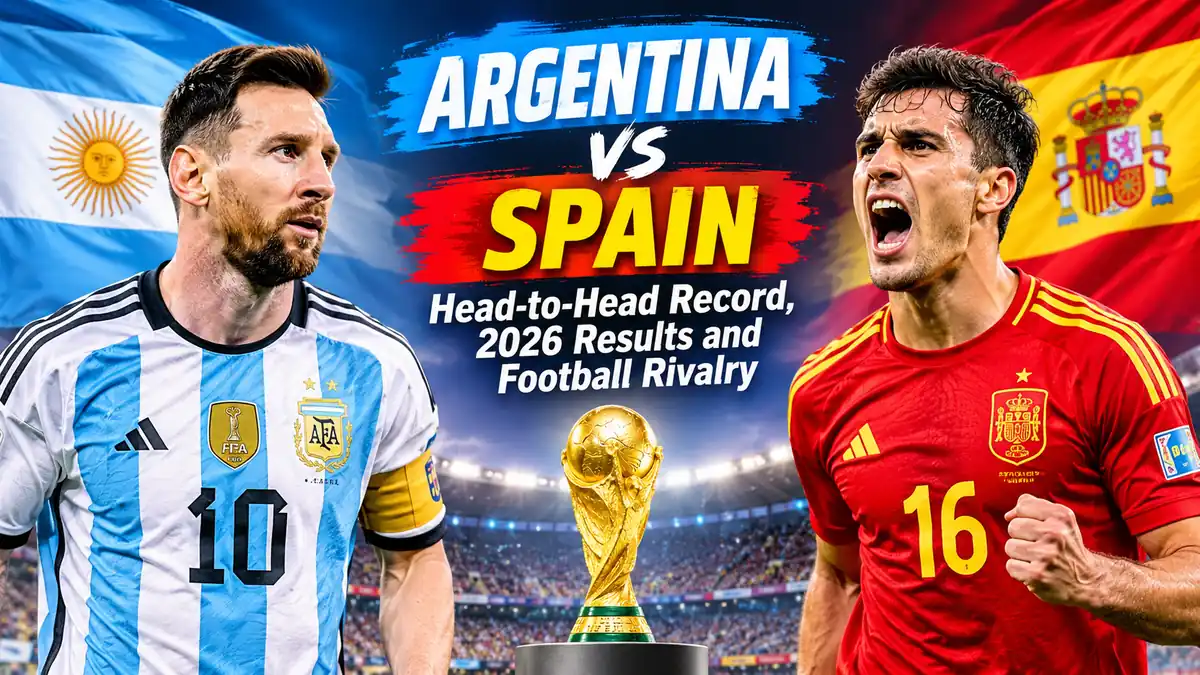
Argentina and Spain are two of international football’s most successful nations. Their rivalry combines World Cup history, contrasting playing styles, legendary footballers, and memorable results. The latest chapter came in the 2026 FIFA World Cup final, following the cancellation of their much-anticipated Finalissima earlier in the year.
The argentina vs spain head-to-head record now favors Spain, with seven wins compared with Argentina’s six and two draws across 15 senior men’s international matches. Spain defeated Argentina 1-0 in the 2026 FIFA World Cup final on July 19, securing its second world title. Their scheduled March 2026 Finalissima was canceled.
Argentina vs Spain: Latest Match Result and Overview
The most significant recent meeting between Argentina and Spain took place on July 19, 2026, in the FIFA World Cup final at MetLife Stadium in East Rutherford, New Jersey.
Spain emerged victorious by a 1-0 scoreline after extra time, adding another major achievement to its international football history.
Argentina vs Spain 2026 World Cup Final
| Match detail | Information |
|---|---|
| Competition | 2026 FIFA World Cup |
| Date | July 19, 2026 |
| Match | Spain vs Argentina |
| Venue | MetLife Stadium, New Jersey, USA |
| Final score | Spain 1-0 Argentina |
| Result | Spain won after extra time |
| Achievement | Spain’s second World Cup title |
The final brought together two nations that had already demonstrated their ability to win major international tournaments.
Argentina entered the 2026 World Cup cycle as the reigning champion from Qatar 2022 and the winner of the 2024 Copa América. Spain arrived with the momentum of its UEFA Euro 2024 triumph.
The encounter represented more than a meeting between European and South American football. It was a contest between two successful footballing traditions with different approaches to possession, pressing, attacking movement, and defensive organization.
Spain’s victory also changed the historical balance of the rivalry, giving the European side a narrow advantage in total victories.
Argentina vs Spain Head-to-Head Record
The historical record demonstrates how closely matched these national teams have been.
Their meetings span more than seven decades, beginning with an international friendly in December 1952.
Overall Head-to-Head Statistics
| Statistic | Argentina | Spain |
|---|---|---|
| Total matches | 15 | 15 |
| Wins | 6 | 7 |
| Draws | 2 | 2 |
| FIFA World Cup titles through 2026 | 3 | 2 |
| Most recent meeting | July 19, 2026 | July 19, 2026 |
| Latest result | Lost 0-1 | Won 1-0 |
Argentina has traditionally been associated with technically gifted attacking players, individual creativity, and adaptability.
Spain has developed a reputation for structured possession football, coordinated midfield play, and patient attacking combinations.
However, these descriptions are broad tendencies rather than permanent tactical rules. Both national teams have changed their approaches considerably under different managers.
Complete Argentina vs Spain Match History
| Date | Match | Score |
|---|---|---|
| December 7, 1952 | Spain vs Argentina | 0-1 |
| July 5, 1953 | Argentina vs Spain | 1-0 |
| July 24, 1960 | Argentina vs Spain | 2-0 |
| June 11, 1961 | Spain vs Argentina | 2-0 |
| July 13, 1966 | Argentina vs Spain | 2-1 |
| October 11, 1972 | Spain vs Argentina | 1-0 |
| October 12, 1974 | Argentina vs Spain | 1-1 |
| October 12, 1988 | Spain vs Argentina | 1-1 |
| September 20, 1995 | Spain vs Argentina | 2-1 |
| November 17, 1999 | Spain vs Argentina | 0-2 |
| October 11, 2006 | Spain vs Argentina | 2-1 |
| November 14, 2009 | Spain vs Argentina | 2-1 |
| September 7, 2010 | Argentina vs Spain | 4-1 |
| March 27, 2018 | Spain vs Argentina | 6-1 |
| July 19, 2026 | Spain vs Argentina | 1-0 |
The historical record reveals several interesting patterns.
Argentina won the first three meetings between the countries, establishing an early advantage.
Spain subsequently became more competitive and secured several victories during the 1990s and 2000s.
The two most dramatic modern results came in 2010 and 2018, when Argentina and Spain recorded convincing victories respectively.
The 2026 World Cup final then became the most consequential meeting in their history.
Argentina vs Spain Finalissima 2026: Why Was It Canceled?
Before the World Cup final, Argentina and Spain were scheduled to compete in the 2026 Finalissima.
The match would have brought together the reigning champions of South America and Europe.
Argentina qualified by winning the 2024 Copa América, while Spain earned its place by winning UEFA Euro 2024.
Original Finalissima Schedule
| Detail | Original plan |
|---|---|
| Match | Argentina vs Spain |
| Competition | Finalissima 2026 |
| Date | March 27, 2026 |
| Stadium | Lusail Stadium |
| Location | Lusail, Qatar |
| Status | Canceled |
The Finalissima is organized through cooperation between UEFA and CONMEBOL, the governing bodies responsible for European and South American international football.
The competition provides a rare opportunity for the champions of the two continents to compete directly.
Why the Match Did Not Take Place
The original venue in Qatar became unavailable because of the regional security situation.
Organizers explored several alternatives, including moving the match to Spain or arranging a neutral European venue.
However, disagreements over the replacement location and match date prevented the participating organizations from reaching a final agreement.
UEFA announced the cancellation on March 15, 2026.
CONMEBOL and the Argentine Football Association subsequently explained their position, emphasizing their preference for neutral territory and the difficulties surrounding the proposed dates.
The cancellation meant that fans did not see the anticipated continental champions’ showdown in March.
Instead, Argentina and Spain eventually faced each other on the biggest international stage: the FIFA World Cup final.
What Is the Difference Between the Finalissima and the World Cup?
The Finalissima is a single match between the reigning European and South American continental champions.
The FIFA World Cup is a much larger international tournament featuring qualified national teams from different confederations.
Winning the Finalissima provides a prestigious intercontinental title, but winning the World Cup establishes the champion of global men’s international football.
Argentina won the 2022 Finalissima by defeating Italy 3-0 at Wembley Stadium in London.
Spain’s 2026 World Cup victory was a separate achievement and did not represent a rescheduled Finalissima.
Argentina vs Spain: Most Memorable Matches
Several encounters have shaped this international football rivalry.
Spain 6-1 Argentina — March 27, 2018
Spain recorded one of the most emphatic victories in the rivalry during an international friendly in Madrid.
Isco scored a hat-trick, while Diego Costa, Thiago Alcântara, and Iago Aspas also contributed goals.
Argentina struggled defensively against Spain’s quick passing combinations and attacking movement.
Lionel Messi did not participate in the match.
The result became particularly memorable because Argentina was preparing for the 2018 World Cup in Russia.
Although friendly results cannot reliably predict tournament outcomes, the six-goal performance demonstrated Spain’s attacking potential.
Argentina 4-1 Spain — September 7, 2010
Argentina produced an impressive home victory over Spain shortly after the European team had won the 2010 FIFA World Cup.
Lionel Messi, Gonzalo Higuaín, Carlos Tévez, and Sergio Agüero scored for Argentina.
Fernando Llorente scored Spain’s goal.
The result illustrated how quickly international football can change, even when one team has recently become world champion.
Argentina capitalized on attacking opportunities and demonstrated the effectiveness of its forward players.
Argentina 2-1 Spain — 1966 FIFA World Cup
Argentina and Spain met during the group stage of the 1966 World Cup in England.
Argentina secured a 2-1 victory, establishing an important competitive precedent between the countries.
For decades, this remained their only meeting in a men’s FIFA World Cup.
Their next World Cup encounter did not occur until the 2026 final, sixty years later.
Spain 1-0 Argentina — July 19, 2026
The 2026 final was the most significant competitive meeting between the two nations.
Unlike previous friendly matches, the result determined the world champion.
Spain’s narrow victory highlighted the importance of defensive concentration, tactical discipline, and managing decisive moments.
The match also gave Spain its second men’s World Cup title, following its first triumph in 2010.
Argentina vs Spain: Playing Style and Tactical Differences
Argentina and Spain have often been compared because both countries produce technically accomplished players.
Nevertheless, their footballing identities have developed in distinct ways.
Argentina’s Tactical Approach
Argentina’s modern success has involved a combination of technical quality, compact defensive organization, and intelligent attacking movement.
Under Lionel Scaloni, Argentina developed a balanced system capable of adapting to different opponents.
Rather than depending exclusively on possession, the team has demonstrated the ability to attack through transitions, combinations between midfield and attack, and coordinated pressing.
Important tactical characteristics include:
- Flexible formations depending on the opposition.
- Strong defensive support from midfield.
- Creative passing between attacking players.
- Quick transitions after recovering possession.
- Effective movement around the penalty area.
Argentina’s 2022 World Cup triumph demonstrated how a balanced collective structure could support exceptional individual talent.
Spain’s Tactical Approach
Spain became internationally associated with tiki-taka, a possession-oriented style emphasizing short passes, movement, and positional control.
Its famous 2008–2012 period featured midfielders such as Xavi Hernández, Andrés Iniesta, and Sergio Busquets.
More recent Spanish teams have retained technical passing quality while incorporating greater attacking width, speed, and directness.
Spain’s modern tactical characteristics include:
- Structured build-up from defense.
- Coordinated pressing after losing possession.
- Technical midfield combinations.
- Wide attacking movement.
- Controlled positional rotations.
- Greater willingness to attack quickly when space appears.
The emergence of young attacking talents has allowed Spain to combine its traditional possession principles with more varied offensive options.
Tactical Comparison
| Tactical feature | Argentina | Spain |
|---|---|---|
| Traditional strength | Individual creativity and adaptability | Possession and positional play |
| Midfield approach | Balance, combinations and transitions | Passing control and structured movement |
| Attacking strategy | Flexible combinations and direct attacks | Wide attacks and coordinated build-up |
| Defensive approach | Compact shape and collective support | Organized pressing and positional discipline |
| Main tactical advantage | Ability to adapt to different situations | Ability to control territory and possession |
Neither approach guarantees victory.
The outcome depends on player availability, preparation, execution, and the specific conditions of each match.
Argentina vs Spain: Legendary Players and Modern Stars
Both nations have produced some of football’s most recognizable players.
Argentina’s Legendary Footballers
Lionel Messi has been central to Argentina’s modern international success.
His vision, dribbling, passing, and finishing helped Argentina win the 2021 Copa América, 2022 Finalissima, 2022 World Cup, and 2024 Copa América.
Diego Maradona remains one of the country’s most celebrated football figures, particularly because of his performances during Argentina’s 1986 World Cup victory.
Other important Argentine players include:
- Ángel Di María, known for decisive performances in major finals.
- Sergio Agüero, a prolific striker across club and international football.
- Javier Mascherano, an influential defensive midfielder and leader.
- Lautaro Martínez, a major contributor to Argentina’s recent attacking success.
- Julián Álvarez, known for intelligent movement, pressing, and versatility.
Spain’s Legendary Footballers
Andrés Iniesta scored the winning goal in the 2010 World Cup final against the Netherlands.
Xavi Hernández played a defining role in Spain’s possession-based midfield.
Iker Casillas captained Spain during its historic period of international success.
Other influential Spanish players include:
- Sergio Ramos, a prominent defender and international leader.
- Sergio Busquets, known for positional awareness and midfield control.
- David Villa, one of Spain’s most important international goalscorers.
- Fernando Torres, a key attacker during Spain’s successful tournament era.
- Rodri, an influential modern midfielder.
- Lamine Yamal, a leading talent of Spain’s newer generation.
- Nico Williams, known for pace, dribbling, and attacking width.
Lionel Messi vs Lamine Yamal
Comparisons between Messi and Yamal have attracted attention because both developed through Barcelona’s football system and became internationally recognized for their technical ability.
However, they belong to different generations and are at very different stages of their careers.
Messi’s achievements span many years at the highest level, while Yamal represents the future of Spanish attacking football.
A meaningful comparison should consider career stage, tactical responsibilities, team structure, and sustained performance rather than individual highlights alone.
Argentina vs Spain: World Cup and International Trophy Comparison
Argentina and Spain have both achieved major success in international football.
Their records demonstrate different historical periods of dominance.
FIFA World Cup Titles
Argentina has won three men’s FIFA World Cups:
- 1978, hosted by Argentina.
- 1986, hosted by Mexico.
- 2022, hosted by Qatar.
Spain has won two:
- 2010, hosted by South Africa.
- 2026, hosted by Canada, Mexico, and the United States.
Argentina retains the advantage in total World Cup titles, despite Spain winning their 2026 final.
Continental Championships
Argentina has a distinguished Copa América history and won its 16th title in 2024.
Spain has won four UEFA European Championships, in 1964, 2008, 2012, and 2024.
Spain’s consecutive European titles in 2008 and 2012, combined with the 2010 World Cup, created one of the most successful periods in international football history.
Argentina’s victories in the 2021 Copa América, 2022 World Cup, and 2024 Copa América similarly established a remarkable modern era.
Major Trophy Comparison
| Achievement | Argentina | Spain |
|---|---|---|
| Men’s World Cup titles | 3 | 2 |
| Continental championships | 16 Copa América titles | 4 European Championships |
| Most recent World Cup title | 2022 | 2026 |
| Most recent continental title | 2024 | 2024 |
| 2022 Finalissima | Winners | Did not participate |
| 2026 Finalissima | Canceled | Canceled |
These figures should not be interpreted as a direct measure of which footballing nation is permanently stronger.
The Copa América and European Championship have different histories, participation structures, and competitive environments.
Argentina vs Spain: Which Team Has the Better Record?
The answer depends on the statistic being considered.
Spain leads the direct head-to-head record by seven victories to six, with two draws.
Argentina has won more men’s FIFA World Cups overall, with three titles compared with Spain’s two.
Argentina also has a longer history of continental success, while Spain has produced two especially influential periods of European and global dominance.
In their most recent competitive meeting, Spain was the stronger team on the scoreboard, winning the 2026 World Cup final.
However, historical results alone cannot determine the outcome of a future fixture.
Squad development, coaching changes, injuries, and tactical evolution all affect international football performance.
Why Is This Rivalry So Interesting?
The Argentina-Spain rivalry brings together several important dimensions of international football.
Both countries have produced world-class midfielders and attackers. Both have won major championships. Both have influenced football tactics beyond their national borders.
There is also a strong cultural and linguistic connection between the nations, contributing to interest in their encounters.
Yet their direct meetings have been relatively infrequent compared with many traditional international rivalries.
That combination of shared football heritage and limited head-to-head opportunities makes each major encounter particularly significant.
What Comes Next for Argentina and Spain?
Following their 2026 World Cup final, both national teams face the challenge of maintaining competitiveness while developing future generations of players.
Argentina’s long-term success will depend on maintaining its collective structure and integrating emerging talent.
Spain will aim to build on its World Cup victory while continuing to develop a team capable of competing at the highest level.
Future meetings could occur through international friendlies, major tournament draws, or intercontinental competitions.
However, a future Argentina-Spain fixture should not be treated as confirmed without an official announcement from the relevant football associations or tournament organizers.
The canceled 2026 Finalissima also demonstrates why announced international fixtures can change because of scheduling, organizational, or external circumstances.
Final Thoughts on argentina vs spain
The argentina vs spain rivalry reflects the rich history and competitive quality of international football.
Argentina holds the advantage in overall men’s World Cup titles, while Spain leads their direct head-to-head record following its 1-0 victory in the 2026 World Cup final.
Their memorable matches, including Argentina’s 4-1 victory in 2010 and Spain’s 6-1 win in 2018, demonstrate how dramatically results can vary between generations.
Although the 2026 Finalissima never took place, the World Cup final provided a historic encounter between the two nations.
For anyone following this rivalry, the most useful approach is to consider both the complete historical record and the teams’ current development, rather than judging either nation by a single result.
