

Calculating the area of a circle is one of the most useful skills in geometry. From measuring a round garden to finding the surface of a pizza, the same simple mathematical formula helps you determine how much space a circle covers.
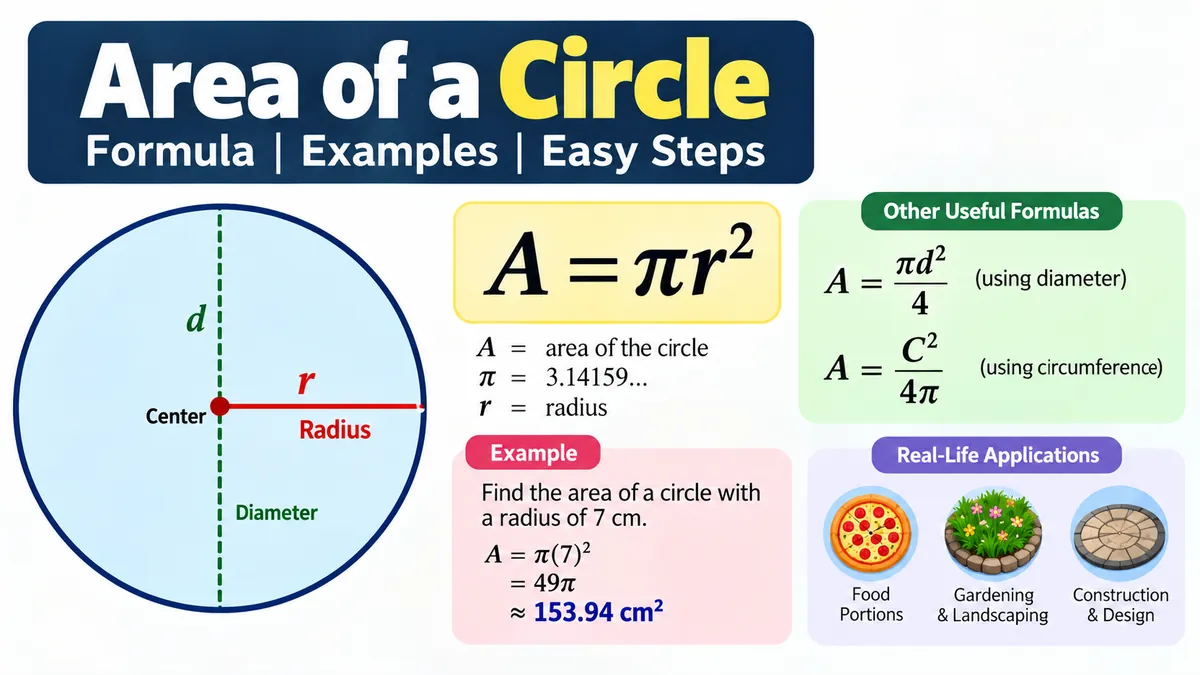
The area of a circle is the amount of two-dimensional space enclosed by its circular boundary. It is calculated using the formula A = πr², where A represents area, π (pi) is approximately 3.14159, and r is the radius. The answer is expressed in square units, such as cm², m², or in².
H2: What Is the Area of a Circle?
The area of a circle measures the entire flat region inside its circumference. Unlike the circumference, which measures the distance around the circle, area measures the space within it.
For example, imagine a circular tabletop. Its circumference describes the length of its outer edge, while its area describes the amount of material needed to cover its surface.
A circle has several important geometric properties:
- Center: The fixed point equally distant from every point on the circle.
- Radius (r): The distance from the center to the boundary.
- Diameter (d): The distance across the circle through its center.
- Circumference (C): The total distance around the circle.
- Pi (π): A mathematical constant approximately equal to 3.14159.
The radius is half the diameter, so r = d/2. Understanding this relationship makes it easier to calculate circular area from different measurements.
H2: Area of a Circle Formula
The standard formula is:
\[ \boxed{A=\pi r^2} \]
Where:
- A = area of the circle
- π = pi, approximately 3.14159
- r = radius of the circle
- r² = radius multiplied by itself
To find the area, square the radius and multiply the result by pi.
H3: How to Calculate the Area of a Circle Step by Step
Suppose a circle has a radius of 7 cm.
Step 1: Identify the radius.
\[ r=7\text{ cm} \]
Step 2: Square the radius.
\[ r^2=7\times7=49 \]
Step 3: Multiply by pi.
\[ A=\pi\times49 \]
Step 4: Calculate the answer.
\[ A\approx153.94\text{ cm}^2 \]
The area is approximately 153.94 square centimeters.
When an exact answer is required, leave it as 49π cm² instead of converting pi into a decimal.
H3: Why Is the Radius Squared?
Area is a two-dimensional measurement. When a circle becomes larger, its area increases with the square of its radius.
For instance, doubling the radius makes the area four times larger, while tripling it makes the area nine times larger.
This relationship is known as the square-law relationship and explains why even a small increase in radius can produce a substantial increase in area.
H2: How to Find the area of a circle Using Diameter
Sometimes a geometry problem provides the diameter rather than the radius.
Since the radius equals half the diameter, the formula can be rewritten as:
\[ A=\pi\left(\frac d2\right)^2 \]
Or, equivalently:
\[ \boxed{A=\frac{\pi d^2}{4}} \]
H3: Example Using Diameter
A circular plate has a diameter of 20 cm. Find its area.
First, calculate the radius:
\[ r=\frac{20}{2}=10\text{ cm} \]
Next, use the standard formula:
\[ A=\pi(10)^2 \]
\[ A=100\pi \]
\[ A\approx314.16\text{ cm}^2 \]
The plate has an area of approximately 314.16 cm².
You can also substitute the diameter directly:
\[ A=\frac{\pi(20)^2}{4}=100\pi \]
Both approaches produce the same answer.
H2: How to Calculate the area of a circle From Circumference
If the circumference is known, you can calculate the area without measuring the radius directly.
The circumference formula is:
\[ C=2\pi r \]
Rearranging gives:
\[ r=\frac{C}{2\pi} \]
Substituting this expression into the area formula produces:
\[ \boxed{A=\frac{C^2}{4\pi}} \]
H3: Example Using Circumference
Suppose a circular track has a circumference of 50 meters.
\[ A=\frac{50^2}{4\pi} \]
\[ A=\frac{2500}{4\pi} \]
\[ A\approx198.94\text{ m}^2 \]
Therefore, the enclosed area is approximately 198.94 square meters.
This method is especially useful when you can measure the distance around a circular object but cannot easily reach its center.
H2: Understanding Pi (π) in Circle Area Calculations
Pi is the ratio of a circle’s circumference to its diameter.
\[ \pi=\frac Cd \]
Its value begins:
\[ \pi=3.141592653589793\ldots \]
Pi is an irrational number, meaning its decimal expansion continues indefinitely without repeating.
In practical calculations, common approximations include:
| Pi value | Typical use |
|---|---|
| π | Exact mathematical answers |
| 3.14 | Basic classroom calculations |
| 3.1416 | More precise decimal calculations |
| 22/7 | Convenient fractional approximation |
The fraction 22/7 is close to pi but is not exactly equal to it.
H3: Should You Use 3.14 or 22/7?
Follow the instructions in your mathematics problem. If none are provided, keeping π in the expression until the final calculation generally gives better accuracy.
For example, a circle with a radius of 14 cm has an exact area of 196π cm², which is approximately 615.75 cm².
Using 22/7 instead produces 616 cm², a slightly different approximation.
H2: Area of a Circle Calculator
Use this interactive calculator to find the area from a radius, diameter, or circumference.
Choose the known measurementRadiusDiameterCircumferenceEnter measurement
CALCULATED AREA (SQUARE UNITS)
153.938
Radius: 7
Diameter: 14
Circumference: 43.9823
Enter all measurements in the same length unit. The area is returned in that unit squared.
H2: Area of a Circle Formula Chart
The correct formula depends on which measurement is available.
| Given measurement | Formula |
|---|---|
| Radius (r) | \(A=\pi r^2\) |
| Diameter (d) | \(A=\frac{\pi d^2}{4}\) |
| Circumference (C) | \(A=\frac{C^2}{4\pi}\) |
| Area (A), find radius | \(r=\sqrt{\frac A\pi}\) |
| Area (A), find diameter | \(d=2\sqrt{\frac A\pi}\) |
H3: Area of a Circle for Common Radius Values
The following table uses the pi constant and rounds results to two decimal places.
| Radius | Diameter | Area |
|---|---|---|
| 1 cm | 2 cm | 3.14 cm² |
| 2 cm | 4 cm | 12.57 cm² |
| 3 cm | 6 cm | 28.27 cm² |
| 4 cm | 8 cm | 50.27 cm² |
| 5 cm | 10 cm | 78.54 cm² |
| 6 cm | 12 cm | 113.10 cm² |
| 7 cm | 14 cm | 153.94 cm² |
| 8 cm | 16 cm | 201.06 cm² |
| 9 cm | 18 cm | 254.47 cm² |
| 10 cm | 20 cm | 314.16 cm² |
The table illustrates how quickly circular area increases as the radius becomes larger.
H2: Why Does the Area of a Circle Equal πr²?
The formula is not simply a rule to memorize. It can be understood by rearranging a circle into a shape whose area is easier to calculate.
Imagine dividing a circle into many equal, narrow sectors, similar to pizza slices.
Arrange the sectors alternately, with one pointing upward and the next downward. As the number of sectors increases, the resulting shape approaches a rectangle.
Its approximate dimensions become:
- Height = radius (r)
- Width = half the circumference (πr)
The area of a rectangle is length multiplied by width.
Therefore:
\[ A=\pi r\times r \]
\[ \boxed{A=\pi r^2} \]
As the sectors become increasingly narrow, this reasoning leads to the exact formula. This geometric rearrangement is a standard way to explain circle area.

Khan Academy
+1
H3: Comparing the Area of a Circle and a Square
Suppose a circle has a radius of 5 cm. Its diameter is 10 cm.
A square with sides of 10 cm has an area of:
\[ A_{\text{square}}=10\times10=100\text{ cm}^2 \]
The circle has an area of:
\[ A_{\text{circle}}=\pi(5)^2\approx78.54\text{ cm}^2 \]
The circle covers approximately 78.54% of the area of the surrounding square.
This comparison helps explain why the area of a circle with diameter d is \(\pi d^2/4\), rather than simply d².
H2: Solved Examples of the area of a circle
Working through different types of problems helps you understand when and how to apply each formula.
H3: Example 1 — Circle With a Radius of 5 cm
Given:
\[ r=5\text{ cm} \]
Apply the formula:
\[ A=\pi(5)^2=25\pi \]
\[ A\approx78.54\text{ cm}^2 \]
Answer: 78.54 cm².
H3: Example 2 — Circle With a Diameter of 12 m
Given:
\[ d=12\text{ m} \]
Find the radius:
\[ r=12/2=6\text{ m} \]
Calculate the area:
\[ A=\pi(6)^2=36\pi \]
\[ A\approx113.10\text{ m}^2 \]
Answer: 113.10 m².
H3: Example 3 — Finding Radius From Area
Suppose the area of a circle is 200 cm².
Rearrange the formula:
\[ r=\sqrt{\frac A\pi} \]
Substitute:
\[ r=\sqrt{\frac{200}{\pi}} \]
\[ r\approx7.98\text{ cm} \]
Answer: The radius is approximately 7.98 cm.
H3: Example 4 — Finding the Area of a Semicircle
A semicircle is half of a circle.
Its area formula is:
\[ A=\frac{\pi r^2}{2} \]
For a semicircle with a radius of 6 cm:
\[ A=\frac{\pi(6)^2}{2} \]
\[ A=18\pi\approx56.55\text{ cm}^2 \]
Answer: 56.55 cm².
H3: Example 5 — Finding the Area of an Annulus
An annulus is the ring-shaped region between two concentric circles.
Its area is:
\[ A=\pi(R^2-r^2) \]
Here, R is the outer radius and r is the inner radius.
If the outer radius is 10 cm and the inner radius is 6 cm:
\[ A=\pi(10^2-6^2) \]
\[ A=\pi(100-36)=64\pi \]
\[ A\approx201.06\text{ cm}^2 \]
Answer: 201.06 cm².
This calculation is useful for washers, circular tracks, rings, and other objects with a circular opening.
H2: Area of a Circle in Real-Life Applications
Circle area calculations are useful in everyday activities and technical fields.
H3: Gardening and Landscaping
Suppose a circular flower bed has a radius of 3 meters.
\[ A=\pi(3)^2\approx28.27\text{ m}^2 \]
The flower bed covers approximately 28.27 square meters.
This measurement helps estimate soil, mulch, grass, or ground-cover requirements.
H3: Pizza and Food Portions
A pizza with a diameter of 14 inches has a radius of 7 inches.
\[ A=\pi(7)^2\approx153.94\text{ in}^2 \]
A 10-inch pizza has an area of approximately 78.54 in².
Although the larger pizza has a diameter only 40% greater, its area is 96% greater.
This is because area increases with the square of the radius.
H3: Construction and Architecture
Architects and construction professionals use circular area measurements for round patios, windows, columns, and floor plans.
For example, a circular patio with a diameter of 8 meters covers:
\[ A=\pi(4)^2\approx50.27\text{ m}^2 \]
This figure can help estimate flooring or paving material, with an additional allowance for cutting and waste.
H3: Engineering and Manufacturing
Engineers calculate circular cross-sectional areas when working with pipes, rods, cylinders, and mechanical components.
For a solid cylindrical rod, the cross-sectional area is πr².
For a hollow pipe, the material’s cross-sectional area is the outer circular area minus the inner circular area.
These measurements are important in material calculations, structural analysis, and fluid-flow applications.
H2: Difference Between Area and Circumference of a Circle
Area and circumference describe different properties of the same shape.
| Feature | Area | Circumference |
|---|---|---|
| Meaning | Space enclosed | Distance around |
| Formula | πr² | 2πr |
| Measurement | Two-dimensional | One-dimensional |
| Units | cm², m², in² | cm, m, in |
| If radius doubles | Increases 4 times | Increases 2 times |
For example, a circle with a radius of 4 cm has:
\[ A=16\pi\approx50.27\text{ cm}^2 \]
Its circumference is:
\[ C=8\pi\approx25.13\text{ cm} \]
Although both calculations use pi and radius, they answer different questions.
Use area when measuring surface coverage. Use circumference when measuring the length of a circular boundary.
NIST
+1
H2: Common Mistakes When Calculating the area of a circle
Several small mistakes can produce significantly incorrect answers.
H3: Confusing Radius and Diameter
One of the most frequent errors is using the diameter directly in A = πr².
If the diameter is 10 cm, the radius is 5 cm.
Correct:
\[ A=\pi(5)^2\approx78.54\text{ cm}^2 \]
Incorrect:
\[ A=\pi(10)^2\approx314.16\text{ cm}^2 \]
The incorrect calculation produces an answer four times too large.
H3: Forgetting to Square the Radius
The expression r² means r × r, not r × 2.
For a radius of 8 cm:
\[ r^2=8\times8=64 \]
It does not equal 16.
H3: Using the Wrong Units
Area must be expressed in square units.
If the radius is measured in meters, the area is measured in square meters.
For example:
\[ A=25\pi\text{ m}^2 \]
Writing the result simply as meters would be incorrect.
H3: Rounding Too Early
Using 3.14 instead of the full value of pi may introduce small differences.
For better accuracy, use the π button on a scientific calculator and round only the final result.
H3: Mixing Measurement Units
If one measurement is given in centimeters and another in meters, convert them into a common unit before calculating.
For example, 50 cm equals 0.5 m, not 5 m.
H2: Advanced Circle Area Calculations
Once you understand the basic formula, you can apply it to sectors, circular segments, and composite shapes.
H3: Area of a Sector of a Circle
A sector is a portion of a circle enclosed by two radii and the arc between them.
For a central angle θ measured in degrees:
\[ A_{\text{sector}}=\frac{\theta}{360^\circ}\pi r^2 \]
Suppose a sector has a central angle of 90° and a radius of 8 cm.
\[ A=\frac{90}{360}\pi(8)^2 \]
\[ A=16\pi\approx50.27\text{ cm}^2 \]
The sector covers one-quarter of the complete circle.
If θ is measured in radians, the formula becomes:
\[ A_{\text{sector}}=\frac12r^2\theta \]
H3: Area of a Circular Segment
A circular segment is the region between a chord and its corresponding arc.
For a minor segment with central angle θ in radians:
\[ A_{\text{segment}}=\frac{r^2}{2}(\theta-\sin\theta) \]
This formula subtracts the area of the triangle formed by the two radii from the area of the sector.
It is useful in engineering, architectural design, and calculations involving partially filled circular containers.
H3: Area of Composite Shapes Containing Circles
Some geometric figures combine circles with rectangles, triangles, or other shapes.
For example, a rectangle with a semicircle attached to one side has a total area of:
\[ A_{\text{total}}=lw+\frac{\pi r^2}{2} \]
Here, l and w represent the rectangle’s length and width.
For shapes with circular cutouts, subtract the circular area from the surrounding shape’s area.
The key is to divide the figure into recognizable components and calculate each part separately.
H2: Practice Problems for Finding the Area of a Circle
Try these exercises to test your understanding.
Circle Area Quiz
0 of 4 answered
1. A circle has a radius of 4 cm. What is its area?12.57 cm²25.13 cm²50.27 cm²100.53 cm²
2. A circle has a diameter of 18 m. What is its area?56.55 m²254.47 m²1017.88 m²324 m²
3. What happens to the area when the radius is tripled?It triplesIt increases sixfoldIt increases ninefoldIt stays the same
4. A circle has an area of 64π cm². What is its radius?4 cm8 cm16 cm32 cm
H2: Final Thoughts on the area of a circle
The area of a circle is calculated using the simple formula A = πr². Once you know the radius, finding the area requires only two operations: squaring the radius and multiplying by pi.
If you know the diameter, divide it by two first. If you know the circumference, use A = C²/(4π).
Remember to use consistent measurements, write the answer in square units, and avoid rounding too early. With these basic principles, you can solve circle area problems ranging from elementary geometry exercises to practical measurements in construction, design, and engineering.
