

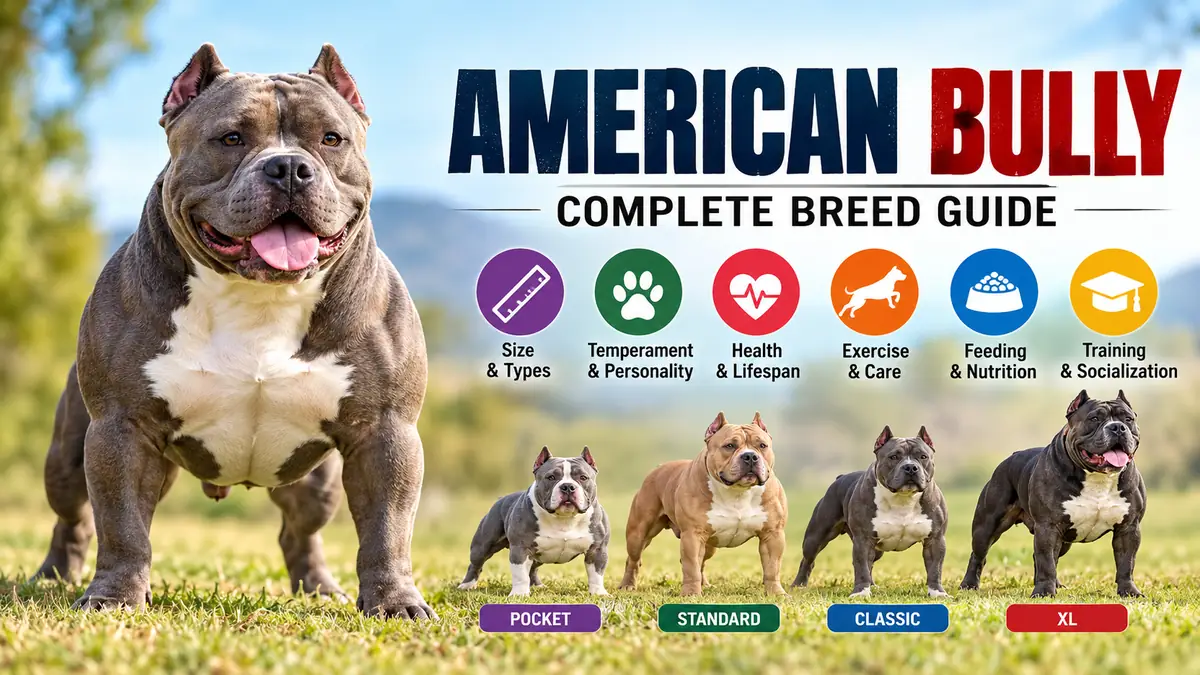
The american bully is a muscular, confident-looking dog with a surprisingly affectionate personality. Although its powerful build can seem intimidating, the breed was developed primarily for companionship rather than guarding, hunting, or fighting.
Understanding its temperament, size varieties, exercise needs, and potential health problems is essential for anyone interested in this distinctive dog.
The american bully is a companion dog breed developed in the United States using American Pit Bull Terrier and other bull-type breed ancestry. It is known for its broad chest, substantial bone structure, short coat, and people-oriented temperament. The United Kennel Club recognizes the breed, while the American Bully Kennel Club identifies four principal size varieties: Pocket, Standard, Classic, and XL.
What Is an american bully?


16
The american bully is a modern dog breed developed to combine the physical strength and distinctive appearance of bull-type dogs with a stable, friendly companion temperament.
Its most recognizable features include a broad head, pronounced cheek muscles, compact body, wide chest, and smooth coat. However, appearance alone does not determine whether a dog meets the breed standard.
The breed is intended to be confident, sociable, and manageable. Aggression toward humans is considered undesirable by responsible breed organizations.
History and origin
The american bully began developing in the United States during the late twentieth century, particularly through breeding programs associated with the 1980s and 1990s.
Early breeders used American Pit Bull Terrier lines, with American Staffordshire Terrier and other bull-type influences contributing to the breed’s development.
The goal was to establish a distinct companion dog with a powerful physique and a more consistent family-oriented temperament.
Several milestones shaped its development:
- 1990s: The breed gained a recognizable identity among American breeders.
- 2004: The American Bully Kennel Club (ABKC) was established and helped formalize breed standards.
- 2013: The United Kennel Club (UKC) officially recognized the American Bully.
Today, the breed has an international following, although recognition and classification vary between kennel clubs.
Is an american bully a Pit Bull?
Not exactly.
The American Bully and American Pit Bull Terrier share historical ancestry, but they are not identical breeds.
The American Pit Bull Terrier is generally more athletic and traditionally leaner, while the American Bully was selectively developed for a heavier companion-dog appearance.
The term pit bull can also refer informally to several related breeds or mixed-breed dogs, creating confusion.
An American Bully may be described as a pit bull-type dog in everyday language or under certain legal definitions, even though breed registries distinguish it from the American Pit Bull Terrier.
american bully Sizes and Types Explained

ClassicLighter overall frame

XLTaller, powerful stature
Illustrative examples of the four ABKC varieties. Actual classification depends on measured height, proportions, and registry standards.
One of the breed’s distinctive characteristics is its range of sizes.
The ABKC recognizes four principal varieties based on height and overall structure. These varieties share the same basic breed identity rather than representing four unrelated breeds.
american bully size chart
| Variety | Adult male height | Adult female height |
|---|---|---|
| 14–under 17 in | 13–under 16 in | |
| Standard | 17–20 in | 16–19 in |
| Classic | 17–20 in | 16–19 in |
| XL | Over 20–23 in | Over 19–22 in |
Measurements are taken at the withers (shoulders) and reflect ABKC size classifications. UKC uses a different breed-standard framework.
Pocket American Bully
The Pocket variety has a shorter stature while retaining the broad head, muscular body, and substantial bone structure associated with the breed.
Pocket does not mean miniature or toy-sized. These dogs can still be powerful and relatively heavy for their height.
Their smaller stature may suit some households, but they still need training, exercise, and careful weight management.
Standard American Bully
The Standard variety represents the familiar balanced American Bully appearance.
It combines a muscular frame with sufficient athletic ability for normal daily activities.
A well-structured Standard dog should move comfortably without excessive bulk interfering with breathing, walking, or running.
Classic American Bully
The Classic variety shares the same height range as the Standard but has a comparatively lighter frame.
It generally displays less exaggerated bone and muscle mass, creating a more athletic silhouette.
Classic does not mean that the dog is a different breed or that it necessarily has a different personality.
XL American Bully
The XL variety is the tallest ABKC-recognized classification.
Its larger body requires attention to joint health, appropriate exercise, and controlled growth during puppyhood.
An XL American Bully should still move freely and comfortably. Extreme body mass is not an indicator of better breed quality.
What about Micro, Exotic, and XXL Bullies?
Terms such as Micro Bully, Exotic Bully, and XXL Bully frequently appear in advertisements and online communities.
However, these are not additional official ABKC size varieties.
Some dogs marketed under these labels have exaggerated physical characteristics, including extremely short legs, oversized heads, or unusually heavy bodies.
Such features can increase the risk of mobility, respiratory, skin, and orthopedic problems.
A dog’s ability to breathe normally, move comfortably, and remain healthy matters more than an extreme appearance.
american bully Temperament and Personality
Despite its muscular appearance, a well-bred American Bully is intended to be affectionate, confident, and people-oriented.
Many enjoy close interaction with their households and prefer spending time around people rather than remaining isolated outdoors.
Nevertheless, temperament varies between individual dogs. Genetics, early experiences, socialization, health, and training all influence behavior.
Are American Bullies good family dogs?
They can be excellent family companions when their temperament and household environment are compatible.
Common desirable traits include:
- Affection toward familiar people
- Confidence in ordinary social situations
- Interest in play and interaction
- Responsiveness to reward-based training
- A relatively calm demeanor indoors after appropriate activity
Their strength makes supervision especially important around small children.
Children should learn not to pull ears, disturb sleeping dogs, or approach dogs while they are eating. Adults should supervise interactions regardless of the dog’s breed or previous behavior.
Are American Bullies aggressive?
Aggression is not an inevitable characteristic of the breed.
A muscular appearance does not automatically indicate dangerous behavior, and responsible breeding aims for stable temperament.
However, any dog can display aggression when frightened, injured, poorly socialized, or placed in a stressful situation.
Some individuals may also show dog-directed reactivity or aggression, even when friendly toward humans.
Owners should recognize warning signals such as stiff posture, prolonged staring, growling, resource guarding, or repeated attempts to escape interactions.
Punishing warning signals can make behavior less predictable. Early assistance from a qualified reward-based trainer or veterinary behaviorist is preferable.
Do American Bullies get along with other pets?
Some live peacefully with other dogs and cats, particularly when introductions are gradual and positive.
Others may be selective about unfamiliar dogs.
Successful introductions depend on individual temperament, previous experiences, and the other animal’s behavior.
For new introductions, use neutral environments when appropriate, keep interactions controlled, and separate animals when supervision is unavailable.
Never assume that two dogs will get along simply because one belongs to a breed described as friendly.
american bully Lifespan and Common Health Problems
An American Bully’s lifespan is often estimated at approximately 10–13 years, although reliable population-wide longevity data for the breed are limited.
Individual lifespan depends on genetics, body condition, veterinary care, nutrition, and the presence of inherited or acquired disease.
Hip and elbow dysplasia
Hip dysplasia occurs when the hip joint develops abnormally, potentially contributing to pain and arthritis.
Elbow dysplasia refers to several developmental abnormalities affecting the elbow joint.
Signs can include stiffness, limping, reluctance to jump, or difficulty rising after rest.
Maintaining a lean body condition and selecting breeding dogs with appropriate orthopedic screening can help reduce risk.
Skin allergies and irritation
Some American Bullies experience allergic skin disease, which may cause itching, redness, recurrent ear infections, or paw licking.
Possible triggers include environmental allergens, flea bites, and, less commonly, food ingredients.
Veterinary assessment is important because parasites, bacterial infections, and yeast can produce similar symptoms.
Breathing difficulties
Dogs with excessively shortened muzzles or exaggerated head shapes may develop breathing problems.
Potential symptoms include noisy breathing, exercise intolerance, overheating, and difficulty recovering after physical activity.
These signs should not be dismissed as normal characteristics of a muscular dog.
A veterinarian can assess possible brachycephalic obstructive airway syndrome or other respiratory conditions.
Heart conditions
Certain heart diseases, including congenital abnormalities, can occur in bull-type dogs.
Symptoms may include reduced stamina, fainting, coughing, or unusually rapid breathing.
Not every affected dog shows obvious signs early, which makes routine veterinary examinations valuable.
Obesity and joint stress
Excess body weight places additional strain on joints and can reduce exercise tolerance.
Owners sometimes mistake unnecessary fat for desirable muscle mass.
A healthy dog should have a discernible waist when viewed from above, and its ribs should be palpable beneath a modest covering of tissue.
Recommended preventive care
A practical health routine includes regular veterinary examinations, appropriate vaccinations, parasite prevention, dental care, and weight monitoring.
For breeding dogs, health screening should be guided by veterinary recommendations and relevant registry or breed-club programs. Hip and elbow evaluations, cardiac assessment, and other tests may be appropriate depending on family history.
No single test guarantees that puppies will be free of inherited disease.
american bully Exercise and Daily Activity Requirements
American Bullies need regular physical activity to maintain cardiovascular fitness, muscle condition, and a healthy body weight.
However, exercise requirements vary according to age, size, fitness, and physical structure.
A healthy adult may enjoy approximately 45–60 minutes of daily activity, divided into manageable sessions. This is a general starting point rather than a strict requirement.
Best exercises for American Bullies
Suitable activities include walking, controlled games of fetch, scent-based activities, and supervised play.
Some dogs enjoy swimming, although their muscular build may make swimming difficult. Use a properly fitted canine life jacket and close supervision around water.
Mental stimulation is equally valuable. Food puzzles, scent games, and short training sessions help prevent boredom.
Avoid forcing a dog to exercise through excessive panting, limping, or obvious fatigue.
Can an American Bully tolerate hot weather?
Heat requires special attention, particularly for heavily built dogs and those with shortened muzzles.
Overheating can occur during vigorous activity, especially in humid conditions.
Exercise during cooler parts of the day, provide drinking water, and avoid hot pavement.
Heavy panting, weakness, vomiting, confusion, or collapse may indicate heatstroke, which is a veterinary emergency.
Feeding and Nutrition for an american bully
Proper nutrition supports healthy growth, muscle maintenance, immune function, and long-term joint health.
American Bullies do not require a special diet simply because they are muscular.
They need a complete and balanced diet appropriate for their life stage, body size, and health status.
What should an American Bully eat?
A suitable diet should provide adequate protein, essential fatty acids, vitamins, minerals, and sufficient energy without excessive calories.
Look for foods formulated to meet recognized nutritional standards such as those established by the Association of American Feed Control Officials (AAFCO) or the European Pet Food Industry Federation (FEDIAF), as applicable.
Puppies require diets designed for growth. Large-framed puppies may benefit from growth formulations specifically suitable for large dogs.
Adults generally need maintenance diets, while senior dogs may require adjustments based on activity and health.
How much food does an American Bully need?
There is no universal feeding amount.
Daily calorie requirements depend on body weight, age, reproductive status, metabolism, and activity level.
Start with the feeding instructions for the chosen complete diet, then adjust portions according to body condition and veterinary guidance.
Measure meals rather than relying on guesswork. Treats should generally account for no more than about 10% of daily calorie intake.
Should American Bullies eat raw meat?
Raw meat diets carry potential risks, including exposure to Salmonella, Listeria, and other pathogens.
They can also be nutritionally unbalanced when not carefully formulated.
There is no established requirement for American Bullies to eat raw food to develop healthy muscles.
A properly formulated cooked or commercial complete diet is generally a safer and more practical option.
Are muscle-building supplements necessary?
Most healthy dogs receiving balanced nutrition do not need muscle-building supplements.
Avoid anabolic steroids, unregulated growth products, and supplements marketed to create extreme muscle mass.
Healthy muscular development comes from genetics, appropriate nutrition, physical activity, and normal maturation.
american bully Training and Socialization
Training is particularly important because even a friendly American Bully can be difficult to control if it pulls strongly on the leash or jumps on people.
The most effective approach emphasizes consistency, positive reinforcement, and early social experiences.
When should training begin?
Training can begin as soon as a puppy arrives home.
Simple skills such as responding to its name, sitting, coming when called, and walking calmly on a leash can be introduced through short, rewarding sessions.
Early socialization should include positive exposure to different people, surfaces, noises, and environments.
Puppy classes can be useful when they follow appropriate vaccination and disease-prevention guidance.
Socialization does not mean forcing a puppy to interact with every stranger or dog. Controlled, pleasant experiences are more beneficial than overwhelming exposure.
Basic training priorities
- Name recognition: Reward the dog for responding when called.
- Loose-leash walking: Reinforce walking without pulling.
- Recall: Practice returning reliably in safe, enclosed spaces.
- Impulse control: Teach waiting, settling, and polite greetings.
- Handling tolerance: Gradually introduce nail trimming, brushing, and veterinary-style examinations.
- Calm behavior around dogs: Reward relaxed observation without forcing greetings.
Short, frequent training sessions usually work better than prolonged repetitive drills.
Common training mistakes
One mistake is encouraging rough behavior in puppies because it seems harmless when they are small.
Jumping, grabbing clothing, and uncontrolled play become harder to manage as the dog grows.
Another mistake is using intimidation or physical punishment. Such methods can increase fear and defensive behavior.
Reward-based training helps build reliable behavior while protecting the relationship between dog and owner.
Grooming and Everyday Care
The American Bully has a short, smooth coat that generally requires less grooming than long-haired breeds.
However, low-maintenance does not mean maintenance-free.
Coat care and shedding
American Bullies shed, although the amount varies between individuals and seasons.
Weekly brushing with a soft-bristle brush or rubber grooming mitt can remove loose hair and distribute natural skin oils.
Bathing every few weeks or as needed is usually sufficient, provided a dog-safe shampoo is used.
Excessive bathing can irritate sensitive skin.
Nail, ear, and dental care
Nails should be trimmed before they become long enough to affect normal walking.
Check ears regularly for redness, odor, discharge, or discomfort. Avoid inserting cotton swabs deep into the ear canal.
Daily toothbrushing with dog-specific toothpaste is ideal for reducing plaque accumulation.
Routine veterinary dental assessments are also important.
Do American Bullies drool?
Some American Bullies drool, especially around food or after drinking.
Dogs with looser lips may drool more than those with tighter facial structure.
Sudden excessive drooling, particularly when accompanied by distress, vomiting, or difficulty swallowing, warrants veterinary attention.
american bully vs Pit Bull, American Bulldog, and Staffordshire Terrier
Several muscular breeds share physical characteristics, which can make identification difficult.
The American Bully, American Pit Bull Terrier, American Staffordshire Terrier, and American Bulldog have overlapping historical influences but distinct breed identities.
| Feature | American Bully | American Pit Bull Terrier | American Bulldog |
|---|---|---|---|
| General build | Broad, muscular, compact | Leaner, athletic | Large, powerful |
| Original development | Companionship | Working and sporting ancestry | Farm and working roles |
| Typical appearance | Wide chest, substantial bone | Balanced athletic frame | Taller, strong working build |
| Exercise needs | Moderate to active, varies | Often highly active | Moderate to active |
| Breed identity | Distinct UKC-recognized breed | Distinct breed | Distinct breed |
These descriptions represent broad tendencies, not guarantees about individual dogs.
The American Staffordshire Terrier is another related but distinct breed recognized by major kennel organizations.
Can you identify an American Bully by appearance alone?
Not reliably.
Mixed-breed dogs can resemble purebred American Bullies, and individuals within the breed vary considerably.
Pedigree documentation provides information about registered ancestry, while DNA testing may offer additional insight. Neither appearance nor a consumer DNA test automatically establishes legal breed classification.
Are American Bullies Suitable for Apartment Living?
An American Bully can adapt to apartment living if its exercise, social, and behavioral needs are met.
Living space alone is not the deciding factor.
A calm, well-trained dog receiving daily activity may be more comfortable in an apartment than a poorly exercised dog living in a large house.
Important considerations include the dog’s size, noise sensitivity, ability to settle indoors, and access to suitable walking areas.
XL varieties may be more difficult to manage in cramped environments because of their physical dimensions.
Owners should also check housing policies and local breed-related restrictions.
American Bully Puppies: Growth and Development

American Bully puppies typically develop rapidly during their first year.
Height growth often slows around 12–18 months, although larger individuals may continue physically maturing beyond that period.
Muscle development and body proportions can change into early adulthood.
Puppy development stages
| Age | Typical development |
|---|---|
| 0–8 weeks | Nursing, early learning, social development |
| 8–16 weeks | Important socialization and foundational training |
| 4–6 months | Teething, rapid growth, increased exploration |
| 6–12 months | Adolescence, growing strength, behavioral changes |
| 12–24 months | Continued physical and behavioral maturation |
| 2–3 years | Many individuals reach fuller adult muscular maturity |
These stages are approximate. Individual development varies.
How to raise a healthy puppy
Prioritize balanced nutrition, appropriate veterinary care, positive socialization, and gradual physical development.
Avoid forced long-distance running, repetitive high jumps, and excessive weight-bearing exercise while the skeleton is developing.
Do not deliberately overfeed a puppy to produce a wider chest or larger head.
Rapid weight gain can increase orthopedic stress without improving health.
A veterinarian can help establish a suitable growth and feeding plan.
American Bully Colors and Coat Patterns
The breed appears in many coat colors and patterns.
Common examples include black, blue-gray, fawn, brindle, white, chocolate, and combinations of these colors.
Color is primarily an appearance characteristic and should not be treated as proof of superior temperament or health.
What is a blue American Bully?
A blue American Bully has a diluted black coat that appears gray or slate-colored.
This coloration results from inherited pigment genetics.
Some dilute-colored dogs may experience coat or skin problems, including color dilution alopecia, although not every blue dog develops this condition.
Are merle American Bullies recognized?
Merle is a mottled coat pattern that requires special consideration.
Registry policies differ, and merle is not accepted under every American Bully breed standard.
Breeding two merle-patterned dogs together increases the risk of puppies inheriting two copies of the merle-associated variant, which can be linked to serious hearing and vision abnormalities.
Health and responsible genetic screening should take priority over unusual coloration.
American Bully Breed Restrictions and Legal Considerations
Ownership rules differ significantly by country, state, municipality, and housing provider.
In some jurisdictions, laws focus on named breeds. Others classify dogs according to physical appearance or type.
XL Bully restrictions in the United Kingdom
England and Wales introduced restrictions on XL Bully-type dogs beginning in December 2023, with possession restrictions taking effect in February 2024.
As of October 2026, keeping an XL Bully-type dog in England and Wales generally requires a valid Certificate of Exemption. Selling, breeding, gifting, or rehoming these dogs is prohibited, and exempted dogs must be leashed and muzzled in public.
The legal definition depends on physical characteristics rather than pedigree or registration alone. Scotland and Northern Ireland also have XL Bully restrictions, with jurisdiction-specific requirements.

GOV.UK
+1
Laws may change, so owners should consult the relevant government authority before relocating or traveling with a dog.
Responsible ownership and public safety
Regardless of legal classification, owners should ensure their dogs are securely contained, properly trained, and supervised around vulnerable people and unfamiliar animals.
Secure fencing, reliable leash control, identification, and appropriate liability precautions help reduce preventable incidents.
Responsible ownership protects the dog as well as the surrounding community.
Is an american bully the Right Dog for Your Lifestyle?
An American Bully may suit a household that wants an affectionate, physically strong companion and can provide consistent training, exercise, and veterinary care.
The breed is less suitable for someone who expects a dog to remain isolated for long periods or wants an intimidating appearance without accepting the responsibilities associated with a powerful animal.
Consider these practical questions before deciding:
- Can you manage a strong dog safely on a leash?
- Do you have time for daily exercise and mental stimulation?
- Are you prepared for veterinary expenses, including possible orthopedic or skin conditions?
- Can you supervise interactions with children and other pets?
- Does your housing situation permit this type of dog?
- Are you comfortable continuing training throughout adolescence and adulthood?
An individual dog’s temperament, health, and behavior should carry more weight than appearance or size classification.
Final Thoughts on the american bully
The american bully is a distinctive companion breed combining a muscular physique with an intended affectionate and confident temperament.
Its four principal ABKC varieties—Pocket, Standard, Classic, and XL—offer different physical proportions, but all require thoughtful care, positive training, balanced nutrition, and regular veterinary attention.
The most important distinction is not how large, wide, or muscular an American Bully appears. It is whether the dog is physically healthy, behaviorally stable, and able to enjoy a comfortable life.
For anyone learning about this breed, understanding its genuine care requirements and individual temperament is the best foundation for responsible ownership.
