

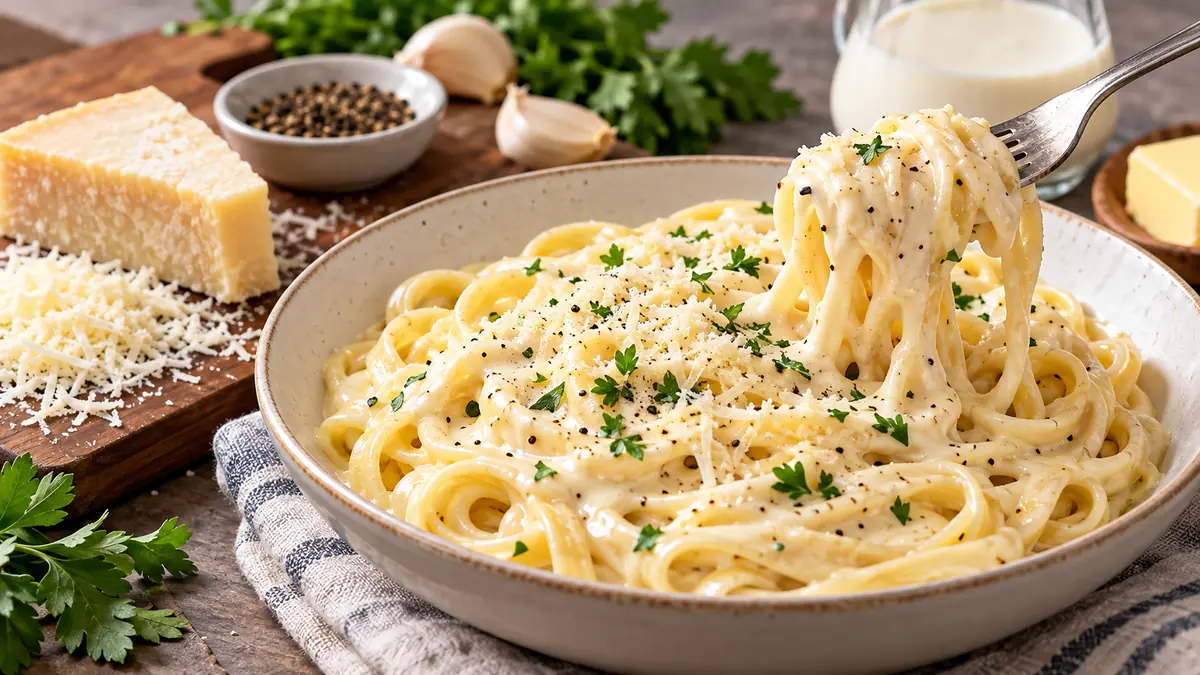
Alfredo sauce looks simple, but the difference between a silky sauce and a greasy, grainy one comes down to technique. Butter, cream, Parmesan, gentle heat, and a little pasta water can create a restaurant-style sauce in minutes—without flour, cornstarch, or complicated equipment.
Alfredo sauce is a rich white pasta sauce commonly made with butter, heavy cream, freshly grated Parmesan cheese, salt, and black pepper. The ingredients are gently heated until they form a smooth, creamy sauce. Traditional Roman fettuccine Alfredo is different: it relies on butter, Parmigiano Reggiano, and starchy pasta water rather than heavy cream. Kitchn
What Is Alfredo Sauce?
Alfredo sauce is best known as the creamy coating on fettuccine Alfredo. In the United States and many other countries, the name usually describes a white Parmesan cream sauce made from butter, heavy cream, and cheese.
The original Roman dish was much simpler.
Fettuccine Alfredo is associated with Roman restaurateur Alfredo Di Lelio. Rome’s official tourism site traces the dish to 1908 and describes the traditional preparation as fresh fettuccine tossed with softened butter, Parmigiano Reggiano, and enough pasta cooking water to create a creamy emulsion. Turismo Roma
The cream-based version evolved separately and became especially popular outside Italy.
That distinction explains why you will encounter two seemingly contradictory answers to the question, “Does Alfredo sauce contain cream?”
Both describe dishes now called Alfredo, but they refer to different styles.
Traditional vs. Cream-Based Alfredo
| Traditional Roman Style | Modern Cream-Based Style |
|---|---|
| Butter | Butter |
| Parmigiano Reggiano | Parmesan |
| Pasta cooking water | Heavy cream |
| Fresh fettuccine | Any suitable pasta |
| No heavy cream required | Cream provides much of the richness |
| Sauce forms while tossing pasta | Sauce can be prepared separately |
The Roman preparation depends heavily on emulsification. The modern version is more forgiving because cream supplies additional liquid and fat.
For an everyday homemade Alfredo sauce that can also be used with chicken, vegetables, pizza, or stuffed pasta, the cream-based version is especially practical.
Easy Homemade Alfredo Sauce Recipe
This recipe makes about 2 cups of sauce, enough for approximately 12 to 16 ounces of pasta depending on how heavily you sauce it.
Ingredients
- 1/2 cup unsalted butter
- 2 cloves garlic, finely minced
- 1 1/2 cups heavy cream
- 1 1/2 cups finely grated Parmesan cheese
- 1/4 teaspoon freshly ground black pepper
- Salt, to taste
- Pinch of freshly grated nutmeg, optional
- 1/4 to 1/2 cup reserved pasta cooking water, as needed
Freshly grated Parmesan is worth the extra minute of preparation. Pre-grated cheese can contain ingredients that help prevent clumping in the package, and it may not melt as smoothly into the sauce.
How to Make Alfredo Sauce
- Cook your pasta first. Before draining it, reserve about one cup of the starchy cooking water.
- Melt the butter. Place a wide skillet or saucepan over medium-low heat and melt the unsalted butter.
- Cook the garlic. Add the minced garlic and cook for about 30 seconds, just until fragrant. Avoid browning it.
- Add the cream. Slowly pour in the heavy cream while stirring. Bring it to a gentle simmer rather than a vigorous boil.
- Lower the heat. Let the cream cook gently for a few minutes until it begins to thicken.
- Add Parmesan gradually. Reduce the heat to low or remove the pan briefly from direct heat. Add the finely grated Parmesan in small amounts while whisking.
- Season the sauce. Add black pepper, a small amount of salt if necessary, and optional nutmeg.
- Adjust the consistency. If the sauce is too thick, stir in reserved pasta water a tablespoon or two at a time.
- Add the pasta. Toss the hot pasta directly with the sauce until every strand is evenly coated.
- Serve immediately. Alfredo is at its smoothest and creamiest straight from the pan.
The basic method closely follows the approach used by established recipe sources: warm butter and cream, incorporate Parmesan, then adjust with pasta cooking water when necessary. Food Network
Why These Alfredo Sauce Ingredients Work
A short ingredient list leaves little room for mediocre ingredients or careless technique. Each component has a specific job.
Butter
Butter supplies richness and helps establish the fat base of the sauce.
Unsalted butter gives you better control over seasoning because Parmesan already contributes substantial saltiness.
Avoid aggressively browning the butter unless you intentionally want a nuttier flavor. Classic Alfredo should have a clean dairy-and-cheese character.
Heavy Cream
Heavy cream creates the luxurious consistency associated with Italian-American Alfredo sauce.
Its relatively high fat content also makes the sauce easier to manage than one based on ordinary milk. The Kitchn, for example, recommends heavy cream or half-and-half and notes that lower-fat milk does not provide the same richness and smoothness. Kitchn
Parmesan Cheese
Parmesan supplies saltiness, umami, nuttiness, and much of Alfredo’s characteristic flavor.
For an especially pronounced cheese flavor, use Parmigiano Reggiano. Grate it finely so that it incorporates quickly.
Cheese is also one reason you should avoid excessive heat. Parmesan proteins can tighten and clump when overheated.
Pasta Water
Do not automatically pour all your pasta water down the drain.
Cooking pasta releases starch into the water. A small splash can loosen an Alfredo sauce that has become too thick while helping it continue to coat the noodles.
Traditional Roman fettuccine Alfredo depends even more heavily on pasta water because the creamy consistency comes from emulsifying butter, cheese, and the cooking liquid rather than adding cream. Turismo Roma
Garlic
Garlic is common in modern Alfredo recipes but is not part of the historic three-ingredient Roman preparation.
Use it lightly. Alfredo should taste primarily of butter, cream, and Parmesan rather than becoming a garlic sauce.
Black Pepper and Nutmeg
Freshly ground black pepper cuts through some of the dairy richness.
Nutmeg is optional, but a tiny amount adds warmth without making the finished sauce noticeably sweet or spicy.
How to Make Alfredo Sauce Without Cream
You do not actually need heavy cream to create creamy fettuccine Alfredo.
The traditional technique demonstrates why.
Rome’s published version uses very thin fresh egg fettuccine, unsalted softened butter, aged Parmigiano Reggiano, and cooking water for emulsification. The hot pasta is combined with butter, cheese, and enough cooking liquid to form the creamy coating. Turismo Roma
At home, the general technique is:
- Cook fettuccine until al dente.
- Reserve plenty of pasta cooking water.
- Place softened butter in a warm serving bowl or pan.
- Transfer the hot pasta directly to the butter.
- Add finely grated Parmigiano Reggiano.
- Add small splashes of hot pasta water.
- Toss vigorously until the butter, cheese, starch, and water form a glossy emulsion.
This method sounds easier than it is.
Temperature matters. Too much heat can make the cheese clump, while insufficient mixing may leave melted butter pooling underneath the pasta.
The reward is a sauce that tastes intensely of butter and Parmesan without needing cream.
Why Alfredo Sauce Turns Grainy
Grainy Alfredo is one of the most common homemade pasta problems.
Usually, the cheese is responsible—not because anything is wrong with Parmesan, but because of how it was incorporated.
The Pan Was Too Hot
Parmesan does not need aggressive heat to melt.
If your cream is furiously boiling when the cheese goes in, the proteins may seize instead of melting smoothly.
Lower the temperature before adding cheese.
The Cheese Was Added Too Quickly
Dumping a large pile of Parmesan into the pan can create clumps.
Add it gradually while whisking continuously.
The Parmesan Was Too Coarsely Grated
Large cheese shreds take longer to melt.
A Microplane or similarly fine grater creates delicate pieces that incorporate much more easily.
You Used Pre-Shredded Cheese
Bagged shredded Parmesan is convenient, but freshly grated cheese generally gives you more control over melting and texture.
For a sauce with so few ingredients, grating your own Parmesan is a worthwhile step.
Why Alfredo Sauce Separates
A broken Alfredo sauce may show visible butter or oil rather than looking smooth and cohesive.
High heat is often the culprit.
Once the cheese has been incorporated, keep the temperature gentle. You are trying to maintain an emulsion, not boil the sauce aggressively.
If the sauce begins separating, remove the pan from the heat and whisk in a small splash of warm pasta water.
Sometimes that is enough to bring everything back together.
Quick Takeaway
For smooth Alfredo sauce, remember three rules: grate the cheese finely, keep the heat low, and add the Parmesan gradually.
Those habits solve a surprising number of Alfredo problems.
How to Fix Alfredo Sauce That Is Too Thick or Thin
Alfredo changes consistency quickly, particularly as it cools.
That does not necessarily mean you made it incorrectly.
If Alfredo Sauce Is Too Thick
Add warm pasta water one tablespoon at a time.
Toss after each addition before adding more. You want enough liquid to make the sauce flow around the noodles without turning watery.
If you are reheating leftover sauce separately, a small splash of milk or cream can also help loosen it.
If Alfredo Sauce Is Too Thin
First, give it a little time.
Freshly prepared Alfredo thickens as it cools slightly and as the cheese interacts with the other ingredients.
If it remains noticeably thin, gently cook the cream a little longer before adding additional Parmesan.
Avoid reaching immediately for flour or cornstarch. A properly proportioned cream-based Alfredo sauce normally does not require either.
If Alfredo Sauce Is Too Salty
This can happen because Parmesan is naturally salty.
That is why salt should usually be added near the end rather than automatically at the beginning.
If the finished sauce is slightly too salty, adding more unsalted cream may dilute it. When combining it with pasta, avoid adding extra salt until you have tasted the complete dish.
What Pasta Goes Best With Alfredo Sauce?
Fettuccine is the classic pairing for good reason.
Its broad, flat surface gives the creamy sauce plenty of area to cling to, creating a balanced amount of pasta and sauce in each bite.
But Alfredo sauce is not restricted to fettuccine.
Good alternatives include:
- linguine
- tagliatelle
- pappardelle
- penne
- rigatoni
- tortellini
- ravioli
- gnocchi
Stuffed pasta can be particularly good with Alfredo because the mild Parmesan sauce complements cheese, spinach, mushroom, squash, and similar fillings. Food Network also recommends Alfredo with stuffed pastas and as a base for white pizza. Food Network
Whatever shape you choose, combine the pasta and sauce while both are hot.
Popular Alfredo Sauce Variations
Once you understand the base sauce, it is easy to adapt.
Chicken Alfredo
Cook seasoned chicken breast separately, slice it, and serve it over fettuccine coated with Alfredo sauce.
Chicken Alfredo is an Italian-American adaptation rather than part of the original Roman dish, but it has become one of Alfredo’s best-known forms.
Shrimp Alfredo
Shrimp works particularly well because it cooks quickly and does not overpower the Parmesan.
Sauté the shrimp separately with butter, salt, and pepper, then add it to the finished pasta.
Broccoli Alfredo
Blanched or roasted broccoli provides freshness and texture that contrast with the rich sauce.
It can also be combined with chicken for a more substantial dish.
Mushroom Alfredo
Brown mushrooms separately before introducing them to the sauce.
Cooking mushrooms directly in a crowded cream sauce can prevent them from developing the deeper flavor that comes from proper browning.
Spinach Alfredo
Fresh spinach can be folded into the sauce near the end of cooking. It wilts rapidly, so it needs only a short time in the pan.
Spicy Alfredo
A small amount of crushed red pepper flakes adds heat without changing the basic structure of the sauce.
Cajun seasoning is another popular option, particularly with chicken or shrimp.
Can You Make Alfredo Sauce With Milk?
Yes, but the result will not behave exactly like a heavy-cream Alfredo.
Whole milk contains substantially less fat, so the sauce tends to be thinner and less rich. Simply replacing heavy cream with the same quantity of low-fat milk may produce disappointing results.
If reducing richness is your priority, half-and-half is an easier substitute. The Kitchn specifically lists heavy cream or half-and-half for its Alfredo preparation. Kitchn
There is another option: skip the cream entirely and use the Roman butter-Parmesan-pasta-water technique.
That creates a different style of Alfredo rather than trying to imitate heavy cream with a lower-fat dairy product.
Does Alfredo Sauce Need Cream Cheese?
No.
Cream cheese appears in some quick Alfredo recipes because it makes the sauce thick and stable, but it is not required for either traditional Roman Alfredo or a straightforward Parmesan cream sauce.
Using cream cheese also changes the flavor. The result becomes tangier and heavier.
If you like that style, there is nothing inherently wrong with it. Just recognize that it is a variation rather than an essential Alfredo ingredient.
Does Alfredo Sauce Need Flour?
A classic homemade Alfredo sauce does not require flour.
Heavy cream reduces naturally, while Parmesan contributes body. Starchy pasta water helps adjust the final consistency.
Flour can create a stable white sauce, but the result moves closer to a cheese-flavored béchamel-style preparation than the simple butter-and-Parmesan character associated with Alfredo.
If your Alfredo routinely needs flour to become thick, examine your ingredient ratios and cooking technique first.
How Much Alfredo Sauce Per Pound of Pasta?
Around 2 cups of cream-based Alfredo sauce is generally a practical starting point for 1 pound of pasta.
The exact amount depends on the shape of the pasta and how heavily you prefer it coated.
Do not judge the sauce-to-pasta ratio while the sauce is sitting alone in the pan.
Toss everything together first.
Pasta absorbs and carries sauce, while residual cooking water can change its consistency. You may discover that what looked like too much sauce in the skillet is exactly right once the pasta has been thoroughly tossed.
How to Store Alfredo Sauce
Fresh Alfredo is best eaten immediately, but leftovers can be refrigerated.
Allow the sauce to cool, transfer it to an airtight container, and refrigerate promptly.
Storage recommendations vary by recipe. The Kitchn recommends refrigerating its homemade sauce for up to two days, while Food Network gives a longer window for its version. Following the storage guidance for the particular recipe you prepared is therefore preferable. Kitchn
Regardless of the exact recipe, discard Alfredo that develops an unusual smell, appearance, or signs of spoilage.
Can You Freeze Alfredo Sauce?
Technically, cream-based sauces can be frozen, but texture is the bigger issue.
Freezing and thawing may cause Alfredo to separate or become grainy. Food Network notes that its sauce can be frozen but does not recommend doing so because the creamy texture can deteriorate. Food Network
If quality matters, make a smaller batch rather than preparing Alfredo specifically for long-term freezer storage.
How to Reheat Alfredo Sauce Without Separating It
Reheating is where a perfectly good Alfredo sauce often goes wrong.
Do not blast it over high heat.
Instead:
- Put the leftovers in a saucepan over low heat.
- Add a small splash of milk, cream, or water.
- Stir frequently as the sauce warms.
- Add more liquid only if necessary.
- Remove it from the heat as soon as it is hot.
The Kitchn similarly recommends adding a splash of milk or half-and-half and reheating over low heat. Kitchn
If you are reheating Alfredo pasta rather than sauce alone, gentle stovetop reheating usually gives you more control than intense microwave heating.
What Goes Well With Alfredo Sauce?
Because Alfredo is rich, side dishes with freshness, acidity, or crisp texture provide useful contrast.
Try it with:
- roasted broccoli
- asparagus
- green beans
- sautéed spinach
- grilled chicken
- shrimp
- mushrooms
- garlic bread
- a simple green salad
- roasted vegetables
You can also use Alfredo beyond pasta.
Spread a thin layer over pizza dough for a white pizza, spoon it over roasted vegetables, use it with stuffed pasta, or incorporate a modest amount into a baked pasta dish.
The key word is modest. Alfredo is rich enough that more sauce does not automatically mean a better dish.
Traditional Alfredo Sauce vs. the Alfredo Most People Know
The history of Alfredo helps clear up one of the biggest misconceptions surrounding the sauce.
Alfredo Di Lelio’s Roman preparation was built around fresh fettuccine, butter, and Parmesan. Rome’s tourism authority says Di Lelio developed the dish in 1908 and later gained international attention, with Hollywood actors Mary Pickford and Douglas Fairbanks becoming associated with its rise in fame. Turismo Roma
The dish eventually evolved abroad.
Heavy cream, garlic, chicken, shrimp, broccoli, and other additions became familiar parts of Alfredo dishes, particularly in North America. That does not make the cream-based sauce “fake”; it makes it a later adaptation with a different culinary identity.
Knowing the difference is useful because it gives home cooks two legitimate approaches.
Choose the Roman style when you want the intense flavor of butter and Parmigiano Reggiano and are comfortable building an emulsion directly on the pasta.
Choose cream-based Alfredo when you want a standalone, forgiving sauce that can coat pasta or accompany chicken, seafood, vegetables, and other dishes.
The Secret to Better Homemade Alfredo Sauce
You do not need a long ingredient list to make memorable Alfredo sauce.
You need control.
Use good butter. Grate the Parmesan yourself. Keep the heat gentle. Reserve some pasta water. Add the cheese gradually rather than dumping it into boiling cream. Most importantly, serve the sauce while it is fresh and silky.
Once you understand those fundamentals, alfredo sauce becomes one of the easiest rich pasta sauces to make from scratch—and you can adjust its thickness, seasoning, and additions without losing the creamy Parmesan character that makes it distinctive.
