

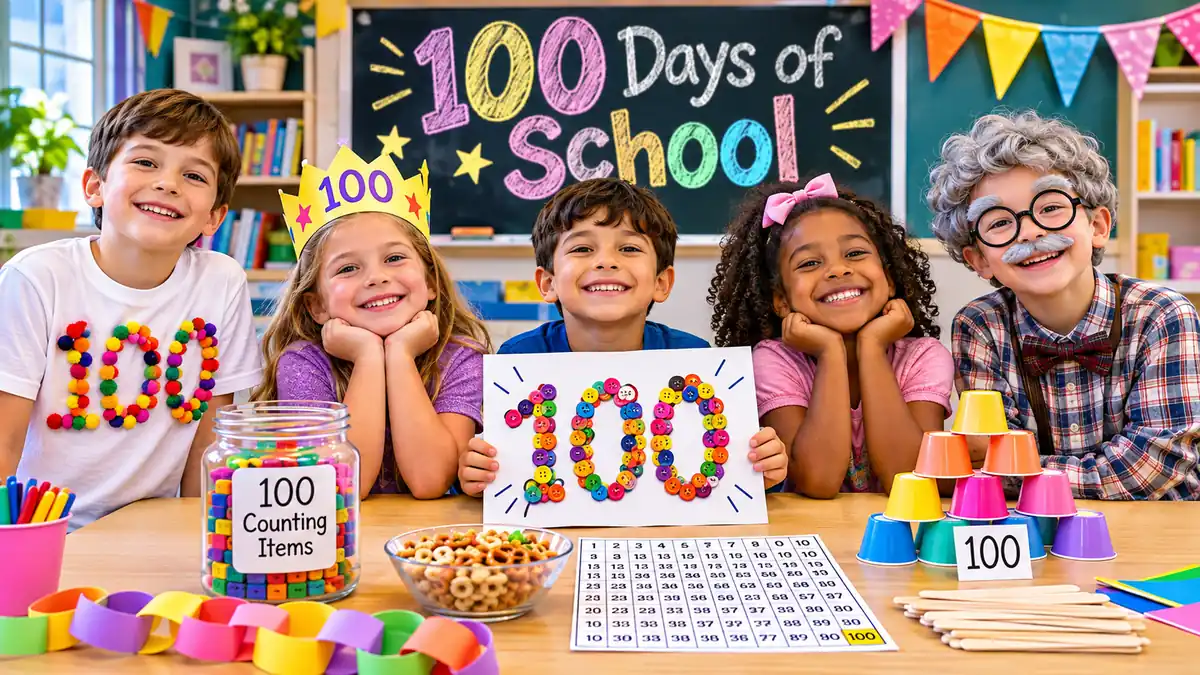
Reaching the 100th day of school is a significant milestone for young learners. It is an opportunity to celebrate their achievements, recognize their progress, and make learning more exciting through hands-on activities.
The best 100 days of school ideas include counting collections, decorating T-shirts, creating paper crowns, building structures with 100 objects, completing STEM challenges, and making themed snacks. These activities help children develop number sense, creativity, problem-solving skills, and teamwork while celebrating their first 100 days of classroom learning.
From simple kindergarten crafts to educational challenges for elementary students, there are plenty of ways to make the celebration memorable without spending much money.
What Is the 100th Day of School and Why Is It Celebrated?
The 100th day of school marks the completion of 100 instructional days during an academic year. It typically occurs in January or February in the United States, although the exact date depends on the school calendar, holidays, and weather-related closures.
The celebration is particularly popular in preschool, kindergarten, and elementary classrooms because it provides an opportunity to explore mathematical concepts through practical activities.
Educational resources dating back several decades describe the celebration as a way to strengthen number sense and help children understand larger numbers through everyday objects. ERIC+1
Teachers use this occasion to help students:
- Count independently to 100.
- Understand place value and number patterns.
- Practice skip counting by twos, fives, and tens.
- Develop fine motor skills.
- Participate in collaborative projects.
- Reflect on academic and personal achievements.
- Build confidence in their learning abilities.
Rather than treating the occasion as an ordinary classroom party, teachers can incorporate mathematics, literacy, science, art, and physical activity into the celebration.
Easy 100 days of school ideas for Preschool and Kindergarten
Younger children learn effectively when they can touch, move, arrange, and count physical objects. These simple activities introduce the number 100 through interactive experiences.
1. Create a 100-Day Crown
Give each child a paper crown and provide stickers, markers, or colored paper shapes. Encourage students to decorate their crowns with 100 small designs arranged in groups of ten.
Children can wear their finished crowns throughout the celebration.
2. Make a 100-Link Paper Chain
Cut colorful construction paper into strips. Have students connect 100 strips to create a decorative classroom chain.
Use a different color for every group of ten to demonstrate how ten groups of ten make 100.
3. Create a 100-Fingerprint Painting
Provide washable paint and a large sheet of paper. Children can make 100 fingerprints to form a tree, rainbow, flower garden, or colorful pattern.
Divide the paper into ten sections to make counting easier.
4. Fill a Hundreds Chart
Give students a blank chart containing 100 squares. Ask them to fill in the missing numbers, color number patterns, or highlight multiples of five and ten.
This activity strengthens number recognition and sequencing.
5. Build a 100-Piece Puzzle
Allow children to work together to complete an age-appropriate 100-piece puzzle. Divide larger groups into smaller teams so everyone can participate.
6. Make a 100-Bead Necklace
Provide string and large, age-appropriate beads. Children can organize ten different colors into groups of ten before threading them.
Supervise younger children closely, particularly when using small materials.
7. Complete a 100-Second Challenge
Set a timer for 100 seconds and ask students to complete a simple task, such as stacking blocks, drawing circles, or sorting colored objects.
Discuss how long 100 seconds feels compared with their predictions.
8. Create a Classroom Number Train
Assign students different numbers between 1 and 100. Have them decorate individual number cards before arranging all the cards into a continuous classroom display.
This activity combines creativity with number sequencing.
Creative 100th Day of School Crafts and Project Ideas
Art projects help children visualize the number 100 while developing concentration, hand-eye coordination, and creativity.
9. Design a 100-Item Poster
Students can attach 100 lightweight objects to a poster board. Suitable materials include paper shapes, stickers, pom-poms, or foam decorations.
Arrange the objects into groups of ten so the final total is easy to verify.
10. Create a 100-Day Gumball Machine
Draw or print a large gumball machine outline. Children fill the machine with 100 colorful paper circles.
This project works well as a bulletin board display.
11. Make a 100-Piece Mosaic
Cut small squares from colored paper and challenge students to create an image using exactly 100 pieces.
They can make houses, animals, geometric patterns, or abstract designs.
12. Paint 100 Rocks
Have the class decorate 100 small rocks collectively. Each student can paint several rocks with flowers, letters, numbers, or positive messages.
Display the finished collection in a classroom garden or designated school area, with permission.
13. Build a 100-Day Classroom Quilt
Give students paper squares to decorate with drawings representing their favorite school memories.
Combine 100 squares into a collaborative paper quilt.
14. Create a 100-Spot Animal
Provide an outline of a Dalmatian, ladybug, or imaginary animal. Ask students to decorate it with exactly 100 spots.
Older students can use different colors to represent groups of 20 or 25.
15. Make a 100-Petal Flower Garden
Create ten paper flowers with ten petals each. Students can label the flowers with numbers or write something they have learned on each petal.
16. Create a 100-Day Celebration Banner
Make a large classroom banner with 100 drawings, stars, or handwritten messages. Every student contributes, making it a shared celebration of classroom progress.
Fun 100 days of school ideas for Math and STEM Learning
The 100th day offers a natural connection to mathematics, science, technology, engineering, and problem-solving activities.
Hands-on challenges encourage students to investigate quantities, test predictions, and discover relationships between numbers.
17. Build a Tower With 100 Cups
Provide each team with 100 paper or plastic cups. Challenge them to construct the tallest freestanding tower they can.
Afterward, discuss which designs were stable and why some structures collapsed.
18. Construct a 100-Block Building
Use building blocks, LEGO bricks, or connecting cubes to create structures containing exactly 100 pieces.
Ask students to explain their designs and identify how they counted their materials.
19. Complete a Race to 100
Give each student a hundreds chart and a die. Players roll the die and move forward by the corresponding number.
The first player to reach 100 wins. For additional difficulty, require an exact final roll.
20. Create 100 Using Ten Frames
Provide ten ten-frame worksheets or reusable counting boards. Students fill each frame with ten counters.
This activity demonstrates an essential place-value relationship:
10 × 10 = 100
21. Explore Estimation Jars
Fill several transparent containers with different quantities of classroom objects.
Ask children to predict which container holds exactly 100 items. Count the objects afterward to compare the results with their estimates.
22. Measure With 100 Paper Clips
Connect 100 paper clips to create a long chain. Use the chain to estimate and compare the lengths of classroom furniture or other objects.
Students can record their measurements and discuss why standard measurement units are useful.
23. Investigate Combinations of 100
Challenge students to find different addition combinations that equal 100.
| First number | Second number | Total |
|---|---|---|
| 10 | 90 | 100 |
| 20 | 80 | 100 |
| 25 | 75 | 100 |
| 35 | 65 | 100 |
| 40 | 60 | 100 |
| 50 | 50 | 100 |
Older children can explore subtraction, multiplication, and division using the same target number.
24. Explore the Weight of 100 Objects
Collect groups of 100 items, such as cotton balls, craft sticks, and connecting cubes.
Students predict which collection is heaviest before using a classroom balance or scale.
The activity demonstrates that equal quantities do not necessarily have equal weights.
25. Conduct a 100-Coin Experiment
Flip a coin 100 times and record the results using tally marks.
Older elementary students can calculate the percentage of heads and tails and compare their observations with their initial predictions.
26. Design a Bridge With 100 Craft Sticks
Challenge students to construct a bridge using exactly 100 craft sticks and teacher-approved connecting materials.
Test each bridge with lightweight objects to discover how different structural designs distribute weight.
Quick takeaway: STEM challenges are more valuable when children explain their predictions, describe their methods, and reflect on what they discovered instead of focusing only on the finished project.
Best 100th Day of School Shirt and Dress-Up Ideas
Themed clothing is a popular way to celebrate this milestone. Families can create simple outfits using materials they already have at home.
27. Make a 100-Star Shirt
Decorate a plain T-shirt with 100 fabric stars, washable fabric-marker designs, or securely attached decorations.
Organize the stars into ten groups of ten.
28. Create a 100-Dot Shirt
Use fabric paint or fabric markers to add 100 colorful dots to an old shirt.
Children can arrange the dots into a large number 100 or create their own pattern.
29. Design a 100-Smile Shirt
Draw 100 small smiling faces across a T-shirt to represent 100 days of positive experiences and learning.
Add a phrase such as “100 Days Happier” or “100 Days Brighter.”
30. Dress Up as a 100-Year-Old
Children can imagine how they might dress when they reach the age of 100.
Optional costume elements include cardigans, hats, bow ties, scarves, and comfortable clothing.
Keep costumes respectful and avoid suggesting that all older adults look or behave the same way.
31. Wear a 100-Day Superhero Cape
Create a lightweight cape decorated with 100 stars or lightning bolts.
Add a message celebrating learning achievements, such as “100 Days of Super Learning.”
Ensure the cape is short enough to prevent tripping and does not tie tightly around the neck.
32. Organize a 100-Day Fashion Parade
Invite students to display their themed shirts, crowns, or handmade accessories during a short classroom parade.
Participation should remain optional so children without costumes feel equally included.
Popular 100th Day Shirt Sayings
| Shirt saying | Suggested design |
|---|---|
| 100 Days Smarter | Numbers and pencils |
| 100 Days Brighter | Colorful stars |
| 100 Days of Awesomeness | Lightning bolts |
| 100 Days and Counting | Number chart |
| 100 Days of Learning | Books and letters |
| I Rocked 100 Days | Musical notes |
| 100 Days of Kindness | Hearts |
| Level 100 Unlocked | Video game-inspired graphics |
The best homemade shirts are comfortable, inexpensive, and easy for children to help create.
What Can Kids Bring for the 100th Day of School?
Many teachers ask children to bring a collection of 100 objects from home. The collection allows students to practice counting, grouping, sorting, and comparing quantities.
33. Bring 100 Stickers
Children can attach stickers to a sheet of paper in ten rows of ten. This is one of the easiest collections to transport.
34. Collect 100 Cotton Balls
Cotton balls are lightweight and easy to organize. Students can use them to make clouds, snowmen, or decorative artwork.
35. Bring 100 Pasta Pieces
Dried pasta can be sorted into groups by shape or color before being used in a supervised craft activity.
36. Collect 100 Building Bricks
Students can bring a counted collection of building bricks to construct a model with classmates.
Use a labeled container to prevent pieces from getting lost.
37. Create a 100-Button Collection
Arrange buttons by size, shape, or color. Older children can compare the quantities in each category and display their results using a simple graph.
38. Bring 100 Paper Shapes
Cut out paper hearts, circles, triangles, or stars. These inexpensive materials are suitable for counting games, sorting exercises, and classroom crafts.
Easy 100-Item Collections From Home
| Item | Suggested activity | Cost |
|---|---|---|
| Stickers | Counting chart | Low |
| Cotton balls | Artwork | Low |
| Paper clips | Measurement | Low |
| Dried pasta | Sorting | Low |
| Paper squares | Mosaic | Very low |
| Craft sticks | STEM building | Low |
| Building bricks | Construction | Free if already owned |
| Bottle caps | Color sorting | Free if collected |
| Buttons | Classification | Low |
| Pom-poms | Counting practice | Low |
| Leaves | Nature observation | Free |
| Cardboard shapes | Creative artwork | Free if recycled |
How to Organize 100 Objects for School
Count the objects at home and divide them into ten groups containing ten items each. Place them on a labeled poster or inside a secure container.
Avoid sharp objects, glass, prohibited materials, and items that could create choking hazards for younger children. Always follow the school’s classroom collection guidelines.
100th Day of School Writing, Reading and Kindness Activities
Celebrating 100 days of learning does not have to focus exclusively on mathematics. Literacy activities encourage children to reflect on their experiences and express themselves creatively.
39. Write About Being 100 Years Old
Give students the writing prompt:
“When I am 100 years old, I think I will…”
Younger children can draw a picture and dictate their answers, while older students can write a short story about their imagined future.
40. Create a List of 100 Words
Work together to create a collection of 100 words students have learned during the school year.
Organize the words into categories such as animals, colors, actions, classroom objects, and descriptive vocabulary.
41. Write a Story With 100 Sentences
Create a collaborative classroom story in which students take turns adding sentences.
Read the completed story aloud to celebrate everyone’s contribution.
For younger classes, teachers can record children’s spoken sentences.
42. Imagine Spending $100
Ask students what they would do if they received $100.
Older children can create a simple budget explaining how much they would spend, save, or donate.
This introduces basic financial literacy in an age-appropriate way.
43. Create a 100-Day Time Capsule
Have students write letters to their future selves explaining what they have learned and what they hope to achieve before the school year ends.
Store the letters in a classroom time capsule and reopen them on the final day of school.
44. Complete 100 Acts of Kindness
Create a classroom chart to record 100 positive actions.
Examples include helping classmates, sharing materials, welcoming others, and cleaning shared spaces.
The class can complete the challenge over several days rather than attempting everything at once.
Recommended 100th Day of School Books
Reading themed picture books can introduce activities and encourage classroom discussions.
| Book | Author | Learning theme |
|---|---|---|
| Miss Bindergarten Celebrates the 100th Day of Kindergarten | Joseph Slate | Classroom celebrations |
| Emily’s First 100 Days of School | Rosemary Wells | Counting and school experiences |
| 100th Day Worries | Margery Cuyler | Problem-solving and emotions |
| The Biggest Snowman Ever | Steven Kroll | Creativity and teamwork |
| The Night Before the 100th Day of School | Natasha Wing | Preparing for celebrations |
| The Very Hungry Caterpillar | Eric Carle | Counting and sequencing |
Several of these titles are recommended in Scholastic’s collection of educational activities for the 100th day of school. scholastic.com
Fun 100th Day of School Games, Snacks and Celebrations
Physical activities, classroom games, and themed refreshments can make the celebration feel special while reinforcing educational concepts.
45. Organize a 100-Movement Challenge
Divide 100 movements into manageable sets.
| Movement | Repetitions |
|---|---|
| Arm circles | 20 |
| Claps | 20 |
| Side steps | 20 |
| Gentle marches | 20 |
| Toe taps | 20 |
| Total | 100 |
Adapt movements to students’ physical abilities and provide seated alternatives when necessary.
46. Complete a 100-Item Scavenger Hunt
Hide 100 numbered paper cards around the classroom. Students work together to locate the cards and arrange them in numerical order.
Mark each discovered number on a classroom hundreds chart.
47. Make a 100-Day Snack Mix
Create a snack-counting activity using ten portions of ten small food items.
Possible ingredients include cereal, crackers, pretzels, and age-appropriate pieces of dried fruit.
The USDA also includes a counting-based snack mix in its kindergarten classroom celebration resources. fns-prod.azureedge.us
Check dietary restrictions, food allergies, hygiene requirements, and school policies before preparing food. Children do not need to eat all 100 pieces.
48. Take a 100-Step Classroom Walk
Take students on a supervised walk around the school grounds.
Ask them to predict how far 100 steps will take them before counting their actual steps.
Compare the results and discuss why different people may travel different distances.
49. Create a 100 Days of Learning Display
Invite each student to contribute drawings, photographs, assignments, or written reflections representing their achievements.
Arrange the contributions into a display containing 100 individual examples of learning.
50. Hold a 100th Day Award Ceremony
Present students with personalized certificates recognizing their participation, learning progress, and classroom contributions.
Recognize individual achievements rather than comparing students with one another.
How to Choose the Right 100th Day Activities by Grade
The most suitable projects depend on children’s ages, mathematical abilities, attention spans, and developmental needs.
| Grade level | Recommended activities | Main learning objective |
|---|---|---|
| Preschool | Paper crowns, stickers, painting | Early number awareness |
| Kindergarten | Counting objects, ten frames, paper chains | Counting and grouping |
| First grade | Hundreds charts, number games, writing prompts | Number sequences and place value |
| Second grade | Coin experiments, measurement, estimation | Arithmetic and problem-solving |
| Third grade | STEM projects, budgeting, graphs | Applied mathematics |
| Fourth grade | Engineering challenges, probability | Critical thinking |
| Fifth grade | Percentages, data analysis, collaborative projects | Advanced mathematical reasoning |
Preschool children do not need to count independently to 100 to participate successfully. Teachers can provide visual supports and completed groups of ten while allowing children to count smaller quantities.
Older elementary students benefit from challenges that move beyond basic counting and involve reasoning, measurement, and explaining results.
How to Plan a 100th Day of School Celebration
A successful celebration does not require dozens of activities. A balanced schedule containing mathematics, creative projects, movement, and reflection is usually more manageable.
Sample 100th Day Classroom Schedule
| Time | Activity | Learning focus |
|---|---|---|
| 9:00 AM | Welcome and themed read-aloud | Literacy |
| 9:20 AM | Counting collection activity | Mathematics |
| 9:45 AM | Paper crown craft | Creativity |
| 10:15 AM | Movement challenge | Physical activity |
| 10:30 AM | Snack and counting activity | Number sense |
| 11:00 AM | STEM building challenge | Engineering |
| 11:45 AM | Lunch and recess | Break |
| 1:00 PM | Future-self writing activity | Literacy |
| 1:30 PM | Classroom scavenger hunt | Teamwork |
| 2:00 PM | Celebration reflection | Personal development |
| 2:30 PM | Certificates and classroom display | Achievement recognition |
Essential Supplies for the Celebration
Most activities can be completed using ordinary classroom materials, including construction paper, washable markers, glue sticks, child-safe scissors, counting cubes, paper cups, stickers, craft sticks, hundreds charts, and recycled cardboard.
Gather materials several days before the event and organize them into activity stations. Pre-counting supplies into groups of ten reduces classroom preparation time and makes mathematical activities easier to manage.
How to Celebrate the 100th Day on a Budget
A memorable celebration does not require expensive costumes, purchased decorations, or elaborate projects.
Use recycled paper, cardboard packaging, existing classroom manipulatives, homemade worksheets, and materials donated voluntarily by families.
Teachers can also organize shared projects rather than requiring every child to bring 100 individual objects. For example, a class of 20 students could each contribute five drawings to create a 100-picture display.
Make the Celebration Inclusive
Children should be able to participate regardless of their family’s financial circumstances, physical abilities, dietary requirements, or learning needs.
Provide classroom materials for students who cannot bring collections from home. Offer alternatives to costumes, food-based activities, and timed competitions.
Visual counting guides, larger craft materials, flexible instructions, and additional assistance can make activities more accessible to children with different learning needs.
The goal is to celebrate everyone’s progress, not to reward the most elaborate project or the fastest student.
Final Thoughts
The best 100 days of school ideas combine meaningful learning with creativity, movement, and celebration. From counting collections and decorating shirts to building towers, writing stories, and completing kindness challenges, these activities help children recognize how much they have achieved.
Choose projects that match your students’ ages, interests, and abilities. Use affordable materials, encourage teamwork, and create opportunities for every child to participate.
Above all, make the 100th day of school a celebration of curiosity, confidence, friendship, and continued learning. A thoughtful combination of simple activities can turn this educational milestone into one of the most memorable days of the school year.
