

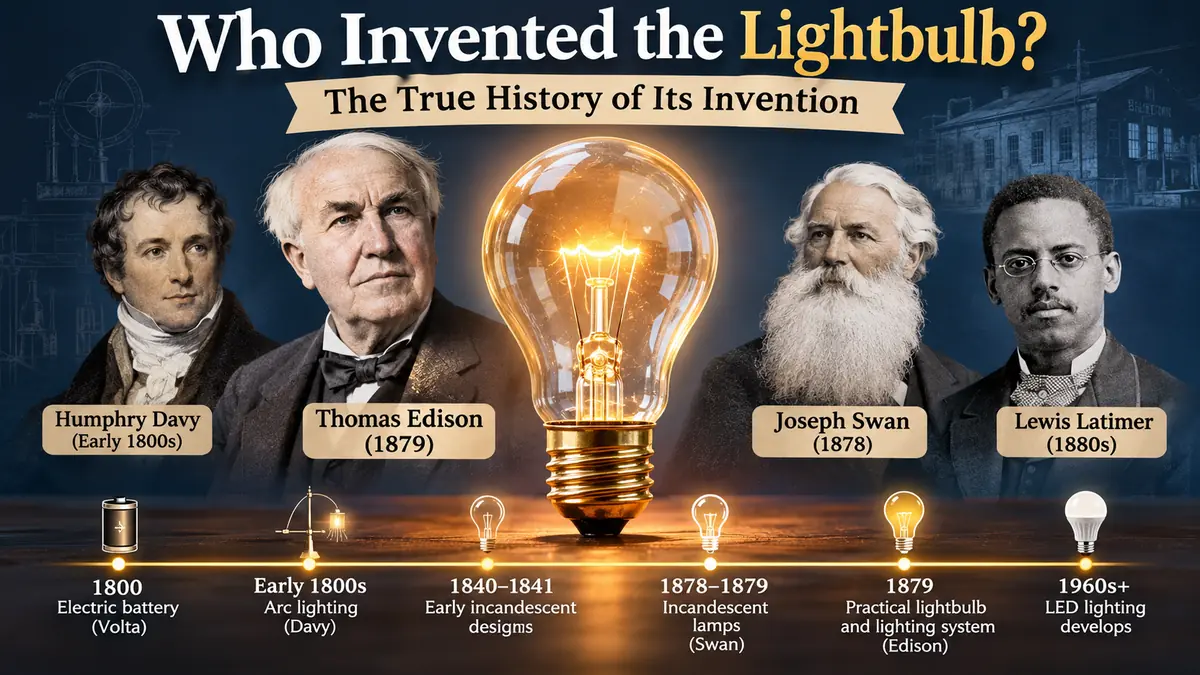
Thomas Edison is often credited with inventing the lightbulb, but the real story involves decades of experiments, scientific discoveries, and contributions from several inventors. The electric lightbulb was not created by one person in a single moment.
Thomas Alva Edison developed a commercially practical incandescent lightbulb in 1879, but he was not the first person to produce electric light. Humphry Davy demonstrated electric lighting in the early 1800s, while Joseph Swan developed working incandescent lamps before Edison’s famous breakthrough. Edison helped transform these inventions into a reliable, affordable lighting system.
Understanding who invented the lightbulb means looking beyond one famous name. The history of electric lighting includes early arc lamps, experimental filaments, vacuum technology, patent disputes, and the development of electrical distribution networks.
Who Invented the Lightbulb First?
The answer depends on what qualifies as inventing a lightbulb.
If the question refers to the earliest demonstration of electric lighting, British scientist Humphry Davy deserves recognition. If it refers to a practical incandescent lamp, several inventors contributed important advances before Edison.
Thomas Edison became the most widely recognized figure because his team developed an effective incandescent lamp and helped establish the infrastructure needed to use electric lighting in homes and businesses.
Book Review: ‘Edison’ Is A Lively Story Of The Inventor, If Only You Read It Backwards : NPR
SpeakerNet – Sir Joseph Wilson Swan: physicist, chemist and inventor
6
Thomas Edison, Joseph Swan, and Humphry Davy were three important figures in the development of electric lighting.
Key inventors and their contributions
| Inventor | Year | Contribution |
|---|---|---|
| Alessandro Volta | 1800 | Developed the voltaic pile, an early electric battery |
| Humphry Davy | Early 1800s | Demonstrated electric light using electricity and carbon |
| Warren de la Rue | 1840 | Used a platinum filament inside a vacuum tube |
| Frederick de Moleyns | 1841 | Patented an early incandescent lamp design |
| Joseph Swan | 1870s | Developed practical carbon-filament incandescent lamps |
| Thomas Edison | 1879 | Developed a long-lasting, commercially practical incandescent lamp |
| Lewis Latimer | 1880s | Improved carbon-filament manufacturing technology |
These contributions were not identical. Some established the scientific principles, others created working lamps, and still others improved manufacturing or electrical distribution.
How Humphry Davy Created Early Electric Lighting
The history of electric light began well before Edison’s laboratory experiments.
In 1800, Italian physicist Alessandro Volta introduced the voltaic pile, a device capable of supplying a continuous electric current. This development gave scientists a new way to experiment with electricity.
Humphry Davy used powerful batteries to demonstrate electric lighting in the early nineteenth century.
The first electric arc light
Davy demonstrated that electricity could create intense illumination by passing current through carbon electrodes.
When the electrodes were separated slightly, an electrical arc formed between them, producing a brilliant light.
This technology became known as the electric arc lamp.
Arc lighting was powerful but unsuitable for ordinary household use because it required substantial electrical power and produced intense light and heat.
Nevertheless, arc lamps eventually found applications in streets, factories, and large public spaces.
Why Davy’s invention was not the modern lightbulb
Davy’s early electric lighting experiments demonstrated an essential scientific principle: electricity could be converted into visible light.
However, his arc lamp did not use the same operating method as a modern incandescent bulb.
An incandescent lamp produces light by heating a filament until it glows. Davy’s arc lamp generated light through an electrical discharge between electrodes.
This distinction explains why Davy is recognized as an early pioneer of electric lighting rather than the sole inventor of the household incandescent bulb.
Joseph Swan and the Development of the Incandescent Lightbulb
British physicist and inventor Joseph Swan played a central role in developing practical incandescent lighting.
Swan began experimenting with electric lamps in the nineteenth century, focusing on carbon filaments and the removal of air from glass bulbs.
His early designs faced two major problems: filaments burned out quickly, and vacuum technology was not yet sufficiently advanced.
How Swan improved the electric lamp
By the late 1870s, improvements in vacuum pumps made it possible to remove more air from a glass bulb.
This mattered because oxygen causes a heated carbon filament to burn rapidly.
Swan developed lamps using carbonized filaments enclosed inside evacuated glass bulbs.
He publicly demonstrated working incandescent lighting in Britain in 1878 and 1879, around the same period that Edison was developing his own designs.
Swan electric lamp | Science Museum Group Collection
collection.sciencemuseumgroup.org.uk
Did Joseph Swan invent the lightbulb before Edison?
Swan demonstrated a working incandescent lamp before Edison’s famous October 1879 experiment.
However, Swan’s earlier designs and Edison’s later designs differed in performance, electrical resistance, manufacturing methods, and commercial suitability.
Swan’s work was especially influential in Britain, where he helped establish incandescent electric lighting.
The two inventors eventually became connected through a British business arrangement.
In 1883, their British lighting interests were combined in the Edison & Swan United Electric Light Company, commonly known as Ediswan.
Their history illustrates why credit for the invention cannot be assigned accurately without considering the specific technical achievement being discussed.
Why Thomas Edison Is Credited With Inventing the Lightbulb
Edison’s achievement was not simply making a filament glow. His goal was to develop an electric lighting system that could compete with gas lighting in everyday life.
In 1878, Edison began investigating incandescent lighting at his laboratory in Menlo Park, New Jersey.
Working with a team of researchers and technicians, he tested different materials, bulb designs, electrical components, and manufacturing methods.
The challenge was to produce a lamp that could operate for many hours without consuming excessive electricity.
The breakthrough of October 1879
In October 1879, Edison’s team tested a carbonized cotton-thread filament inside an evacuated glass bulb.
The filament glowed for approximately 14.5 hours.
This was an important breakthrough because earlier incandescent designs often failed quickly or required impractical amounts of electrical power.
The researchers continued improving the design.
By December 1879, Edison was publicly demonstrating electric lighting at Menlo Park. On New Year’s Eve, visitors saw buildings and grounds illuminated by electric lamps.
The demonstration showed that incandescent lighting could function as part of an integrated system rather than as an isolated laboratory experiment. Census.gov+1
Why bamboo became important
After experimenting with different materials, Edison’s researchers adopted carbonized bamboo for lamp filaments.
Bamboo had properties that made it useful for producing a thin, durable carbon filament.
According to the U.S. Department of Energy, improvements involving bamboo filaments eventually allowed some Edison lamps to operate for approximately 1,200 hours.
That was a major improvement over the initial 14.5-hour experiment.
Carbonized bamboo remained important in Edison’s lamp production for years before other filament materials became standard. Department of Energy+1
Edison invented more than a working bulb
A useful lightbulb needs more than a glowing filament. It also requires electricity, wiring, switches, sockets, and a reliable power supply.
Edison recognized that successful electric lighting depended on developing these components together.
His work included electrical generators, distribution networks, protective devices, meters, and lamp fittings.
This system-level approach was one of the main reasons Edison’s name became so closely associated with electric lighting.
Who Invented the Lightbulb Before Thomas Edison?
Several inventors made important contributions before Edison’s commercially practical design.
Their experiments helped solve the technical problems that eventually made incandescent lighting possible.
Warren de la Rue and the platinum filament
In 1840, British scientist Warren de la Rue developed an experimental incandescent lamp using a platinum filament enclosed in an evacuated glass tube.
Platinum was useful because it could withstand high temperatures.
However, platinum was expensive, making the design unsuitable for widespread commercial production.
The experiment nevertheless demonstrated the value of heating a filament inside a controlled atmosphere.
Frederick de Moleyns and the early lightbulb patent
In 1841, British inventor Frederick de Moleyns received a patent for an incandescent electric lamp.
His design used platinum wires and carbon-based materials to generate light.
Although it did not become a practical household product, the patent represented an important step in the formal development of incandescent lighting. ACS Publications
Henry Woodward and Mathew Evans
Canadian inventors Henry Woodward and Mathew Evans developed an incandescent lamp design in the 1870s.
They received a Canadian patent in 1874 and a U.S. patent in 1876 for their electric lighting technology.
Their design involved carbon elements enclosed in glass containers filled with a protective gas.
Woodward’s patent interests were subsequently acquired by Edison.
Their contribution is another example of how early electrical inventions influenced later commercial developments.
William Sawyer and Albon Man
American inventors William Sawyer and Albon Man also developed patented incandescent lighting technology.
Their work became relevant to the patent disputes surrounding the early electric lighting industry.
The companies and patents associated with different inventors eventually became part of larger industrial organizations, including the businesses that formed General Electric in 1892.
These overlapping developments show that the invention of the incandescent lamp was a competitive international effort rather than the achievement of one laboratory. Department of Energy
How Lewis Latimer Helped Improve the Lightbulb
Lewis Howard Latimer was an American inventor, engineer, and technical draftsman who contributed significantly to the development of practical incandescent lighting.
His work focused particularly on improving the production of carbon filaments.
Latimer’s carbon-filament innovation
Early carbon filaments could be fragile and inconsistent, making large-scale manufacturing difficult.
Latimer developed improvements in the process used to manufacture carbon filaments.
In 1882, he received U.S. Patent No. 252,386 for a process of manufacturing carbons.
His technique helped make filament production more reliable and economical.
Latimer’s contribution was especially valuable because a commercially successful lamp needed to be manufactured repeatedly with consistent quality.
Did Lewis Latimer invent the lightbulb?
Latimer did not invent the first electric lightbulb.
His achievement was improving the technology that made incandescent lighting more practical and accessible.
He worked in the electric lighting industry and later joined Edison’s organization, contributing engineering and patent-related expertise.
In 1890, he published Incandescent Electric Lighting: A Practical Description of the Edison System, documenting the technology behind electric lighting.
His work demonstrates that the history of the lightbulb includes important manufacturing and engineering innovations, not only the earliest prototypes. Lemelson
How Does an Incandescent Lightbulb Work?
An incandescent lightbulb operates through a process called incandescence, in which a material becomes hot enough to emit visible light.
The basic principle is straightforward: electrical energy heats a filament, and the filament produces light.
Incandescent Light Bulb Explained at Linda Burk blog
The main components of an incandescent bulb
| Component | Function |
|---|---|
| Glass envelope | Protects the filament from the surrounding air |
| Filament | Heats up and produces visible light |
| Support wires | Hold the filament in position |
| Lead-in wires | Carry electrical current into and out of the filament |
| Vacuum or inert gas | Reduces filament deterioration |
| Metal base | Connects the bulb to an electrical socket |
| Insulating material | Separates electrical contacts |
How electricity produces light
The process takes place in four main stages:
- Electrical current enters the bulb through its metal contacts.
- Current passes through a thin filament with electrical resistance.
- The filament becomes extremely hot and begins to glow.
- The glowing filament emits visible light along with substantial infrared radiation and heat.
In traditional incandescent bulbs, the filament commonly reaches temperatures of roughly 2,500–3,000°C.
Modern conventional incandescent lamps typically use tungsten rather than the carbon filaments found in nineteenth-century designs.
Tungsten is suitable because it has an exceptionally high melting point and can withstand the temperatures required to produce visible light.
Why does an incandescent bulb get hot?
An incandescent bulb generates light by heating its filament, so heat is an unavoidable part of its operation.
Much of the electrical energy supplied to a conventional incandescent bulb is released as heat rather than useful visible light.
This is one reason newer lighting technologies, especially LEDs, are considerably more energy-efficient.
When Was the Lightbulb Invented? A Historical Timeline
The development of electric lighting took place over more than a century.
The following timeline highlights the major milestones that led from early experiments to modern lighting.
- 1800 — Volta develops the electric batteryAlessandro Volta introduces the voltaic pile, providing a source of continuous electrical current.
- Early 1800s — Davy demonstrates electric lightingHumphry Davy shows how electrical energy can produce light, helping establish the foundations of arc lighting.
- 1840–1841 — Early incandescent designsWarren de la Rue experiments with a platinum filament, while Frederick de Moleyns patents an incandescent lamp.
- 1874–1876 — Canadian lamp patentsHenry Woodward and Mathew Evans patent an electric lighting design.
- 1878–1879 — Swan demonstrates incandescent lampsJoseph Swan develops and publicly demonstrates working carbon-filament lighting.
- 1879 — Edison’s practical breakthroughEdison’s team produces a carbon-filament lamp and publicly demonstrates an integrated electric lighting system.
- 1880–1882 — Commercial improvementsEdison continues improving lamp technology, while Lewis Latimer advances carbon-filament manufacturing.
- 1882 — Pearl Street Station begins operationEdison’s electricity-generating station in New York City begins supplying power to customers.
- 1883 — Ediswan is establishedThe British lighting interests of Edison and Swan combine.
- 1904–1913 — Tungsten and gas-filled lampsTungsten-filament technology develops, followed by improvements involving inert gases.
- 1960s onward — LED technology developsPractical visible-light LEDs emerge, eventually leading to efficient white LED lighting.
The timeline makes one point clear: electric lighting evolved through successive discoveries and improvements. No single date represents the invention of every type of electric lamp.
How the Lightbulb Changed Everyday Life
The spread of electric lighting transformed homes, workplaces, cities, and industrial production.
Before widespread electric lighting, people relied heavily on candles, oil lamps, and gas lighting.
These older technologies could provide useful illumination, but they also introduced smoke, heat, fire hazards, and maintenance requirements.
Electric lighting in homes
Incandescent lamps made it possible to illuminate indoor spaces with a convenient source of light that did not require an exposed flame.
As electricity networks expanded, households gained greater control over when and where they used lighting.
Electric lights also made evening activities such as reading, studying, and household work more convenient.
However, adoption was gradual. Early electrical installations were expensive, and many communities continued using gas and oil lighting for decades.
Factories and workplaces
Electric lighting improved illumination in factories, offices, workshops, and other workplaces.
Better lighting helped workers perform detailed tasks and allowed businesses greater flexibility in operating hours.
It also reduced some hazards associated with open-flame lighting.
The overall effects on working conditions depended on other factors, including workplace safety practices and labor regulations.
Streets and public spaces
Electric street lighting began with arc lamps, which were particularly suitable for illuminating large outdoor areas.
Incandescent lighting later became common in buildings and smaller spaces where a softer, more controllable light was needed.
As electrical distribution networks expanded, public lighting became an important part of urban infrastructure.
The growth of electrical infrastructure
One of the lightbulb’s most significant effects was encouraging the development of electrical power systems.
Edison’s Pearl Street Station began operating in Manhattan in September 1882.
The station demonstrated the commercial potential of generating electricity centrally and distributing it to customers.
Electric lighting helped create demand for the infrastructure that would eventually support household appliances, industrial machinery, and other electrical technologies. Department of Energy+1
From Edison’s Lightbulb to Modern LED Lighting
The incandescent lamp was a major technological achievement, but it was not the final stage in the evolution of electric lighting.
Scientists and engineers continued developing technologies that could produce more light while using less energy.
Tungsten-filament lightbulbs
Early incandescent bulbs commonly used carbon filaments.
During the early twentieth century, manufacturers began adopting tungsten filaments.
Tungsten offered several advantages, including a very high melting point and the ability to operate at temperatures that produced brighter light.
Improvements in filament manufacturing helped tungsten become the standard material for conventional incandescent bulbs.
Fluorescent lighting
Fluorescent lamps generate light through a different process.
An electrical discharge excites mercury vapor inside a tube, producing ultraviolet radiation.
A phosphor coating converts much of that ultraviolet radiation into visible light.
Fluorescent lighting became popular in offices, schools, factories, and commercial buildings because it generally used less electricity than traditional incandescent lighting.
Compact fluorescent lamps, or CFLs, later brought similar technology into many homes.
Who invented the LED lightbulb?
The LED lightbulb was not invented by Thomas Edison.
LED stands for light-emitting diode, a semiconductor device that emits light when electrical current passes through it.
In 1962, Nick Holonyak Jr. demonstrated a practical visible-spectrum red LED.
Later developments in semiconductor materials enabled LEDs to produce additional colors.
The work of Isamu Akasaki, Hiroshi Amano, and Shuji Nakamura was especially important in developing efficient blue LEDs.
Their achievements made practical white LED lighting possible through techniques such as combining blue LEDs with phosphor materials.
The three researchers received the 2014 Nobel Prize in Physics for their work on efficient blue light-emitting diodes.
Incandescent vs. fluorescent vs. LED bulbs
| Feature | Incandescent | CFL | LED |
|---|---|---|---|
| Technology | Heated filament | Gas discharge and phosphor | Semiconductor |
| Typical efficiency | Low | Moderate | High |
| Typical lifespan | About 1,000 hours | About 6,000–15,000 hours | About 15,000–25,000+ hours |
| Heat generation | High | Moderate | Lower |
| Mercury content | None | Usually contains mercury | None in standard LED lamps |
| Common application | Legacy and specialty lighting | Older residential and commercial installations | Modern general lighting |
These are approximate values for common products, not universal limits.
For example, a typical LED bulb can produce similar visible light to a traditional 60-watt incandescent bulb while consuming only about 8–10 watts.
This reduction in electricity consumption is one reason LED lighting has become the dominant technology in many markets.
Common Misconceptions About Who Invented the Lightbulb
The history of electric lighting is frequently simplified into a single inventor and date.
Several common claims need more context.
Did Thomas Edison steal the lightbulb invention?
The claim that Edison simply stole the lightbulb is misleading.
Numerous inventors had developed electric lamps before Edison, and patent disputes were common in the rapidly growing electrical industry.
Edison built upon existing scientific and technical knowledge while making substantial improvements of his own.
His achievements included developing a high-resistance incandescent lamp and integrating it into a practical electrical distribution system.
Joseph Swan’s earlier work was also significant, and the two inventors’ business interests eventually combined in Britain.
The historical record supports recognizing multiple contributors rather than describing the entire invention as either Edison’s original idea or an act of theft. National Park Service+1
Did Nikola Tesla invent the lightbulb?
Nikola Tesla did not invent the original incandescent lightbulb.
Tesla made important contributions to alternating-current electrical systems, motors, and high-frequency electrical technologies.
He also experimented with forms of electric lighting, including gas-discharge and wireless illumination concepts.
His work influenced how electricity could be generated, transmitted, and used, but the development of the incandescent lamp began before his major electrical engineering achievements.
Did Edison invent the lightbulb in 1879 or 1880?
Both years are important, but they refer to different milestones.
Edison’s major practical incandescent-lamp breakthrough occurred in October 1879.
His U.S. Patent No. 223,898, covering an electric lamp, was granted on January 27, 1880.
The distinction between invention, public demonstration, patent filing, patent approval, and commercial production explains why different historical accounts sometimes mention different dates.
Was the first lightbulb made from bamboo?
No. Bamboo was not the material used in the earliest incandescent experiments.
Earlier inventors experimented with platinum, carbon, paper, and other materials.
Edison’s October 1879 experiment used carbonized cotton thread.
His team subsequently developed successful carbonized bamboo filaments, which became important in commercial production.
How long did Edison’s first successful lightbulb last?
The well-known October 1879 cotton-thread experiment lasted approximately 14.5 hours.
Later versions achieved substantially longer operating times.
Edison’s December 1879 demonstration lamps could operate for more than 100 hours, and improved bamboo-filament lamps eventually achieved lifespans approaching 1,200 hours.
The important achievement was not a single lamp with an extraordinary lifespan, but a series of improvements that made electric lighting reliable enough for practical use. Department of Energy+1
Why the Invention of the Lightbulb Still Matters
The lightbulb illustrates how major technologies usually emerge through cumulative innovation.
Early scientists established that electricity could produce light. Inventors developed experimental lamps, improved filament materials, and created better vacuum systems.
Engineers then solved the problems of manufacturing, electricity distribution, and everyday usability.
The same pattern continues in modern lighting.
Today’s LEDs rely on semiconductor physics rather than heated carbon or tungsten filaments, but they serve the same fundamental purpose: converting electrical energy into useful illumination.
The transition from early arc lamps to modern LEDs also shows how technological progress involves improvements in efficiency, reliability, affordability, and safety.
For students studying the history of inventions, the lightbulb is a particularly useful example of why historical credit should distinguish between the first experiment, the first working prototype, and the first commercially successful product.
Final Answer: who invented the lightbulb?
Thomas Edison is credited with developing the first commercially practical incandescent lightbulb in 1879, but he did not invent electric lighting alone.
Humphry Davy demonstrated early electric lighting, Warren de la Rue and Frederick de Moleyns developed incandescent designs, Joseph Swan produced working lamps, and Lewis Latimer improved filament manufacturing.
Edison’s most important contribution was combining an effective incandescent lamp with a practical electrical lighting system.
The most accurate answer to who invented the lightbulb is therefore that several inventors contributed to its development, with Edison playing the leading role in making incandescent electric lighting commercially practical.
The lightbulb’s history is not simply the story of one inventor. It is the story of how generations of scientists, engineers, and entrepreneurs transformed experimental electric light into an everyday technology.
