

Ever stared at a syllabus that says “Final Exam: 40%, Homework: 10%, Quizzes: 20%” and wondered what is weighted grade actually is and how it turns into your final score? You’re not alone. Most students get through an entire semester without really understanding the math behind their own report card.
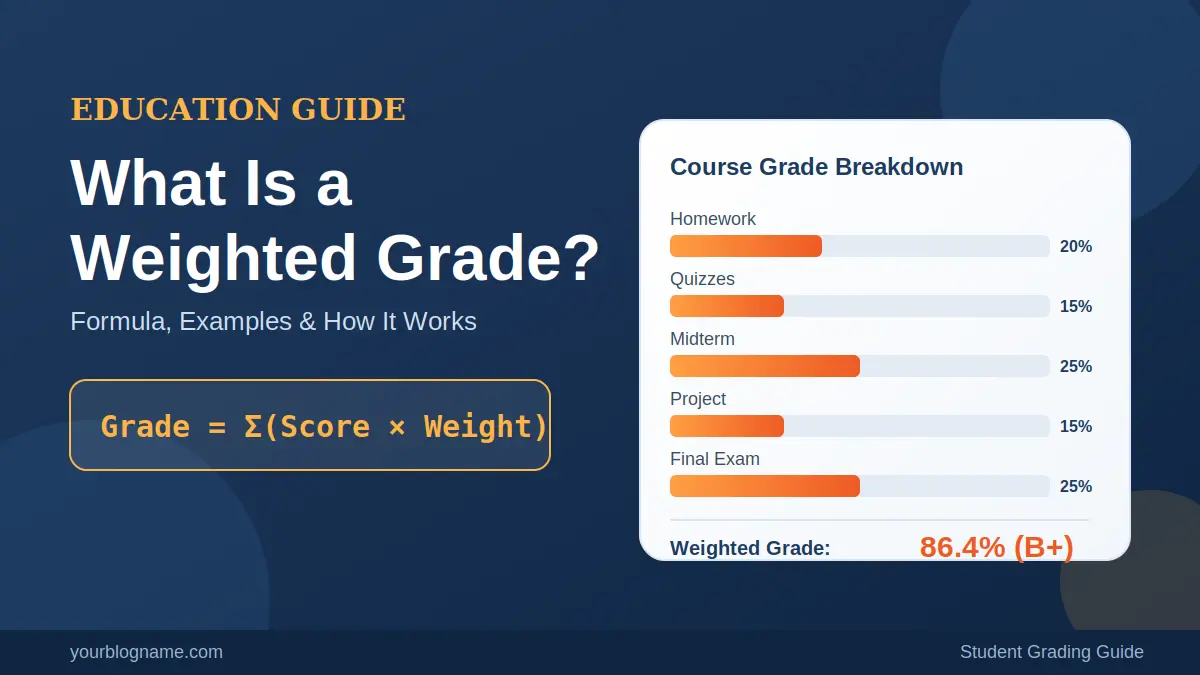
A weighted grade is a final score calculated by multiplying each assignment or category by its assigned percentage (weight), then adding those results together — so a 40%-weight exam affects your grade far more than a 10%-weight quiz, even if you scored the same on both. The formula is: Overall Grade = Σ (Category Score × Category Weight) ÷ Σ (Category Weights)
Not all assignments carry the same weight — our weighted grade calculator helps you factor that in accurately.
How a Weighted Grade Actually Works
Not every assignment counts the same. Teachers and professors decide, usually right in the syllabus, how much each category is worth toward your final grade. A pop quiz might be worth almost nothing. A final exam might be worth nearly half your grade.
That’s the entire point of weighting: it lets an instructor say “this matters more than that” in a way that shows up directly in your number.
Here’s the part people miss — a weighted grade isn’t just an average of your scores. It’s an average adjusted by importance. Score 95% on a quiz worth 10% and 70% on a final worth 40%, and your final exam will drag your grade down hard, even though your quiz score was higher.
The Weighted Grade Formula
The weighted grade equals the sum of each weight (in percent) multiplied by its corresponding grade: Weighted grade = w1×g1 + w2×g2 + w3×g3…
If your weights are expressed as raw numbers instead of percentages — say, credit hours or points instead of percent — you also need to divide the result by the sum of the weights to normalize it.
Step-by-Step Calculation
- List every graded category (homework, quizzes, midterm, final, projects) and its weight from the syllabus.
- Confirm the weights add up to 100%. If they don’t, something on the syllabus is off, or there’s a category you’re missing.
- Multiply each score by its weight.
- Add all the weighted scores together.
- That total is your overall weighted grade.
Weighted Grade Example (Real Numbers)
Let’s use real numbers instead of abstract letters.
| Category | Score | Weight | Weighted Contribution |
|---|---|---|---|
| Homework | 88% | 20% | 17.6 |
| Quizzes | 92% | 15% | 13.8 |
| Midterm | 78% | 25% | 19.5 |
| Project | 95% | 15% | 14.25 |
| Final Exam | 85% | 25% | 21.25 |
Adding these contributions together: 17.6 + 13.8 + 19.5 + 14.25 + 21.25 = 86.4%, which lands as a solid B+ on most standard scales.
Notice something: the student scored their lowest on the midterm (78%), and it still pulled meaningful weight because it’s worth 25% of the grade. Meanwhile a near-perfect project score (95%) at only 15% weight couldn’t fully offset it. That’s weighting in action.
Quick Takeaway: Multiply, don’t average blindly. A high score in a low-weight category won’t save you from a low score in a high-weight one.
Weighted Grade vs. Unweighted Grade
People often confuse “weighted grade” (how one course grade is calculated from its parts) with “weighted GPA” (how course difficulty affects your overall GPA across all classes). They’re related concepts but answer different questions.
An unweighted GPA uses the 4.0 scale for every class, regardless of difficulty, while a weighted GPA adds extra points — commonly +0.5 for Honors or +1.0 for AP/IB — before calculating the average. That’s a different kind of weighting: it rewards course rigor rather than assignment importance. GPA Calculator
Comparison Table
| Weighted Grade (in-class) | Weighted GPA (across classes) | |
|---|---|---|
| What it measures | How assignments combine into one course grade | How course difficulty affects your overall average |
| Set by | Individual instructor/syllabus | School district or college policy |
| Typical scale | 0–100% | 0.0–4.0 (unweighted) or up to 5.0 (weighted) GIGACalculator.com |
| Boosted by | Higher weight on categories | Honors, AP, IB courses |
Weighted Grades in GPA (Honors, AP, IB)
A weighted GPA is the grade point average that considers both the difficulty level of a course and the student’s grade in that course. Weighting typically adds 0.5 points for Honors courses and 1.0 point for AP/IB courses, though some schools use smaller bumps like 0.25 for honors and 0.5 for AP — so it’s worth double-checking your school’s exact policy rather than assuming a standard. Toolscrow + 2
This system exists because many high schools now offer more challenging courses, and weighting acknowledges the extra effort those courses demand. A student earning a B in all AP classes can end up with a GPA equal to or higher than a student earning straight A’s in standard classes — and colleges tend to view the student who chose harder courses more favorably, even with a slightly lower raw grade. ToolscrowToolscrow
Colleges typically look at both numbers: your unweighted GPA to see raw performance, and your weighted GPA to understand course rigor. Neither one alone tells the full story. College Essay Guy
Common Mistakes Students Make With Weighted Grades
- Assuming all assignments count equally. They almost never do — check the syllabus weights before you decide what to prioritize studying for.
- Ignoring low-weight categories entirely. A 5% homework grade seems trivial until you realize five of them add up to 25%.
- Confusing weighted grade with weighted GPA. One is per-course math; the other is cross-course GPA policy.
- Forgetting that weights must total 100%. If your calculation feels off, recheck this first.
- Not asking what happens to a missed assignment’s weight. Some instructors redistribute it; others count it as a zero.
Quick Takeaway: The syllabus is the source of truth. When in doubt about how something is weighted, ask your instructor directly instead of guessing.
For more free tools like this, visit GradeCalcs.com.
FAQ Section
What is a weighted grade in simple terms?
It’s a course grade calculated by giving different assignments different levels of importance, then combining them using their assigned percentages rather than a simple average.
How do you calculate a weighted grade by hand?
Multiply each category’s score by its weight (as a decimal), add all the results together, and divide by the total weight if the weights aren’t already in percentage form.
What’s the difference between weighted and unweighted grades?
An unweighted grade treats every assignment equally; a weighted grade assigns different importance levels to different categories based on the syllabus.
Why is my final exam weighted more than homework?
Instructors typically weight cumulative assessments like finals higher because they reflect overall mastery, while smaller assignments like homework are meant to build skills along the way.
Can a weighted grade go above 100%?
Yes, if extra credit is included, or if a category weight exceeds what’s mathematically expected — otherwise it stays within the normal percentage range.
Is weighted GPA the same as weighted grade?
No. A weighted grade is calculated within one course; a weighted GPA adjusts your overall average across all courses based on course difficulty (Honors, AP, IB).
How do you find the weight of a category on your syllabus?
Check the grading breakdown section, usually near the top or in a table, where instructors list each category alongside its percentage of the final grade.
What happens if weights don’t add up to 100%?
It usually signals a missing category, a syllabus typo, or a category (like extra credit) meant to sit outside the standard 100%. Always confirm with your instructor.
