

Most syllabi list something like “Homework 20%, Tests 40%, Final 30%, Participation 10%” and leave you to figure out what that actually means for your grade. If you’ve ever averaged your scores and gotten a number that didn’t match what your professor reported, this is why — you can’t just add up percentages and divide by how many there are.
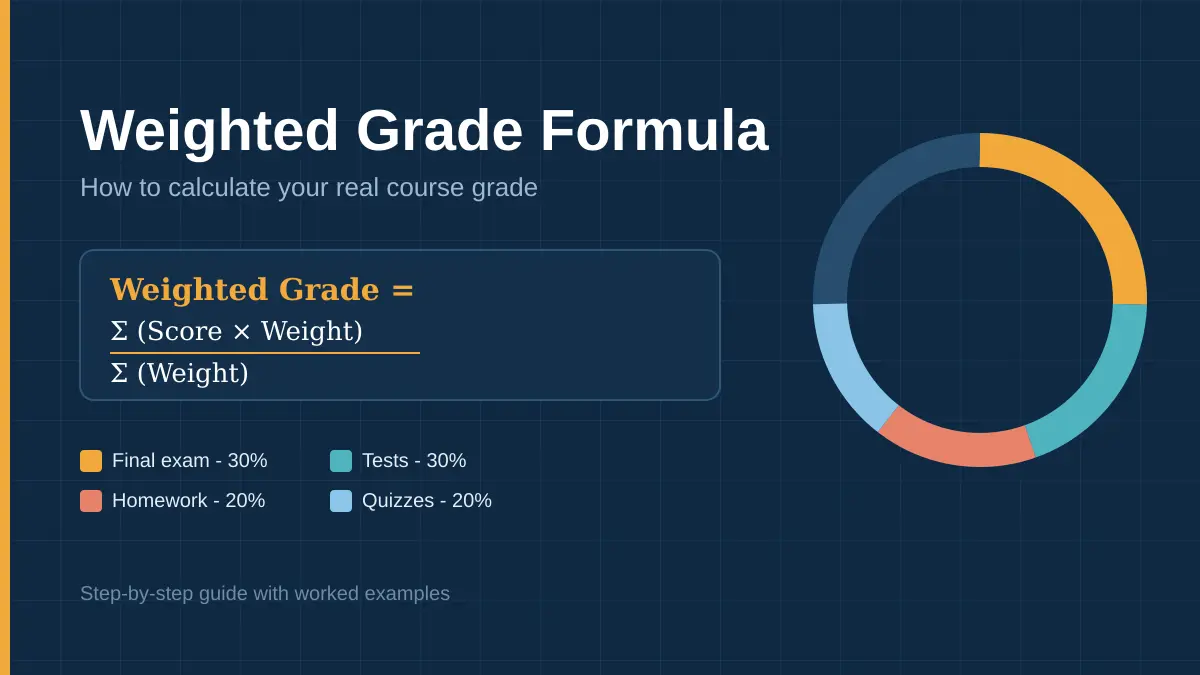
The weighted grade formula is: Weighted Grade = Σ(Score × Weight) ÷ Σ(Weight). You multiply each category’s average score by its assigned weight, add those results together, then divide by the total of all the weights used. This gives more influence to categories your instructor marked as more important, like a final exam over a single homework assignment.
To calculate your real course grade based on assignment weights, check out this weighted grade calculator.
What a Weighted Grade Actually Means
A weighted grade system assigns each category of coursework — homework, quizzes, midterms, projects, a final exam — a percentage that reflects how much it counts toward your overall grade. <cite index=”3-1″>A weighted grade gives different levels of importance to different assignments, so categories with higher weights contribute more to your final grade than categories with lower weights.</cite>
That’s the whole point of the system. A professor who wants your final exam to matter more than a single homework set will set the exam weight at, say, 30% and homework at 10%. Ignore the weighting and you’ll misjudge exactly where you stand.
The Weighted Grade Formula
The Formula Written Out
<cite index=”4-1″>Your weighted grade equals the sum of each score multiplied by its weight, divided by the sum of all the weights.</cite> Written as an equation:
Weighted Grade = (w₁ × g₁ + w₂ × g₂ + w₃ × g₃ + …) ÷ (w₁ + w₂ + w₃ + …)
Where w is the weight (as a percentage or decimal) and g is the grade in that category.
Why You Divide by the Sum of Weights, Not by 100
Here’s the part that trips people up. If your weights sum to exactly 100%, dividing by their sum and dividing by 100 give you the same result — so it’s easy to assume you can skip that step entirely. But the moment your weights don’t total 100 (because a category is missing, or a professor uses point values instead of percentages), dividing by 100 gives you the wrong number. <cite index=”9-1″>If weights do not sum to 100%, the formula still works correctly by normalizing — each category’s effective contribution is Weight_i divided by the sum of all weights.</cite>
That’s why the formula always includes “÷ Σ(Weight)” rather than a flat “÷ 100.” It’s the part of the formula that makes it self-correcting.
How to Calculate a Weighted Grade Step by Step
Step 1 — Find Your Category Weights
Pull the weighting breakdown straight from your syllabus. This is usually spelled out early on, something like: Homework 20%, Quizzes 10%, Tests 40%, Final Exam 30%. <cite index=”3-1″>Before proceeding, verify that the combined weight of all categories equals 100%, since an inaccurate total will throw off the entire calculation.</cite>
Step 2 — Average the Scores Within Each Category
If you have three homework grades, average those three first. Do the same for every category. You need one representative number per category before you touch the weighting formula.
Step 3 — Multiply Each Average by Its Weight
Convert each weight to a decimal (20% becomes 0.20) and multiply it by that category’s average. Do this for every category separately — don’t combine them yet.
Step 4 — Add the Results and Divide
Sum every weighted value from Step 3. Then divide that sum by the total of all the weights you used (as a decimal, this is usually 1.00 if everything adds to 100%). The result is your weighted grade.
Worked Example With Real Numbers
Say your course breaks down like this:
| Category | Weight | Your Average Score |
|---|---|---|
| Homework | 20% | 85% |
| Quizzes | 10% | 90% |
| Tests | 30% | 78% |
| Final Exam | 40% | not yet taken |
Using just the categories completed so far — homework, quizzes, and tests — the math looks like this: <cite index=”4-1″>(85 × 0.20) + (90 × 0.10) + (78 × 0.30) = 17 + 9 + 23.4 = 49.4, and that’s out of a combined 0.60 total weight, so 49.4 ÷ 0.60 = 82.33%.</cite>
That 82.33% reflects only the work completed so far — the final exam’s 40% weight still hangs over the outcome.
What If Your Weights Don’t Add Up to 100%?
This happens more than you’d think — a syllabus lists categories that sum to 90%, or a teacher uses a point-based system where categories carry different total point values instead of clean percentages. In either case, the fix is the same: use the actual sum of the weights as your denominator, not 100. The ratio between categories is what matters, not the total. A course weighted 25/25/50 produces the exact same result as one weighted 1/1/2, because only the relative proportions affect the outcome.
Calculating Your Grade Mid-Semester (Before Everything Is Graded)
You don’t need every category filled in to get an accurate current grade — you just need to adjust the denominator. <cite index=”5-1″>You do the math just like the full calculation, except you divide the total by the percentage of only the factors you’re using up to that point.</cite>
So if your syllabus has Assignments at 35% and Midterms at 40%, and those are the only two categories graded so far, your usable weight total is 75%. You’d calculate: (0.35 × homework average + 0.40 × midterm score) ÷ 0.75. Everything else in the course — quizzes, final exam, participation — simply hasn’t been counted yet, and that’s fine. This is exactly how instructors calculate your “current grade” before the semester ends.
Weighted Grade vs. Simple Average — What’s the Difference?
A simple average treats every score the same regardless of how important the assignment was. A weighted average deliberately doesn’t. <cite index=”9-1″>If your homework carries a 10% weight and scores 100, while your final exam carries a 40% weight and scores 60, the simple average would land at 80 — but the weighted grade would come out closer to 70.</cite>
That gap is the entire reason weighted grading exists. It stops a handful of easy, low-stakes assignments from masking a weak performance on the parts of the course that actually count most.
Common Mistakes Students Make With Weighted Grades
- <cite index=”3-1″>Adding raw grades together without applying weights at all.</cite>
- <cite index=”3-1″>Using outdated category weights pulled from an old version of the syllabus instead of the current one.</cite>
- Dividing by 100 automatically, even when the weights used so far don’t sum to 100.
- Forgetting to average multiple assignments within a category before applying the weight.
- Mixing point-based grades with percentage-based grades without converting them first.
Small errors here compound — a single misapplied weight can shift your reported grade by several points.
Figuring Out What You Need on Your Final Exam
Once you know your current weighted grade and the final’s weight, you can reverse the formula to solve for the score you need. Set your target overall grade, plug in your known category results, and solve for the missing exam score algebraically. This is the exact function most online weighted grade calculators automate — you enter your target grade and remaining weight, and it back-calculates the score needed.
Quick Takeaway Box
- Formula: Weighted Grade = Σ(Score × Weight) ÷ Σ(Weight)
- Always divide by the actual sum of weights used, not by 100
- Average scores within a category before applying the weight
- Mid-semester grades use the same formula with a smaller weight total
- Small weighting mistakes can meaningfully shift your reported grade
Final Thoughts
The weighted grade formula isn’t complicated once you see it applied with real numbers — the confusion almost always comes from skipping the “divide by the sum of weights” step. Pull your category weights from the syllabus, average each category’s scores, multiply by weight, add, and divide. Do that once by hand and you’ll never need to guess at your grade again.
Browse all our grade and GPA tools here for more academic planning help.
FAQ Section
Q1: What is the formula for a weighted grade?
Weighted Grade = Σ(Score × Weight) ÷ Σ(Weight). Multiply each category’s average score by its weight, add the results, and divide by the total of all weights used, not by a flat 100.
Q2: How do you calculate a weighted average grade by hand?
Average the scores in each category, multiply each average by its weight (as a decimal), add all the weighted values together, then divide by the sum of the weights you used.
Q3: What happens if my grading weights don’t add up to 100%?
The formula still works — divide by the actual sum of the weights instead of 100. Only the ratio between categories affects your final grade, not the total.
Q4: How is a weighted grade different from a regular average?
A simple average treats every category equally. A weighted average gives more influence to categories marked as more important, like a final exam over a quiz, so the two numbers can differ significantly.
Q5: What grade do I need on my final to get a B?
Take your current weighted grade from completed categories, subtract it from your target grade, then divide by the final exam’s weight to solve for the score you need on the remaining work.
Q6: How do you calculate your current grade halfway through a semester?
Use the same formula, but divide only by the weight of the categories completed so far — not the full 100%. This shows your accurate standing before the course ends.
Q7: Can a weighted grade calculator handle letter grades?
Most calculators accept letter grades and convert them to a numeric equivalent before applying the weighted formula, then convert the result back to a letter grade if needed.
Q8: Why do some assignments count more than others?
Instructors set higher weights on assignments that better reflect mastery of the material, like exams and major projects, so those pieces have a bigger impact on the final grade than lower-stakes work like homework.

The explanation of weight normalization is a useful detail. It shows why you should divide by the actual weight total when calculating a current grade, rather than automatically using 100%.