

You’ve probably heard someone say “vice versa” in a conversation or seen it in a book, email, or social media post. But what exactly does this expression mean, and when should you use it?
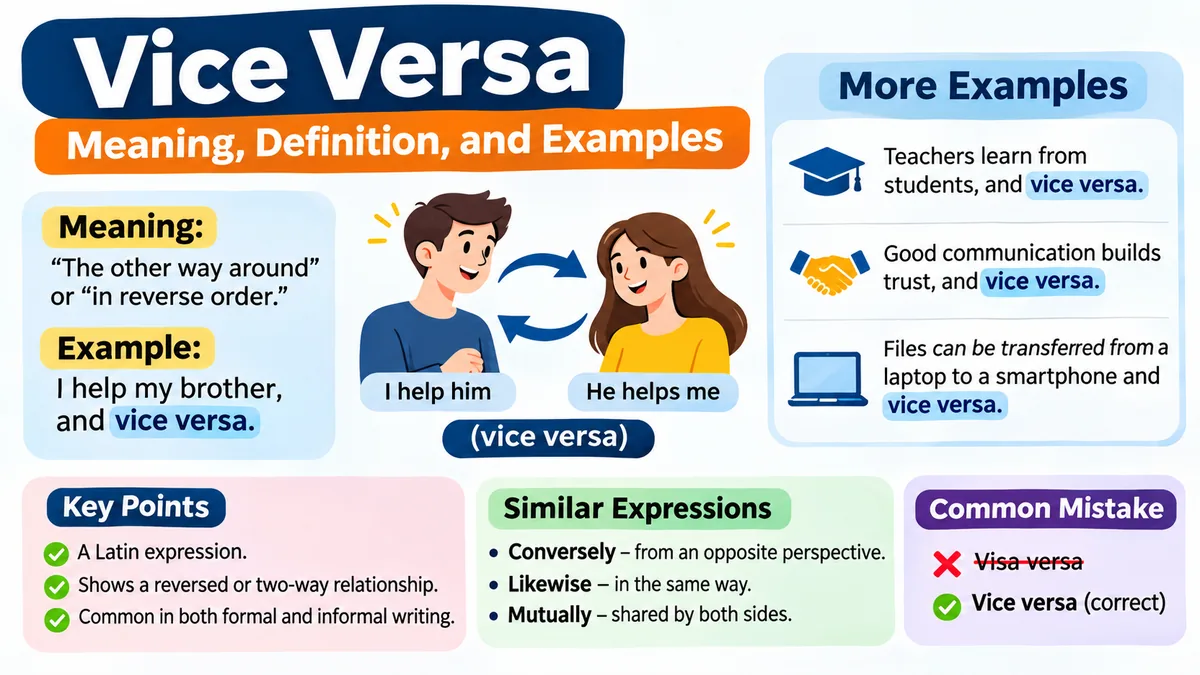
vice versa means “the other way around” or “in reverse order.” It is a Latin expression used when two people, things, actions, or situations can exchange positions while the statement remains true. For example, “I help my brother, and vice versa” means your brother also helps you.
Understanding this phrase makes everyday communication clearer and helps you avoid repeating the same information.
What Does vice versa Mean?
The expression vice versa describes a reversed relationship between two things. It tells the reader or listener that a statement also works when the people, objects, or actions switch places.
Consider this sentence:
“Parents teach their children, and vice versa.”
The first part tells us that parents teach children. The second part means that children also teach their parents.
Instead of writing two complete sentences, the speaker uses vice versa to express both relationships efficiently.
Simple Definition
According to standard English dictionary usage, vice versa means:
- The other way around
- With the positions reversed
- In the opposite order
- With the relationship working in both directions
The Cambridge Dictionary and Merriam-Webster both recognize the expression as a way of describing reversed positions or relationships.
Is vice versa a Word or a Phrase?
Vice versa is a two-word expression borrowed from Latin. In English grammar, it generally functions as an adverbial phrase because it modifies or completes the meaning of a statement.
It is written as two separate words, not as “viceversa” or “vice-versa” in standard modern English.
How to Use vice versa in a Sentence
The most common structure places vice versa after a statement that describes a relationship between two people or things.
Basic structure:
Subject + verb + object, and vice versa.
For example:
“Sarah supports David, and vice versa.”
This means Sarah supports David, and David supports Sarah.
The expression is particularly useful when the reversed statement would otherwise repeat almost the same words.
10 Everyday Examples of vice versa
| Example sentence | What it means |
|---|---|
| I respect my friends, and vice versa. | My friends respect me too. |
| Teachers learn from students, and vice versa. | Students also learn from teachers. |
| Cats can scare dogs, and vice versa. | Dogs can scare cats too. |
| She calls me every weekend, and vice versa. | I call her every weekend too. |
| English speakers learn Spanish, and vice versa. | Spanish speakers learn English too. |
| Exercise improves sleep, and vice versa. | Better sleep can support exercise. |
| Parents influence children, and vice versa. | Children influence parents too. |
| Good communication builds trust, and vice versa. | Trust can improve communication. |
| You can convert dollars into euros, and vice versa. | You can also convert euros into dollars. |
| Technology influences culture, and vice versa. | Culture also influences technology. |
These examples demonstrate how the phrase communicates reciprocity, reversal, or a two-way relationship.
Using vice versa in Formal Writing
Vice versa is acceptable in academic papers, professional emails, business reports, and formal correspondence.
For example:
“Changes in consumer demand affect market prices, and vice versa.”
This sentence indicates that demand influences prices while prices can also influence demand.
However, the reversed meaning must be logically accurate. A sentence should not use vice versa merely because two concepts are related.
vice versa Pronunciation and Spelling
American English
/ˌvaɪs ˈvɝː.sə/
VYSS VUR-suh
British English
/ˌvaɪs ˈvɜː.sə/
VYSS VUR-suh
IPA pronunciations are approximate standard forms; accents vary.
The expression contains four syllables: vice (one syllable) and versa (two syllables), with the usual English pronunciation totaling three syllables: vice-ver-sa.
The first word sounds like “vice” in “vice president,” while the second is commonly pronounced “VUR-suh.”
Common Spelling Mistakes
Incorrect spellings include:
- Vise versa
- Vice verca
- Vicevers
- Viceversa
The standard spelling is vice versa, with a space between the two words.
Origin and Latin Meaning of vice versa
The expression comes from Latin and has been used in English for centuries.
Its components are associated with the idea of turning, changing, or reversing positions.
The Latin word vice relates to change, succession, or an alternate position, while versa comes from a form of the verb vertere, meaning “to turn.”
Together, the words communicate the idea of something being turned around or reversed.
How the Expression Entered English
English borrowed numerous Latin expressions, particularly through scholarly, legal, scientific, and formal writing.
Vice versa became useful because it expressed a reciprocal or reversed relationship without requiring a complete repetition.
Other familiar Latin expressions used in English include et cetera (etc.), per se, ad hoc, and status quo.
Unlike some Latin expressions that appear mainly in academic writing, vice versa is now common in everyday conversation.
vice versa vs. Similar English Expressions
Several English expressions communicate reversal, contrast, or mutual relationships. However, they are not always interchangeable.
| Expression | Meaning | Example |
|---|---|---|
| Vice versa | The reverse is also true | I help her, and vice versa. |
| Conversely | From an opposite perspective | Some prefer mornings; conversely, others prefer evenings. |
| Likewise | In the same way | She enjoys reading, and likewise, her sister does. |
| Mutually | Shared by both sides | They mutually respect each other. |
| Reciprocally | In return or in both directions | The two teams support each other reciprocally. |
| Inversely | In an opposite mathematical or directional relationship | Speed and travel time are inversely related for a fixed distance. |
vice versa vs. Conversely
Both expressions can introduce an opposite relationship, but their grammatical uses differ.
Vice versa usually refers directly to a reversal of the preceding statement.
Conversely introduces a contrasting or opposite point.
For example:
“Managers evaluate employees, and vice versa.”
This means employees also evaluate managers.
“Some employees prefer remote work. Conversely, others prefer working in an office.”
The second example contrasts two preferences rather than reversing the roles of two participants.
vice versa vs. Likewise
Likewise means “similarly” or “in the same manner.”
Vice versa specifically indicates that the order or relationship is reversed.
Consider:
“Emma enjoys painting, and likewise, her sister enjoys painting.”
Both people share an interest.
“Emma teaches her sister, and vice versa.”
Each person teaches the other.
The difference is between similarity and reversal.
When Should You Not Use vice versa?
Although the expression is convenient, it does not work in every sentence.
The main rule is simple: the reversed statement must make sense in the intended context.
Mistake 1: Using It When the Reverse Is False
Incorrect:
“All dogs are mammals, and vice versa.”
This incorrectly suggests that all mammals are dogs.
Correct:
“All dogs are mammals, but not vice versa.”
This makes clear that the reverse relationship does not hold.
The expression can therefore appear after “not” to explicitly reject a reversed statement.
Mistake 2: Using It Without a Clear Relationship
Unclear:
“The weather is beautiful, and vice versa.”
The sentence does not identify two things whose relationship can be reversed.
Better:
“Warm weather can encourage outdoor activities, and outdoor activities can influence how people experience the weather.”
This version explains the intended relationship without relying on an unclear reversal.
Mistake 3: Confusing Reversal With Cause and Effect
Consider:
“Stress can disrupt sleep, and vice versa.”
This is meaningful because poor sleep can also contribute to stress.
However, not every cause-and-effect relationship operates in both directions.
For example, saying “Heavy rain causes flooding, and vice versa” would normally be incorrect. Flooding does not generally cause heavy rain.
Always check whether the reversed claim is factually reasonable.
Mistake 4: Writing “Visa Versa”
The phrase is sometimes misspelled as “visa versa” because of its pronunciation.
The correct form is vice versa.
Similarly, “vice a versa” is not the standard written expression. Definition & Examples+1
Can You Start a Sentence With vice versa?
Yes, but it is less common than placing the expression at the end of a clause.
For example:
“Vice versa, the same arrangement could apply to the second group.”
This construction is understandable, but it may sound awkward without clear context.
A more natural alternative is:
“The same arrangement could apply to the second group, and vice versa.”
The expression works best when readers can immediately identify which relationship or order is being reversed.
Do You Need a Comma Before vice versa?
A comma is commonly used when the expression follows a complete clause introduced by “and” or “or.”
For example:
“She trusts him, and vice versa.”
“We could visit Paris before Rome, or vice versa.”
A comma is not always required, especially in shorter constructions.
For example:
“English can be translated into French and vice versa.”
Both forms can be grammatically acceptable, depending on sentence structure and editorial style.
Should vice versa Be Italicized?
Generally, no.
Although the phrase originated in Latin, it has become established in modern English.
Writers normally use regular type rather than italics in everyday, academic, and professional writing. Definition & Examples+1
Practical Examples in Different Situations
Understanding the expression becomes easier when you see how it works across different contexts.
In Relationships and Friendships
“I listen when my best friend needs advice, and vice versa.”
This communicates mutual emotional support.
“She understands my problems, and vice versa.”
Both individuals understand each other’s difficulties.
In Education
“Students can learn from teachers, and vice versa.”
This emphasizes that learning can happen in both directions.
“Mathematics supports physics, and vice versa.”
The two academic subjects can contribute to each other’s development.
In Business and Work
“Marketing teams provide information to sales teams, and vice versa.”
This describes a two-way exchange of information.
“Managers give feedback to employees, and vice versa.”
Employees can also provide feedback to managers.
In Technology
“Some applications convert text into speech and vice versa.”
This means they can also convert speech into text.
“Files can be transferred from a laptop to a smartphone and vice versa.”
The transfer can occur in either direction.
In Travel and Directions
“You can travel from London to Manchester or vice versa.”
The journey can begin in either city.
“We can visit the museum before the park, or vice versa.”
The order of the two activities can be reversed.
This last example illustrates an important distinction: vice versa does not always mean two people do the same thing to each other. It can also refer to reversing a sequence.
Does vice versa Always Mean Both Ways?
Not necessarily.
In many everyday sentences, vice versa indicates that a relationship works in both directions.
For example:
“Anna respects Ben, and vice versa.”
Both people respect each other.
However, the expression can also describe alternative arrangements.
“We can have dinner before the movie, or vice versa.”
Here, it means the movie could come before dinner instead.
The conjunction matters:
- And vice versa often adds a reversed relationship that is also true.
- Or vice versa often presents the reversed order as an alternative.
- But not vice versa indicates that the original statement is true while its reverse is false.
Understanding these distinctions helps prevent ambiguity.
A Simple Way to Remember vice versa
Whenever you encounter the phrase, mentally replace it with “the other way around.”
Take this sentence:
“I help my neighbor, and vice versa.”
Replace the expression:
“I help my neighbor, and my neighbor helps me.”
If the expanded version makes sense, vice versa is probably being used correctly.
Another example:
“Children influence their parents, and vice versa.”
Expanded:
“Children influence their parents, and parents influence their children.”
This simple substitution is particularly useful for English language learners who are unfamiliar with Latin-derived expressions.
Final Thoughts on vice versa
The expression vice versa is a concise way to say that a relationship, action, or order also works in reverse. It is widely used in spoken and written English, from casual conversations to academic and professional communication.
The key is to ensure that the reversed statement is logical and clear. Remember its standard two-word spelling, distinguish it from expressions such as “conversely” and “likewise,” and use it only when the intended reversal makes sense.
When in doubt, replace vice versa with “the other way around” and check whether the sentence still communicates your intended meaning.
