

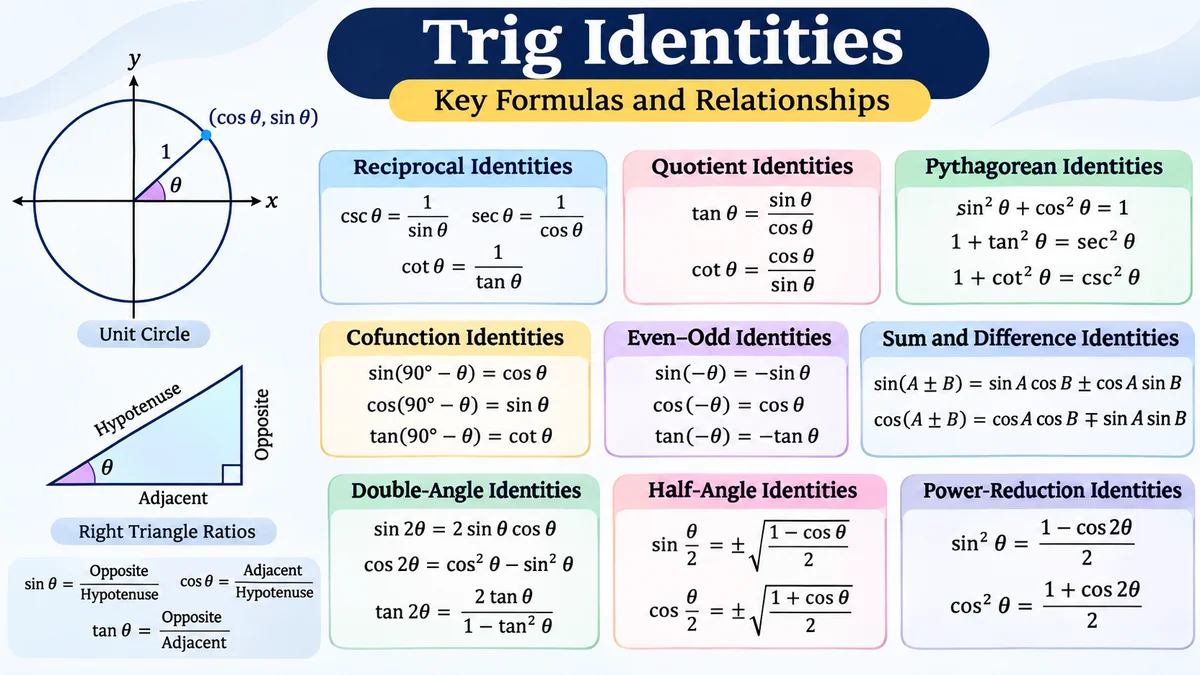
Trigonometric expressions can look complicated, especially when they contain several sine, cosine, and tangent functions. The key to simplifying them is recognizing the relationships between these functions.
trig identities are equations involving trigonometric functions that remain true for every angle where both sides are defined. They include reciprocal, quotient, Pythagorean, cofunction, even-odd, sum-and-difference, double-angle, and half-angle identities. These formulas help simplify expressions, prove equations, solve trigonometric problems, and work with angles without calculating every function separately.
Understanding these relationships is essential for algebra, precalculus, calculus, physics, and engineering. This guide explains the major identities, where they come from, and how to apply them correctly.
What Are trig identities?
A trigonometric identity is an equation that expresses an equivalent relationship between trigonometric functions.
For example:
\[ \sin^2\theta+\cos^2\theta=1 \]
This is called the fundamental Pythagorean identity.
It works for every real angle \(\theta\), whether measured in degrees or radians.
An identity differs from a trigonometric equation. An identity is true throughout its domain, while a trigonometric equation may only be true for certain angles.
For example:
\[ \sin\theta=\frac12 \]
is an equation, not an identity, because it is true only at particular angles.
The six trigonometric functions
Trigonometry uses six primary functions:
| Function | Abbreviation | Right-triangle ratio |
|---|---|---|
| Sine | sin | Opposite / Hypotenuse |
| Cosine | cos | Adjacent / Hypotenuse |
| Tangent | tan | Opposite / Adjacent |
| Cosecant | csc | Hypotenuse / Opposite |
| Secant | sec | Hypotenuse / Adjacent |
| Cotangent | cot | Adjacent / Opposite |
These ratios describe acute angles in right triangles. The unit circle extends the functions to other angles, including negative angles and angles greater than \(360^\circ\).
For a point \((x,y)\) on the unit circle:
\[ \cos\theta=x,\qquad \sin\theta=y \]
Because the circle has radius 1:
\[ x^2+y^2=1 \]
Substituting sine and cosine gives the fundamental Pythagorean identity.
Basic trig identities: Essential Formula Chart
The basic identities connect the six trigonometric functions. They form the foundation for nearly every other identity.
Reciprocal identities
Reciprocal identities show how pairs of trigonometric functions are related through division.
\[ \csc\theta=\frac1{\sin\theta} \]
\[ \sec\theta=\frac1{\cos\theta} \]
\[ \cot\theta=\frac1{\tan\theta} \]
Their reverse forms are:
\[ \sin\theta=\frac1{\csc\theta} \]
\[ \cos\theta=\frac1{\sec\theta} \]
\[ \tan\theta=\frac1{\cot\theta} \]
These relationships apply wherever the expressions are defined.
For example, if:
\[ \sin\theta=\frac35 \]
then:
\[ \csc\theta=\frac53 \]
The reciprocal identity lets you find cosecant immediately without constructing a triangle.
Quotient identities
Two important identities express tangent and cotangent using sine and cosine:
\[ \boxed{\tan\theta=\frac{\sin\theta}{\cos\theta}} \]
\[ \boxed{\cot\theta=\frac{\cos\theta}{\sin\theta}} \]
The tangent identity is valid when \(\cos\theta\ne0\), while the cotangent identity requires \(\sin\theta\ne0\).
These formulas are especially useful when an expression contains several different trigonometric functions.
For example:
\[ \frac{\sin\theta}{\tan\theta} \]
Replace tangent with its quotient identity:
\[ =\frac{\sin\theta}{\sin\theta/\cos\theta} \]
Simplifying gives:
\[ =\cos\theta \]
This equivalence holds where the original expression is defined.
Pythagorean identities
The three Pythagorean identities are among the most frequently used formulas in trigonometry.
FUNDAMENTAL IDENTITIES
\[ \sin^2\theta+\cos^2\theta=1 \]
\[ 1+\tan^2\theta=\sec^2\theta \]
\[ 1+\cot^2\theta=\csc^2\theta \]
The first identity comes from the Pythagorean theorem.
Dividing it by \(\cos^2\theta\) produces:
\[ \frac{\sin^2\theta}{\cos^2\theta}+1 =\frac1{\cos^2\theta} \]
Therefore:
\[ \tan^2\theta+1=\sec^2\theta \]
Similarly, dividing the fundamental identity by \(\sin^2\theta\) produces:
\[ 1+\cot^2\theta=\csc^2\theta \]
The latter two identities require their denominators to be nonzero.
Rearranged Pythagorean formulas
Several useful expressions follow from these identities:
\[ \sin^2\theta=1-\cos^2\theta \]
\[ \cos^2\theta=1-\sin^2\theta \]
\[ \tan^2\theta=\sec^2\theta-1 \]
\[ \cot^2\theta=\csc^2\theta-1 \]
For example, if \(\cos\theta=4/5\) and the angle is in the first quadrant:
\[ \sin^2\theta=1-\frac{16}{25} =\frac9{25} \]
Therefore:
\[ \sin\theta=\frac35 \]
The quadrant matters because taking a square root introduces a positive or negative possibility.
trig identities for Negative and Complementary Angles
Angle identities explain how trigonometric functions change when angles are reflected, shifted, or complemented.
Even and odd identities
Sine, tangent, cosecant, and cotangent are odd functions, while cosine and secant are even functions.
\[ \sin(-\theta)=-\sin\theta \]
\[ \cos(-\theta)=\cos\theta \]
\[ \tan(-\theta)=-\tan\theta \]
\[ \csc(-\theta)=-\csc\theta \]
\[ \sec(-\theta)=\sec\theta \]
\[ \cot(-\theta)=-\cot\theta \]
For example:
\[ \sin(-30^\circ)=-\frac12 \]
but:
\[ \cos(-60^\circ)=\frac12 \]
These relationships are useful for simplifying negative-angle expressions.
Cofunction identities
Cofunction identities connect functions of complementary angles.
Two angles are complementary when their sum is \(90^\circ\), or \(\pi/2\) radians.
\[ \sin(90^\circ-\theta)=\cos\theta \]
\[ \cos(90^\circ-\theta)=\sin\theta \]
\[ \tan(90^\circ-\theta)=\cot\theta \]
\[ \cot(90^\circ-\theta)=\tan\theta \]
\[ \sec(90^\circ-\theta)=\csc\theta \]
\[ \csc(90^\circ-\theta)=\sec\theta \]
For example:
\[ \sin60^\circ=\cos30^\circ \]
Both values equal:
\[ \frac{\sqrt3}{2} \]
The identities are particularly helpful in right-triangle problems involving complementary acute angles.
Periodic identities
Trigonometric functions repeat their values after certain intervals.
Sine and cosine have a period of \(360^\circ\), or \(2\pi\) radians:
\[ \sin(\theta+2\pi)=\sin\theta \]
\[ \cos(\theta+2\pi)=\cos\theta \]
Tangent and cotangent have a period of \(180^\circ\), or \(\pi\) radians:
\[ \tan(\theta+\pi)=\tan\theta \]
\[ \cot(\theta+\pi)=\cot\theta \]
Cosecant and secant repeat every \(2\pi\) radians.
For example:
\[ \sin390^\circ=\sin30^\circ=\frac12 \]
Periodicity makes it possible to reduce large angles to familiar reference angles.
Sum and Difference trig identities
Sum-and-difference formulas calculate trigonometric functions of angles formed by adding or subtracting two other angles.
These identities are particularly useful for finding exact values of angles such as \(15^\circ\), \(75^\circ\), and \(105^\circ\).
Sine addition and subtraction formulas
\[ \sin(A+B)=\sin A\cos B+\cos A\sin B \]
\[ \sin(A-B)=\sin A\cos B-\cos A\sin B \]
Notice that the sign between the terms matches the sign between the angles.
Cosine addition and subtraction formulas
\[ \cos(A+B)=\cos A\cos B-\sin A\sin B \]
\[ \cos(A-B)=\cos A\cos B+\sin A\sin B \]
For cosine, the sign between the terms is opposite to the sign between the angles.
Tangent addition and subtraction formulas
\[ \tan(A+B)= \frac{\tan A+\tan B}{1-\tan A\tan B} \]
\[ \tan(A-B)= \frac{\tan A-\tan B}{1+\tan A\tan B} \]
These quotient forms require the individual tangent values and displayed denominators to be defined and nonzero.
Example: Find the exact value of sin 75°
Write \(75^\circ\) as the sum of two familiar angles:
\[ 75^\circ=45^\circ+30^\circ \]
Apply the sine addition formula:
\[ \sin75^\circ= \sin45^\circ\cos30^\circ+ \cos45^\circ\sin30^\circ \]
Substitute the known values:
\[ =\frac{\sqrt2}{2}\cdot\frac{\sqrt3}{2} +\frac{\sqrt2}{2}\cdot\frac12 \]
Simplify:
\[ \boxed{\sin75^\circ=\frac{\sqrt6+\sqrt2}{4}} \]
This exact answer is more informative than a rounded decimal.
Double-Angle and Half-Angle Identities
Double-angle identities express trigonometric functions of \(2\theta\) using functions of \(\theta\).
Half-angle identities do the reverse: they help evaluate functions of \(\theta/2\).
Double-angle formulas for sine
\[ \boxed{\sin2\theta=2\sin\theta\cos\theta} \]
This follows directly from the sine addition identity by setting \(A=B=\theta\).
For example:
\[ \sin60^\circ=2\sin30^\circ\cos30^\circ \]
\[ =2\cdot\frac12\cdot\frac{\sqrt3}{2} =\frac{\sqrt3}{2} \]
Double-angle formulas for cosine
Cosine has three commonly used forms:
\[ \cos2\theta=\cos^2\theta-\sin^2\theta \]
\[ \cos2\theta=2\cos^2\theta-1 \]
\[ \cos2\theta=1-2\sin^2\theta \]
The different forms are useful depending on whether an expression contains sine, cosine, or both.
Double-angle formula for tangent
\[ \boxed{\tan2\theta=\frac{2\tan\theta}{1-\tan^2\theta}} \]
This formula is valid where its right-hand side and \(\tan2\theta\) are defined.
Half-angle formulas
The half-angle identities for sine and cosine are:
\[ \sin\frac{\theta}{2} =\pm\sqrt{\frac{1-\cos\theta}{2}} \]
\[ \cos\frac{\theta}{2} =\pm\sqrt{\frac{1+\cos\theta}{2}} \]
The correct sign depends on the quadrant containing \(\theta/2\).
For tangent:
\[ \tan\frac{\theta}{2} =\frac{\sin\theta}{1+\cos\theta} \]
An alternative form is:
\[ \tan\frac{\theta}{2} =\frac{1-\cos\theta}{\sin\theta} \]
Each tangent formula is used only where its denominator is nonzero.
Power-reduction identities
Power-reduction identities are derived from the cosine double-angle formulas.
\[ \sin^2\theta=\frac{1-\cos2\theta}{2} \]
\[ \cos^2\theta=\frac{1+\cos2\theta}{2} \]
\[ \sin\theta\cos\theta=\frac{\sin2\theta}{2} \]
These are especially valuable in calculus when integrating squared trigonometric functions.
For example:
\[ \int\sin^2x\,dx =\int\frac{1-\cos2x}{2}\,dx \]
Therefore:
\[ \boxed{\int\sin^2x\,dx=\frac{x}{2}-\frac{\sin2x}{4}+C} \]
Product-to-Sum and Sum-to-Product Identities
These identities transform products of trigonometric functions into sums or differences, and vice versa.
They are useful in calculus, signal processing, wave analysis, and oscillation problems.
Product-to-sum formulas
\[ \sin A\sin B= \frac{\cos(A-B)-\cos(A+B)}{2} \]
\[ \cos A\cos B= \frac{\cos(A-B)+\cos(A+B)}{2} \]
\[ \sin A\cos B= \frac{\sin(A+B)+\sin(A-B)}{2} \]
\[ \cos A\sin B= \frac{\sin(A+B)-\sin(A-B)}{2} \]
Sum-to-product formulas
\[ \sin A+\sin B= 2\sin\frac{A+B}{2}\cos\frac{A-B}{2} \]
\[ \sin A-\sin B= 2\cos\frac{A+B}{2}\sin\frac{A-B}{2} \]
\[ \cos A+\cos B= 2\cos\frac{A+B}{2}\cos\frac{A-B}{2} \]
\[ \cos A-\cos B= -2\sin\frac{A+B}{2}\sin\frac{A-B}{2} \]
Example: Simplify a product of sines
Consider:
\[ \sin5x\sin3x \]
Use the product-to-sum identity:
\[ \sin A\sin B= \frac{\cos(A-B)-\cos(A+B)}{2} \]
Substitute \(A=5x\) and \(B=3x\):
\[ \sin5x\sin3x= \frac{\cos2x-\cos8x}{2} \]
This form can be easier to integrate or manipulate algebraically.
How to Prove trig identities Step by Step
Proving trigonometric identities means showing that two expressions are equivalent for every angle in their common domain.
Unlike solving a trigonometric equation, proving an identity does not require finding specific angle values.
The most reliable method is to simplify one side until it matches the other.
A practical method for proving identities
- Start with the more complicated side. Look for fractions, multiple functions, or squared expressions.
- Convert functions to sine and cosine. Use reciprocal and quotient identities when helpful.
- Apply Pythagorean identities. Replace expressions such as \(1-\sin^2x\) with \(\cos^2x\).
- Factor or combine fractions. Use ordinary algebra to simplify the expression.
- Compare both sides. Confirm that the resulting expressions match on the original domain.
Avoid assuming the identity is true while attempting to prove it.
Example 1: Prove a basic identity
Prove:
\[ \frac{1-\cos^2x}{\sin x}=\sin x \]
Start with the left-hand side:
\[ \frac{1-\cos^2x}{\sin x} \]
Apply the Pythagorean identity:
\[ 1-\cos^2x=\sin^2x \]
Substitute:
\[ =\frac{\sin^2x}{\sin x} \]
Cancel the common factor:
\[ =\sin x \]
Therefore, the identity is verified wherever \(\sin x\ne0\).
Example 2: Prove an identity involving secant and tangent
Prove:
\[ \frac{\sec^2x-1}{\tan x}=\tan x \]
Use the Pythagorean identity:
\[ \sec^2x-1=\tan^2x \]
Substitute:
\[ \frac{\tan^2x}{\tan x} \]
Simplify:
\[ =\tan x \]
The identity holds wherever the original expression is defined.
Example 3: Prove an identity with two fractions
Prove:
\[ \frac1{1-\sin x}+\frac1{1+\sin x}=2\sec^2x \]
Combine the fractions:
\[ =\frac{(1+\sin x)+(1-\sin x)} {(1-\sin x)(1+\sin x)} \]
Simplify the numerator:
\[ =\frac2{1-\sin^2x} \]
Apply the Pythagorean identity:
\[ 1-\sin^2x=\cos^2x \]
Therefore:
\[ =\frac2{\cos^2x}=2\sec^2x \]
Both sides match, so the identity is proven wherever \(\cos x\ne0\).
Why domain restrictions matter
Consider:
\[ \frac{\sin x}{\sin x}=1 \]
This statement is valid only when \(\sin x\ne0\).
At \(x=0\), the left side becomes \(0/0\), which is undefined.
Canceling a trigonometric factor does not make the original expression valid at angles where its denominator was zero.
This distinction is essential when proving identities and solving equations.
How to Solve Trigonometric Equations Using Identities
Trigonometric identities can transform difficult equations into simpler forms that can be solved using algebra and unit-circle values.
Example 1: Solve a quadratic trigonometric equation
Solve:
\[ 2\sin^2x-\sin x-1=0 \]
Factor:
\[ (2\sin x+1)(\sin x-1)=0 \]
Therefore:
\[ \sin x=-\frac12 \]
or:
\[ \sin x=1 \]
For \(0\le x<2\pi\), the solutions are:
\[ \boxed{x=\frac{7\pi}{6},\frac{11\pi}{6},\frac{\pi}{2}} \]
Example 2: Solve using a double-angle identity
Solve:
\[ \sin2x=\sin x \]
Apply:
\[ \sin2x=2\sin x\cos x \]
Then:
\[ 2\sin x\cos x=\sin x \]
Move everything to one side:
\[ \sin x(2\cos x-1)=0 \]
Thus:
\[ \sin x=0 \]
or:
\[ \cos x=\frac12 \]
For \(0\le x<2\pi\):
\[ \boxed{x=0,\pi,\frac{\pi}{3},\frac{5\pi}{3}} \]
Factoring is preferable to dividing by \(\sin x\), because division would eliminate the solutions where \(\sin x=0\).
Example 3: Simplify before solving
Solve:
\[ 1+\tan^2x=4 \]
Use:
\[ 1+\tan^2x=\sec^2x \]
Therefore:
\[ \sec^2x=4 \]
This gives:
\[ \cos^2x=\frac14 \]
So:
\[ \cos x=\pm\frac12 \]
For \(0\le x<2\pi\), the solutions are:
\[ \boxed{x=\frac{\pi}{3},\frac{2\pi}{3}, \frac{4\pi}{3},\frac{5\pi}{3}} \]
All four solutions satisfy the original equation.
Common Mistakes When Using Trigonometric Identities
Even when students memorize the formulas correctly, small algebraic errors can lead to incorrect answers.
Confusing squared functions with double angles
These expressions mean different things:
\[ \sin^2x=(\sin x)^2 \]
\[ \sin2x=\sin(2x) \]
They are not interchangeable.
For example:
\[ \sin^230^\circ=\frac14 \]
but:
\[ \sin60^\circ=\frac{\sqrt3}{2} \]
Using incorrect addition formulas
A frequent mistake is writing:
\[ \sin(A+B)=\sin A+\sin B \]
This is generally false.
The correct identity is:
\[ \sin(A+B)=\sin A\cos B+\cos A\sin B \]
Similarly, cosine addition requires both cosine and sine products.
Forgetting the positive or negative sign
When solving:
\[ \sin^2x=\frac14 \]
the correct next step is:
\[ \sin x=\pm\frac12 \]
Ignoring the negative solution can cause valid angles to be missed.
Mixing degrees and radians
Degrees and radians are different units for measuring angles.
\[ 180^\circ=\pi\text{ radians} \]
A calculator in radian mode will not interpret an input of 30 as \(30^\circ\).
Always check the calculator’s angle mode before evaluating trigonometric expressions.
Applying identities outside their domains
The expression:
\[ \tan x=\frac{\sin x}{\cos x} \]
is undefined whenever:
\[ \cos x=0 \]
Likewise, cosecant is undefined when sine is zero.
Always preserve the domain of the original expression when simplifying or proving an identity.
trig identities Practice Problems
Practice helps build the pattern recognition needed to select the right formula quickly.
Try these problems before checking the solutions.
Test your understanding
0 of 5 revealed
1.
Simplify \(1-\sin^2x\).
Show answer
2.
Simplify \(\tan x\cos x\).
Show answer
3.
Find \(\sin2x\) when \(\sin x=3/5\) and \(x\) is acute.
Show answer
4.
Find the exact value of \(\cos75^\circ\).
Show answer
5.
Simplify \(\sec^2x-\tan^2x\).
Show answer
Reveal all answers
Tips for memorizing the formulas
Rather than memorizing every identity independently, learn how formulas are connected.
Start with the fundamental Pythagorean identity, reciprocal identities, and quotient identities. These allow you to derive many other formulas.
Next, learn the sine and cosine addition formulas. The double-angle identities follow naturally by setting the two angles equal.
For the half-angle identities, remember that they come from rearranging the cosine double-angle formulas.
Understanding these relationships reduces the number of separate formulas you need to memorize.
Applications of Trigonometric Identities
Trigonometric identities are not limited to classroom exercises. They appear in several mathematical and scientific fields.
Calculus: Power-reduction and product-to-sum formulas simplify trigonometric integrals. Identities also help with differentiation, limits, and substitution methods.
Physics: Sine and cosine describe periodic motion, including waves, vibrations, and oscillations. Angle identities help combine and analyze these expressions.
Engineering: Electrical engineering uses trigonometric relationships to study alternating-current circuits, phase differences, and signal behavior.
Computer graphics: Rotations, transformations, and animation calculations rely on sine, cosine, and their angle relationships.
Fourier analysis: Products and sums of trigonometric functions are used to analyze signals and represent periodic patterns.
In each application, the underlying principle is the same: an identity changes the form of an expression without changing its mathematical value on the applicable domain.
Final Thoughts on trig identities
Mastering trig identities begins with understanding the six trigonometric functions and the fundamental relationship:
\[ \boxed{\sin^2\theta+\cos^2\theta=1} \]
From this foundation, you can derive reciprocal, quotient, double-angle, half-angle, and many other useful formulas.
The most effective approach is to understand why each identity works, recognize when it is useful, and practice applying it to different expressions.
Start with the basic identities, work through the proof examples, and gradually move toward more advanced formulas. With consistent practice, simplifying trigonometric expressions and solving equations becomes much more systematic.
