

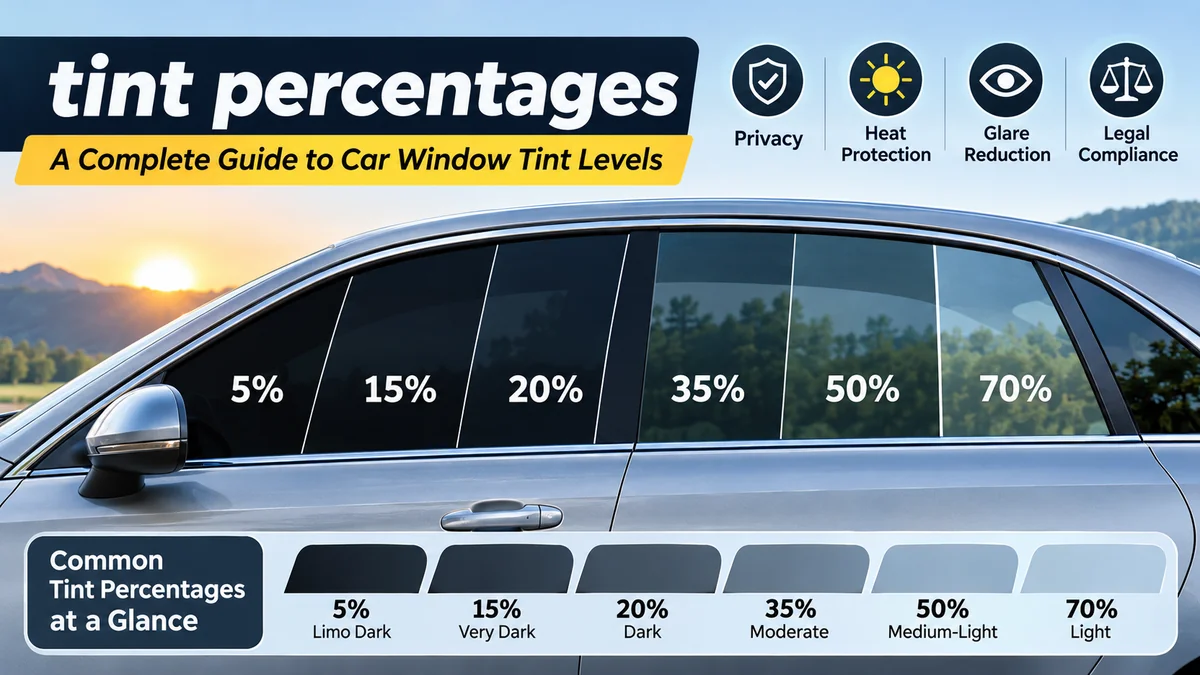
Choosing the wrong window tint can make your car uncomfortable to drive at night, reduce visibility, and lead to unnecessary traffic fines. Understanding tint percentages helps you balance privacy, appearance, heat protection, and driving safety.
Window tint percentages represent Visible Light Transmission (VLT), which measures how much visible light passes through a window. Lower percentages indicate darker tint, while higher percentages allow more light through. Common automotive tint levels include 5%, 15%, 20%, 35%, 50%, and 70%, each offering different visibility and privacy characteristics.
What Do Window tint percentages Mean?
Window tint percentage refers to the proportion of visible light that can pass through window film or tinted glass. This measurement is expressed as VLT.
For example, a window with 20% VLT allows 20% of visible light to pass through while preventing the remaining 80% from being transmitted.
A common misunderstanding is that higher percentages indicate darker windows. The opposite is true.
- 5% tint: Extremely dark.
- 15% tint: Very dark.
- 20% tint: Dark.
- 35% tint: Moderately dark.
- 50% tint: Light to moderate.
- 70% tint: Very light.
- 90% tint: Almost transparent.
The percentage primarily describes visible light transmission rather than ultraviolet protection or heat rejection. Two window films with identical VLT ratings can deliver substantially different thermal performance.
Window Tint Percentage Chart
The following chart compares common automotive tint shades and their general characteristics.
| Tint Percentage | Light Transmitted | Light Not Transmitted | Appearance |
|---|---|---|---|
| 5% | 5% | 95% | Limo dark |
| 10% | 10% | 90% | Extremely dark |
| 15% | 15% | 85% | Very dark |
| 20% | 20% | 80% | Dark |
| 25% | 25% | 75% | Medium-dark |
| 35% | 35% | 65% | Moderate |
| 50% | 50% | 50% | Medium-light |
| 70% | 70% | 30% | Light |
| 80% | 80% | 20% | Very light |
| 90% | 90% | 10% | Nearly transparent |
These figures represent nominal VLT levels. Actual results depend on the original glass, film specifications, and installation.
Common Car Window tint percentages Explained
Different tint shades serve different purposes. A vehicle used for daily commuting may require a lighter shade than one primarily intended to provide rear passenger privacy.
5% Window Tint
Also called limo tint, 5% window tint is among the darkest commonly available automotive films.
It provides substantial daytime privacy and significantly reduces incoming visible light. However, it can make pedestrians, cyclists, obstacles, and surrounding vehicles difficult to see under low-light conditions.
This shade is generally associated with limousine passenger compartments and rear privacy windows where permitted.
Many jurisdictions prohibit 5% tint on front side windows.
15% Window Tint
A 15% tint creates a very dark appearance while admitting more light than limo tint.
It offers strong daytime privacy and glare reduction but remains challenging to see through at night, particularly on poorly illuminated roads.
20% Window Tint
A 20% tint is a common reference point for dark automotive window film and resembles the appearance of some factory privacy glass.
It offers a combination of glare reduction, styling, and passenger privacy. However, nighttime visibility is noticeably reduced compared with lighter alternatives.
35% Window Tint
A 35% tint provides moderate darkness without making the windows appear completely black.
It is often considered a compromise between appearance, daytime privacy, and visibility. Nevertheless, whether it is appropriate for front windows depends on local regulations and the final measured VLT.
50% Window Tint
A 50% tint allows half of the visible light to pass through.
It provides modest privacy while maintaining better outward visibility than darker shades. This makes it more suitable for drivers who frequently travel after sunset, provided the installed tint complies with applicable laws.
70% Window Tint
A 70% tint produces relatively little visible darkening.
High-performance ceramic films in this range can reduce solar heat and ultraviolet exposure without dramatically changing the vehicle’s appearance.
However, installing a 70% film does not automatically produce a window with 70% final VLT because the original glass also affects light transmission.
How Different Tint Levels Affect Privacy and Visibility
Window darkness changes how easily occupants can see outside and how easily people outside can see into the vehicle.
Illustrative window tint shade comparison. Actual appearance varies with glass, film color, and lighting conditions.
20% vs. 35% Tint
A 20% tint creates a darker exterior appearance and offers greater daytime privacy. A 35% tint allows 1.75 times as much visible light through when comparing their nominal ratings.
The difference becomes particularly noticeable when reversing or driving at night.
35% vs. 50% Tint
A 35% tint offers more visible darkening and daytime privacy, while a 50% tint maintains better visibility.
For vehicles regularly driven in low-light conditions, lighter tint generally presents fewer visibility challenges.
Can You See Through Tinted Windows at Night?
Yes, but visibility depends on the VLT percentage and surrounding lighting.
Dark tint reduces the amount of available light reaching your eyes. During nighttime driving, this can make unlit objects particularly difficult to identify.
Tint also does not guarantee complete privacy. If the vehicle’s interior is illuminated at night, occupants may become visible from outside.
How to Calculate Window Tint Percentage
One of the most overlooked aspects of automotive window tinting is the difference between film VLT and combined window VLT.
Factory automotive glass already blocks some visible light. Adding window film reduces transmission further.
The approximate calculation is:
Final VLT = (Glass VLT × Film VLT) ÷ 100
For example, applying a 35% film to factory glass with 80% VLT produces approximately 28% combined VLT. WrapColor+1
Window Tint Percentage Calculator
Original glass VLT
80%
5%
50%
100%Window film percentage
35% — Moderate
Estimated final window VLT
28%
80% × 35% ÷ 100 = 28%Estimated calculation only. Use a calibrated tint meter to verify actual VLT and legal compliance.
Combined Window Tint Chart
| Film VLT | 70% Factory Glass | 80% Factory Glass |
|---|---|---|
| 5% | 3.5% | 4% |
| 15% | 10.5% | 12% |
| 20% | 14% | 16% |
| 35% | 24.5% | 28% |
| 50% | 35% | 40% |
| 70% | 49% | 56% |
| 80% | 56% | 64% |
| 90% | 63% | 72% |
How to Measure Existing Window Tint
A window tint meter measures light transmission through automotive glass. Professional installers, inspection stations, and law enforcement agencies commonly use these devices.
Measuring the glass before and after installation helps determine whether the finished window satisfies applicable VLT requirements.
Does Darker Window Tint Block More Heat?
Darker tint does not necessarily provide better heat protection. Thermal performance depends on film construction and its ability to manage solar radiation.
Manufacturers such as 3M, XPEL, and ORAFOL provide technical performance specifications that distinguish visible light transmission from solar energy rejection. 3M Multimedia+2
Three particularly useful measurements are:
| Measurement | Meaning |
|---|---|
| VLT | Visible Light Transmission |
| TSER | Total Solar Energy Rejected |
| UV Rejection | Percentage of ultraviolet radiation rejected |
| IRR | Infrared Rejection |
| VLR | Visible Light Reflectance |
| Glare Reduction | Reduction in incoming visible light glare |
A lighter ceramic film can offer better heat rejection than a darker, lower-performance dyed film.
When comparing infrared rejection figures, check the wavelength range and testing methodology. A high rejection rating measured across a narrow wavelength range does not necessarily indicate superior overall solar performance.
Types of Automotive Window Tint
| Film Type | Heat Rejection Potential | Signal Interference | Relative Cost |
|---|---|---|---|
| Dyed | Low to moderate | Unlikely | Low |
| Metalized | Moderate to high | Possible | Medium |
| Carbon | Moderate to high | Unlikely | Medium |
| Ceramic | High | Unlikely | High |
| Hybrid | Varies | Possible | Medium |
Dyed window tint primarily provides visible darkening and glare reduction. Lower-quality products may fade over time.
Metalized window tint uses metallic components to help manage solar energy but may interfere with certain electronic signals.
Carbon window tint incorporates carbon-based materials and generally provides good color stability.
Ceramic window tint uses ceramic particles to manage solar radiation while maintaining relatively good optical clarity.
Actual performance varies between individual products, even within the same film category.
Legal Window Tint Limits in the United States
Window tint laws differ across US states. Restrictions can also vary according to vehicle classification and window position.
A tint that is legal on rear passenger windows may be prohibited on front side windows or windshields.
Common regulatory considerations include minimum VLT, maximum reflectivity, prohibited film colors, mirror requirements, and medical exemptions.
Front and Rear Window Tint Regulations
| Window Position | Typical Regulatory Approach |
|---|---|
| Windshield | Highly restricted, with limited exceptions |
| Front side windows | Minimum VLT requirements |
| Rear side windows | Often more flexible |
| Rear windshield | May depend on vehicle type and mirrors |
| Sunroof | Subject to applicable local regulations |
In the United States, Federal Motor Vehicle Safety Standard No. 205 addresses vehicle glazing requirements. State-level rules govern many aspects of aftermarket tint use.
Always verify current requirements through your state’s Department of Motor Vehicles, transportation department, or highway patrol before installing window film.
Is 35% Tint Legal?
A 35% tint may be legal in some circumstances but prohibited in others.
Even where a minimum VLT of 35% is permitted, applying a nominal 35% film to existing automotive glass can produce a combined reading below the legal threshold.
Is 5% Limo Tint Legal?
Some states allow extremely dark tint on certain rear windows, particularly on specific vehicle classifications. Front side windows generally face much stricter requirements.
Medical exemptions may permit different tint levels for qualifying individuals, but approval procedures and documentation requirements vary by jurisdiction.
How to Choose the Right Window Tint Level
The appropriate window tint depends on your climate, driving habits, original vehicle glass, and applicable regulations.
| Primary Requirement | Tint Range to Consider |
|---|---|
| Maximum outward visibility | 70%–90% |
| Frequent nighttime driving | 50%–90% |
| Moderate appearance and privacy | 35%–50% |
| Greater daytime privacy | 15%–25% |
| Rear passenger privacy | 5%–20%, where legal |
| Heat protection with minimal darkening | 70%–90% high-performance film |
| Everyday driving | 35%–70%, where legal |
These ranges describe general film selection considerations rather than guaranteed legal or safe installed VLT levels.
Factory Tint vs. Aftermarket Tint
Factory privacy glass typically gets its darker appearance from coloring incorporated into the glass during manufacturing. Aftermarket tint involves applying a separate film to the window surface.
Factory privacy glass does not necessarily provide the same heat rejection or ultraviolet protection as specialized aftermarket films.
Adding film over factory-tinted glass can improve certain performance characteristics but will usually reduce the final VLT further.
Common Window Tinting Mistakes
Drivers sometimes select a tint based entirely on its exterior appearance without considering how it affects visibility from the driver’s seat.
Other common mistakes include ignoring factory glass VLT, confusing UV protection with tint darkness, relying on outdated state laws, and comparing infrared rejection ratings measured under different conditions.
Getting the original glass measured and reviewing the manufacturer’s technical specifications can help prevent these problems.
Conclusion
Understanding tint percentages makes it easier to evaluate automotive window films without sacrificing visibility, comfort, or legal compliance.
Lower VLT percentages provide darker windows and greater daytime privacy, while higher percentages preserve more natural light and generally improve nighttime visibility. Heat protection, however, depends on film technology and solar performance rather than darkness alone.
Before choosing a window tint, measure your existing glass, check current local regulations, compare VLT and TSER specifications, and consider the conditions in which you regularly drive. The most appropriate tint is one that meets your practical needs while maintaining safe visibility and legal compliance.
