

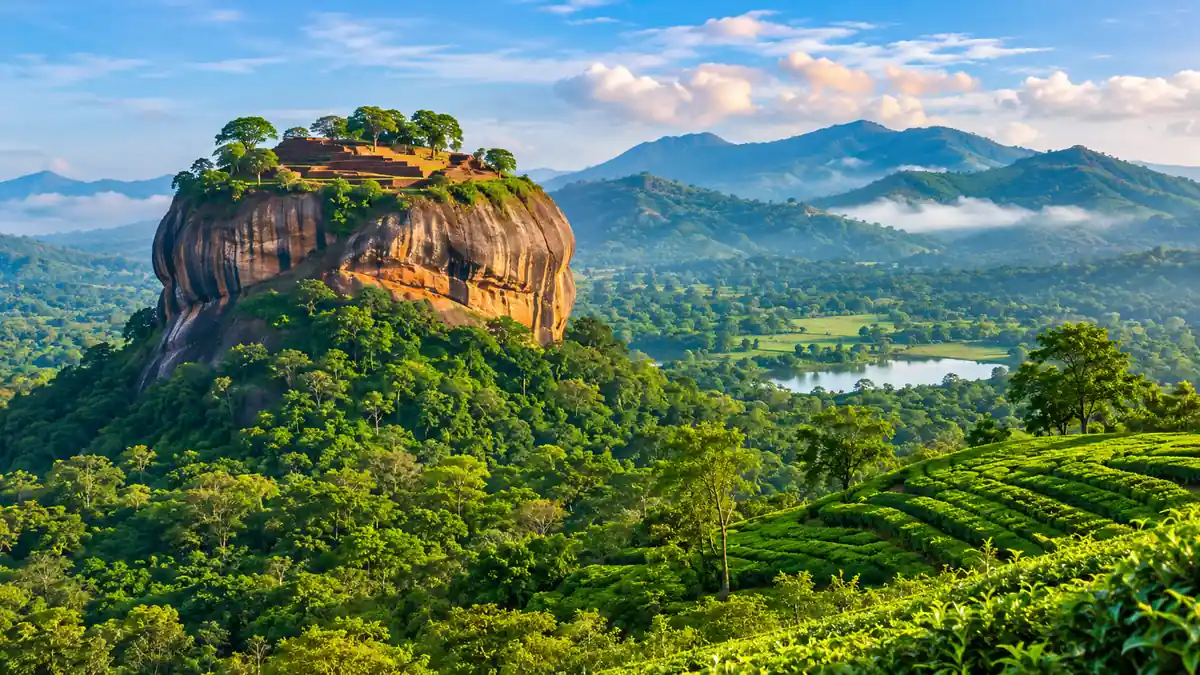
Sri Lanka is a tropical island nation where ancient Buddhist temples, mist-covered tea plantations, wildlife-rich national parks, and golden beaches exist within a relatively small geographical area. Located just south of India, this South Asian country has a history spanning thousands of years and a distinctive cultural identity.
Sri Lanka is an island country in the Indian Ocean, officially known as the Democratic Socialist Republic of Sri Lanka. It has a population of approximately 21.8 million, with Sri Jayawardenepura Kotte serving as its administrative capital and Colombo as its largest city and commercial center. The country is known for Ceylon tea, ancient civilizations, biodiversity, and scenic coastlines. Sri Lanka+1
Where Is Sri Lanka Located?
Sri Lanka lies in South Asia, southeast of the Indian subcontinent. The island is separated from India’s southern coast by the Palk Strait and the Gulf of Mannar.
Its position along major Indian Ocean shipping routes has made it an important center for trade, migration, and cultural exchange throughout history.
Sri Lanka — Australian Marist Solidarity
5 Day Pekoe Trail Luxury Hike | Private Journeys in Sri Lanka | Walk Into Luxury
8
Sri Lanka at a Glance
| Feature | Information |
|---|---|
| Official name | Democratic Socialist Republic of Sri Lanka |
| Region | South Asia |
| Administrative capital | Sri Jayawardenepura Kotte |
| Commercial center | Colombo |
| Population | Approximately 21.8 million |
| Area | Approximately 65,610 km² |
| Official languages | Sinhala and Tamil |
| Link language | English |
| Currency | Sri Lankan rupee (LKR) |
| Time zone | UTC+5:30 |
| International dialing code | +94 |
| Independence | February 4, 1948 |
| Highest mountain | Pidurutalagala, 2,524 meters |
Population figures reflect World Bank estimates for 2025, while geographic measurements follow Sri Lanka’s Ministry of Foreign Affairs. Sri Lanka+1
Is Sri Lanka Part of India?
No. Sri Lanka is an independent sovereign country with its own government, constitution, currency, and political institutions.
Although the island shares deep historical, religious, linguistic, and commercial connections with India, it has developed its own national identity.
The two countries maintain close diplomatic relations, particularly in trade, tourism, regional security, and cultural cooperation.
Geography and Natural Environment of Sri Lanka
Sri Lanka’s landscape changes dramatically between its coastal regions and mountainous interior.
The island features sandy beaches, lagoons, tropical rainforests, rivers, agricultural plains, waterfalls, and central highlands.
Mountains and Central Highlands
The central highlands contain some of the country’s most spectacular scenery.
Important mountain destinations include:
- Pidurutalagala: Sri Lanka’s highest mountain, reaching approximately 2,524 meters.
- Adam’s Peak (Sri Pada): A mountain regarded as sacred by several religious communities.
- Ella: A hill-country town known for hiking trails, mountain views, and railway scenery.
- Nuwara Eliya: A highland town famous for tea estates, cool temperatures, and colonial-era architecture.
- Horton Plains National Park: A protected upland ecosystem featuring grasslands, cloud forests, and the dramatic World’s End viewpoint.
The mountains also influence rainfall, temperature, agriculture, and the distribution of ecosystems across the island.
Rivers, Forests, and Biodiversity
The Mahaweli River is Sri Lanka’s longest river and plays an important role in irrigation, agriculture, and hydroelectric generation.
The country supports a remarkable range of wildlife, including Asian elephants, Sri Lankan leopards, sloth bears, crocodiles, and numerous endemic bird species.
Protected areas such as Sinharaja Forest Reserve, Yala National Park, and Udawalawe National Park help conserve these ecosystems.
However, deforestation, habitat fragmentation, human-elephant conflict, and climate change continue to create conservation challenges.
History of Sri Lanka: From Ancient Kingdoms to Independence
Sri Lanka’s history includes early settlements, powerful kingdoms, international maritime trade, European colonial rule, and the establishment of a modern republic.
Ancient Civilizations and Kingdoms
Human settlement on the island dates back to prehistoric times.
The ancient city of Anuradhapura became one of the country’s most important political and religious centers. Its rulers constructed extensive irrigation networks, reservoirs, monasteries, and Buddhist monuments.
Buddhism was introduced to the island during the third century BCE, traditionally associated with the missionary Mahinda during the reign of King Devanampiya Tissa.
The development of Buddhist institutions profoundly influenced Sri Lankan architecture, literature, education, and political traditions.
Polonnaruwa later emerged as another major royal capital, particularly during the medieval period.
The Arrival of European Powers
European colonial influence began in the early sixteenth century.
The Portuguese established control over significant coastal territories, followed by the Dutch during the seventeenth century.
The British eventually consolidated control over the island, taking over Dutch possessions in 1796 and bringing the Kingdom of Kandy under British rule in 1815.
Under British administration, plantation agriculture expanded, particularly the production of coffee and subsequently tea.
Railways, ports, and other infrastructure developed alongside a colonial economy that created lasting social and economic inequalities.
Independence and Modern Political History
Sri Lanka gained independence from Britain on February 4, 1948, initially under the name Ceylon.
In 1972, the country became a republic and officially adopted the name Sri Lanka.
Its post-independence history was shaped by ethnic tensions, constitutional changes, and political conflict.
A civil war between the Sri Lankan government and the Liberation Tigers of Tamil Eelam (LTTE) lasted from 1983 until 2009.
The conflict caused extensive loss of life, displacement, and long-term social damage. Its legacy continues to influence discussions about reconciliation, accountability, minority rights, and national unity.
Sri Lanka’s Recent Economic Crisis
In 2022, Sri Lanka experienced a severe economic crisis involving foreign currency shortages, rising prices, fuel scarcity, debt distress, and widespread public protests.
The country subsequently pursued debt restructuring, fiscal reforms, and an International Monetary Fund-supported stabilization program.
By the first half of 2026, real economic output had returned to its 2018 level, according to the World Bank. Nevertheless, poverty, household purchasing power, and employment remained significant challenges. worldbank.org+1
People, Languages, Religions, and Culture
Sri Lanka’s identity reflects centuries of interaction among different ethnic, linguistic, and religious communities.
Ethnic and Linguistic Diversity
The Sinhalese constitute the country’s largest ethnic community, while Sri Lankan Tamils, Indian Tamils, Muslims, and other communities contribute to its multicultural character.
Sinhala and Tamil are the two official languages.
English functions as a link language and is widely used in tourism, business, higher education, and certain administrative settings.
Language use varies geographically. Sinhala is predominant in many southern, western, and central regions, while Tamil is especially important in northern and eastern areas.
Religion in Sri Lanka
Theravada Buddhism is the country’s largest religious tradition.
Hinduism, Islam, and Christianity also have substantial historical and cultural significance.
Religious sites include Buddhist stupas, Hindu kovils, mosques, and Christian churches.
The Temple of the Sacred Tooth Relic in Kandy is one of the country’s most revered Buddhist pilgrimage destinations.
Religious festivals often bring communities together through processions, music, food, and traditional ceremonies.
Festivals and Traditions
Major cultural celebrations include:
- Vesak: Commemorates important events in the life of the Buddha.
- Sinhala and Tamil New Year: Celebrated in April with traditional food, family gatherings, and cultural customs.
- Kandy Esala Perahera: A major religious and cultural procession featuring dancers, drummers, and ceremonial traditions.
- Deepavali: A Hindu festival associated with light and spiritual renewal.
- Eid celebrations: Observed by Sri Lanka’s Muslim communities.
- Christmas: Celebrated by Christian communities across the island.
Traditional Kandyan dance, drumming, woodcarving, weaving, and mask-making remain important elements of the country’s artistic heritage.
Best Places to Visit in Sri Lanka
Sri Lanka offers a combination of cultural landmarks, coastal destinations, mountain scenery, and wildlife experiences.
Sri Lankas unverzichtbare Highlights – Die wichtigsten Hot-Spots
1. Sigiriya Rock Fortress
This ancient rock fortress rises dramatically above the surrounding plains. It is famous for its archaeological remains, landscaped gardens, frescoes, and panoramic summit views.
Kandy Travel Guide 2026: 15 Things You Actually Need to See | Ceylon Route
2. Kandy
Kandy is a historic hill-country city known for the Temple of the Sacred Tooth Relic, Kandy Lake, botanical gardens, and cultural performances.
Srí Lanka – To nejlepší z jihu | CK SEN
3. Ella
Ella attracts visitors with its tea plantations, Nine Arch Bridge, Little Adam’s Peak, and hiking routes through the central highlands.
Triton Bastion (2026) – Best of TikTok, Instagram & Reddit Travel Guide
4. Galle Fort
This historic coastal fort showcases European colonial architecture, narrow streets, defensive walls, museums, and views of the Indian Ocean.
5. Yala National Park
Yala is known for its leopard population, elephants, crocodiles, birdlife, and diverse dry-zone habitats. Wildlife sightings depend on season, weather, and animal behavior.
6. Mirissa
Mirissa is a southern coastal destination associated with beaches, marine excursions, surfing, and whale-watching opportunities.
UNESCO World Heritage Sites
Sri Lanka has eight UNESCO World Heritage Sites, including six cultural sites and two natural sites.
Its cultural properties include the ancient cities of Anuradhapura and Polonnaruwa, Sigiriya, the Golden Temple of Dambulla, the Sacred City of Kandy, and the Old Town of Galle and its Fortifications.
The natural properties are Sinharaja Forest Reserve and the Central Highlands of Sri Lanka.
These sites demonstrate the island’s archaeological, architectural, religious, and ecological importance.
Climate and Best Time to Visit Sri Lanka
Sri Lanka has a tropical climate, with warm temperatures throughout much of the year and cooler conditions in its mountainous interior.
The country’s weather is shaped by two major monsoon systems, which affect different regions at different times.
Understanding the Monsoon Seasons
The southwest monsoon generally brings increased rainfall to the western and southwestern regions between May and September.
The northeast monsoon typically affects northern and eastern areas between December and February.
Transitional intermonsoon periods occur around March–April and October–November.
These seasonal differences mean travelers can often find favorable weather somewhere on the island throughout the year. Sri Lanka+1
Best Months for Different Regions
| Region | Generally favorable period | Popular activities |
|---|---|---|
| South and west coasts | December–March | Beaches, coastal sightseeing |
| East coast | May–September | Swimming, snorkeling, surfing |
| Central highlands | January–April | Hiking, tea estates, sightseeing |
| Cultural Triangle | January–March, June–September | Temples, ruins, archaeology |
| Southern wildlife parks | Varies by park and rainfall | Safaris, birdwatching |
These are broad seasonal guidelines rather than guarantees of dry weather. Rainfall patterns vary, and occasional storms can affect travel conditions.
Food and Traditional Cuisine in Sri Lanka
Sri Lankan cuisine combines rice, coconut, spices, vegetables, seafood, and regional cooking traditions.
Its flavors reflect South Asian influences alongside centuries of trade with Arab, European, and Southeast Asian communities.
Sri Lankan Rice and Curry with Veg or Egg at Earthbound Residence | OrderNow.lk
Rice and curry
A staple meal featuring rice accompanied by vegetable, lentil, fish, or meat curries.
Hoppers (Appa)
Bowl-shaped pancakes made from fermented rice flour batter, sometimes served with an egg.
The Ultimate Guide to Sri Lankan Food | Celebrity Cruises
Kottu roti
Chopped flatbread stir-fried with vegetables, spices, eggs, or meat.
String hoppers
Steamed rice-flour noodles commonly served with curry and coconut sambol.
Other traditional dishes include dhal curry, pol sambol, lamprais, fish ambul thiyal, and kiribath, a coconut milk rice dish associated with celebrations.
Cinnamon, cardamom, cloves, black pepper, curry leaves, and pandan leaves contribute to the country’s distinctive culinary traditions.
Food can vary considerably by region, household, and religious community. Coastal areas often feature seafood, while agricultural regions have their own vegetable-based specialties.
Sri Lanka’s Economy and Major Industries
Sri Lanka has a diversified economy involving services, manufacturing, agriculture, international trade, and tourism.
Its strategic location in the Indian Ocean supports shipping and logistics, while its agricultural exports have historically connected the island with international markets.
Agriculture and Ceylon Tea
Sri Lanka is internationally recognized for Ceylon tea, which is grown primarily in the country’s central and southern highlands.
Tea cultivation developed extensively during British colonial rule and remains an important export industry.
Other agricultural products include:
- Coconut and coconut-based products
- Natural rubber
- Ceylon cinnamon and other spices
- Rice and vegetables
- Fruits and plantation crops
The agricultural sector also supports rural employment and food security.
Manufacturing and Services
Apparel and textile manufacturing are major sources of export revenue.
The services sector includes banking, transportation, information technology, telecommunications, hospitality, and tourism.
The Port of Colombo plays a significant role in regional container shipping because of its location near major international maritime routes.
Economic Recovery in 2026
Sri Lanka’s economy has made measurable progress since the 2022 crisis, although its recovery has not benefited all households equally.
Economic indicators — World Bank, October 2026
4.4%
Projected GDP growth in 2026
4.2%
Projected GDP growth in 2027
16.9%
Estimated poverty rate in 2025
Source: World Bank Sri Lanka Development Update. worldbank.org+1
The economy expanded by 4.7% during the first half of 2026, returning to its pre-crisis 2018 output level.
However, debt obligations, living costs, employment conditions, and household welfare remain important concerns.
Sustained improvements will depend on investment, productivity, export competitiveness, infrastructure development, and effective economic governance.
Wildlife and Environmental Conservation
Sri Lanka is particularly notable for the variety of ecosystems found within its relatively small territory.
Its protected landscapes include tropical rainforests, dry-zone forests, grasslands, wetlands, coastal habitats, and montane cloud forests.
Elephants and Leopards
The Sri Lankan elephant is a subspecies of the Asian elephant and one of the country’s most recognizable animals.
Large elephant populations inhabit several protected areas, including Udawalawe and Minneriya.
Sri Lankan leopards occupy different habitats across the island, with Yala National Park particularly well known for leopard sightings.
However, wildlife encounters are never guaranteed, and responsible tourism requires maintaining appropriate distances from animals.
Rainforests and Endemic Species
Sinharaja Forest Reserve is an important surviving area of lowland tropical rainforest.
It supports numerous endemic birds, amphibians, reptiles, and plants.
The Central Highlands also contain distinctive habitats that provide refuge for species adapted to cooler mountainous environments.
Both locations are recognized as UNESCO natural World Heritage properties. UNESCO World Heritage Convention
Environmental Challenges
Sri Lanka faces several environmental pressures, including deforestation, plastic pollution, coastal erosion, extreme rainfall, and changing weather patterns.
Human-elephant conflict is especially significant where agricultural settlements overlap with traditional elephant habitats.
Conservation efforts involve habitat protection, wildlife management, community participation, and sustainable tourism practices.
Education, Healthcare, and Daily Life
Sri Lanka has a long history of investment in education and public healthcare.
Free education policies helped expand literacy and educational participation, while the public healthcare system provides essential services across much of the country.
Education System
School education includes primary, junior secondary, senior secondary, and collegiate-level studies.
Students commonly take the General Certificate of Education Ordinary Level (O-Level) and Advanced Level (A-Level) examinations.
Higher education institutions include the University of Colombo, University of Peradeniya, University of Moratuwa, and several other public and private institutions.
Although educational participation is relatively strong, disparities remain between urban and rural areas, particularly in access to specialized facilities and employment opportunities.
Healthcare
Sri Lanka has achieved comparatively strong health outcomes for its income level.
World Bank data report life expectancy at birth of approximately 77.7 years in 2024. Data
The healthcare system includes public hospitals, primary care facilities, and private medical providers.
Challenges include workforce shortages in certain areas, rising treatment costs, and the increasing burden of noncommunicable diseases.
Urban and Rural Life
Daily life varies considerably between Colombo and rural communities.
Colombo is a major center for finance, commerce, education, and entertainment.
In rural areas, livelihoods may depend more heavily on farming, fishing, small businesses, and local services.
Family networks, religious institutions, and community traditions continue to influence social life throughout the country.
Travel Information for Visiting Sri Lanka
Sri Lanka’s compact geography allows visitors to experience beaches, mountains, wildlife, and historical sites during the same trip.
However, travel times can be longer than distances suggest because of winding mountain roads, traffic, and railway schedules.
Airports and Transportation
Bandaranaike International Airport, near Colombo, is the country’s principal international air gateway.
Domestic transportation options include trains, public buses, taxis, three-wheelers, and private vehicles.
Rail travel is especially popular through the central highlands, where routes connect towns such as Kandy, Nanu Oya, and Ella.
For shorter journeys, three-wheelers are common, although agreeing on fares or using metered services can help avoid misunderstandings.
Visa and Entry Requirements
Foreign visitors generally need to meet Sri Lanka’s visa or Electronic Travel Authorization (ETA) requirements, subject to nationality and applicable exemptions.
As of November 2026, the official ETA system lists a 30-day tourist visa fee waiver for nationals of 40 eligible countries, while still requiring eligible visitors to obtain the appropriate authorization before arrival. eta.gov.lk
Travelers should verify the latest requirements through the official Sri Lanka ETA website before departure.
Passport validity, permitted stay duration, entry conditions, and visa charges can vary according to nationality and travel purpose.
Health and Safety Considerations
Sri Lanka is a popular international travel destination, but visitors should follow normal travel precautions.
Important considerations include:
- Drinking safe water and practicing food hygiene.
- Using mosquito repellent to reduce exposure to dengue and other mosquito-borne illnesses.
- Following beach safety warnings, especially during monsoon periods.
- Dressing respectfully at religious sites.
- Avoiding close contact with wild animals.
- Monitoring official weather and travel advisories.
Travelers planning hiking, wildlife excursions, or remote-area visits should check local conditions and use qualified guides when appropriate.
What Makes Sri Lanka Unique?
Several characteristics distinguish Sri Lanka from other South Asian destinations.
Its ancient hydraulic engineering systems demonstrate the sophistication of early kingdoms, while Buddhist monasteries and archaeological monuments preserve centuries of religious and artistic development.
The island also combines contrasting natural environments within relatively short distances.
A journey from the coastal plains to the central highlands can reveal major changes in temperature, vegetation, architecture, and agricultural activity.
Sri Lanka’s internationally recognized tea industry, distinctive cuisine, multilingual society, and traditional festivals further contribute to its identity.
The country’s position along Indian Ocean trade routes has also created a cultural landscape shaped by local traditions and centuries of interaction with the wider world.
Conclusion
Sri Lanka is a country of exceptional historical depth, cultural diversity, and natural beauty. From the ancient cities of Anuradhapura and Polonnaruwa to the mountains of Ella, the beaches of the southern coast, and the rainforests of Sinharaja, the island offers a remarkable variety of landscapes and experiences.
Its identity extends well beyond tourism. Sri Lanka’s history, languages, religious traditions, agricultural heritage, and economic development provide important insights into South Asia and the wider Indian Ocean region.
Understanding sri lanka means appreciating both its achievements and its ongoing challenges, including economic recovery, environmental conservation, and social reconciliation. Exploring its geography, history, and communities offers a fuller picture of this distinctive island nation.
