

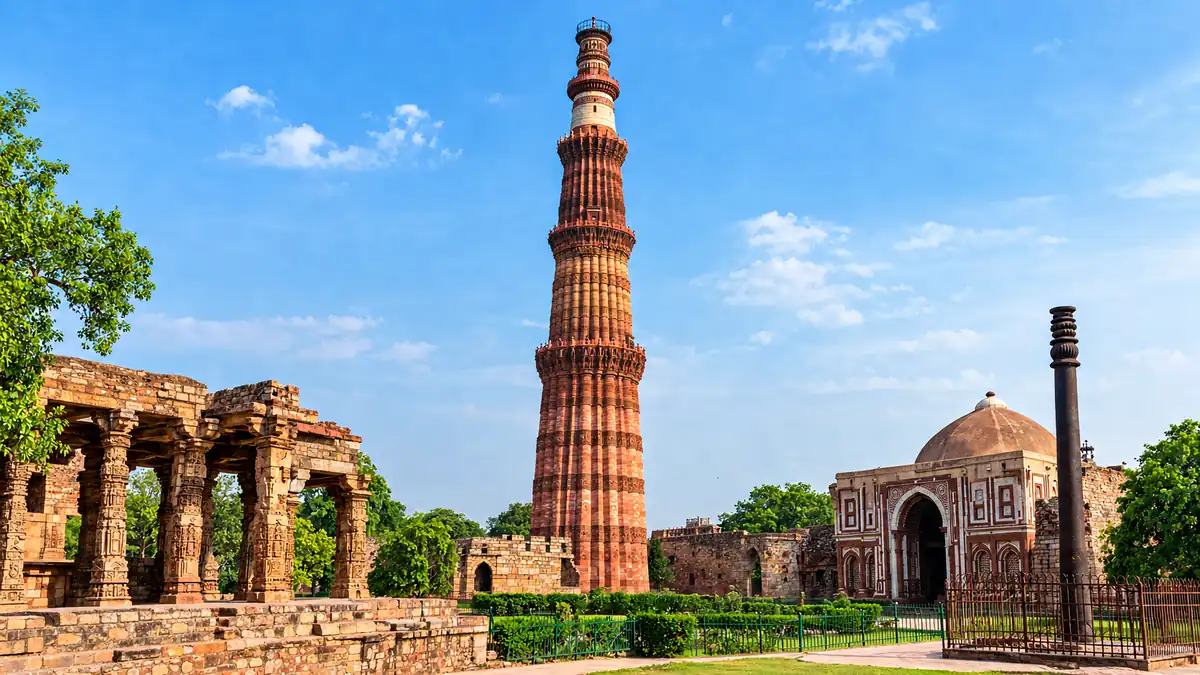
Rising above the historic ruins of Mehrauli in South Delhi, qutub minar is one of India’s most recognizable monuments. Its towering red sandstone structure tells a story of medieval rulers, architectural innovation, cultural transformation, and centuries of preservation.
Standing approximately 72.5 metres (238 feet) tall, Qutub Minar is a five-storey medieval tower within the UNESCO-listed Qutb complex in Delhi, India. Construction began under Qutb-ud-din Aibak around 1199 and continued under his successors. The monument is celebrated for its fluted shaft, intricate inscriptions, decorative balconies, and Indo-Islamic architectural design.
What Is qutub minar and Why Is It Famous?
Qutub Minar, also written as Qutb Minar or Qutab Minar, is a historic minaret located in Mehrauli, New Delhi. It forms part of an extensive archaeological complex containing mosques, tombs, gateways, and other monuments associated with the early Delhi Sultanate.
The tower is famous for its remarkable height, elaborate stone carvings, and historical association with the establishment of Sultanate rule in northern India.
Unlike a modern observation tower, Qutub Minar was constructed in a medieval religious and political setting. Its design reflects the architectural traditions introduced by the early rulers of the Delhi Sultanate, alongside craftsmanship and decorative practices found in the Indian subcontinent.
Key Facts About Qutub Minar
| Feature | Details |
|---|---|
| Location | Mehrauli, New Delhi, India |
| Height | Approximately 72.5 metres (238 feet) |
| Number of storeys | Five |
| Construction began | Around 1199 CE |
| Original patron | Qutb-ud-din Aibak |
| Major successor | Shams-ud-din Iltutmish |
| Architectural style | Early Indo-Islamic |
| Primary materials | Red sandstone, with marble used in later sections |
| UNESCO designation | World Heritage Site, 1993 |
| Heritage authority | Archaeological Survey of India |
| Monument complex | Qutb complex |
The tower is not simply an isolated landmark. Its historical significance becomes clearer when considered alongside the surrounding structures, particularly the Quwwat-ul-Islam Mosque and the Iron Pillar of Delhi.
History of qutub minar: Who Built It and When?
The history of Qutub Minar begins in the late twelfth century, during a period of major political change in northern India.
The monument developed over several generations rather than being completed by a single ruler. Successive sultans expanded, repaired, and modified the structure.
Qutb-ud-din Aibak and the Beginning of Construction
Qutb-ud-din Aibak, a military commander associated with Muhammad of Ghor and later the founder of the Mamluk dynasty in Delhi, initiated construction of Qutub Minar around 1199 CE.
He is generally credited with constructing the first storey.
The tower stood beside the Quwwat-ul-Islam Mosque, an important early mosque of the Delhi Sultanate. Its position helped establish a monumental architectural setting associated with the new ruling authority.
The precise purpose of the tower remains a subject of historical interpretation. It is commonly described as a minaret connected with the mosque and as a monument celebrating political and military authority.
Iltutmish and the Expansion of the Tower
Shams-ud-din Iltutmish, Aibak’s successor and son-in-law, made a substantial contribution to the monument during the thirteenth century.
He added three storeys, bringing the structure closer to its eventual height.
Iltutmish also strengthened the Delhi Sultanate and commissioned important buildings within the surrounding complex, including his own tomb.
His architectural contributions helped establish the Qutb complex as a major centre of early Sultanate architecture.
Firoz Shah Tughlaq and Later Restoration
During the fourteenth century, Qutub Minar suffered damage, commonly associated with lightning.
Sultan Firoz Shah Tughlaq undertook repairs and reconstructed the upper portion of the tower. The upper levels seen today reflect these later interventions, including the use of marble alongside sandstone.
Subsequent repairs were carried out during later periods, including under Sikandar Lodi in the early sixteenth century.
The monument therefore represents several phases of medieval construction and restoration.
British-Era Repairs
During British rule, conservation work introduced further changes.
Major Robert Smith supervised repairs in the nineteenth century and added a cupola to the summit in 1828.
The cupola did not match the monument’s earlier architectural character and was removed in 1848.
It was subsequently placed elsewhere within the complex, where it became known as Smith’s Folly.
This episode illustrates how conservation approaches have changed over time. Modern heritage practice generally places greater emphasis on understanding and protecting the historical authenticity of monuments.
Timeline of Qutub Minar
| Period | Historical development |
|---|---|
| Around 1199 | Qutb-ud-din Aibak begins construction |
| Early 13th century | Iltutmish adds three storeys |
| 14th century | Firoz Shah Tughlaq repairs and reconstructs upper sections |
| Early 16th century | Repairs under Sikandar Lodi |
| 1828 | Major Robert Smith adds a cupola |
| 1848 | Smith’s cupola is removed |
| 1993 | UNESCO inscribes the Qutb complex as a World Heritage Site |
Architecture of qutub minar: Design, Materials and Structure
Qutub Minar is an outstanding example of early Indo-Islamic architecture.
Its design combines monumental proportions, geometric ornamentation, calligraphic inscriptions, and construction techniques that developed during the Delhi Sultanate.
The tower is particularly striking because its circular shaft becomes progressively narrower as it rises.
Height and Dimensions
Qutub Minar measures approximately 72.5 metres in height.
Its diameter is about 14.3 metres at the base and narrows to approximately 2.7 metres near the top.
This tapering form creates a strong visual impression while helping distribute the structural load through the masonry.
The tower’s five storeys are separated by projecting balconies, which create horizontal divisions across the otherwise vertical composition.
Why Does Qutub Minar Have Five Storeys?
The present tower consists of five distinct storeys, reflecting both its original construction and subsequent rebuilding.
The first three levels are primarily associated with red sandstone construction. The upper storeys, reconstructed during later repairs, incorporate marble and sandstone.
Each storey has its own decorative character, although the overall design maintains a consistent architectural rhythm.
The projecting balconies are supported by elaborately carved stone brackets, adding both visual detail and architectural complexity.
Red Sandstone and Marble Construction
Red sandstone gives the lower sections of Qutub Minar their characteristic warm colour.
The material was suitable for intricate carving, allowing craftsmen to create bands of inscriptions, decorative motifs, and detailed architectural elements.
Marble appears more prominently in the upper levels.
The contrast between sandstone and marble helps visitors distinguish different phases of construction and restoration.
Fluted Columns and Decorative Patterns
One of the tower’s most distinctive features is its fluted exterior.
Instead of having a uniformly smooth surface, portions of the shaft display alternating rounded and angular flutes.
These vertical patterns emphasize the monument’s height and create changing effects of light and shadow throughout the day.
The decorative system includes:
- Geometric patterns and carved borders.
- Bands of Arabic inscriptions.
- Floral and ornamental stonework.
- Projecting balconies with decorative brackets.
- Alternating circular and angular fluting.
Together, these elements demonstrate the skill of medieval stoneworkers and the evolving architectural vocabulary of the Delhi Sultanate.
Arabic Inscriptions and Calligraphy
Several sections of Qutub Minar contain inscriptions in Arabic and other historically used languages and scripts.
These inscriptions record aspects of the monument’s construction, royal patronage, and later repairs.
Quranic verses and ornamental calligraphy also form part of the decorative scheme.
For historians, the inscriptions are valuable documentary evidence. They provide information about the rulers associated with the tower and the circumstances surrounding its development.
The Qutb Complex: Monuments Around Qutub Minar
Qutub Minar is the most prominent structure in the Qutb complex, but several surrounding monuments are equally important for understanding the site’s history.
The complex preserves architectural remains from different periods, creating a layered record of Delhi’s political, religious, and cultural past.
Quwwat-ul-Islam Mosque
The Quwwat-ul-Islam Mosque is among the earliest surviving mosques associated with the Delhi Sultanate.
Construction began under Qutb-ud-din Aibak in the late twelfth century, and the mosque was subsequently expanded.
The building is particularly significant for its early Indo-Islamic architectural features and the incorporation of architectural material from earlier Hindu and Jain temples.
This reuse of materials reflects the complex and sometimes violent political and religious transformations accompanying the establishment of Sultanate rule.
The mosque’s columns, arches, and decorative carvings reveal different architectural traditions within a single historical setting.
Iron Pillar of Delhi
The Iron Pillar stands within the mosque courtyard and predates the Delhi Sultanate by several centuries.
It is generally associated with the Gupta period and is often dated to the fourth or fifth century CE.
The pillar is famous for its resistance to extensive atmospheric corrosion.
Its durability has attracted attention from historians, archaeologists, and materials scientists studying ancient Indian ironworking techniques.
The pillar is not entirely rust-free, but its unusual corrosion resistance is an important example of historical metallurgical achievement.
Alai Darwaza
Alai Darwaza is a monumental gateway commissioned by Alauddin Khalji in 1311 CE.
It is regarded as an important example of mature Delhi Sultanate architecture.
The gateway features carefully proportioned arches, decorative stonework, geometric patterns, and a dome.
Its architectural sophistication provides an interesting contrast with the earlier structures of the Qutb complex.
Alai Minar: The Unfinished Tower
Alai Minar was an ambitious project initiated by Alauddin Khalji.
The ruler reportedly intended to construct a tower substantially larger than Qutub Minar.
However, the project remained unfinished after his death.
Today, the massive incomplete base provides evidence of the scale of the original ambition.
The unfinished structure also offers a useful comparison with Qutub Minar’s completed architectural form.
Tomb of Iltutmish
The tomb of Shams-ud-din Iltutmish dates to the thirteenth century.
Its interior contains elaborate inscriptions and decorative stone carving.
The tomb is especially important for understanding early funerary architecture under the Delhi Sultanate.
Its surviving ornamental details show the sophistication of the craftsmen working in Delhi during this period.
Why Was Qutub Minar Built?
Historians generally associate Qutub Minar with religious, ceremonial, and political functions.
Its proximity to the Quwwat-ul-Islam Mosque supports the interpretation of the structure as a minaret connected with Islamic worship.
However, its extraordinary height and elaborate decoration also suggest a strong symbolic purpose.
Religious Function
Minarets traditionally serve as towers associated with mosques, historically including the call to prayer.
Qutub Minar’s placement beside an important early mosque is consistent with this architectural tradition.
Nevertheless, the tower’s precise historical use should not be reduced to the assumption that every level functioned as an ordinary working platform for a muezzin.
Its monumental scale suggests that symbolism was also central to its design.
Political Symbolism
The tower was constructed during the establishment and consolidation of the Delhi Sultanate.
Large monuments helped rulers demonstrate authority, legitimacy, and permanence.
Qutub Minar’s height made it an unmistakable feature of the surrounding landscape.
Its inscriptions and royal associations reinforced its role as a monument of political power.
Architectural Influence
Qutub Minar also reflects connections with earlier minaret traditions in Central and South Asia.
The Minaret of Jam in present-day Afghanistan is frequently discussed as an important architectural comparison.
Both monuments demonstrate the significance of tall, decorated towers in the architectural culture of the region.
Qutub Minar nevertheless developed its own distinctive character through local materials, craftsmanship, and subsequent additions.
qutub minar as a UNESCO World Heritage Site
The Qutb complex was inscribed on the UNESCO World Heritage List in 1993 under criterion (iv), which recognizes outstanding examples of architectural or technological ensembles illustrating significant stages of human history.
UNESCO recognizes the complex for its contribution to early Islamic architecture in the Indian subcontinent and the artistic achievements represented by its monuments. UNESCO World Heritage Centre+1
What Makes Qutub Minar Historically Important?
The complex demonstrates how architectural traditions developed during the establishment of the Delhi Sultanate.
Its buildings combine influences from Central Asian and Islamic architectural traditions with the skills, materials, and established decorative practices of Indian craftsmen.
The monument also provides physical evidence of changing royal patronage. Different sections preserve the contributions of successive rulers, allowing historians to examine architectural development over several centuries.
Conservation by the Archaeological Survey of India
The Archaeological Survey of India (ASI) manages and protects the Qutb complex.
Conservation work focuses on preserving historic masonry, carved inscriptions, structural stability, and the wider archaeological environment.
The site is protected under Indian heritage legislation, including the Ancient Monuments and Archaeological Sites and Remains Act, 1958, and its subsequent amendments.
Managing a heavily visited monument requires balancing public access with the protection of fragile historical structures. UNESCO World Heritage Centre+1
Interesting Facts About qutub minar
Beyond its famous height and historical background, Qutub Minar contains several details that make it particularly interesting to students, historians, and architecture enthusiasts.
How Many Steps Are in Qutub Minar?
Qutub Minar contains 379 steps within its internal spiral staircase, according to the Archaeological Survey of India’s monument documentation.
The staircase connects the different levels of the tower, although public access to the interior is restricted.
The narrow passageways reflect medieval construction rather than modern visitor-access standards. IGNCA
Can Visitors Climb Qutub Minar?
Visitors can explore the archaeological complex, but climbing the tower itself is not permitted.
Access to the interior was restricted following a deadly crowd incident in 1981.
The restriction helps protect visitors and the historic structure.
The exterior, however, offers excellent opportunities to examine the tower’s balconies, inscriptions, and decorative stonework.
Is Qutub Minar the Tallest Minaret in the World?
Qutub Minar is one of the world’s best-known historic masonry minarets, but it is not the tallest minaret in the world.
Modern minarets in several countries exceed its height.
Its distinction lies in its medieval construction, architectural character, and remarkable state of preservation rather than an absolute global height record.
UNESCO identifies it as India’s tallest masonry tower. UNESCO World Heritage Centre
Who Is Qutub Minar Named After?
The origin of the name is commonly associated with Qutb-ud-din Aibak, who initiated construction.
Some historical discussions also connect the name with the Sufi saint Qutbuddin Bakhtiar Kaki, who lived in the Delhi region.
The exact naming history is not conclusively established by a single universally accepted explanation.
This distinction matters because the monument’s name, patronage, and religious associations are related but separate historical questions.
Why Is Qutub Minar Slightly Tapered?
The tower’s diameter decreases significantly from its base to its summit.
This tapering profile is an intentional architectural characteristic rather than evidence that the monument is collapsing.
Its broad foundation and progressively narrower upper levels contribute to its proportions and structural design.
The tower should not be confused with the Leaning Tower of Pisa, whose famous inclination resulted from foundation-related settlement.
Is Qutub Minar Older Than the Taj Mahal?
Yes. Qutub Minar predates the Taj Mahal by more than four centuries.
Construction of Qutub Minar began around the end of the twelfth century, while construction of the Taj Mahal began in 1632 under Mughal emperor Shah Jahan.
The two monuments represent different phases of Indo-Islamic architecture.
Qutub Minar belongs to the early Delhi Sultanate, whereas the Taj Mahal represents the mature architectural traditions of the Mughal Empire.
Visiting Qutub Minar in Delhi
The Qutb complex is one of Delhi’s major heritage attractions. Understanding its layout and historical significance can make a visit considerably more rewarding.
Where Is Qutub Minar Located?
Qutub Minar is situated in Mehrauli, South Delhi, within the National Capital Territory of Delhi.
The surrounding area contains several other historic sites, including remains associated with the early settlements and fortifications of Delhi.
The monument can be reached by road and public transport, with Qutub Minar Metro Station on the Delhi Metro Yellow Line serving the wider area.
Best Time to Visit
October through March is generally a comfortable period for outdoor sightseeing in Delhi because temperatures are usually more moderate than during the peak summer months.
Early morning visits can be particularly pleasant, offering softer natural light and often fewer crowds.
Summer afternoons can be extremely hot, while winter mornings may experience fog or poor visibility.
Visitors interested in photography may prefer the early morning or late afternoon, when sunlight emphasizes the tower’s carved surfaces.
Opening Hours and Entry Information
Qutub Minar is generally open daily, but published visitor hours vary between official tourism sources.
Government tourism information describes access from sunrise, with closing times depending on the applicable visitor schedule.
Ticket prices may differ for Indian visitors, eligible regional visitors, and other international tourists. Online and counter prices may also differ.
Before visiting, check the latest information through the Archaeological Survey of India or the official Incredible India Qutub Minar visitor guide. India+1
What Should You See Inside the Complex?
A rewarding visit includes more than viewing the main tower from its entrance.
Start with the exterior of Qutub Minar to appreciate its changing stone patterns and balcony details. Then examine the Quwwat-ul-Islam Mosque and its historic columns.
The Iron Pillar offers an opportunity to learn about ancient metallurgy, while Alai Darwaza illustrates a later stage of architectural development.
Finally, compare the completed Qutub Minar with the unfinished Alai Minar.
Allowing approximately one to two hours provides a reasonable opportunity to explore the principal monuments without rushing.
qutub minar and Its Lasting Architectural Legacy
Qutub Minar occupies a significant position in the history of Indian architecture because it represents an early stage in the development of monumental Sultanate buildings.
Its influence is best understood through the broader evolution of arches, domes, decorative inscriptions, minarets, and funerary structures in medieval India.
Early Indo-Islamic Architecture
The earliest buildings of the Delhi Sultanate reveal an architectural culture in transition.
Builders adapted imported forms to local materials and existing construction traditions.
At the Qutb complex, this process is visible in the relationship between the mosque’s carved pillars, its monumental screens, the tower’s fluted shaft, and later structures such as Alai Darwaza.
These features provide a valuable record of artistic and technical experimentation.
Comparison With Other Famous Indian Monuments
| Monument | Main historical period | Distinctive feature |
|---|---|---|
| Qutub Minar | Delhi Sultanate | Tall, fluted masonry minaret |
| Taj Mahal | Mughal Empire | White marble mausoleum |
| Humayun’s Tomb | Mughal Empire | Monumental garden tomb |
| Red Fort, Delhi | Mughal Empire | Fortified imperial palace complex |
| Alai Darwaza | Khalji dynasty | Ornamental gateway and dome |
The comparison demonstrates how Indian monumental architecture evolved across different ruling dynasties.
Qutub Minar is particularly important because it belongs to an earlier phase than many of India’s most internationally recognized Mughal monuments.
Why the Monument Still Matters
Qutub Minar remains valuable for several reasons.
For historians, it preserves evidence of the political and cultural transformations of medieval northern India.
For architects, it demonstrates sophisticated masonry construction, decorative geometry, and the adaptation of regional architectural traditions.
For students, it provides a tangible connection to the Delhi Sultanate and the wider history of the Indian subcontinent.
For conservation specialists, it presents the continuing challenge of protecting a centuries-old structure while allowing the public to experience its historical setting.
Its importance extends beyond tourism. The monument is part of India’s architectural heritage and a source of information about the societies that built, altered, and preserved it.
Conclusion
qutub minar is much more than a 72.5-metre-high tower in Delhi. It is a historical landmark that reflects the establishment of the Delhi Sultanate, the development of Indo-Islamic architecture, and the contributions of successive medieval rulers.
From its red sandstone fluting and intricate inscriptions to the surrounding mosque, Iron Pillar, and Alai Darwaza, the Qutb complex offers a detailed record of centuries of architectural history.
Recognized as a UNESCO World Heritage Site since 1993, it continues to hold exceptional cultural and educational value.
Understanding Qutub Minar’s history, architectural design, and surrounding monuments reveals why this extraordinary structure remains one of India’s most significant heritage landmarks.
