

Long before social media feeds, autoplay video ads, and sophisticated behavioral targeting, internet advertising had a much simpler way to get your attention: put a moving object inside a banner and challenge you to click it.
Few examples are remembered as clearly as punch the monkey.
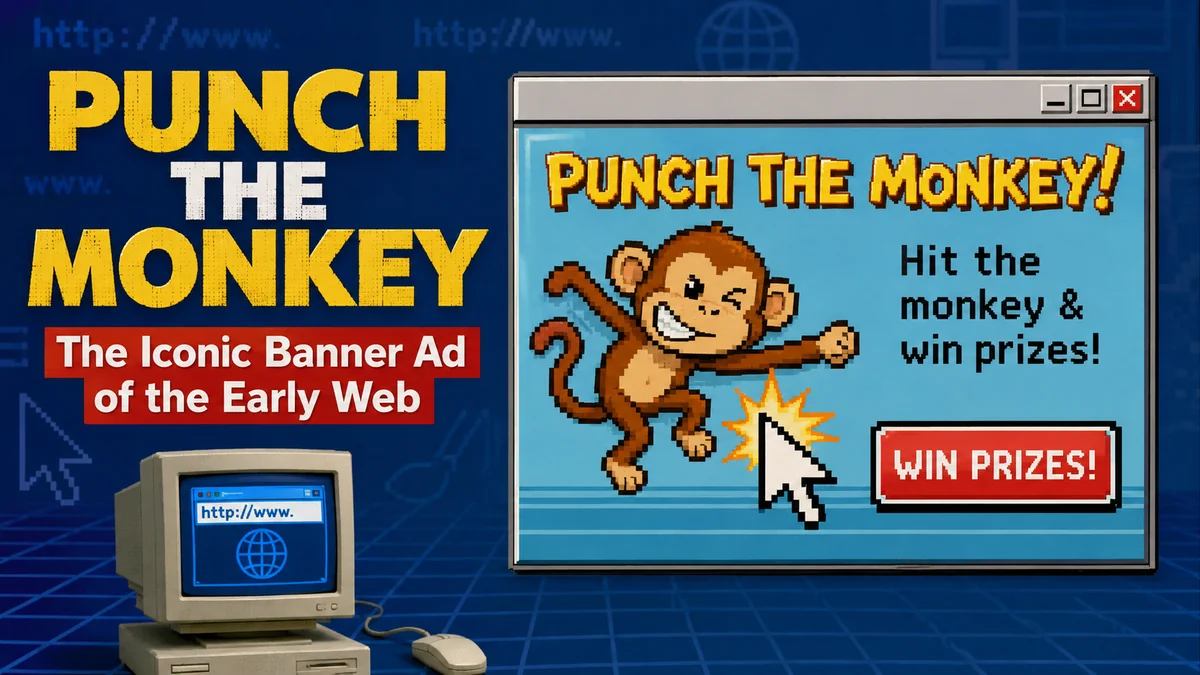
The animated banner became closely associated with the late-1990s and early-2000s internet. A monkey moved around a small advertising box while visitors were encouraged to hit it with their mouse pointer, usually alongside a prize-oriented message. Contemporary accounts show that the format became both highly recognizable and notoriously irritating.
Quick answer: punch the monkey was a famous interactive web-banner concept in which users tried to click or “punch” an animated monkey. The game-like interaction led users into an advertiser’s promotion or offer. It became an enduring symbol of flashy early internet advertising and the attention-grabbing tactics of the dot-com era.
What Was punch the monkey?
The original idea was remarkably simple.
Instead of displaying a static advertisement containing a headline and button, the banner presented something resembling a tiny browser game. A monkey moved within the advertising area, and the visitor was challenged to hit it by clicking at the right moment.
The apparent game was really an advertising mechanism.
Clicking the monkey interacted with the advertisement and could send the visitor toward the advertiser’s website, promotion, registration process, or prize-related offer. The gaming element made the banner more noticeable than conventional advertising surrounding it.
Academic discussion of early online communities describes these monkey-punching ads as animated invitations in which users clicked a moving monkey for an opportunity to win prizes.
That distinction matters. punch the monkey wasn’t primarily remembered because it was a great game. It was remembered because advertising temporarily disguised itself as a game.
How the punch the monkey Banner Worked
The basic interaction followed a pattern that would be instantly understandable even today:
- A visitor loaded a webpage carrying the banner advertisement.
- An animated monkey appeared or moved around inside the banner.
- The advertisement challenged the visitor to punch or hit the monkey.
- The visitor moved the mouse and clicked.
- The click activated the advertisement and led into the associated promotional experience.
The mechanics were deliberately uncomplicated. Users did not need instructions, an account, or gaming experience to understand what they were supposed to do.
That simplicity was part of its effectiveness.
A conventional banner effectively said, “Click here.”
The monkey banner gave people a reason to perform the click.
This technique belongs to the broader category of interactive or game-like banner advertising, where a small challenge—shooting, punching, catching, aiming, throwing, or selecting something—creates an interaction before the visitor fully considers the advertisement behind it.
Forbes later described this broader format as an “ad-banner game”: a simple application inviting viewers to click, punch, or shoot an object before directing them toward an advertiser.
Why punch the monkey Became So Famous
The advertisement arrived during a formative period for online marketing.
People were still learning what banners, pop-ups, hyperlinks, browser windows, and interactive web elements were supposed to do. Advertisers, meanwhile, were experimenting aggressively with ways to attract clicks.
It looked different from ordinary advertising
Early banners often resembled miniature print advertisements: logo, headline, short message, and perhaps a button.
Animation immediately changed that equation.
Movement naturally attracted the eye, particularly when most of the surrounding webpage remained static. Adding a simple challenge made the advertisement harder to ignore.
It transformed clicking into a challenge
“Click this advertisement” isn’t particularly exciting.
“Can you hit this moving target?” is different.
The user had an immediate objective. The advertiser benefited because completing that objective required exactly the behavior it wanted: interaction with the banner.
Prize messaging increased curiosity
Versions of these advertisements were associated with prizes, cash, electronics, and similar rewards. The Los Angeles Times later recalled monkey-style banners offering rewards ranging from consumer electronics to cash.
Prize messaging added another psychological incentive. The user wasn’t merely chasing a cartoon character; there appeared to be something available beyond the click.
People saw the format repeatedly
Repetition turned a disposable advertisement into internet folklore.
Period discussions from 2000 show users complaining about the banner, including concerns about its effect on computer performance. That contemporary reaction provides useful evidence that the advertisement was already recognizable enough to generate shared frustration among web users.
Why Interactive Banner Ads Worked
To understand the popularity of punch the monkey, it helps to understand the state of online advertising at the time.
Banner advertising initially generated much stronger interaction than it would later achieve. By 2001, The Irish Times reported that banner click-through rates had fallen to below 0.5%, compared with roughly 3% in the mid-1990s. The decline encouraged advertisers to experiment with increasingly aggressive techniques for attracting attention.
Game-like advertisements attacked that problem directly.
| Traditional banner | Game-like banner |
|---|---|
| Asks users to click | Gives users something to do |
| Mostly passive | Interactive |
| Relies heavily on copy | Relies on movement and curiosity |
| Clearly feels like advertising | Can initially feel like a mini-game |
| Easy to overlook | Designed to interrupt attention |
This is one reason the monkey became historically significant.
It represented an early version of a problem marketers still face: how do you make someone stop what they’re doing and interact with an advertisement?
Modern advertisers have far more sophisticated technology, but the underlying attention problem hasn’t disappeared.
Was punch the monkey a Real Game?
Not in the conventional sense.
The banner contained a game-like interaction, but its primary purpose was advertising. There generally wasn’t a deep game behind the monkey with levels, storytelling, progression, or substantial gameplay.
The challenge itself was the hook.
This is why remembering punch the monkey as an ordinary browser game can be misleading. It belonged to the overlap between rich-media advertising, interactive banners, mini-games, direct-response marketing, and prize promotions.
The format was influential enough that “punch the monkey” eventually became shorthand for an entire style of intrusive, gimmicky online advertising. The Los Angeles Times used the phrase in this broader sense when discussing the decline of flashy interactive ads in 2009.
Did You Really Win by Punching the Monkey?
This is one of the most interesting questions surrounding memories of the advertisement.
The banner’s presentation encouraged users to feel as though successfully hitting the monkey represented a meaningful achievement. Yet the real objective was getting the visitor to interact with the advertisement and continue into its promotional process.
A Computerworld writer recalling the ad described an especially revealing experience: he appeared to “win” even when he missed the monkey.
That tells us something important about the design.
The apparent skill challenge and the advertising outcome were not necessarily the same thing.
In other words, the banner could create the emotional moment of winning while still directing the visitor toward the advertiser’s intended next step.
That technique has obvious descendants in later online advertising: simulated quizzes, spinning wheels, scratch cards, mystery boxes, animated prize selectors, fake download buttons, and other interfaces designed primarily to generate interaction.
The Technology Behind Early Interactive Ads
Early web advertising went through several technical generations.
Basic banners could be ordinary image files. Animation could be created with animated GIFs, while increasingly sophisticated interactive advertisements used technologies such as Java and, especially during the following years, Flash.
By 2007, Computerworld was looking back at punch the monkey as part of the period when internet advertising moved beyond static, print-inspired banners and into animated Flash-based experiences.
Flash became particularly important because it allowed designers to combine:
- animation,
- mouse interaction,
- sound,
- buttons,
- timing,
- simple games,
- and richer visual effects
inside relatively compact web advertisements.
For marketers, this opened an enormous creative playground.
For users, it sometimes created an enormous annoyance.
Why People Eventually Hated Ads Like punch the monkey
Novelty has a short lifespan.
The first time an animated challenge appeared beside a webpage, it could be entertaining. After encountering similar ads hundreds of times, the experience changed dramatically.
They competed with the content
Visitors normally opened websites to read an article, check information, download something, participate in a forum, or complete another task.
An animated banner was intentionally trying to pull their eyes elsewhere.
The better it became at attracting attention, the more effectively it could interfere with the content users actually wanted.
Animation could become distracting
Bright colors, rapid movement, flashing graphics, and continuously looping animations made some banners difficult to ignore.
This was especially noticeable on pages containing several advertisements simultaneously.
Older computers had limited resources
Modern users can easily forget how constrained consumer computers and internet connections once were.
A resource-heavy animated advertisement could matter far more on an older machine than a comparable advertisement does on current hardware. Forum discussions from 2000 specifically complained about the monkey banner causing slowdowns while browsing.
Everyone copied the formula
Once advertisers discovered that mini-games attracted attention, the concept spread.
Punching one monkey might be amusing.
Being repeatedly challenged to punch, shoot, catch, swat, throw, or click animated targets across the web was another matter entirely.
By 2006, Forbes was already describing game-like banner advertising as a familiar and frustrating marketing device.
punch the monkey and the Rise of Ad Blocking
Annoying advertisements didn’t single-handedly create ad blocking, but aggressive web advertising helped create demand for technologies that gave users more control.
Pop-ups, flashing banners, intrusive animations, pop-unders, interstitial pages, and other disruptive formats gradually changed expectations about acceptable online advertising.
Research examining online communities notes that monkey-punching banners and similar ads were quickly perceived as nuisances and that users developed ways of hiding advertisements from view.
This created a tension that still defines digital publishing.
Publishers need revenue.
Advertisers need attention.
Users want content without excessive interruption.
Push any one of those interests too aggressively, and the others react.
From GIFs and Flash to HTML5 Advertising
The technology surrounding web advertising eventually changed dramatically.
Adobe Flash, once central to interactive web content and advertising, lost its dominant position as web standards and browser capabilities improved. HTML5, CSS, and JavaScript could increasingly provide animation and interaction without requiring the Flash plugin.
The advertising-design industry followed that transition. TechCrunch, for example, described how banner-design service Bannersnack evolved from its Flash-related origins as HTML5 and modern graphics technologies became more important.
The visual language of advertising changed too.
Websites and advertising networks increasingly standardized ad formats, while marketers gained access to better analytics, targeting, attribution, responsive design, and programmatic delivery.
The old monkey belonged to a more experimental internet.
Why You Rarely See Classic punch the monkey Ads Today
Several developments pushed the classic format out of mainstream advertising.
Technology changed. The web moved away from plugin-dependent interactive experiences such as Flash.
User expectations changed. People became less tolerant of distracting advertisements that interfered with browsing.
Browsers improved. Pop-up controls, security protections, tracking restrictions, and performance features became far more sophisticated.
Advertising matured. Brands gained access to search advertising, social platforms, video, native ads, programmatic display, retargeting, influencer campaigns, and other channels.
Mobile became dominant. Tiny desktop-style game banners don’t translate particularly well to touchscreen browsing and responsive page layouts.
By 2009, the Los Angeles Times was already describing this category of flashy monkey-style advertising as fading from the mainstream web.
Can You Still Play the Original punch the monkey?
Finding references, recreations, screenshots, or archived material is much easier than experiencing every original banner exactly as it appeared.
That is partly a preservation problem.
Interactive advertisements were temporary by design. Campaigns ended, advertising servers disappeared, websites changed, supporting files vanished, and technologies became obsolete. Flash’s disappearance from mainstream browser support made many surviving interactive web artifacts harder to run directly.
Even when an old banner graphic survives, its original destination or promotional system may not.
There are also modern games and unrelated projects using similar wording. For example, a mobile arcade game called “Punch The Monkey” currently exists on Google Play, but that is a contemporary game rather than evidence that the famous early-web advertising campaign itself has returned.
So someone searching for the original experience should distinguish between historical banner material, modern recreations, and unrelated games sharing the phrase.
Don’t Confuse the Banner With the Modern Viral Monkey
There is another source of confusion today.
“Punch the monkey” can now refer to a real macaque named Punch that became an internet personality. ABC News covered the viral baby monkey in February 2026, describing online fascination with Punch and his plush companion.
That modern viral animal is separate from the historical punch the monkey advertising phenomenon discussed here.
The distinction is useful because current search results can contain both meanings:
Historical meaning: an interactive banner-ad concept associated with early internet advertising.
Modern meaning: Punch, the viral macaque appearing in contemporary social-media content.
For internet-history searches, the first meaning remains the important one.
punch the monkey as an Early Form of Gamification
The most interesting way to view the banner today isn’t simply as an annoying old advertisement.
It was also an elementary example of gamification.
Gamification means applying game-like mechanics to something that isn’t fundamentally a game. Modern examples include progress bars, achievement badges, points, streaks, challenges, reward wheels, quizzes, loyalty programs, and interactive promotions.
Punching the monkey used several of the same psychological ingredients:
Goal: hit the target.
Challenge: time the click correctly.
Feedback: the advertisement reacts.
Reward: the visitor believes a prize or result may follow.
Progression: continue to the next promotional step.
The execution was primitive compared with modern interactive marketing, but the underlying principle remains recognizable.
Make participation feel like play, and more people may participate.
What Modern Marketers Learned From These Ads
The legacy of punch the monkey isn’t that marketers should recreate obnoxious flashing banners.
The more useful lesson is that interaction can increase attention, but attention alone doesn’t guarantee a good user experience.
The banner solved one problem brilliantly: getting noticed.
It created another problem by becoming so noticeable that users remembered the advertising style as irritating.
Modern interactive campaigns work better when the interaction provides genuine value. A useful calculator, configurator, assessment, visualization, product demo, educational quiz, or relevant interactive tool can engage someone without tricking them into clicking.
The difference is intent.
Good interaction helps users accomplish something.
Bad interaction merely interrupts them.
Quick Takeaway
The strongest lesson from punch the monkey is surprisingly modern: a high-interaction advertisement isn’t automatically a successful advertisement. Clicks matter, but relevance, trust, usability, brand perception, and what happens after the click matter too.
Why punch the monkey Still Matters in Internet History
The early web disappears surprisingly quickly.
Websites close. Domains change owners. Plugins stop working. Advertising campaigns expire. Images disappear from servers, and interactive files become incompatible with modern browsers.
That makes memorable artifacts valuable cultural markers.
The monkey banner represents an era when online advertisers were still discovering what a digital advertisement could be. A web ad didn’t have to behave like a newspaper advertisement. It could move. It could respond to the mouse. It could make noise. It could become a tiny game.
Advertisers experimented with those possibilities enthusiastically—sometimes too enthusiastically.
The format became so culturally recognizable that Google itself later referenced “Punch the Monkey” while joking about old-school display-advertising techniques in a 2011 Google Partners Blog post.
That longevity is remarkable for something originally designed to occupy a small rectangle beside web content.
The Lasting Legacy of punch the monkey
punch the monkey survives less as a functional advertisement than as a piece of internet folklore.
It captured a transitional moment when banner advertising moved from static graphics toward interactive rich media. The moving target, immediate challenge, prize messaging, and game-like interface demonstrated how effectively curiosity could generate clicks.
It also demonstrated the limits of that strategy.
Repeated animation became distracting. Aggressive advertising generated frustration. Users adopted blocking tools and learned to ignore banners. Browsers, advertising standards, and web technologies matured, while Flash-era interactive advertising gradually gave way to HTML5, mobile-friendly formats, video, social media, native advertising, and more sophisticated targeting.
Yet the central idea never completely disappeared.
Modern quizzes, reward wheels, playable ads, interactive product demos, challenges, and gamified promotions all pursue a familiar objective: turn a passive viewer into an active participant.
The tools are different. The interfaces are cleaner. The targeting is vastly more advanced.
But anyone who remembers trying to hit that moving monkey has already seen one of the web’s earliest and most memorable attempts to make advertising playable.
